* Yeah, I read the article. Regardless of the IEC's noble attempt, in all my years of working with people and computers I've never heard anyone actually pronounce MiB (or write it out in full) as "mebibyte".
Sectors per track or tracks per side is subject to change. Moreover a different filesystem may have non-linear growth of the MFT/superblock that'll have a different overhead.
It doesn't matter. "kilo" means 1000. People are free to use it wrong if they wish.
“Kilo” can mean what we want in different contexts and it’s really no more or less correct as long as both parties understand and are consistent in their usage to each other.
We agree to meaning to communicate and progress without endless debate and confusion.
SI is pretty clear for a reason.
We decidedly do not do that. There's a whole term for new terms that arbitrarily get injected or redefined by new people: "slang". I don't understand a lot of the terms teenagers say now, because there's lots of slang that I don't know because I don't use TikTok and I'm thirty-something without kids so I don't hang out with teenagers.
I'm sure it was the same when I was a teenager, and I suspect this has been going on since antiquity.
New terms are made up all the time, but there's plenty of times existing words get redefined. An easy one, I say "cool" all the time, but generally I'm not talking about temperature when I say it. If I said "cool" to refer to something that I like in 1920's America, they would say that's not the correct use of the word.
SI units are useful, but ultimately colloquialisms exist and will always exist. If I say kilobyte and mean 1024 bytes, and if the person on the other end knows that I mean 1024 bytes, that's fine and I don't think it's "nihilistic".
https://en.wikipedia.org/wiki/Language_planning
(Then you could decide what you think about language planning.)
Fair enough.
1000 watts is a kilowatt
1000 hertz is a kilohertz
1000 metres is a kilometre
1000 litres is a kilolitre
1000 joules is a kilojoule
1000 volts is a kilovolt
1000 newtons is a kilonewton
1000 pascals is a kilopascal
1024 bytes is a kilobyte, because that's what we're used to and we don't want to change to a new prefix
It's also stupid because it's rare than anyone outside of programming even needs to care exactly how many bytes something else. At the scales that each of kilobyte, megabyte, gigabyte, terabyte etc are used, the smaller values are pretty much insignificant details.
If you ask for a kilogram of rice, then you probably care more about that 1kg of rice is the same as the last 1kg of rice you got, you probably wouldn't even care how many grams that is. Similarly, if you order 1 ton of rice, you do care exactly how many grams it is, or do you just care that this 1 ton is the same as that 1 ton?
This whole stupidity started because hard disk manufacturers wanted to make their drives sound bigger than they actually were. At the time, everybody buying hard disks knew about this deception and just put up with it. We'd buy their 2GB drive and think to ourselves, "OK so we have 1.86 real GB". And that was the end of it.
Can you just imagine if manufacturers started advertising computers as having 34.3GB of RAM? Everybody would know it was nonsense and call it 32GB anyway.
Before all that nonsense, it was crystal clear: a megabyte in storage was unambiguously 1024 x 1024 bytes --- with the exception of crooked mass storage manufacturers.
There was some confusion, to be sure, but the partial success of attempt to redefine the prefixes to their power-of-ten meanings has caused more confusion.
> All words are made up.
Yes, and the made up words of kilo and kibi were given specific definitions by the people who made them up:
* https://en.wikipedia.org/wiki/Metric_prefix
* https://en.wikipedia.org/wiki/Binary_prefix
> […] as long as both parties understand and are consistent in their usage to each other.
And if they don't? What happens then?
Perhaps it would be easier to use the words definitions as they are set up in standards and regulations so context is less of an issue.
Kilo was generally understood to mean one thousand long before it was adopted by a standards committee. I know the French love to try and prescribe the use of language, but in most of the world words just mean what people generally understand them to mean; and that meaning can change.
Good for them. People make up their own definitions for words all the time. Some of those people even try to get others to adopt their definition. Very few are ever successful. Because language is about communicating shared meaning. And there is a great deal of cultural inertia behind the kilo = 2^10 definition in computer science and adjacent fields.
Can’t use a dictionary, those bastards try to get us to adopt their definitions.
Inability to communicate isn't what we observe because as I already stated, meaning is shared. Dictionaries are one way shared meaning can be developed, as are textbooks, software source codes, circuits, documentation, and any other artifact which links the observable with language. All of that being collectively labeled culture. The mass of which I analogized with inertia so as to avoid oversimplifications like yours.
My point is that one person's definition does not a culture, make. And that adoption of new word definitions is inherently a group cultural activity which requires time, effort, and the willingness of the group to participate. People must be convinced the change is an improvement on some axis. Dictation of a definition from on high is as likely to result in the word meaning the exact opposite in popular usage as not. Your comment seems to miss any understanding or acknowledgement that a language is a living thing, owned by the people who speak it, and useful for speaking about the things which matter most to them. That credible dictionaries generally don't accept words or definitions until widespread use can be demonstrated.
It seems like some of us really want human language to work like rule-based computer languages. Or think they already do. But all human languages come free with a human in the loop, not a rules engine.
That being said, I think the difference between mib and mb is niche for most people
90 mm floppy disks. https://jdebp.uk/FGA/floppy-discs-are-90mm-not-3-and-a-half-...
Which I have taken to calling 1440 KiB – accurate and pretty recognizable at the same time.
That page is part right and part wrong.
It is right in claiming that "3.5-inch" floppies are actually 90 mm.
It is wrong in claiming that the earlier "5.25-inch" floppies weren't metric
"5.25-inch" floppies are actually 130 mm as standardised in ECMA-78 [0]
"8-inch" floppies are actually 200 mm as standardised in ECMA-69 [1]
Actually there's a few different ECMA standards for 130 and 200 mm floppies – the physical dimensions are the same, but using different recording mechanisms (FM vs MFM–those of a certain age may remember MFM as "double density", and those even older may remember FM as "single density"), and single-sided versus double-sided.
[0] ECMA-78: Data interchange on 130 mm flexible disk cartridges using MFM recording at 7 958 ftprad on 80 tracks on each side), June 1986: https://ecma-international.org/publications-and-standards/st...
[1] ECMA-69: Data interchange on 200 mm flexible disk cartridges using MFM recording at 13 262 ftprad on both sides, January 1981: https://ecma-international.org/publications-and-standards/st...
Donald Knuth himself said[1]:
> The members of those committees deserve credit for raising an important issue, but when I heard their proposal it seemed dead on arrival --- who would voluntarily want to use MiB for a maybe-byte?! So I came up with the suggestion above, and mentioned it on page 94 of my Introduction to MMIX. Now to my astonishment, I learn that the committee proposals have actually become an international standard. Still, I am extremely reluctant to adopt such funny-sounding terms; Jeffrey Harrow says "we're going to have to learn to love (and pronounce)" the new coinages, but he seems to assume that standards are automatically adopted just because they are there.
If Gordon Bell and Gene Amdahl used binary sizes -- and they did -- and Knuth thinks the new terms from the pre-existing units sound funny -- and they do -- then I feel like I'm in good company on this one.
0: https://honeypot.net/2017/06/11/introducing-metric-quantity....
> I'm a big fan of binary numbers, but I have to admit that this convention flouts the widely accepted international standards for scientific prefixes.
He also calls it “an important issue” and had written “1000 MB = 1 gigabyte (GB), 1000 GB = 1 terabyte (TB), 1000 TB = 1 petabyte (PB), 1000 PB = 1 exabyte (EB), 1000 EB = 1 zettabyte (ZB), 1000 ZB = 1 yottabyte (YB)” in his MMIX book even before the new binary prefixes became an international standard.
He is merely complaining that the new names for the binary prefixes sound funny (and has his own proposal like “large megabyte” and notation MMB etc), but he's still using the kilo/mega/etc prefixes with decimal meanings.
Edit: Disregard the metric bit but I think the rest still stands.
Ummm, what? https://en.wikipedia.org/wiki/Metric_prefix
No, they already did the opposite with KiB, MiB.
Because most metric decimal units are used for non-computing things. Kilometers, etc. Are you seriously proposing that kilometers should be renamed kitrimeters because you think computing prefixes should take priority over every other domain of science and life?
It would be annoying of one frequently found themselves calculating gigabytes per hectare. I don't think I've ever done that. The closest I've seen is measure magnetic tape density where you get weird units like "characters per inch", where neither "character" nor "inch" are the common units for their respective metrics.
E.g. Macs measure file sizes in powers of 10 and call them KB, MB, GB. Windows measures file sizes in powers of 2 and calls them KB, MB, GB instead of KiB, MiB, GiB. Advertised hard drives come in powers of 10. Advertised memory chips come in powers of 2.
When you've got a large amount of data or are allocating an amount of space, are you measuring its size in memory or on disk? On a Mac or on Windows?
Especially that it was only partially successful.
Which is not to say that there had been zero confusion; but it was only made worse.
Things like hard drives often used decimal/metric sizing from the start. Because their capacity has always been based on physical platter size and density, not powers of two the way memory is.
So this confusion has been with computing since the beginning. The attempt to introduce units like KiB isn't revisionism, it's an attempt at clarity around something that has always been ambiguous.
And obviously, if you need two separate prefixes, you're going to change the one whose unit of measurement differs from all the rest of science and technology.
Yes it is; it is literally asking people who call 1024 bytes "kilobyte" to stop doing that and say "kibibyte" instead, and to revise the meaning of "kilobyte" to 1000 bytes.
Some people have not stopped doing that, so there is more confusion now. You no longer know whether a fellow engineer is using powers of 1000 or powers of 1024 when using kilobyte, megabyte or gigabyte; it depends on whether they took the red pill or the blue pill.
> You no longer know whether a fellow engineer is using powers of 1000 or powers of 1024 when using kilobyte, megabyte or gigabyte
You never knew this, that's the point. You didn't know it in e.g. 1990, before KiB was introduced in 1998. People didn't only start using powers of 10 once KiB was formally introduced. They'd always used them, but conventions around powers of 10 vs 2 depended greatly on the computing context, and were frequently confusing.
There isn't more confusion now. Fortunately, places that explicitly state KiB result in less confusion because, at least in that case, you know for sure what it is.
Unfortunately, a lot of people won't get on board with it, so the confusion persists.
And frankly, I don't care what you call it when you're speaking, as long as you just use the right label in software and in tech specs.
And in most cases, using 1024 is more convenient because the sizes of page sizes, disk sectors, etc. are powers of 2.
That doesn't conform to SI. It should be written as kB mB gB. Ambiguity will only arise when speaking.
> Advertised hard drives come in powers of 10.
Mass storage (kB) has its own context at this point, distinct from networking (kb/s) and general computing (KB).
> When you've got a large amount of data or are allocating an amount of space, ...
You aren't speaking but are rather working in writing. kb, kB, Kb, and KB refer to four different unit bit counts and there is absolutely zero ambiguity. The only question that might arise (depending on who you ask) is how to properly verbalize them.
Little m is milli, big M is mega. Little g doesn’t exist, only big G.
Note that no one is going to confuse mB for millibytes because what would that even mean? But also in practice MB versus Mb aren't ambiguous because except for mass storage no one mixes bytes with powers of ten AFAIK.
And let's take a minute to appreciate the inconsistency of (SI) km vs Mm. KB to GB is more consistent.
Data compression. For example, look at http://prize.hutter1.net/ , heading "Contestants and Winners for enwik8". On 23.May'09, Alex's program achieved 1.278 bits per character. On 4.Nov'17, Alex achieved 1.225 bits per character. That is an improvement of 0.053 b/char, or 53 millibits per character. Similarly, we can talk about how many millibits per pixel JPEG-XL is better than classic JPEG for the same perceptual visual quality. (I'm using bits as the example, but you can use bytes and reach the same conclusion.)
Just because you don't see a use for mB doesn't mean it's open for use as a synonym of MB. Lowercase m means milli-, as already demonstrated in countless frequently used units - millilitre, millimetre, milliwatt, milliampere, and so on.
In case you're wondering, mHz is not a theoretical concept either. If you're generating a tone at say 440 Hz, you can talk about the frequency stability in millihertz of deviation.
> Just because you don't see a use for mB doesn't mean it's open for use as a synonym of MB.
At the end of the day it's all down to convention. We've never needed approval from a standards body to do something. Standards are useful to follow when they provide a tangible benefit; following them for their own sake to the detriment of something immediately practical is generally a waste of time and effort.
I don't believe I hallucinated unit notations such as mB and gB. Unfortunately I don't immediately recall where I encountered their use.
> In case you're wondering, mHz is not a theoretical concept either.
Just to be clear, I was not meaning to suggest that non-SI prefixes be used for quantifying anything other than bits. SI standardized prefixes are great for most things.
https://en.wikipedia.org/wiki/Mile#Roman
https://en.wikipedia.org/wiki/Ancient_Roman_units_of_measure...
I gave some examples in my post https://blog.zorinaq.com/decimal-prefixes-are-more-common-th...
Storage capacity also uses binary prefixes. The distinction here isn't that file sizes are reported in binary numbers and storage capacity is reported in decimal numbers. It's that software uses binary numbers and hard drive manufacturers use decimal numbers. You don't see df reporting files in binary units and capacities in decimal units.
Of that large list of measurements, only bandwidth is measured in bytes, making the argument mostly an exercise in sophistry. You can't convince anyone that KB means 1000 bytes by arguing that kHz means 1000 Hz.
I disagreed strongly - I think X-per-second should be decimal, to correspond to Hertz. But for quantity, binary seems better. (modern CS papers tend to use MiB, GiB etc. as abbreviations for the binary units)
Fun fact - for a long time consumer SSDs had roughly 7.37% over-provisioning, because that's what you get when you put X GB (binary) of raw flash into a box, and advertise it as X GB (decimal) of usable storage. (probably a bit less, as a few blocks of the X binary GB of flash would probably be DOA) With TLC, QLC, and SLC-mode caching in modern drives the numbers aren't as simple anymore, though.
There are probably cases where corresponding to Hz, is useful, but for most users I think 119MiB/s is more useful than 1Gbit/s.
Interestingly, from 10GBit/s, we now also have binary divisions, so 5GBit/s and 2.5GBit/s.
Even at slower speeds, these were traditionally always decimal based - we call it 50bps, 100bps, 150bps, 300bps, 1200bps, 2400bps, 9600bps, 19200bps and then we had the odd one out - 56k (actually 57600bps) where the k means 1024 (approximately), and the first and last common speed to use base 2 kilo. Once you get into MBps it's back to decimal.
56000 BPS was the bitrate you could get out of a DS0 channel, which is the digital version of a normal phone line. A DS0 is actually 64000 BPS, but 1 bit out of 8 is "robbed" for overhead/signalling. An analog phone lined got sampled to 56000 BPS, but lines were very noisy, which was fine for voice, but not data.
7 bits per sample * 8000 samples per second = 56000, not 57600. That was theoretical maximum bandwidth! The FCC also capped modems at 53K or something, so you couldn't even get 56000, not even on a good day.
I mean, that's not quite it. By that logic, had memory been defined in decimal from the start (happenstance), we'd have 4000 byte pages.
Now ethernet is interesting ... the data rates are defined in decimal, but almost everything else about it is octets! Starting with the preamble. But the payload is up to an annoying 1500 (decimal) octets. The _minimum_ frame length is defined for CSMA/CD to work, but the max could have been anything.
The decimal-vs-binary discrepancy is used more as slack space to cope with the inconvenience of having to erase whole 16MB blocks at a time while allowing the host to send write commands as small as 512 bytes. Given the limited number of program/erase cycles that any flash memory cell can withstand, and the enormous performance penalty that would result from doing 16MB read-modify-write cycles for any smaller host writes, you need way more spare area than just a small multiple of the erase block size. A small portion of the spare area is also necessary to store the logical to physical address mappings, typically on the order of 1GB per 1TB when tracking allocations at 4kB granularity.
RAM had binary sizing for perfectly practical reasons. Nothing else did (until SSDs inherited RAM's architecture).
We apply it to all the wrong things mostly because the first home computers had nothing but RAM, so binary sizing was the only explanation that was ever needed. And 50 years later we're sticking to that story.
- magnetic media
- optical media
- radio waves
- time
There's good reasons for having power-of-2 sectors (they need to get loaded into RAM), but there's really no compelling reason to have a power-of-2 number of sectors. If you can fit 397 sectors, only putting in 256 is wasteful.
The choice would be effectively arbitrary, the number of actual bits or bytes is the same regardless of the multiplier that you use. But since it's for a computer, it makes sense to use units that are comparable (e.g. RAM and HD).
Just later, some marketing assholes thought they could better sell their hard drives when they lie about the size and weasel out of legal issues with redefining the units.
(The old excuse was that networks are serial but they haven't been serial for decades.)
the same and even more confusion is engendered when talking about "fifths" etc.
Sometimes, other systems just make more sense.
For example, for time, or angles, or bytes. There are properties of certain numbers (or bases) that make everything descending from them easier to deal with.
for angles and time (and feet): https://en.wikipedia.org/wiki/Superior_highly_composite_numb...
For other problems we use base 2, 3, 8, 16, or 10.
Must we treat metric as a hammer, and every possible problem as a nail?
The ancient Sumerians used multiples of 60, as we continue to do for time and angles (which are related) today. It makes perfect sense. 60 is divisible by 2, 3, 4, 5, and 6, which makes it easy to use in calculations. Even the metric people are not so crazy as to propose replacing these with powers of 10.
Same with pounds, for example. A pound is 16 ounces, which can be divided 4 times without involving any fractions. Try that with metric.
Then there's temperature. Fahrenheit just works more naturally over the human-scale temperature range without involving fractions. Celsius kind of sucks by comparison.
Not sure if you're actually serious... 1 kg is 1000 g, dividing with 4 gets you 250 g, no fractions. And no need to remember arbitrary names or numbers for conversions.
> Then there's temperature. Fahrenheit just works more naturally over the human-scale temperature range without involving fractions. Celsius kind of sucks by comparison.
Again, I'm not sure I get it. With celsius, 0°C is freezing temperature of water and 100°C is boiling point of water. For fahrenheit it was something like 32 and 212? And in every day use, people don't need fractions, only full degrees. Celsius also aligns well with Kelvins without fractions (unlike fahrenheit).
But Fahrenheit aligns well with Rankine without fractions (unlike Celsius). [Imagine some symbol here indicating humour.]
IOW each Celsius degree is bigger than each Fahrenheit degree.
Even though the F numbers are so much higher and it seems unbearably hot :)
So for a thermostat that only can be set in 1 degree increments (without a decimal point), you have finer control when using F than using C.
Anybody can memorize the conversion more easily by throwing out the math, using table lookup -- made easier by throwing out most of the table too.
Just remember every 5 C equals a non-fractional F.
And every 5 C equals 9 F.
If all you are interested in is comfort level it's like this:
   C   F

   0  32
   5  41
  10  50
  15  59
  20  68
  25  77
  30  86
  35  95
  40 104
Looks like it increases by 1 each time in the tens column, but it's only 9 so 50 & 59 are the outliers, which most people have memorized already.
If you are a Celsius native and you think in terms of 10, 15, 20, 25, 30 -- you only need to remember 5 different F numbers, 50, 59, 68, 77 & 86 and that will get you far.
Good luck using these as your lottery numbers ;)
Whereas in C, 0 is fine and 100 means you died 50 degrees ago.
However, C is much more useful in industry, where boiling and freezing points are more important.
In the end, it's probably what one is used to. Temperatures here are typically between -20'C and +30'C.
1000 g, 500 g, 250 g, 125 g
I also don't understand the fear around fractions - we deal with halves, quarters and fifths all the time in the natural world.
Yes, and a certain fast food company found that their 1/3 lb burgers weren't selling well, because their idiot customers can't maff too good and thought 1/4 was bigger than 1/3.
No, they were absolutely that crazy [1]. Luckily the proposal fell through.
And you can go with 120 or, better 210 so you get 7 in.
Pure madness.
Well I guess we already basically have this in practice since Ki can be shortened to K seeing as metric prefixes are always lower case and we clearly aren't talking about kelvin bytes.
Call me calcitrant, reactionary, or whatever, but I will not say kibibyte out loud. It's a dumb word and I'm not using it. It was a horrible choice.
https://en.wikipedia.org/wiki/Byte#Multiple-byte_units
"the C64 took its name from its 64 kilobytes (65,536 bytes) of RAM"
"I bought a two tib SSD."
"I just want to serve five pibs."
Perhaps we can simplify this compromise and have a kilobyte as 1024 bytes, a megabyte as 1024000 bytes, a gigabyte as 1048576000 bytes and a terabyte as 1048576000000 bytes.
The author doesn’t actually answer their question, unless I missed something?
They go on to make a few more observations, and say finally only that the current different definitions are sometimes confusing, to non experts.
I don’t see much of an argument here for changing anything. Some non experts experience minor confusion about two things that are different, did I miss something bigger in this?
Because Windows, and only Windows, shows it this way. It is official and documented: https://devblogs.microsoft.com/oldnewthing/20090611-00/?p=17...
> Explorer is just following existing practice. Everybody (to within experimental error) refers to 1024 bytes as a kilobyte, not a kibibyte. If Explorer were to switch to the term kibibyte, it would merely be showing users information in a form they cannot understand, and for what purpose? So you can feel superior because you know what that term means and other people don’t.
As a programmer, I think in the binary units.
1 kB is 1024 B. It's measurement unit thing. Not logics. 8 bits in a byte. Not 10, neither 6 nor 5. Just 8.
Like feet in yards, inches in feet, meters in kilometers and ounces in pounds.
It's 1024. Period.
Then of course you are free to count as many bytes as you want and call that bunch a kB.
Pretending anyone else will agree on that is a different thing.
This ambiguity is documented at least back to 1984, by IBM, the pre-eminent computer company of the time.
In 1972 IBM started selling the IBM 3333 magnetic disk drive. This product catalog [0] from 1979 shows them marketing the corresponding disks as "100 million bytes" or "200 million bytes" (3336 mdl 1 and 3336 mdl 11, respectively). By 1984, those same disks were marketed in the "IBM Input/Output Device Summary"[1] (which was intended for a customer audience) as "100MB" and "200MB"
0: (PDF page 281) "IBM 3330 DISK STORAGE" http://electronicsandbooks.com/edt/manual/Hardware/I/IBM%20w...
1: (PDF page 38, labeled page 2-7, Fig 2-4) http://electronicsandbooks.com/edt/manual/Hardware/I/IBM%20w...
Also, hats off to http://electronicsandbooks.com/ for keeping such incredible records available for the internet to browse.
-------
Edit: The below is wrong. Older experience has corrected me - there has always been ambiguity (perhaps bifurcated between CPU/OS and storage domains). "And that with such great confidence!", indeed.
-------
The article presents wishful thinking. The wish is for "kilobyte" to have one meaning. For the majority of its existence, it had only one meaning - 1024 bytes. Now it has an ambiguous meaning. People wish for an unambiguous term for 1000 bits, however that word does not exist. People also might wish that others use kibibyte any time they reference 1024 bytes, but that is also wishful thinking.
The author's wishful thinking is falsely presented as fact.
I think kilobyte was the wrong word to ever use for 1024 bytes, and I'd love to go back in time to tell computer scientists that they needed to invent a new prefix to mean "1,024" / "2^10" of something, which kilo- never meant before kilobit / kilobyte were invented. Kibi- is fine, the phonetics sound slightly silly to native English speakers, but the 'bi' indicates binary and I think that's reasonable.
I'm just not going to fool myself with wishful thinking. If, in arrogance or self-righteousness, one simply assumes that every time they see "kilobyte" it means 1,000 bytes - then they will make many, many failures. We will always have to take care to verify whether "kilobyte" means 1,000 or 1,024 bytes before implementing something which relies on that for correctness.
There was always a confusion about whether a kilobyte was 1000 or 1024 bytes. Early diskettes always used 1000, only when the 8 bit home computer era started was the 1024 convention firmly established.
Before that it made no sense to talk about kilo as 1024. Earlier computers measured space in records and words, and I guess you can see how in 1960, no one would use kilo to mean 1024 for a 13 bit computer with 40 byte records. A kiloword was, naturally, 1000 words, so why would a kilobyte be 1024?
1024 bearing near ubiquitous was only the case in the 90s or so - except for drive manufacturing and signal processing. Binary prefixes didn't invent the confusion, they were a partial solution. As you point out, while it's possible to clearly indicate binary prefixes, we have no unambiguous notation for decimal bytes.
Even worse, the 3.5" HD floppy disk format used a confusing combination of the two. Its true capacity (when formatted as FAT12) is 1,474,560 bytes. Divide that by 1024 and you get 1440KB; divide that by 1000 and you get the oft-quoted (and often printed on the disk itself) "1.44MB", which is inaccurate no matter how you look at it.
But that said, we aren't talking about sector sizes. Of course storage mediums are always going to use sector sizes of powers of two. What's being talked about here is the confusion in how to refer to the storage medium's total capacity.
Actually, that's not true.
As far as I know, IBM floppy disks always used power-of-2 sizes. The first read-write IBM floppy drives to ship to customers were part of the IBM 3740 Data Entry System (released 1973), designed as a replacement for punched cards. IBM's standard punched card format stored 80 bytes per a card, although some of their systems used a 96 byte format instead. 128 byte sectors was enough to fit either, plus some room for expansion. In their original use case, files were stored with one record/line/card per a disk sector.
However, unlike floppies, (most) IBM mainframe hard disks didn't use power-of-2 sectors. Instead, they supported variable sector sizes ("CKD" format) – when you created a file, it would be assigned one or more hard disk tracks, which then would be formatted with whatever sector size you wanted. In early systems, it was common to use 80 byte sectors, so you could store one punched card per a sector. You could even use variable length sectors, so successive sectors on the same track could be of different sizes.
There was a limit on how many bytes you could fit in a track - for an IBM 3390 mainframe hard disk (released 1989), the maximum track size is 56,664 bytes – not a power of two.
IBM mainframes historically used physical hard disks with special firmware that supported all these unusual features. Nowadays, however, they use industry standard SSDs and hard disks, with power of two sector sizes, but running special software on the SAN which makes it look like a busload of those legacy physical hard disks to the mainframe. And newer mainframe applications use a type of file (VSAM) which uses power-of-two sector sizes (512 bytes through 32KB, but 4KB is most common). So weird sector sizes is really only a thing for legacy apps (BSAM, BDAM, BPAM-sans-PDSE), and certain core system files which are stuck on that format due to backward compatibility requirements. But go back to the 1960s/1970s, non-power-of-2 sector sizes were totally mainstream on IBM mainframe hard disks.
And in that environment, 1000 bytes rather than 1024 bytes makes complete sense. However, file sizes were commonly given in allocation units of tracks/cylinders instead of bytes.
I wonder if there's a wikipedia article listing these...
Example: in 1972, DEC PDP 11/40 handbook [0] said on first page: "16-bit word (two 8-bit bytes), direct addressing of 32K 16-bit words or 64K 8-bit bytes (K = 1024)". Same with Intel - in 1977 [1], they proudly said "Static 1K RAMs" on the first page.
[0] https://pdos.csail.mit.edu/6.828/2005/readings/pdp11-40.pdf
[1] https://deramp.com/downloads/mfe_archive/050-Component%20Spe...
But once hard drives started hitting about a gigabyte was when everyone started noticing and howling.
Similarly, the 4104 chip was a "4kb x 1 bit" RAM chip and stored 4096 bits. You'd see this in the whole 41xx series, and beyond.
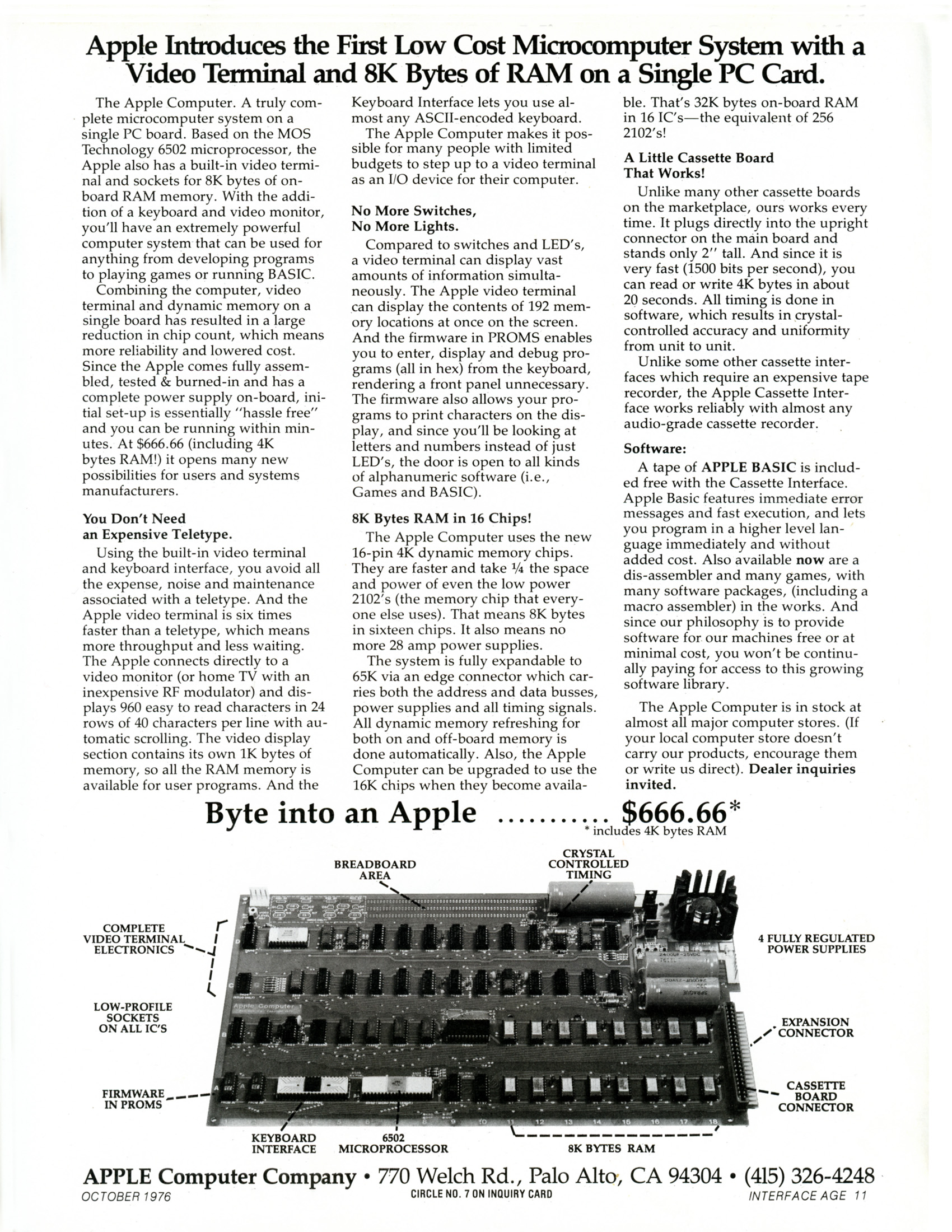
I was going to say that what it could address and what they called what it could address is an important distinction, but found this fun ad from 1976[1].
"16K Bytes of RAM Memory, expandable to 60K Bytes", "4K Bytes of ROM/RAM Monitor software", seems pretty unambiguous that you're correct.
Interestingly wikipedia at least implies the IBM System 360 popularized the base-2 prefixes[2], citing their 1964 documentation, but I can't find any use of it in there for the main core storage docs they cite[3]. Amusingly the only use of "kb" I can find in the pdf is for data rate off magnetic tape, which is explicitly defined as "kb = thousands of bytes per second", and the only reference to "kilo-" is for "kilobaud", which would have again been base-10. If we give them the benefit of the doubt on this, presumably it was from later System 360 publications where they would have had enough storage to need prefixes to describe it.
[1] https://commons.wikimedia.org/wiki/File:Zilog_Z-80_Microproc...

[2] https://en.wikipedia.org/wiki/Byte#Units_based_on_powers_of_...
[3] http://www.bitsavers.org/pdf/ibm/360/systemSummary/A22-6810-...
I don't know if that's correct, but at least it'd explain the mismatch.
That's the microcomputer era that has defined the vast majority of our relationship with computers.
IMO, having lived through this era, the only people pushing 1,000 byte kilobytes were storage manufacturers, because it allows them to bump their numbers up.
https://www.latimes.com/archives/la-xpm-2007-nov-03-fi-seaga...
More like late 60s. In fact, in the 70s and 80s, I remember the storage vendors being excoriated for "lying" by following the SI standard.
There were two proposals to fix things in the late 60s, by Donald Morrison and Donald Knuth. Neither were accepted.
Another article suggesting we just roll over and accept the decimal versions is here:
https://cacm.acm.org/opinion/si-and-binary-prefixes-clearing...
This article helpfully explains that decimal KB has been "standard" since the very late 90s.
But when such an august personality as Donald Knuth declares the proposal DOA, I have no heartburn using binary KB.
In fact, they practically say the same exact thing you have said: In a nutshell, base-10 prefixes were used for base-2 numbers, and now it's hard to undo that standard in practice. They didn't say anything about making assumptions. The only difference is that that the author wants to keep trying, and you don't think it's possible? Which is perfectly fine. It's just not as dramatic as your tone implies.
Here's my theory. In the beginning, everything was base10. Because humans.
Binary addressing made sense for RAM. Especially since it makes decoding address lines into chip selects (or slabs of core, or whatever) a piece of cake, having chips be a round number in binary made life easier for everyone.
Then early DOS systems (CP/M comes to mind particularly) mapped disk sectors to RAM regions, so to enable this shortcut, disk sectors became RAM-shaped. The 512-byte sector was born. File sizes can be written in bytes, but what actually matters is how many sectors they take up. So file sizing inherited this shortcut.
But these shortcuts never affected "real computers", only the hamstrung crap people were running at home.
So today we have multiple ecosystems. Some born out of real computers, some with a heavy DOS inheritance. Some of us were taught DOS's limitations as truth, and some of us weren't.
However it doesn't seem to be divided into sectors at all, more like each track is like a loop of magnetic tape. In that context it makes a bit more sense to use decimal units, measuring in bits per second like for serial comms.
Or maybe there were some extra characters used for ECC? 5 million / 100 / 100 = 500 characters per track, leaves 72 bits over for that purpose if the actual size was 512.
First floppy disks - also from IBM - had 128-byte sectors. IIRC, it was chosen because it was the smallest power of two that could store an 80-column line of text (made standard by IBM punched cards).
Disk controllers need to know how many bytes to read for each sector, and the easiest way to do this is by detecting overflow of an n-bit counter. Comparing with 80 or 100 would take more circuitry.
You can get away with those on machines with 64 bit address spaces and TFLOPs of math capacity. You can't on anything older or smaller.
> The author's wishful thinking is falsely presented as fact.
There's good reason why the meanings of SI prefixes aren't set by convention or by common usage or by immemorial tradition, but by the SI. We had several thousand years of setting weights and measures by local and trade tradition and it was a nightmare, which is how we ended up with the SI. It's not a good show for computing to come along and immediately recreate the long and short ton.
Adding to your point, it is human nature to create industry- or context-specific units and refuse to play with others.
In the non-metric world, I see examples like: Paper publishing uses points (1/72 inch), metal machinists use thousands of an inch, woodworkers use feet and inches and binary fractions, land surveyors use decimal feet (unusual!), waist circumference is in inches, body height is in feet and inches, but you buy fabric by the yard, airplane altitudes are in hundreds to tens of thousands of feet instead of decimal miles. Crude oil is traded in barrels but gasoline is dispensed in gallons. Everyone thinks their usage of units and numbers is intuitive and optimal, and everyone refuses to change.
In the metric(ish) world, I still see many tensions. The micron is a common alternate name for the micrometre, yet why don't we have a millin or nanon or picon? The solution is to eliminate the micron. I've seen the angstrom (0.1 nm) in spectroscopy and in the discussion of CPU transistor sizes, yet it diverts attention away from the picometre. The bar (100 kPa) is popular in talking about things like tire pressure because it's nearly 1 atmosphere. The mmHg is a unit of pressure that sounds metric but is not; the correct unit is pascal. No one in astronomy uses mega/giga/tera/peta/etc.-metres; instead they use AU and parsec and (thousand, million, billion) light-years. Particle physics use eV/keV/MeV instead of some units around the picojoule.
Having a grab bag of units and domains that don't talk to each other is indeed the natural state of things. To put your foot down and say no, your industry does not get its own special snowflake unit, stop that nonsense and use the standardized unit - that takes real effort to achieve.
Kudos for getting back. (and closing the tap of "you are wrong" comments :))
Which makes it really @#ing annoying when you have things like "I want to transmit 8 gigabytes (meaning gibibytes, 2*30) over a 1 gigabit/s link, how long will it take?". Welcome to every networking class in the 90s.
We should continue moving towards a world where 2*k prefixes have separate names and we use SI prefixes only for their precise base-10 meanings. The past is polluted but we hopefully have hundreds of years ahead of us to do things better.
Which doesn't make it more correct, of course, even through I strongly believe believe that it is (where appropriate for things like memory sizes). Just saying, it goes much further back than 1984.
Which is the reality. "kilobyte" means "1000 bytes". There's no possible discussion over this fact.
Many people have been using it wrong for decades, but its literal value did not change.
You are free to intend only one meaning in your own communication, but you may sometimes find yourself being misunderstood: that, too, is reality.
E.g., M-W lists both, with even the 1,024 B definition being listed first. Wiktionary lists the 1,024 B definition, though it is tagged as "informal".
As a prescriptivist myself I would love if the world could standardize on kilo = 1000, kibi = 1024, but that'll likely take some time … and the introduction of the word to the wider public, who I do not think is generally aware of the binary prefixes, and some large companies deciding to use the term, which they likely won't do, since companies are apt to always trade for low-grade perpetual confusion over some short-term confusion during the switch.
This is a myth. The first IBM harddrive was 5,000,000 characters in 1956 - before bytes were even common usage. Drives have always been base10, it's not a conspiracy.
Drives are base10, lines are base10, clocks are base10, pretty much everything but RAM is base10. Base2 is the exception, not the rule.
You can say that one meaning is more correct than the other, but that doesn't vanish the other meaning from existence.
In fact, this is the only case I can think of where that has ever happened.
If we are talking about kilobytes, it could just as easily the opposite.
Unless you were referring to only contracts which you yourself draft, in which case it'd be whatever you personally want.
https://www-cs-faculty.stanford.edu/~knuth/news99.html
And he was right.
Context is important.
"K" is an excellent prefix for 1024 bytes when working with small computers, and a metric shit ton of time has been saved by standardizing on that.
When you get to bigger units, marketing intervenes, and, as other commenters have pointed out, we have the storage standard of MB == 1000 * 1024.
But why is that? Certainly it's because of the marketing, but also it's because KB has been standardized for bytes.
> Which is the reality. "kilobyte" means "1000 bytes". There's no possible discussion over this fact.
You couldn't be more wrong. Absolutely nobody talks about 8K bytes of memory and means 8000.
Anyway, here's my contribution to help make everything worse. I think we should use Kylobyte, etc. when we don't care whether it's 1000 or 1024. KyB. See! Works great.
SI units are attempting to fix standard measurements with perceived constants in nature. A meter(Distance) is the distance light travels in a vacuum, back and forth, within a certain amount of ossilations of a cesium atom(Time). This doesn't mean we tweak the meter to conform to observational results as we'd all be happier if light really was 300 000KM/s instead of ~299 792km/s.
Then there's the problem of not mixing different measurement units. SI was designed to conform all measurements to the same base 10 exponents (cm, m, km versus feet inches and yards) But the authors attempt to resolve this matter doesn't even conform to standardised SI units as we would expect them to.
What is a byte? Well, 8 bits, sometimes. What is a kilobit? 1000 Bits What is a kilobyte? 1000 Bytes, or 1024 Bytes.
Now we've already mixed units based on what a bit or a byte even is and the addition of the 8 multiplier in addition to the exponent of 1000 or 1024.
And if you think, hey, at least the bit is the least divisible unit of information, That's not even correct. If there Should* be a reformalisation of information units, you would agree that the amount of "0"'s is the least divisible unit of information. A kilo of zero's, would be 1000. A 'byte' would be defined as containing up to 256 zero's. A Megazero would contain up to a million zero's.
It wouldn't make any intuitive sense for anyone to count 0's, which would automatically convert your information back to base 10, but it does prove that the most sensible unit of information is already what we've had before, that is, you're not mixing bytes (powers of 2) with SI-defined units of 1000
You can use `--si` for fake, 1000-byte kilobytes - trying it it seems weird that these are reported with a lowercase 'k' but 'M' and so on remain uppercase.
For SI units, the abbreviations are defined, so a lowercase k for kilo and uppercase M for mega is correct. Lower case m is milli, c is centi, d is deci. Uppercase G is giga, T is tera and so on.
https://en.wikipedia.org/wiki/International_System_of_Units#...
If you really want to come at it from an information theory perspective, even the "byte" is rather arbitrary - the only thing that matters is the number of bits.
"I will not sacrifice my dignity. We've made too many compromises already; too many retreats. They invade our space and we fall back. They assimilate entire worlds with awkward pronunciations. Not again. The line must be drawn here! This far, no further! And I will make them pay for what they've done to the kilobyte!"
KB is 1024 bytes, and don't you dare try stealing those 24 bytes from me
“A byte was described as consisting of any number of parallel bits from one to six. Thus a byte was assumed to have a length appropriate for the occasion. Its first use was in the context of the input-output equipment of the 1950s, which handled six bits at a time.”
People who say things like kibibyte usually have no sense of humor, and no tolerance for inconsistencies.
ketchi means stingy in Japanese (careful with that word because it is informal and negative). I propose we rename kibibyte to ketchibaito. ketchibaito could also take on a double meaning as denoting badly paid part-time work.
(One word having two meanings: don't that just make the kibibyte people's puny heads explode ...)
Let me introduce the kibimeter
What the hell is a "kibibyte"? Sounds like a brand of dog food.
I don't know what the better alternative would have been, but this certainly wasn't it.
1. defined traditional suffixes and abbreviations to mean powers of two, not ten, aligning with most existing usages, but...
2. deprecated their use, especially in formal settings...
3. defined new spelled-out vocabulary for both pow10 and pow2 units, e.g. in English "two megabytes" becomes "two binary megabytes" or "two decimal megabytes", and...
4. defined new unambiguous abbreviations for both decimal and binary units, e.g. "5MB" (traditional) becomes "5bMB" (simplified, binary) or "5dMB" (simplified, decimal)
This way, most people most of the time could keep using the traditional units and be understood just fine, but in formal contexts in which precision is paramount, you'd have a standard way of spelling out exactly what you meant.
I'd have gone one step further too and stipulate that truth in advertising would require storage makers to use "5dMB" or "5 decimal megabytes" or whatever in advertising and specifications if that's what they meant. No cheating using traditional units.
(We could also split bits versus bytes using similar principles, e.g. "bi" vs "by".)
I mean consider UK, which still uses pounds, stone, and miles. In contexts where you'd use those units, writing "10KB" or "one megabyte" would be fine too.
It's leagues better than "kibibyte".
nice to see the battlefield again, just as I remembered it
The misuse of those prefixes as powers of 1024, while useful as shorthand for computer memory where binary addressing means, is still exactly that: a misuse of SI prefixes.
There's now a separate set of base-2 prefixes to solve this, and people need to update their language accordingly.
I need to update my language accordingly? No thanks. I'll keep saying what I say and nothing will happen.
It's the same reason—for pure marketing purposes—that screens are measured diagonally.
It's easy to find some that are marketed as 500GB and have 500x10^9 bytes [0]. But all the NVMe's that I can find that are marketed as 512GB have 512x10^9 bytes[1], neither 500x10^9 bytes nor 2^39 bytes. I cannot find any that are labeled "1TB" and actually have 1 Tebibyte. Even "960GB" enterprise SSD's are measured in base-10 gigabytes[2].
0: https://download.semiconductor.samsung.com/resources/data-sh...
1: https://download.semiconductor.samsung.com/resources/data-sh...
2: https://image.semiconductor.samsung.com/resources/data-sheet...
(Why are these all Samsung? Because I couldn't find any other datasheets that explicitly call out how they define a GB/TB)
I'm the author. Actually I'm quite familiar how memory addressing works, including concepts related to virtual memory / memory paging. Yes, I'm not a "low-level nerd" with deep knowledge in OS, hardware or machine code / assembly, but I know enough basics. And yes, I already mentioned that binary addressing makes more sense in RAM (and most of the hardware), and yes, I would not expect 4000-byte memory pages or disk clusters.
My main points are:
1) Kilo, mega, etc. prefixes are supposed to be base 10 instead of base 2, but in tech industry they are often base 2.
2) But this isn't the worst part. While we could agree on 1024 magnitude for memory, the problem is that it's still used inconsistently. Sometimes kilobyte is 1024 bytes, sometimes it's 1000. And this causes a confusion. In some contexts, such as RAM stick or disk cluster, you can assume base 2, but in some other contexts, such as file size, it's ambiguous. For example, would it be good if Celsius meant different things? I don't think so, it would certainly complicate things.
It would be nice to have a different standard for decimal vs. binary kilobytes.
But if Don Knuth thinks that the "international standard" naming for binary kilobytes is dead on arrival, who am I to argue?
Approximating metric prefixing with kibi, Mibi, Gibi... is confusing because it doesn't make sense semantically. There is nothing base-10-ish about it.
I propose some naming based on shift distance, derived from the latin iterativum. https://en.wikipedia.org/wiki/Latin_numerals#Adverbial_numer...
* 2^10, the kibibyte, is a deci (shifted) byte, or just a 'deci'
* 2^20, the mibibyte, is a vici (shifted) byte, or a 'vici'
* 2^30, the gibibyte, is a trici (shifted) byte, or a 'trici'
I mean, we really only need to think in bytes for memory addressing, right? The base doesn't matter much, if we were talking exabytes, does it?
Why don’t kilobyte continue to mean 1024 and introduce kilodebyte to mean 1000. Byte, to me implies a binary number system, and if you want to introduce a new nomenclature to reduce confusion, give the new one a new name and let the older of more prevalent one in its domain keep the old one…
Many things acquire domain specific nuanced meaning ..
Agreed. For the naysayers out there, consider these problems:
* You have 1 "MB" of RAM on a 1 MHz system bus which can transfer 1 byte per clock cycle. How many seconds does it take to read the entire memory?
* You have 128 "GB" of RAM and you have an empty 128 GB SSD. Can you successfully hibernate the computer system by storing all of RAM on the SSD?
* My camera shoots 6000×4000 pixels = exactly 24 megapixels. If you assume RGB24 color (3 bytes per pixel), how many MB of RAM or disk space does it take to store one raw bitmap image matrix without headers?
The SI definitions are correct: kilo- always means a thousand, mega- always means a million, et cetera. The computer industry abused these definitions because 1000 is close to 1024, creating endless confusion. It is a idiotic act of self-harm when one "megahertz" of clock speed is not the same mega- as one "megabyte" of RAM. IEC 60027 prefixes are correct: there is no ambiguity when kibi- (Ki) is defined as 1024, and it can coexist beside kilo- meaning 1000.
The whole point of the metric system is to create universal units whose meanings don't change depending on context. Having kilo- be overloaded (like method overloading) to mean 1000 and 1024 violates this principle.
If you want to wade in the bad old world of context-dependent units, look no further than traditional measures. International mile or nautical mile? Pound avoirdupois or Troy pound? Pound-force or pound-mass? US gallon or UK gallon? US shoe size for children, women, or men? Short ton or long ton? Did you know that just a few centuries ago, every town had a different definition of a foot and pound, making trade needlessly complicated and inviting open scams and frauds?
They didn't abuse the definitions. It's simply the result of dealing with pins, wires, and bits. For your problems, for example, you won't ever have a system with 1 "MB" of RAM where that's 1,000,000 bytes. The 8086 processor had 20 address lines, 2^20, that's 1,048,576 bytes for 1MB. SI units make no sense for computers.
The only problem is unscrupulous hardware vendors using SI units on computers to sell you less capacity but advertise more.
Yes they did. Kilo- means 1000 in SI/metric. The computer industry decided, "Gee that looks awfully close to 1024. Let's sneakily make it mean 1024 in our context and sell our RAM that way".
> It's simply the result of dealing with pins, wires, and bits. For your problems, for example, you won't ever have a system with 1 "MB" of RAM where that's 1,000,000 bytes.
I'm not disputing that. I'm 100% on board with RAM being manufactured and operated in power-of-2 sizes. I have a problem with how these numbers are being marketed and communicated.
> SI units make no sense for computers.
Exactly! Therefore, use IEC 60027 prefixes like kibi-, because they are the ones that reflect the binary nature of computers. Only use SI if you genuinely respect SI definitions.
You have to sort of remember that these didn't exist at the time that "kilobyte" came around. The binary prefixes are — relatively speaking — very new.
I'm happy to say it isn't an SI unit. Kilo meaning 1000 makes no sense for computers, so lets just never use it to mean that.
> Therefore, use IEC 60027 prefixes like kibi-,
No. They're dumb. They sound stupid, they were decades too late, etc. This was a stupid plan. We can define Kilo as 1024 for computers -- we could have done that easily -- and just don't call them SI units if that makes people weird. This is how we all actually work. So rather than be pedantic about it lets make the language and units reflect their actual usage. Easy.
32 Gb ram chip = 4 GiB of RAM.
If you think 32 Gb are binary gibibits, then you've disagreed with Ethernet (e.g. 2.5 Gb/s), Thunderbolt (e.g. 40 Gb/s), and other communication standards.
That's why I keep hammering on the same point: Creating context-dependent prefixes sows endless confusion. The only way to stop the confusion is to respect the real definitions.
So the "sane" options would be either not using SI for digital, or, what was chosen, change the colloquial prefixes in the digital world. The former would have been easier in the short term.
But really!?
I'll keep calling it in nice round powers of two, thank you very much.
I would argue fruit and fruit are two words, one created semasiologically and the other created onomasiologically. Had we chosen a different pronunciation for one of those words, there would be no confusion about what fruits are.
[0] - https://en.wikipedia.org/wiki/Fruit#Botanical_vs._culinary
Or...
Knowledge is understanding that ketchup is tomato jelly. Wisdom is refraining from putting it on your peanut butter and jelly sandwich.
How is it a jelly? It lacks any defining feature of jelly.
All they had to say was that the KiB et. al. were introduced in 1998, and the adoption has been slow.
And not “but a kilobyte can be 1000,” as if it’s an effort issue.
In my mind base 10 only became relevant when disk drive manufacturers came up with disks with "weird" disk sizes (maybe they needed to reserve some space for internals, or it's just that the disk platters didn't like powers of two) and realised that a base 10 system gave them better looking marketing numbers. Who wants a 2.9TB drive when you can get a 3TB* drive for the same price?
Three binary terabytes i.e. 3 * 2^40 is 3298534883328, or 298534883328 more bytes than 3 decimal terabytes. The latter is 298.5 decimal gigabytes, or 278 binary gigabytes.
Indeed, early hard drives had slightly more than even the binary size --- the famous 10MB IBM disk, for example, had 10653696 bytes, which was 167936 bytes more than 10MB --- more than an entire 160KB floppy's worth of data.
That is to say, all the (high-end/“gamer”) consumer SSDs that I’ve checked use 10% overprovisioning and achieve that by exposing a given number of binary TB of physical flash (e.g. a “2TB” SSD will have 2×1024⁴ bytes’ worth of flash chips) as the same number of decimal TB of logical addresses (e.g. that same SSD will appear to the OS as 2×1000⁴ bytes of storage space). And this makes sense: you want a round number on your sticker to make the marketing people happy, you aren’t going to make non-binary-sized chips, and 10% overprovisioning is OK-ish (in reality, probably too low, but consumers don’t shop based on the endurance metrics even if they should).
Its been well over a decade now and neither I nor anyone I know has ever had an SSD endurance issue. So it seems like the type of problem where you should just go enterprise if you have it.
TLC flash actually has a total number of bits that's a multiple of 3, but it and QLC are so unreliable that there's a significant amount of extra bits used for error correction and such.
SSDs haven't been real binary sizes since the early days of SLC flash which didn't need more than basic ECC. (I have an old 16MB USB drive, which actually has a user-accessible capacity of 16,777,216 bytes. The NAND flash itself actually stores 17,301,504 bytes.)
They communicate via the network, right? And telephony has always been in base 10 bits as opposed to base two eight bit bytes IIUC. So these two schemes have always been in tension.
So at some point the Ki, Mi, etc prefixes were introduced along with b vs B suffixes and that solved the issue 3+ decades ago so why is this on the HN front page?!
A better question might be, why do we privilege the 8 bit byte? Shouldn't KiB officially have a subscript 8 on the end?
I found some search results about Texas Instruments' digital signal processors using 16-bit bytes, and came across this blogpost from 2017 talking about implementing 16-bit bytes in LLVM: https://embecosm.com/2017/04/18/non-8-bit-char-support-in-cl.... Not sure if they actually implemented it, but that was surprising to me that non octet bytes still exist, albeit in a very limited manner.
Do you know of any other uses for bytes that are not 8 bits?
For "bytes" as the term-of-art itself? Probably not. For "codes" or "words"? 5 bits are the standard in Baudot transmission (in teletype though). 6- and 7-bit words were the standards of the day for very old computers (ASCII is in itself a 7-bit code), especially on DEC-produced ones (https://rabbit.eng.miami.edu/info/decchars.html).
NXP makes a number of audio DSPs with a native 24 bit width.
Microchip still ships chips in the PIC family with instructions of various widths including 12 and 14 bit however I believe the data memory on those chips is either 8 or 16 bit. I have no idea how to classify a machine where the instruction and data memory widths don't match.
Unlike POSIX, C merely requires that char be at least 8 bits wide. Although I assume lots of real world code would break if challenged on that particular detail.
Okay, but what do you mean by “10”?
First, you implicitly assumed a decimal number base in your comment.
Second: Of course its meaningful. It's also relevant since humans use binary computers and numeric input and output in text is almost always in decimal.
Before the patent on Phillips screws & tools expired, Pozidriv was launched which was different enough to be capable of a bit more torque.
Phillips was for mass-production, Posidriv for mass-production with a little more torque.
Lots of people who wanted that still waited until the Pozidriv patent expired before considering it.
The screws themselves are marked on the head with little ticks so you can tell the difference, but not necessarily the screwdrivers :\
It's good to have the right tool for the job, HP instruments used Posidriv in a number of places.
It's really not all that crazy of a situation. What bothers me is when some applications call KiB KB, because they are old or lazy.
I keep using "K" for kilobyte because it makes the children angry since they lack the ability to judge meaning from context.
It should be "kelvin" here. ;)
Unit names are always lower-case[1] (watt, joule, newton, pascal, hertz), except at the start of a sentence. When referring to the scientists the names are capitalized of course, and the unit symbols are also capitalized (W, J, N, Pa, Hz).
[1] SI Brochure, Section 5.3 "Unit Names" https://www.bipm.org/documents/20126/41483022/SI-Brochure-9-...
I think the author had it just right. There's a lot of inertia, but the traditional way can cause confusion.
Also If you open major Linux distro task managers, you'll be surprised to see that they often show in decimal units when "i" is missing from the prefix. Many utilities often avoid the confusing prefixes "KB", "MB"... and use "KiB", "MiB"...
Why do you keep insisting the author is denying something when the author clearly acknowledges every single thing you're complaining about?
Elsewhere you write
> They are definitely denying the importance of 2-fold partitioning in computing architectures.
No, they definitely aren't. There are no words in the article that deny anything at all.