I'm a solo developer who's been doing UI/UX work since 2007. Over the years, I watched design tools evolve from lightweight products into bloated feature-heavy platforms. I kept finding myself using a small amount of the features while the rest just mostly got in the way.
So a few years ago I set out to build a design tool just like I wanted. So I built Vecti with what I actually need: pixel-perfect grid snapping, a performant canvas renderer, shared asset libraries, and export/presentation features. No collaborative whiteboarding. No plugin ecosystem. No enterprise features. Just the design loop.
Four years later, I can proudly show it off. Built and hosted in the EU with European privacy regulations. Free tier available (no credit card, one editor forever).
On privacy: I use some basic analytics (page views, referrers) but zero tracking inside the app itself. No session recordings, no behavior analytics, no third-party scripts beyond the essentials.
If you're a solo designer or small team who wants a tool that stays out of your way, I'd genuinely appreciate your feedback: https://vecti.com
Happy to answer questions about the tech stack, architecture decisions, why certain features didn't make the cut, or what's next.
Why would I want to use this over figma? The sidepanels and floating toolbar are ripped directly from figma (to the point I would fear a lawsuit). Figma is already a very clean UI, which tries it's best not to shove too many features in your face. Whiteboard, presentations, dev mode are all hidden behind menus. "no plugin support" seems like a very odd thing to flaunt as a feature. Many of the most popular use-cases of figma, such as interactive prototypes, svg creation, html/css exports are all impossible in this tool.
Then, there is the problem of this being maintained by a single person. Components are essential to any serious figma user, good svg and image handling is important (svg is buggy in my testing), selection colors is vital, color palette is important. When can users expect to see these features if the maintainer is busy hunting down bugs?
This is a technically impressive product, but I struggle to see the market plan. I personally hate distractions in software, I go to great lengths to debloat and disable features to make my computer interactions smoother, yet figma is possibly the last program I would want to clean up.
I started this project as a personal endeavour to scratch my own itch during the pandemic, out of a personal desire to contribute to the field of UX design that I’ve always been passionate about, but at the same time I don’t intend on working as a solo developer for much longer.
Some of the features you’ve listed, are currently being worked on, which are going to be launched very soon.
> endeavour to scratch my own itch during the pandemic
Was this an "itch to build something", or an itch as in an annoyance you had with an existing tool? I'm skeptic of whether bloated UI is an itch many users have with figma or similar, which is why I'm critical of presenting this as the selling point for Vecti. If you manage to find an itch many people do have, and you provide the salve, you'll attract paying users.
Wishing you the best of success, really like seeing your vision and hope it bears out.
No, a company can’t sue you (well they can try, but it has no legal standing) because you rip off their side panel design. Thank god the industry doesn’t work like this.
[0] https://www.courtlistener.com/docket/69166901/figma-inc-v-mo...
The design of the UI wouldn't be covered by copyright anyway; Figma would have had to file and be granted a patent, which has a much higher bar (IMO not high enough, but that's a different discussion).
At the time of posting, there were no other comments with criticism, so I thought it better to contribute some of my thoughts.
My main concern for this project is not that it doesn't have feature parity with figma, but that I don't see a well-thought out business model. Vecti sells a seat-based subscription model (same as figma), has almost directly ripped much of figma's design (a proclaimed ex-figma employee pointed out that this may be cause for a lawsuit in another comment), and the only distinguishing selling point is that it has less features than figma (the tool it's trying to emulate).
My opinion (which may be wrong) is that figma is already very good at stripping away features, hiding them behind modes, toggles or contextual menus. I'm a figma power user, but I have held a course in figma and managed to get 20 non-technical people to grok the tool and be able to create their own interactive designs in half an hour.
I’ve been using Figma for a while, and true, it’s powerful. At the same time it becomes increasingly complex, difficult, bloated overall. Simple tasks now require navigating through multiple menus, and the learning curve for new users is steep (took me a while to understand it, and the same experience had it acquaintances of mine). Sometimes I just want to sketch out an idea or make a task without dealing with all that overhead.
The no plugin support thing actually makes sense to me. I’ve had Figma slow down or crash because of poorly maintained plugins. Having a tool that just works, consistently, without worrying about plugin compatibility or security issues? That’s valuable. And yeah, it’s a solo developer versus a massive company (that’s my understanding) but that is why it’s beautiful. Also it’s an uneven comparison if you ask me (but didn’t :)) ).
However, the fact that this is even being compared to Figma shows the quality of what’s been built. Not everyone needs enterprise features. Some of us just want a clean, fast canvas without the friction. Every new feature of Figma feels like an attempt to monopolize the entire market.
I think he did an incredible job. Good work. This has value.
I'm curious which simple tasks you're referring to?
> I’ve had Figma slow down or crash because of poorly maintained plugins
Why not uninstall those plugins? Is no plugin support really the best solution to this problem? Was there not a reason that you originally installed those plugins?
[1]: http://penpot.app/
Figma has pretty much reached the point that they’re inventing features, pushing AI and expanding to other products (figjam, slides), because they’ve reached feature maturity on UI design long time ago and they need to make more money by expanding the other roles (PO, dev) from viewers to paid seats that actually use the tool.
So, you have a good fixed target here for Europeans: keep copying UI features from Figma and get European businesses to start switching over.
Your pricing is way too high.
World’s best UI design tool with all the extra tools? 16€. Your limited offer? 12€!
How about: 16€ ANNUAL. ”For the price of one month of Figma, get Vecti for the whole year.” - there’s a promotion text for the website too.
P.s. My list of must haves before I could consider switching:
- auto layout (w/ slots if possible!!)
- components
- very simple prototyping with click & scroll support
Prototyping is required for user testing, so I’d have to buy software for that if I’d use yours.
Edit: I want to follow your progress. Could you have a mailing list where you update your feature implementation progress - let’s say once a month?
Lik Matry is to Figma as openscad is to traditional CAD (Fusion 360, etc)?
Though that does sound like a huge project to take on!
Matry might pop up in another form. I’m considering turning it into an actual browser for designers. Right now designers are getting into the code and using Claude/Cursor to make changes directly. But they still have to know how to get the app running locally, which is a hurdle. So if they could just navigate to the site, make some design changes directly in the browser, Matry could then take the changes and create a PR on GitHub for them. Designer wouldn’t have to fuss with any dev tools. Kind of a cool idea.
https://www.joelonsoftware.com/2001/03/23/strategy-letter-iv...
A lot of software developers are seduced by the old “80/20” rule. It seems to make a lot of sense: 80% of the people use 20% of the features. So you convince yourself that you only need to implement 20% of the features, and you can still sell 80% as many copies.
Unfortunately, it’s never the same 20%. Everybody uses a different set of features.
This is the key to that quote. If you resolve to selling less, you can still have a multimillion dollar product. If you resolve to it being a billion dollar product, then yeah you need every thing for everyone.
It’s just like the RAD tools - or Java or any of the other cross platform frameworks - there is always something that you need to use that the vendor doesn’t support.
This space specifically is tough. Figma and adobe products are similarly cheap.
1. Where does this fit in Gartner’s Magic Square? No one ever got fired for buying Salesforce/ServiceNow/Workday/well known company
2. “What if I don’t need feature $y now. But I might need it in the future?”
3. “Everyone in my industry already knows how to use $x, so it will be easier to onboard new employees. Even if they don’t know it, there are courses available”
In today’s world for any SaaS to be taken seriously, it has to have Slack/Teams integration and SSO logins with the company’s IDP - there is an industry standard so if you support one, it’s relatively painless to support all of them. So what is your enterprise sales story - even for small startups?
Even if you work at a company that gives everyone a yearly stipend to get almost anything they want that will improve their work, you still have to get approval for any tool where the company’s info is sent to a third party.
These are all things that most people don’t think about when they want to turn their passion product into a business
I’m not making assessments of whether it is or not, but it sure as hell could be. There’s room for all this and he can choose to add features or choose to stay feature light.
I am a backend software engineer so I'm always on the lookout for a way to easily and simply create a professional looking landing page. Therefore I'm always asking the question... is there a template I can choose from and just start filling it in? Just yesterday I found a figma template hosted on figma.site and I used chrome devtools to edit the hero text and navbar and got instant results .. as in I sort of liked it. Typography, spacing, use of color, detailed data presentation (ie bullet points, 2 column layout, etc), and fill-in images are my starting point (as an amateur designer). I could spend hours tweaking a design but I would rather just copy some existing component designs and call it a day. Hope this helps.
1. Every action seems slower than Figma and Sketch-my main tool
2. Some short cuts didn't seem to to work, like how I can't copy and paste a canvas. It was hard for me to forego muscle memory
3. Is there a way to try it without signing up for an account? Like a sandbox? I tried to delete my account but because I logged in via Google and it requires me to enter a password (I don't know), I can't delete.
I'm interested in modding tools in this space in pursuit of finding weird new ways to create and work with UIs
The main difference lies in the rendering engine. Penpot relies on an SVG engine, which limits performance as project complexity grows.
Vecti is built on canvas and WebAssembly (the same architecture used by Figma). This gives us raw performance advantages, allowing you to handle complex, heavy design systems without the lag you might experience in SVG-based tools.
Surely it is an obvious next step to offer export to e.g. React, React Native, SwiftUI…?
Otherwise you spend days, weeks, months crafting your perfect design down to the pixel, and then someone else has to start again from scratch with a totally different approach. Maybe I’m missing something, but that feels incredibly inefficient and regressive.
Not that I like to see that stuff but you did animate the text and feedback does help usability.
It's such a simple feature but it massively improves the workflow of working with vectors. Never understood why Figma, Sketch, or Affinity Designer never implemented it.
Have you considered adding an MCP server? I've had good results recently using the Figma one just
Take my upvote
Not sure why I would pick this over a self-hostable battle-tested option.
I'd be worried about a lawsuit here, primarily due to the overall app architecture and property panel on the right. While there are differences between your implementation and Figma's, it's close enough that things are very clearly Figma-inspired. There've been a lot of Figma copycats, and Figma does have a track record of successful lawsuits against them.
Great work with the backend architecture (a lack of a proper wasm renderer is why penpot will never be competitive), but you're in dangerous territory with the UI.
Just for comparison, here's a side by side of each: https://image.non.io/940a433a-3c25-4610-88e8-4eec810f2235.we...
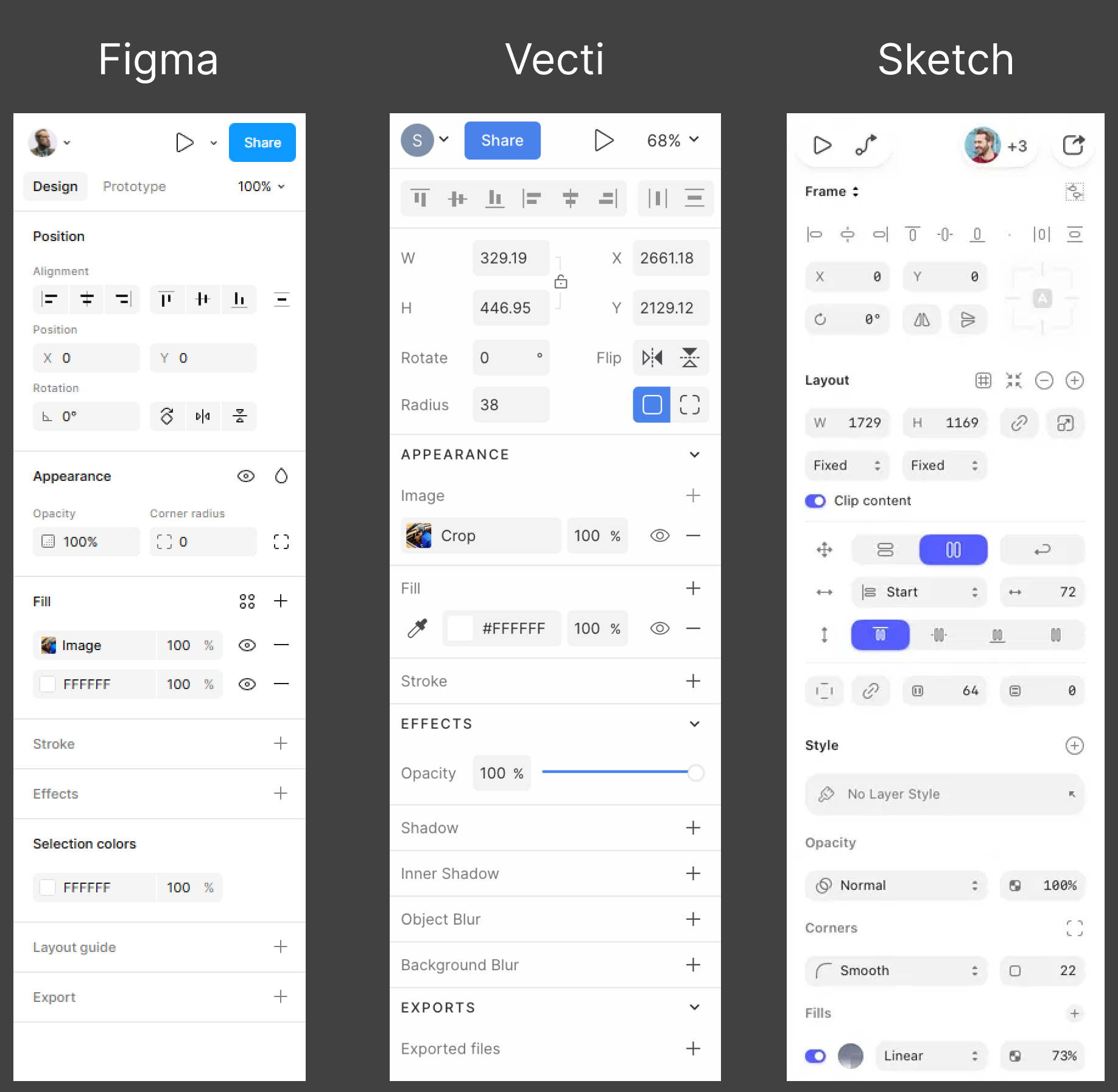
Congrats on completing this project and good luck.
Joel Spolsky said (I'm paraphrasing) that everybody only uses 20% of a given program's features, but the problem is that everyone is using a different 20%, so you can't ship an "unbloated" version and expect it to still work for most people.
So it looks like you've built something really cool, but I have to ask what makes you think that the features that are personally important to you are the same features that other potential users need? Since this clearly seems to be something you're trying to create a business out of rather than just a personal hobby project. I'm curious how you went about customer research and market validation for the specific subset of features that you chose to develop?
I think the Apple II is one example of this.
It's also easier to run a feedback loop. If you implement Y, but Amy doesn't give you $5 a month, what are you going to do? Knock on her door? Users have no idea what they want half the time, anyway.
If you build a product and no one cares, it bruises the ego a bit more, sure, but if you self reflect, you can eek out your own bad assumptions, or bad implementation, or maybe a way to pivot that keeps your product ethos.
First let’s look at B2B, there the “user is not the buyer”. The buyer doesn’t care about “good taste” they care about a lot of other things.
(“Where is my SSO support for multiple users, I’m not going to have my IT department worry about tracking down usernames when Bob leaves)
https://news.ycombinator.com/item?id=46919794
Second, if you have the feature that people need or a service or network effect, they will suffer through a bad app - see every Electron app ever.
That “smaller team” may not be around in a year and if you are lucky, you’ll get an “Our Amazing Journey” blog post. Does this product export to a format that my design team can import into Figma if this product goes tits up?
Games are closer to that than any other type of software even if they tend to cluster around popular genres and styles a bit much.
Especially when, who the heck has time for trying out a dozen products? That's at least a full day of work, which probably costs more than the software itself.
No, you just read a few reviews to find the best full price option and best budget option and figure out if the budget does what you need or not. And often go for full price just because you don't even know what features you'll need in 6 months which you don't need now, so safer to just learn the option that is the most future-proof.
Let's be real, unless some soul somehow had the same 20% as yours and left a review somewhere, you won't know if the features you need, or their implemention, fit your need until you try.
Anecdotally I haven't tried Codex and use Claude Code. The day I try Codex will be when I hear from my friends/communities that it's much better. Same for IDEs, STT tools, etc
Are your customers selecting one of five features in your product, or choosing any twenty from among a hundred?
Which is where the bulk of the other 80% of features come from. It’s a cycle.
You start as you describe, you expand, you end up with this enterprise monstrosity, everyone using a different 20%. New tool comes along, you start as you describe…
Hopefully you can afford to say "No" a lot.
To me this is an argument for more apps that do less extremely well instead of a handful of apps that do everything poorly. There's nothing wrong with a tool that's honed for very specific user. They'll never hyperscale, but that's also fine.
Or then again maybe they can. Google Docs is plenty popular despite being closer to WordPad or TextEdit in terms of functionality than it is to MS Word.
[1] https://www.joelonsoftware.com/2001/03/23/strategy-letter-iv...
I am not even sure it was still true by the time her wrote it. It think that there is a set of core features (laying out stuff in a table, simple formulae) and some very commonly used features (e.g. graphs, data filtering) and a long tail of less commonly used advanced features (pivot tables, database like formulae like VLOOKUP).
Its more like 80% of users only use the same subset. Less commonly used stiff is important to the people who do use them, so you need it to sustain the network effects and enterprise sales.
What you’re saying is basically a majority of SaaS shouldn’t exist because it could just be an excel spreadsheet. Why would anyone pay for a subscription or something when they already pay for excel right? Problem is spreadsheets are a blank canvas and can be difficult for people to build. Just like a design software like adobes and figma. This product is trying to focus on one particular use case of design software and simplify it. It’s not a horrible idea and can exist in the market. I’m not sure it will succeed but conceptually it’s not destined to fail for the this reason. I think you need to also define what success means. For a single dev, could just be a thousand paying users. He’s not necessarily trying to be figma.
My most successful company was a tool that focused on 10% of a ERP feature. One that I had used and implemented at corporates but knew ERP vendors were selling hard for having 100s of features of which I only cared about 20%. Not everyone cared about those same 20% but I found enough people that did and liked my opinionated take on the software. It would have never worked if I had this mindset.
In my experience, what people use is very malleable to how easy/good the flows are they are presented with. Given 100 equal options, they might use 20, and nobody picks the same 20, but given 25 options, 20 of which present a very good experience, almost 90% will go with those 20 without complaints.
I think this is a weird question. Sure he can't be the only soul in the world to need only those features. Those 20% people need gotta overlap. So I think a more generous way to read your question would be "what makes you think that the features that are personally important to you are the same features that the mass audience need?". If that's what you meant then I'd ask why appealing to the mass audience so important? Why maximize sales and risk making your product worse if the core of your product is to make things you care about?
This is a phrase that gets repeated and it sounds clever. But it's completely at odds with statistics, specifically the normal distribution.
We should say, people use 80-90% the same features, and then there's a tail of less common features that only some people use but are very important to them.
This is why plugin systems for apps are so important. You can build an app that supports the 80% with a tightly designed set of core features, and if someone needs to go outside of those they can use/build a plugin.
Like lots of people prefer Trader Joes (limited selection) to a bigger super market
Good question, what's the pitch:
“Vecti is a browser-based UI design tool built from the ground up with one core belief, that creators deserve tools built specifically for them. Better performance, better privacy, and better alignment with their actual needs. A tool that just works, built by someone who genuinely cares about the people using it.”
Hmm. Did founders of Balsamiq or Figma not care about the people using it? And who if not creators were they built for?
“Share & Present - Set viewer and editor permissions at the team or project level. When it's time to present … let your work shine.”
Oh, right, for the people who pay the creator.
https://developer.mozilla.org/en-US/docs/Glossary/blink_elem...
And Gopher support…
I don't think that's really true, unless the behavior of each toggle is tightly coupled to the behavior each other toggle.
Case in point - most mature apps nowadays do have hundreds of toggles for various settings and features.
On the other hand, I'm afraid that if this did happen that FFMPEG frontend would look like a GNOME app and I would hate using it.
My favorite frontend is MPV, because I can generally forgo a GUI and just use single keystrokes to do everything.
Want to generate a video, it's just a few lines of code. Want to connect the user's camera (with permission), it's just a few lines of code. Websockets? About 4 lines of code.
There could be 1000s of options for each of those but they mostly distilled it down to what most people need, and they're cross platform.
The current system of a near-monoculture of garbage sucks.