We have the entire planet storing all sorts of important business and personal data digitally - and no longer a good, common way to ensure it lasts even a decade.
EDIT – that being said, "tape as a service" does exist... it's called S3 Glacier.
Except tape is now rare-bird datacenter thing. Super expensive, and hard to find drives.
The nice thing about discs is they're a mass market consumer medium, so drives have (historically) been very readily available, and they typically have backwards compatibility with old formats.
What are the threat models for tape, and how much do they vary for discs?
I assume if I leave either in my car in an Arizona summer day, it's toast. But are tapes more prone to mould damage in a damp climate, or media shedding if fed through a slightly out-of-adjustment drive?
The problem with M-disc was that it was always a sideshow on the mainstream optical disc market-- like LightScribe/LabelFlash, it was a feature most people weren't interested in except for possibly box-checking during purchase. The main audience was still people buying generic blank discs and burning single use discs or short-term backups.
There is/was an opportunity to box the product up with a clear marketing message of "here's a SMB-scale backup solution", something cheaper than tape, and more built-for-purpose than buying USB hard drives and dangling them off the back of a PC.
I'm picturing the M-disc technology but each disc is pre-installed in a cartridge to discourage accidental scratches/fingerprints/leaving surfaces directly exposed to the sun. It reinforces the "this is durable and you can probably put legal documents you might need for 5-10-20 years on it and leave it in a safe" story. This also creates a vendor-lockin product at a premium price, while quality conventional CD/DVD media was always competing with "but Fry's has spindles of 500 discs for $12.99!"
LTO is enterprise gear that is not suitable for people. If you want to waste alot of time with backups, curate your stuff and get it on optical media. Better yet, print the good stuff on archival papers and ink and stow them securely.
Optical media is an absolutely terrible format for long term archiving.
I just use a box full of old harddrives now, i basically use those like tape cassettes.
Re: hard drives – I gave up entirely on the idea of storing backups "at rest" indefinitely, and use two NASes at different sites. I only store ~50TB, and I plan to need to recover every five years (e.g. when a working computer finally gives up the ghost.) I end up replacing a HD in a ZFS pool once every two years.
Also: I don't have a bd/dvd player in my house today, so even if there are the most tremendous gains in medical sciences I'm almost certainly not going to have one in 100+ years, so I'm not sure m disc even makes cost-sense for smaller volumes.
Maybe if you want to keep your data outside for sunshine like the author of the article, but that's not me...
Never say never. People of today are building "90s entertainment center" setups for nostalgia, complete with VCRs. Given how many generations of game consoles had DVD drives (or BD drives that supported DVDs) in them, I would fully expect the "retro gaming" market of 100 years from now to be offering devices that can play a DVD.
The LTO compression ratio is theoretical and most peoples data will be incompatible with native LTO compression method used.
You have just stumbled on the inherent problem with any archival media.
You really think you will have a working tape drive after 40 years?
Hell, in my experience tape drives are mechanically complex and full of super thin plastic wear surfaces. Do you really expect to have a working tape drive in 10 years?
As far as I can tell there is no good way to do long term static digital archives, And in the absence of that you have to depend on dynamic archives, transfer to new media every 5 years.
I think to have realistic long term static archives the best method is to only depend on the mark 1 eyeball. find your 100 best pictures, and print them out. identify important data and print it out. Stuff you want to leave to future generations, make sure it is in a form they can read.
That said, i imagine optical drives will be much the same.
That was always the hard part to justifying tape backup. the storage is cheap. but the drives are very expensive. And never seemed to last as long as their price would warrant.
TBH, pursuing this type of nerdery is just wasting time to excuse not curating stuff.
All electronic media is bad for long term archiving. People who restore things for a living over a period of many years transition media regularly.
Anyone who has even an amateur interest in, say, making movies, probably has at least a few projects worth of 4K RAW footage they would hope outlives them. (And the average small-time YouTube content creator has far more.)
New computers don't have them and haven't for a few years. I purchased a drive recently and to get a quality drive, I had to go for a NOS pioneer drive, or get another LG, and the LG drives are kid-of shit.
I'd love some kind of external tape drive that I can connect with USB-C, or USB-3...
But everything is SAS? And no way to convert SAS to SATA?
Recommendations?
I still have a ZIP drive around with a parallel port connector. I haven’t owned a computer with a parallel port in 20+ years.
I probably also have a QIC-80 tape drive around somewhere.
I just looked, and iomega.com seems to be some kind of malware site. Sad.
I know MagStor has one with usb-c presentation.
LTO drives are expensive but they are very well designed and it is the most reliable portable storage format available. Full LTO tapes in a good fire rated safe really provide a fantastic sense of security. The cost of the drive is amortized over the total bytes you store.
After the fire, it is likely that the tapes and the papers in the safe are a pile of ash. Fire-rated safes often don't survive fires especially if you live in wildfire country.
On one hand, yes, it's dying. On the other, a PS5 can play DVDs, so there's one class of popular, modern hardware where it's alive and well.
Please do not say LTO tapes. The drives are huge, noisy, expensive, and they have a very quick deprecation policy (new drives cant use old tapes).
Some of my discs are hitting a decade and I am about to create a new set of backups. The market is smaller but the portable blu ray drives are becoming the default now.
So far I’ve just kept extra discs on hand plus a backup portable drive. Hopefully blu ray discs will manage to stick around as long as writable dvds.
More seriously; you can buy used lto-7/8 for very little these days, and the tapes are extremely cheap per gb. The drives are somewhat loud; it’s not a beside device for sure. I’m finding it a bit of a pain to manage a good backup strategy with them.
- You suggest buying multidecade old drives that are no longer manufactured, have weird interfaces that your 2026 PC no longer has, are expensive, large, noisy
- You then mention LTO7 which will not read your LTO4 tapes and is not just expensive but literally out of reach economically for single home
Basically LTO is a terrible backup strategy unless you have a lot of money regularly that you will spend in order to upgrade your entire equipment every two/three generations (otherwise your newer equipment wont read your old tapes). Or you have so much data to backup that cost of drives is not really an issue.
I have stored a lot of data on HDDs, and the only reason why I have not lost any of it yet is because I have always used duplicate HDDs. After 5 years or more, most HDDs had some corrupted sectors, but they were not in the same positions in the duplicate HDDs, allowing complete recovery of the data.
The reality is that both tapes and HDDs suck. What is really needed for long-term storage is a write-once memory with a lifetime of 100 years or more, based on an open standard that would ensure the availability of readers in the future.
If such a memory would use optical reading, it would have to use a great number of layers, filling a 3D volume, in order to achieve densities comparable with the magnetic media. While several research projects in this direction have been announced from time to time, until now none of them has resulted in a commercial product.
Expecting even a nerdy user to successfully restore something from a cobbled together LTO setup is prepper nonsense.
For greater amounts of data, HDDs become too expensive and this is the main reason to switch to tapes.
Obviously, for someone who is certain of never needing more than a few tens of TB of storage space it would be foolish to use LTO.
On the other hand, for someone storing 500 TB, it is foolish to use HDDs, because tapes are more reliable, more compact, faster for sequential transfers, i.e. the actual backup and restoring, and cheaper.
It is as simple as that. The decision of using HDDs or LTO is strictly determined by the amount of data that must be stored.
The argument that HDDs should be fine for most non-technical people is correct only because those people do not store much data.
I'm not preparing for some asteroid impact level event, in that case the loss of my backups will presumably not really matter all that much.
Maybe you're having issues with their writing style or something but the tech is simple. They copy their stuff to a tape and keep it somewhere they aren't. If a disaster happens they'll buy a new tape drive.
Nothing weird. No "prepper nonsense".
I mention LTO 4 because you can today, buy multi decades old LTO-4. Brand new. So in multiple decades from now, I assume you’ll be able to find LTO-7 or 8; brand new. A drive might cost a little more to obtain, but given the plethora of used multi decades old lto currently out there, it seems reasonable to expect that in a recovery scenario you’ll be able to shell out for the right drive.
But yes for most HDDs or the cloud are better. No need to get spicy about it.
> Basically LTO is a terrible backup strategy unless you have a lot of money regularly that you will spend in order to upgrade your entire equipment every two/three generations (otherwise your newer equipment wont read your old tapes).
"regularly" can be 10 years. Your new equipment doesn't need to read your old tapes. If you advance by 4 generations, you can buy 1 new tape to replace 10 old tapes. And the newer generations have abandoned that feature anyway.
Individual used drives aren't too expensive (or at least didn't used to be). Libraries, in contrast, do tend to be more expensive (and also a lot more trouble to ship).
You say "it can read from one generation ago" as if it was some great thing about LTO when it is just a laughably fast obsolescence policy and what really kills it for a home user.
A blueray drive manufactured today can still fscking write to a 90s CD-R from way before LTO even existed.
For magnetic media, the gaps in the magnetic circuit of the read/write heads are optimized for a certain dimension of the bits from the tape material and the efficiency of the read/write process greatly diminishes for other bit sizes.
So there is no obsolescence policy, but there is a real technical difficulty in ensuring compatibility with older magnetic media with different bit densities.
It is not as simple as claiming that optical drives have it easier technologically. If anything, I would claim that tapes have it simpler, definitely for reading at least. There is _nothing_ preventing LTO from retrocompatibility other than market forces.
Most optical discs do not have any guarantees about lifetime and the worst of them may survive only a few years.
There have existed special quality optical discs with gold mirrors that were guaranteed for 100 years, but those are no longer produced and a single modern tape cartridge stores as much data as thousands of those discs.
There are several mechanisms of degradation of optical discs. If the plastic does not seal well enough the metallic mirror, the metal can become oxidized and transparent, so it no longer reflects enough of the laser light. This is why certain archival discs used gold mirrors, which cannot oxidize. The plastic resin may also degrade in various ways and cause disc deformation.
Also CD-Rs have the active layer (top) exposed to the air, but that was solved with DVDs which are a sandwich (which though caused its own issues with shearing)
not hard to find stories about data on LTO tapes being unreadable after 5 years. The same as stories of data on even the worst CD-Rs being still readable after 30 years ( i can personaly attest to that).
I had several hundred CD-Rs. Most of them were OK, especially the gold archival CD-Rs from Kodak, so I have migrated the data from them mostly to save space and improve access speed, not for them being too old. Nevertheless there have been a few that have gone bad, but I had duplicates for all of them, so I did not lose the data. Had I not been cautious, I would have lost some of the data.
The main problem of optical discs is their much too low capacity in comparison with magnetic media. A small suitcase with tape cartridges contains as much data as a big cabinet full of the most dense optical discs.
Literally every single reply to this comment mentions LTO; never change HN.
So "mentions LTO" is true, but:
3 of the comments were disagreeing with claims OP made about LTO. That's a reasonable way to respond even when OP doesn't want to use LTO.
1 of the comments was saying something bad about LTO.
1 comment was really advocating LTO.
When I say "I'm concerned about whether I could buy newly manufactured drives and media in 10,20 years", the answer cannot possibly be "LTO". Because in order for LTO to make any economical sense, I would have to buy ancient LTO drives, and ancient LTO media compatible with those drives, and ancient computers compatible with the interfaces used by those drives.
Therefore I already know the answer on whether I could possibly buy newly manufactured LTO drives and media in 10,20 years, and it starts with a NO. Even today I would be forced to buy second-hand drives. Why would I even entertain LTO as an option, then?
Compare this to BD where in at least today you can buy a simple and cheap USB drive and new media, all of them manufactured today, and not break the bank while doing so. And drives have evolved from $propietary->PATA->SATA->USB, keeping up with the times and interfaces. (Interestingly, I can also buy newly manufactured USB 3.5inch floppy drives. But not media.)
I mean, certainly LTO has its advantages, but in the same way that someone requiring to archive 8TB of data would likely screech if asked to do so with BD media, it just doesn't make sense to suggest LTO as a long-term alternative here.
>Therefore I already know the answer on whether I could possibly buy newly manufactured LTO drives and media in 10,20 years, and it starts with a NO. Even today I would be forced to buy second-hand drives. Why would I even entertain LTO as an option, then?
You can still buy brand new LTO-1 media from 2000 - 26 years old. You shouldn't, but you can. https://www.malelo.com/Maxell_LTO_1_Ultrium_Tape_100_200GB_1... Then here's a cheap drive https://www.ebay.com/itm/355784908408
So if you needed to restore a backup from 26 years ago, it would not cost you very much.
I know for sure optical media & DRIVES will still be available to purchase _brand new_ during the N years they're still manufactured, but also the M years that will follow where I will be able to find new/old stock after they stop manufacturing.
Period N by itself I expect is going to be somewhat long (see 3.5inch floppies), during which one can even expect to see drives with never interfaces (e.g. USB-C). Yes, I have no clue how long it is really going to be, and my concern is whether it will even last this decade.
OTOH I know 100% for sure period N is going to be effectively 0 for any LTO generation I could possibly buy. By the time LTO prices drop for some generation, it is because that generation is dead in the water.
And period M? It is going to incredibly long for optical due to popularity alone, much longer than _any generation_ of LTO could ever hope to be.
And if you say "well, certainly some form of LTO is going to be manufactured in 20 years from now": it should be obvious that I couldn't care less, unless that form of LTO would be able to read the tapes from any generation I can possibly buy now.
The fact that LTO-21 will still be manufactured is of absolutely no relief to someone with LTO-4 tapes. In fact, for all I'm concerned, it could very well be an entirely different media type only sharing the first three letters of the name.
These are not arguments in favor of LTO. If you're already assuming that if your LTO drive breaks you either scavenge for another or basically assume the loss and buy all new media from newer generation and repeat... what's the point of LTO then? Why not buy SmartMedia cards (to say the worst thing that comes to mind)? I'm sure you can scavenge readers and media, and probably will have an easier time finding and using them than with any specific LTO generation.
In the meanwhile, let me keep burning toasters; at least there is a small chance I may be able to buy new drives 20 years from now, using whatever interface replaces USB-C, and they will still be able to read my current discs.
I feel like this is all just two totally separate use cases. Nobody wants to burn 20-40 BDs per TB, just like nobody wants to use a tape drive (or maintain a RAID array, or whatever else) to back up 500GBs of family photos and tax documents or whatever.
At some point the volume of data dictates what solutions are practical.
Sure but old drives are widely available at low prices.
Unless you have a server motherboard with an on-board SAS controller, you need to buy a SAS HBA card, put it in your desktop and also buy a compatible SAS cable, in order to connect an LTO tape drive to the computer.
New tape drives are extremely expensive, e.g. $4500 for the last generation of LTO-9 tapes (18 TB/cartridge), but if you store at least a few hundred TB of data you recover the cost of the drive from the cost difference between HDDs and tape cartridges.
I have an older LTO-7 (6 TB/cartridge) tabletop drive, which has cost me $3000 about 7 or 8 years ago (new), and there are several years since I have recovered its cost.
If you do not intend to store more than 100 TB, the cheapest solution is to buy external HDDs, but for long term storage you must plan to migrate the data periodically, as the lifetime of HDDs is hard to predict and unlikely to be much greater than 5 years.
Why are they so expensive now? they used to be dirt cheap
> I’ve always been skeptical of niche archival formats ... and formats go obsolete ...
The format is supported by Linux, that's never gonna be an issue. Not only can modern version of Linux read DVD or BluRay formats, should the support disappear, there's not a world in which in 30 years I cannot run an older version of Linux. There are, for comparison, people running Commodore 64 and Amiga hardware, today. You'll always be able to run the software, either on bare metal or emulated.
The issue is: will you find a drive in 30 years? As they are still built today and as many DVD readers from 25 years ago are still working today, I take it it's going to not be that hard to find a BluRay drive in 30 years and hook up to a machine running Linux.
And even on a BluRay, you simply do not store that much.
If one doesn't want to only rely on HDD/SDD and online storage, it's still probably a safer bet to go with tapes: you can store much more data, newer readers can read (up to limit) older tapes and these are battle-tested, supported for a long time, available, reliable. Because, well, it's not consumer tech but enterprisey.
would be interesting how that M-disc looks - and reads - today 10 years later..
I've been doing this now for a bit over a decade. It hasn't experienced any noticeable corruption yet on ~22GB of data, but I'm not doing any deeper reads on it. Spot checks on my properly stored discs have also not lost any data.
I have 3 copies so I can check the archive version, active storage volume, and local version to see if any lost integrity in the transfer process.
I’m curious how it would compare against my old CDs and DVDs that were previous backups. My work does something similar for tape drive data.
Granted, if one no longer has the mechanical drive, or if the disk errors out beyond the threshold where the extra ECC can correct the errors, the data's still lost. But it (dvdisaster) does provide some protection from the "bit-rot" case where the disk slowly degrades.
Also also, M-Disc is like Imax, a theater could have that label because it projects 70mm film into a dome or because it's a regular movie theater with a lower resolution than your phone screen that licenses the rights to the name. There are M-Disc DVDs that use a special archival technology that requires compatible drives, but the M-Disc Blu-Ray discs are made with regular Blu-Ray manufacturing technology. With both Imax and M-Disc, they require a minimum quality level to license the trademark, but exceeding that quality level is far from exclusive to that trademark.
Modern mobile browsers can render traditional sites just fine. It was the killer feature of the original iPhone.
So I really fail to understand why you'd make a mobile version of your site that completely breaks on mobile.
Specifically this "killer" feature would already break traditional HTML pages with just text (that were 100% responsive even before "responsive" was a thing).
The entire mobile HTML stacks is hack on top of hacks. Like everything else in computing, TBH...
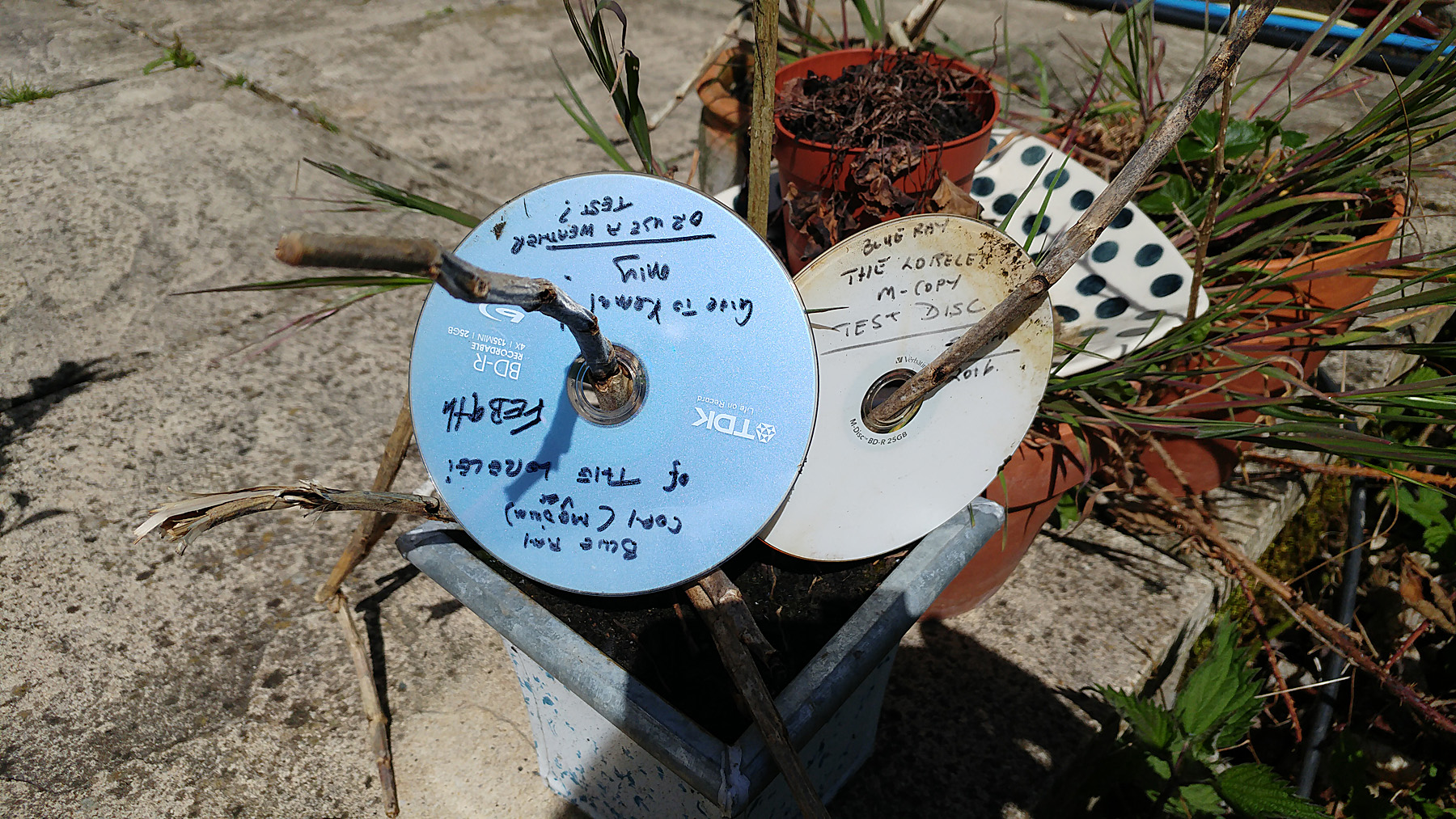
Granted, archival discs aren't designed for full-sun exposure to start with, so in theory, the failed disc could have outlasted the other under real-world archival conditions, and this test wouldn't reveal that.
> Verbatim clarified that these discs were advancements. The technical changes resulted in a different appearance and the ability for higher burning speeds, the changed media-ID was due to an adaptation with regard to other Verbatim products. Verbatim had already shipped the first modified media in early 2022. The data security of the new discs is not inferior to that of the old discs: Data should also last 1000 years, according to the manufacturer.