That said, the large primary display this uses is $2000. That's very hard to justify for any "normal" household, and that's without any mounts, backend, services etc.
Which one? They seem to do 600 calls / min, 5.000 calls / hour, 10.000 calls / day, 300.000 calls / month, how many times do you need to look up the weather for personal use? Fine, maybe you want 3 different locations, you can still call each of those sufficiently with those rate limits, no?
I'm just guessing, but I think it might simply just be for fun :)
If you get an Arduino or Esp32 microcontroller (maybe in one of those starter-kits with various sensors), some breadboards, assorted jumper-cables and a kit with electronic components (resistors, caps) you'll be good to go. A device like a wall clock most likely won't require soldering, since it won't be jostled or moved around much.
Ben Eater: https://www.youtube.com/@BenEater/videos
Paul McWhorter: https://www.youtube.com/@paulmcwhorter/videos
Huy Vector: https://www.youtube.com/@huyvector/videos
I'd also take a look at the other DIY projects that people have linked in this discussion.
Seems like the author has experimented with 2 kindles side by side.
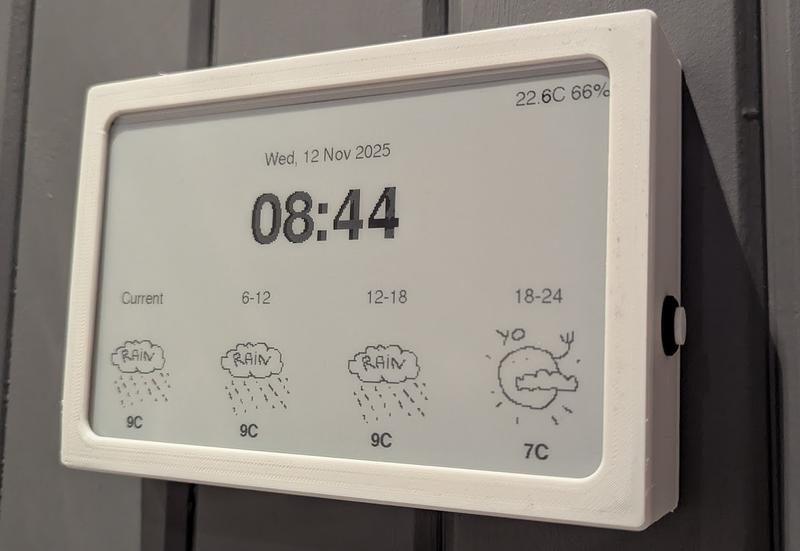
Microcontroller: FireBeetle 2 ESP32
Display: Generic 10" e-Paper display with driver board included
Timekeeping: DS3231 Real Time Clock Module
Temperature and humidity: BME280 module
Charging: Type-C USB 2S Li-ion BMS
That, along with a breadboard, two 18650 batteries, some resistors and capacitors make up the hardware. I modelled and 3D printed the case. I used the PlatformIO plugin (available for VSCode-based IDEs) for programming and transferring code to the esp32.
Weather API: https://openweathermap.org
For actual firmware I'd take a look at matada's github for inspiration (see the other reply in this thread). My own code isn't of the photogenic sort.
edit: https://github.com/sibbl/hass-lovelace-kindle-screensaver
I can vouch for the reTerminal: the build quality is excellent, and they come with a battery, sd card reader, and some sensors: https://www.seeedstudio.com/reTerminal-E1001-p-6534.html
I don't have easy access to a 3d printer, so I just have mine sitting on an extra phone stand I had lying around that can be had for a few bucks from Amazon.
I couldn't be happier with it and am thoroughly enjoying my complacent, lazy solution :)
I’m very tempted, a lot lower resolution than a kindle but it’d be pretty cool.
https://github.com/usetrmnl/trmnl-kindle https://github.com/usetrmnl/trmnl-koreader
moving on to the self-hosting side is probably now backburnered indefinitely, even if i do have some grander ideas in the longer term. unfortunately, i'd need more than a weekend project's timeframe to bring them to fruition.
I love my original one and am planning to get a model X when budget permits
It automatically shuts off after 30 seconds of inactivity.
I added a $3 webcam, and use openCV to detect motion. If three consecutive frames (sampled 0.5s apart) are each sufficiently difficult from the previous one, it attaches a virtual USB mouse, then moves it one pixel.
This wakes up the display whenever you walk past, then puts it back to sleep again when you stop moving.
The motion-detection pipeline uses less than 0.3% CPU on an intel N100 (6w TDP).
https://thepihut.com/products/60ghz-mmwave-breathing-and-hea...
Same kind of tech but higher frequency.
This is kind of crazy, I had no idea this was a thing. And here I have PIR sensors all over the place and hacks around those, that definitively sounds much better. Besides being more expensive and weaker range, any drawbacks for using it for motion sensing?
But seriously you can probably DIY something a lot cheaper.
ReTerminal and other derivatives from Seeed Studio are two options. Seeed even has a newish color unitfor under $250 [0].
Not trying to diminish all of the thought and work that's gone into OPs project but a lot of this has been available to do in HomeAssistant for quite some time. Glad more people are finally seeing the value in eInk like this. I've been using them for a while in my office and bedroom for simple status as the OP states: only showing certain status depending on state.
The other unit I tinkered with quite a bit of is the Heltec Vision Master E290 [1] which is a 3" eInk devices for under $35. Based on ESP32 and has LoRa.
[0] https://www.seeedstudio.com/reTerminal-E1004-p-6692.html [1] https://heltec.org/project/vision-master-e290/
    * repurposed old LCD rotated to portrait mode
    * Raspberry Pi 400
    * Debian with Sway showing various tiled terminals/browser windows
* self-hosted REST server that collects/provides data to displayThe trick with e-ink displays is that naive grayscale conversion looks terrible because you lose all mid-tone detail. Dithering the image down to 2-4 levels before sending it to the display makes a huge difference in readability, especially for things like weather icons and charts. ImageMagick can do it too but Sharp is about 4-5x faster for batch processing since it avoids spawning subprocesses.
I solved a problem (not really the same problem as this, mind you) for my family using a much older technology. I bought a big pane of glass from the hardware store, built a wooden frame for it with a shelf for an eraser and dry markers.
I hung it up in the kitchen and now when we need to leave "sticky" notes to each other we just write on it. We keep our shopping list on it, we write small poems and draw funny faces. It has become a fun ephemeral space for communicating.
Tons of fun and super cheap to build.
An analogue communication medium for myself and others is indeed something that might be much more impactful and human-cetric than a smart system.
Thanks for the inspiration!
For example the washing machine. You dont need real time information because you know how long it takes since you've done it 1000s of times and it beeps. All these things are just managed in our heads subconsciously.
It beeps, on the other end of the house (or on another floor), where it's inaudible. (And, thankfully, where the loud sounds of it operating are also inaudible.)
> All these things are just managed in our heads subconsciously.
And when you remove the need to track that in your head, your head gets freed up for other things.
To be explicit, I don't like "smart appliances" that connect to a cloud server. I do like the idea of devices that can connect locally to something like Home Assistant.
I leave the empty basket in front of the machine, which for me happens to be somewhere where I'll pass by frequently until I need to take it out. That keeps it 'in sight, in mind'. Heck you could even put it in the kitchen to remind you.
I don't like the extra complexity that often comes with digital solutions, but I do like having a system. The simpler and less thought required, the better.
I do this for a number of different things. Rather than put it on a list I put it somewhere where it's in the way.
That requires more thought and clutter than just having the information when it’s relevant.
I have a friend who will say things like “I have to go at 3” and get up at 3 on the dot without even looking at her watch/phone. I’m not that guy and I need buzzers, timers, and ambient displays all working together anything done at a time.
I've just started using the timer function on the dryer and it's been mostly accurate, plus or minus a few minutes perhaps.
Home Automation is just a hobby like "productivity" tools or going all in your coffee setup. You tell yourself you are saving energy, or freeing up your mind from remembering mundane tasks but in reality it's just like a model train set.
It's fun to set up, play around and maintain it for some people. If you'd do the math of setting up hundreds of dollars worth of smart appliances, bulbs, hubs and thermostats to tweak your heaters slightly while you are not at home...it will probably take decades to break even, if at all.
I'm glad that works for you. My (and my wife's) ADHD brains put these directly into "the void".
It is hard to stop yourself from treating every minor inconvenience as nail for which you have a handy hammer, and I find myself overcomplicating things in my life as a result.
The goals are noble but the methods bring a lot of the complexity simply repackaged (and potentially amplified).
I'm not sure this is true anymore, first you usually do different programs depending on what you put into it, and modern washing machines also automatically adjust the washing time depending on how much you throw into it, at least our ~2 year old one does, I'm sure others do too.
I basically never know how long time it will take, sometimes it takes 1.5 hours and sometimes 3 hours. Our washing machine is further away from where we can hear the melody, so having a notification appear on the phone when it's done is actually quite handy, at least for our situation.
On all settings except timer, my dryer is pretty much useless. I set it to dry my bedsheets and towels with bulky item preset, max dry (who chooses minimum dry for anything?) and it'll say it'll take 1h30m, ends up taking 30 minutes, and everything is still wet, despite it having a "dryness sensor"
I've just started using the timer function on the dryer and it's been mostly accurate, plus or minus a few minutes perhaps.
Fortunately, we usually just throw clothes in the dryer before bed, so we don't need a system to remind us when it's done — if it's not done by morning time then we probably need a new dryer!
Besides, the notification is for notifying us, doesn't mean we need to do it within N minutes, it can wait until your Very Important Business Call is over or whatever. As long as it's done before it starts to get overly humid and starts to smell.
Very few things need my attention now.
For me, I think a healthy relationship with technology is technology that is there when I need it, not there when I don't. Added benefit if the technology knows when it's needed (ie alarms and such).
Crucially, a healthy relationship with technology for me is consuming less (reading less "news" and blogs and social media) and creating more (writing, projects, etc). So the concept of using technology to build something that is there when the family needs it and is in the background when not is a healthy relationship imo.
That’s certainly true for some people, and I envy them. Others of us can easily forget the washing machine was on and needs emptying for anything up to three or four days, running it each day before promptly forgetting to empty it before it needs doing again.
This also just adds a series of manual steps, along with having tech setup to deliberately get your attention at a time that may not work for you. I'm not sure why this is seen as a nicer solution than having it happen automatically for you.
Peoples brains work in different ways, and they have different lives. Some days I can more calmly go around dealing with things, others I have a very large number of parallel things to do with more interruptions happening as well (two young kids will do that).
> It doesnt seem like any of this would really be useful as you'd have to enter all the useful data manually(calendar).
You have to enter calendar data somewhere, right now I often have the same info or different subset split between my calendar, work ones, my wifes one and the one on the wall. Even the paper version requires having entered the data - more so than the tech based ones because an invitation sent by email now needs to be manually copied over. Or have I misunderstood?
> You dont need real time information because you know how long it takes since you've done it 1000s of times and it beeps. All these things are just managed in our heads subconsciously.
This seems odd to me. First just a couple of things
> You dont need real time information because you know how long it takes
1. It takes different amounts of time depending on the load and settings
2. Knowing how long it takes and when to take it out is something the person who put it on knows, but there are different people in this house who can all do either task
3. It's in a place where the beeping is often not heard
But more interestingly is that we're comparing two different approaches. One is
* A note written in a place that washing needs to be taken out if it's not been done.
You describe this as an unhealthy relationship with technology.
Your better solution is
* Work out when a machine will finish its task, remember this
* Wait for the machine to shout at you
* If you don't hear it shouting then keep checking the time to see if it's finished its task
* Make sure you track all of this in your head on top of anything else
This is more healthy? Than a note on the wall that says "change the washing"?
Imagine you started with the typical thing being that you have a note on the wall that says "washing is done" when it's done and the machine itself is silent. I come along and tell you I've got a much better, healthier way of interacting with it - wait for it to make an annoying noise!
Spending $1000s on this setup and running it 24/7 is a waste in every regard except hobby enjoyment.
Huh? I could admit it's a bit of a "good problem to have" but why would it be a stressor?
The fact that people are complaining about the cognitive load and beeping sound when running a washing machine is utterly baffling to me. This goes beyond sheltered "first-world problems". There is something insidious about this about micro-optimising for non-issues, something dystopian.
Not all washing machines have static wash times, some (like ours) adjust the time based on what you actually put into it. Not to mention there are like 5-6 different programs we use, who has time to remember kind of how long time each program takes? And it doesn't display how long it'll take until it measured the load, which takes 2-3 minutes.
So instead; chuck in the clothes and cleaning product, put the program, go do other stuff and await for Home Assistant to tell us when it's done. Over-engineered? Nah, just comfortable modern living.
Why do I want only my phone to have a notification? Why do I want it to override other settings and go off at a set time rather than when I choose to interact (as a notification would)?
You can absolutely solve this in other ways, but adding an automation into HA for notifying me about forgetting to setup the dishwasher took a few minutes max and I only had to do it once.
> You can set an alarm on your phone
I don't see "manually setup another bit of technology make an annoying noise" as a nicer or more healthy integration of technology in my life compared to a note written on the wall.
> The fact that people are complaining about the cognitive load and beeping sound when running a washing machine is utterly baffling to me
Perhaps you're reading it in some tone that suggests these are huge issues for people to deal with. I am reading them as just niceties in life. I have tried for some time to practice responding to being baffled with assuming I've not understood something, I think you might be baffled here because you have misinterpreted what people have been saying or not understood their personal issues or how easy it can be to setup some of these things.
Same as the timer on my oven is useful, but I don't need one - I could do it entirely manually right?
I have things setup to notify me if we haven't setup the dishwasher and/or the door has been left open when we head to bed. I'm not in dire need of this and my life was not falling apart at the load of remembering to do it, but it took me less time to add an automation for that than it did to either go and check the dishwasher a few times or clean up bowls in the morning for breakfast by hand. It's caught things a few times, and it's another thing I don't need to keep in my head. I'm not sure why deliberately choosing to increase cognitive load is somehow a good thing, and these things all do build up. I could remember all my appointments and schedules and tasks I need to complete, but calendars and reminders and todo-lists are useful.
The "x minutes ago" on the when it started is really useful and generally enough to know when the cycle will end. Having that timer started automatically is pretty useful in itself.
The article is about a 2000$ eink display that shows a calendar and the weather. Your phone does that for free and you don't need to walk to the hallway every time.
This is basically anti-technology. It takes more time, money and effort than just buying something from the dollar store that does the same thing
The relationship with technology you're designing around your family is worth considering too.
Looking at a shared hallway screen that shows a shared calendar which doesn't exist to pull anyone into a feed doesn't make a worse phone, it's solving a different level of shared understanding entirely.
The assumption that the phone is a neutral free tool tends to come most naturally to people who haven't yet thought about who designed the defaults and why. Free at point of use isn't the same as free. Someone optimized very hard for your continued presence.
It's also possible that the sentence struck a nerve because it's a pretty simple lens and test.
All the scrolling is free labour for tech/social media companies. Other folks seem to use it more as a platform to create, publish or be more mindful of their interactions compared to passive consumption and reaction.
Family schedules can be a unique and valuable problem to solve, namely how much more valuable time becomes, as well as how much a little bit of optimizing can give back.
We tried something like this using the iPad when we moved to a new country with one year old, because there was so much to figure out and track, it felt impossible. Now after a year, it’s gone and things are more internalised.
That’s my main concern with spending time and money building something like this. We thought about everything from commercial displays, Raspberry PI and e-Paper to finally just buying a 10$ wall mount for IPad. After sometime it becomes redundant as routine is formed.
If the author happens to read this, do tell us how have you found the motivation to keep using this? Doesn’t it get redundant after a point? I get adding new information and adapting routines around can be a factor, but people don’t really change that much
I’ve been following Information Radiators since practically the beginning, and wiring has always been one of its problems. First networking and now power. In homes, but also in office spaces. The best locations for radiators are often the worst for wiring.
And eInk displays move the needle because you have a device that can go completely to sleep between updates, which means it can trickle charge.
Instead you find it placed on your smartphone homescreen, on the smartwatch, on the home dashboard, on a notification you receive every morning, on your car screen, on your computer, ... I don't need to see it constantly.
Personally I believe it is something that it is easy to integrate and that users don't perceive as useless, but 99% of the time doesn't add any value
Very useful to know if it's likely to rain or be windy, and the highs and lows. I might be leaving at noon when it's comfortable and warm outside, but I might be coming home needing a thick jacket and an umbrella. If I'm already outside experiencing the sudden rainstorm and my umbrella is at home, it doesn't really matter that it wasn't raining when I left home many hours ago.
I have a pixel device, and by default I have the weather on both lock screen and home screen. Every morning I receive a notification with the expected weather for the day, and it keeps suggesting me to enable the weather preview right after the morning alarm.
Garmin smartwatch? Same
Android car / Apple car? Same
MacOS has the weather as one of the most prominent widgets available, and I believe windows to be the same.
Do I really need to have weather info constantly available to me?
  * Is it any month other than May-August?

  * Is it after 10am or before 4pm?
If you have very light skin you might want to increase the timeframe by an hour.
And if you really want to optimise your sunscreen usage and not use it if you don't have to, the real-time UV index from ARPANSA is the way to go (https://www.arpansa.gov.au/our-services/monitoring/ultraviol...).
All other apps simply display the expected UV index given the time of the day and the day of the year.
And then, this is most critical, use mineral or at least creamy sunscreen (sprays barely do anything) and put it on a few minutes before sun exposure - not when you start feeling it.
Agree that the UV index is not particularly useful - it's kind of obvious. Still good to know though.
I was weather-status neutral until I bought a house that has flooding challenges. Knowing that enough rain that could trigger flooding helps me avoid surprise cleanups and property damage.
It's strange that pretty much every weather widget assumes you want to know the current weather conditions and not the forecast.
Do you... not go outside? And not need to know if you need the heavy coat, light coat, light waterproof coat, and/or umbrella? Or pants vs shorts? And the answers are very different at 7am vs 11am vs 3pm?
I'm not trying to be sarcastic, I'm just genuinely baffled.
I guess you live somewhere very, very different from me.
And I guess I just don't enjoy the surprise of shivering cold, or soaking sweat, when I choose the wrong jacket.
That said: I seem to get by pretty well with a lowly smartphone so far.
The temperature inside is not at all indicative of the temperature outside, the sun being out doesn't mean it is warm, and I don't really have any useful indicators of wind, unless the windows are rattling, but that doesn't let me know if there's a stiff breeze.
I could walk over and open up my balcony door and experience it all personally, but checking my phone or watch is faster and more accurate, and also gives me the forecast at the same time.
In fact, though, a massive bomb cyclone is forming a few hundred miles away and it’s likely to dump over a foot of snow on us in the next 24 hours, accompanied by 50mph winds.
Weather forecasts are, not surprisingly, actually useful.
A few years ago I came into a couple of e-ink displays that had been previously used for storefront/product pricing. The hardware to drive them was locked down but I was able to reverse engineer the panel by finding a datasheet that was close enough and hacking up an adafruit thinkink. I had a lot of fun writing my own driver/abstraction layer. I originally intended to support a bunch of different panels but ran out of steam after the first one did exactly what I wanted.
Well, it's cool, but the usability of it all is below average.
Declutter your life and don't install any more screens in your home ;)
Versus.
Just look at screen.
The equivalent of having the app open on your phone.
What if you are on a bus?
I have the apps on my phone. I use them, and at times they are great - but they are not a perfect solution. (though I agree that $3000 for a system is too much)
- swipe finger to the right to show weather OR swipe finger to the left to show callendar
Android widgets show me much more information about weather and calendar view than these monitors (and are free: weawow https://weawow.com/i/app-download + google callendar).
You should leave your phone on when you are asleep with full trust and confidence that you won't be disturbed except in a real emergency. The do-not-disturb mode is for Friday nights where they is no way for someone to know if you are the theater or just chilling at home - the latter is an acceptable time to call.
I make these https://www.stationdisplay.com/ . They are also just as "useless" as a wall clock yet people find it a lot more pleasing to take a glance at something to give the information instantly, than having to make multiple decisions in order to take their phone out, open the app and find the place with the information they need.
Also nerd is an offensive term. It’s similar to mis-using a pronoun. Please don’t use derogatory or discriminatory terms here.
You're entirely talking out of your ass. You have no clue what's more usable, cluttered-feeling, or useful.
As someone who built a similar device to this: it is absolutely awesome to have one of these, even though I have a smartphone!
This is much more useful compared to that
I’m not going to build one, but this is exactly the sort of creative and highly opinionated tinkering I stick around HN to see.
Inkplate devices are a great entry point. They're recycled Kindle displays with an ESP32.
I've been doing a cheaper version using a Waveshare 7.5 inch screen, a Raspberry Pi and a 3d printed case coupled with Inkycal: https://github.com/aceinnolab/Inkycal. This works well for my needs, but seeing what else can be done maybe it's time for an upgrade.
the best user experience is sometimes no experience
Likewise there are always chores. Cleaning the litter box is daily, but in the rare case where everything that must be done is done there are things like washing windows that can wait a few months but if I have time...
It is also useful to put a clock on this display - computers are accurate unlike the battery powered things you have on the wall. (though it is a matter of taste if this is worth it...)
And at least where I live I always need to know the weather for the day (if storms are expected it might be deadly to ride my bike to work even though it is fine now).
Sure knowing the temperature and relative humidity in the house isn't really useful if the system is working correct. Though it does settle some arguments so it is worth having anyway.
We have several kids and have been organizing our daily todos and calendars on it for several years. We used to drop the ball quite a bit due to a hectic schedule and the dashboard has helped us tremendously. Since it is mounted in the kitchen, being able to pull up recipes is a plus.
I think I need a bigger kitchen, haha.
That sounds really cool, though. I'm currently trying to "train" our kids to manage their own schedules, e.g. reminding me that they have somewhere to be instead of vice versa.
Maybe a wall-mounted solution would help put it front and center for them.
Someone I know has one of these fridges and the screen is just a toy. Doesn't really show anything useful for day-to-day life. Although it provides amusement when it detects bald heads as eggs.
With many newborns there’s a lot of "hurry up and wait" if you’re able to be on parental leave (or just on the weekends). They sleep a ton. Honestly, I’ve never been more caught up on movies or TV than during those overnight newborn shifts with my first child.
The real hectic "I have no free time" era, at least for me, came after that: Toddlers require (and you should try to appreciate giving them) all your available time.
We have no way of knowing, but it would not be at all a surprise if he has more kids in a few year - which makes accurate calendars around the house even more useful as everyone needs to know what everyone else is doing.
And while your rude, completely unnecessary comment displays a lack of the basic human empathy that may be necessary to understand this, it is precisely during a time when my life and home are so busy and chaotic that I would most appreciate having them be better organized, yes.
But how dare I simply leave a comment saying I liked a project that someone shared.
You don't know what goes on inside my mind, you're just guessing.
I have a 4 year old and my point was that the trade off of having a calendar on the wall in exchange for having to learn hardware and maintain services is absolutely awful. Of course everybody wants their life more organized, but my point was this project actually costs you something a lot more important. I have an infinitely long list of things that I'd rather do than adding services for myself to maintain, in exchange to having a calendar on the wall, for example actually spending time with my kid.
I empathize with you even though you don't appreaciate it.
So, I'm not going to say "sorry" because I don't think I did anything wrong. Instead I'll say that if I had known you'd take it that badly I wouldn't have said anything.
That being said, I see a lot of COTS products that fill this niche but all have privacy issues sadly.
The Nook Simple Touch is one of my favorites
If someone wants to go the easy route towards something like this: iPad (Air 1, I think) is connected to the charger 24/7 and runs in Kiosk mode. Application is just a React website hosted on Vercel, client credentials are stored in localStorage …
[1]: https://roblillack.net/unser-stundenplan-family-timetable-vi...
On the subject of dedicated home control dashboards, I'm not sure I see their value at all given we all have screens in our pockets, so when it comes to enabling interactive controls I feel like using your existing devices or voice controls is the right approach.
I've noticed e-ink/paper displays having somewhat of a moment right now (especially very small "phone-like" form factors as portable ereaders), and I hope this trend continues.
I'm very far from a meaningful reduction in "screen time," but looking at e-ink displays instead of OLEDs feels like a nice step in that direction.
The typical e-ink uses cases boil down to e-readers, dumb-phones, and hobbyists, which is not a huge market. Anything niche or specialized tends to carry a higher cost.
One of the main blockers has been the cost of larger, high-resolution e-paper displays. I was considering using an ESP32 to drive one, but the display pricing always felt like the convenient excuse.
Reading through the helpful comments here, I'm starting to think there might be more viable options than I assumed, especially in terms of display size trade-offs and keeping the overall cost reasonable.
https://shop.m5stack.com/products/m5paper-esp32-development-...
Best Buy sells 24" touchscreen displays for $339 right now. So you can spend $3000 on a display that sips current or spend 10% of that and you get $2700 to pay towards the higher electric costs.
I call that an interesting trade-off. YMMV
One potential idea - it might be worth looking at overseas manufacturers to see if they can offer a similar display at a better price point. I did a bit of digging on Alibaba, for example, and found a 25" E-ink display with the same resolution as the Boox for around $1000 (and the price goes down to $500 if you order 100 units or more): https://www.alibaba.com/product-detail/25-3-inch-e-paper-dis...
Seems like they offer a color E-ink display option as well, which could be worth exploring.
Note: I don't have any affiliation with the above company, it was literally just the first one I found when searching. I'm sure there are many other options available as well.
A bit more expensive than the one I linked previously at $1,400, though it's a full color display. It's unfortunately missing a description, so the only evidence that it's a touch screen is in the title itself. Would obviously require some due diligence with the manufacturer.
I'm sure there are other options as well (the breadth of vendors on Alibaba is pretty impressive actually)
> Communication 4G Wifi BLUETOOTH
A world of no in so many ways. Nothing still running Android 7 should be connected to the Internet, and in any case I don't want a display that has a computer and networking in it (though I realize some people do want that). I'm specifically trying to find an E-ink touchscreen that's just a display, to be attached to a real computer whose software can be updated and customized.
Thank you for the pointer, though!
Here is my ~75euros ESP32 eink panel experiment: https://github.com/riston/eink-assist-screen/tree/main
Fwiw, there are 13-inch eInk displays for ~$140 (https://www.waveshare.com/13.3inch-e-paper-hat-b.htm?sku=272...) which you can pair with a Raspberry Pi (~$40) or ESP32 (~$15) and battery (~$10). Smaller displays are cheaper if you don't need all that real estate. You can then use AI vibe coding and open source projects to throw together your own apps
It does remind me though of Portals from FB/Meta, which were really nifty, but not profitable enough for otherwise highly profitable company to continue investing in.
Yet AV remote controls were UX hell and phones are an improvement. So maybe a separate old phone just for that ?
https://github.com/speedyg0nz/MagInkCal
A 12.48 Waveshare eink display costs $175. Sadly haven't gotten it to work with the Raspi Zero and therefore can't use it battery-powered. Got an ugly cord right now. Running power to the right place through the walls is definitely dedication!
Are there similar options on the market for "set and forget" people like me?
That said there are some displays for the adventurous with no clear ready made interface boards that would need some effort to connect to. Like the ES120MC1 12" high res ones for 50ish USD with some gnarly zif sockets.
We got a skylight 27 today. It’s better. I give in.
E-ink is fine for display but too slow for interactivity.
https://github.com/benjajaja/kindle-bueno
However, I would now go for some ~100€ e-ink that is built for hacking.
Love the artistry and dedication in this effort - getting something just right for your own tastes and honing it over time can be really fulfilling.
Elixir’s fault tolerance and ease combined with simple devices to run on
https://www.reddit.com/r/raspberry_pi/comments/1ik3myy/turni...
https://www.stavros.io/posts/making-the-timeframe/
Joking aside, great project. I love e-ink displays.
To be fair on your point about only displaying status when they need attention vs displaying everything at once- this is easily achievable with a bit of IF ELSE logic with most cards in Lovelace.
Though, $2000 is a step price.
I had some fun with using an Inkplate e-ink display - bough a bare 5" for €74 (a 10" with batteries is there €219). Smaller, but also way more affordable.
It connects via WiFi, and make it display random, vide https://github.com/SolderedElectronics/Inkplate-Arduino-libr....
We use a WhatsApp channel for our family to manage breakfast meetups and who needs what from the shops or the pharmacy (they are on our healthcare plan) and general conversation about events or troubles and parental advice in their lives.
One kid live on her own with her bf a few minutes from us but she can't drive so we sometimes have to pick her up from work.
It gets muddled but works for us as the rule is no pet photos unless it is very cute (cat with a dustbin cover on his head) or inspirational daily quotes.
Where I got stuck is calendars... Unfortunately Google Calendar doesn't seem to provide a nice API where you can just say "give me the events for these days", instead you can only download all of your events in iCal format. It's then extremely non-trivial to convert that information into "what is happening today".
Something like:
```
function doGet(req) {
  let start = new Date();

  start.setHours(12,0,0,0);

  let end = new Date(start);

  end.setDate(end.getDate() + 3);

  let events = CalendarApp.getEvents(start, end);

  return ContentService.createTextOutput(events.map(x => x.getTitle()));
```
I'd have had these up on Marketplace the same day if I couldn't figure out a way to drive the panel directly
Yes, please distribute this as an HA app. I can't wait to see that.
It could change a lot of things in the world, especially regarding the power consumption of most commonly used screens for a lot of signage everywhere. But not that much company looks like to be interested in developing the field.
I think that a few years a go, a lot of possible innovation were blocked by a few aggressive patents. I don't know if it is still the case.
why is that crazy? the demand for big epaper isn't really there, but demand for AI has been pretty clear
AI is re-structuring entire industries.
Hence we need more resources for R&D to figure out the shortcomings. LCD didn't pop into existence randomly either. It's not a guaranteed win, but neither AI has proven any realized gains in the majority of industries that gambled on adopting it.
There's something I don't get about common e-paper displays.
I have a Remarkable, and it's great. The battery life is also supposed to be great. It can last for months while the Remarkable is turned off.
If the Remarkable is on, it won't last. All the battery will drain away. You have to babysit it carefully, or this is what will happen, and the next time you want to use the Remarkable, it will be dead and you'll need to charge it first.
For some reason, if left idle, it will enter a "sleeping" mode. The screen shows whatever was on the screen, with a little bar overlaid telling you that it's sleeping.
Sleeping mode is actually just awake mode. It continues to draw power as if it was on. The only difference is that it stops responding to touches. If you press the power button, it wakes up instantly, because it was already on.
Off mode is different. In off mode, the Remarkable stops drawing power. Also, it erases the screen, instead displaying a full-screen message that the Remarkable is off. You have to manually put it in off mode whenever you stop using it, or all the battery will rapidly drain away. If you press the power button, nothing will happen; you have to press it and then hold it down for two seconds (I measured this) in order to get it to boot up.
To put it into off mode, you have to do the same thing, forcefully holding down the power button while you wait for it to admit that you want it to turn off. This takes four seconds. Then you have to confirm on the screen that yes, you held the power button down for four straight seconds on purpose.
The ergonomics of this are awful. Leaving your Remarkable idle means losing your entire charge; it will never transition from awake-but-pretending-to-sleep to off. Turning it off is a huge pain. It would solve so many problems to just leave whatever was on screen before idle on the screen, and actually turn off.
I tried something similar with a Kindle a few years back for just weather + calendar and ran into the same jailbreak maintenance hell. Ended up giving up. The Visionect displays look great but $1000+ per screen is brutal. Curious if the author has looked at the Waveshare e-paper panels driven by an ESP32, they're like $40-80 for a 7.5" screen and you can do partial refreshes. Obviously way smaller than the Boox but might work as a cheaper bedroom/mudroom option for people who want to build something like this without spending $3k.
If we think about paper calendars hung on a wall, and updated sporatically we know what's there is likely good information, only that it might not be up to date.
If a calendar can be calm by default, surface what's changed or newly relevant, and fade when it resolves. The next level could be understanding who's attention something needs, and when, in a personalized way.