A ternary plot of citrus geneology
168 points by jlauf 4 days ago | 35 comments

jihadjihad 2 days ago
A Persian lime is a cross between a Key lime and a lemon? I never would have guessed that, that's really interesting.
reply
CGMthrowaway 14 hours ago
Yeah makes sense though. And for those reading Persian lime is the regular lime found in US grocery stores. Kaffir lime (one of the cornerstone species not included on the ternary axes) is the lime used in Thai food
reply
CamelCaseCondo 23 hours ago
During lockdown I started growing clementine from seed. One of the interesting details of this genus is polyembryonism: multiple seedlings emerging from one seed. Apparently, one of the seedlings will be a clone of the motherplant and the rest will be the product of pollination/genetic reshuffling. My clementine seeds all had 2 seedlings per seed but other attempts (with lemon I think) yielded 3 or more).

During my reading I came across a lot of contradictory info about the origin of the clementine: some papers say it’s an unknown hybrid, other clearly state it’s a mutation instead of a hybrid. So it’s interesting to read the hybrid parentage in this triangle, stated with confidence.

reply
seszett 23 hours ago
Polyembryony is the reverse of what you think: one embryo is a result of pollination and all the others are clones. The sexual reproduction embryo is often less vigorous and sometimes doesn't develop at all. It makes it easy to reproduce "true" plants, but also makes it difficult to produce hybrids for some species.
reply
riffraff 22 hours ago
Chinotto (apparently called mirtle leaves bitter orange in English?) also has some confused origin (perhaps it's a mutation of some other bitter orange, but it's unclear), and afaict it's not in this chart, or I can't find it.

Citrus fruits are fun.

reply
tkfoss 20 hours ago
[dead]
reply
interroboink 20 hours ago
I recently learned about the fact that Sichuan peppercorns are actually related to citrus, so was looking for where the connection is... As it turns out[1], there is a "citrus family" (Rutaceae[2]) and a citrus genus (Citrus[3], in that family). The Sichuan plant is a member of the family, but not the genus (that would be Zanthoxylum[4]). Confusing!

  [1] https://news.ycombinator.com/item?id=47248319
  [2] https://en.wikipedia.org/wiki/Rutaceae
  [3] https://en.wikipedia.org/wiki/Citrus
  [4] https://en.wikipedia.org/wiki/Zanthoxylum
Also, this is a pretty good page on citrus (both family and genus): https://www.clovegarden.com/ingred/citrus.html
reply
wrboyce 12 hours ago
Interesting read, and nicely follows last week’s Lunchbox Envy where “Oranges” was the subject. A great podcast if you like food and fun facts.

https://www.bbc.co.uk/sounds/play/p0n1sn05

reply
contubernio 21 hours ago
Couldn't find blood oranges (sanguina in Spanish). Curious to know where they fit.
reply
drmpeg 14 hours ago
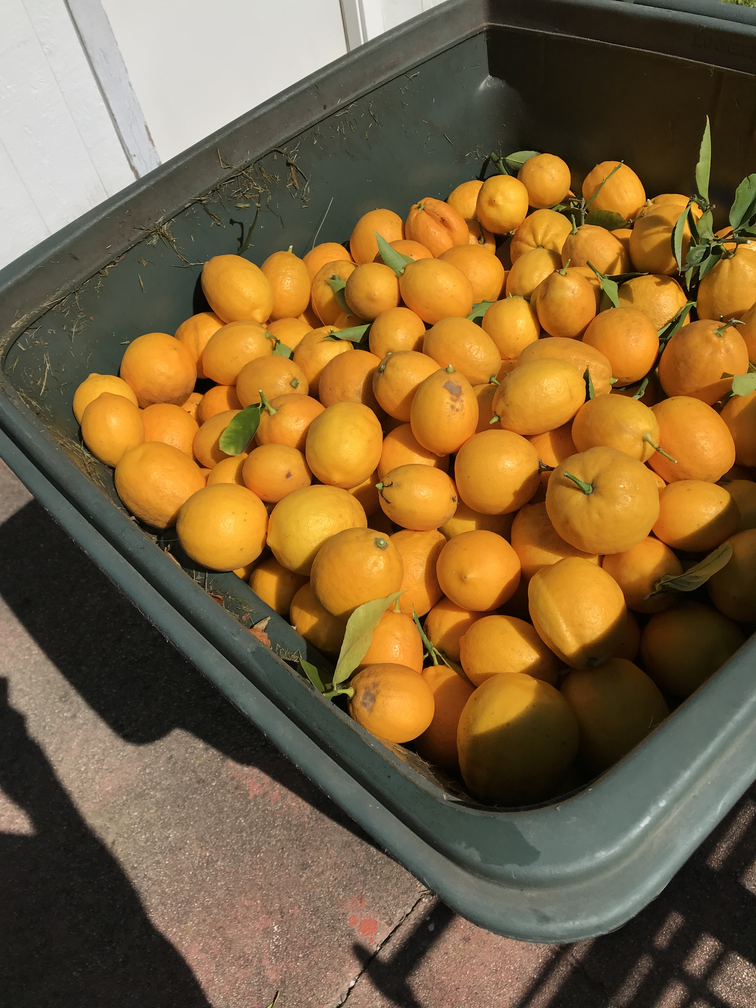
Meyer lemons from my backyard.

https://www.w6rz.net/lemons.png

reply
fritzo 2 days ago
Inheritance is astonishingly more complex than trees, e.g.

Wong et al. (2024) "A general and efficient representation of ancestral recombination graphs" https://doi.org/10.1093/genetics/iyae100

reply
jlauf 2 days ago
Interesting, going to read more!
reply
ok_dad 2 days ago
This is cool! I do wish I could search for a specific citrus by name.
reply
jlauf 2 days ago
Thanks! I'll add it when I get a chance.
reply
zeristor 16 hours ago
Thanks lovely piece of work.

I couldn't find Yuzu, I guess I could have looked at the source JSON file, worked out the co-ordinates that find it on the chart, if its there.

Yuzu seems to be having a bit of a moment, like pistachio nuts.

reply
poizan42 16 hours ago
According to wikipedia they are cultivated from a hybrid of mandarin orange and Ichang papeda, the latter being from another wild lineage than the three shown.
reply
zeristor 14 hours ago
Indeed, thanks.

This takes the citrus gram into 3D

https://en.wikipedia.org/wiki/Papeda_(citrus)

reply
poizan42 13 hours ago
You might need several more dimensions (assuming this quoted claim is correct - it does come with a Citation Needed)

> Recent genetic analysis shows the papedas to be distributed among distinct branches of the Citrus phylogenetic tree, and hence Swingle's proposed subgenus is polyphyletic and not a valid taxonomic grouping, but the term persists as a common name.

reply
zeristor 13 hours ago
Good point, as ever.

So what would be interesting is an interdimensional citrus fruit.

reply
antasvara 14 hours ago
From what I can tell, the papeda is included as a sort of addendum in the bottom right corner of the chart.
reply
smlacy 2 days ago
Seems to be missing the Etrog? https://en.wikipedia.org/wiki/Citrus_taxonomy#Citrons

Also, the "click to show search results" is cool but fails for "Arizona Citron" in obvious ways.

reply
jlauf 2 days ago
There are lots of citruses missing; the ones in the chart are only the ones I could find reliable values for (from the sources at the bottom). I'll add more if I can find other reliable sources. For what it's worth, I think the etrog is basically a pure citron variety.

Yeah, that's definitely an issue. If I get a chance, I'll curate images to add!

reply
vixen99 13 hours ago
Fascinating. Look forward to your update.
reply
jsmith99 20 hours ago
I assume the esrog is the primeval citron but I've noticed that Jewish tradition (which rejects the use of hybrid citrons) allows some surprisingly different citrons in practice, popularly associated with Israel, Morocco, Yemen, Corfu etc. These differ considerably in eg rind thickness.
reply
madcaptenor 2 days ago
Apparently it's also known as the Greek citron, but I don't see it under that name either.
reply
s0rce 2 days ago
I think the etrog is not a hybrid so it would overlap with the citron
reply
pazimzadeh 2 days ago
I couldn't find the Seville orange, or what Iranians call Narang

Nevermind, they have the "Sevillan Sour Orange" and a few other sour oranges

reply
Fordec 22 hours ago
Also appears to be missing Yuzu and Sudachi
reply
lameda 24 hours ago
This is very cool, thank you for building it! I remember reading about the mess of citrus genealogy in John McPhee's Oranges (wonderful book).
reply
hammock 2 days ago
Missing kumquats (and calamondins and mandarinquats)
reply
s0rce 2 days ago
they discuss that, they were not hybridized to the same extent. They do discuss the key lime ancestry as orthogonal, it would be cool to use a tetrahedron instead to show that.
reply
davidw 2 days ago
Now I wish I could try all of these.
reply
s0rce 2 days ago
There is an annual citrus festival in Riverside, CA where many hybrids are developed.
reply
wgrover 23 hours ago
Yes! And every day the California Citrus State Historic Park is open for tours and tasting of various citrus varieties:

https://www.californiacitruspark.com

reply
dheera 2 days ago
Just walk around San Jose residential neighborhoods, all the combinations are literally dropping everywhere.
reply
cwmoore 2 days ago
There was a great pomelo tree around the corner from me a few years back.
reply