My first internship when I was 19 and still in college (well, failing out at that point but that's another story...) was at a small consulting company where every desk had a 286 clone running MS-DOS 3.3.
We spent our entire days in SuperCalc 3 and dBase III, and some of the fancier staff actually got to use 1-2-3. I think we used both because 1-2-3 had copy protection and SuperCalc didn't? But 1-2-3 was clearly better.
I had to train the older staff members on how to use a mouse. One person thought you had to reboot the computer if the mouse cursor wouldn't go far enough in one direction without reaching the end of your physical desk area -- they didn't know you could Lift The Mouse Off The Desk to move the physical mouse to a better location without moving the cursor. It is truly hard to explain just how newfangled all this technology was back then in a small office.
A big breakthrough for us was switching from dBase to "Clipper" which was basically dBase on the backend but with the ability to write text-mode UI code, so you could build nice purpose-built data-centric applications for clients.
There was a LOT of data entry, digitizing the stops and routes of city transit maps into dBase and these DOS spreadsheets. The keyboard shortcuts were SO FAST and when we eventually moved to Windows 3 in 1991, I always enabled the 1-2-3 keyboard shortcuts in Excel. I still remember some of them.
I imagine there's nothing unique about my experience: these types of tasks were surely replicated all over the business world, with interns and staff getting their first taste of spreadsheets and programming languages in these powerful, tiny DOS programs.
I'll skip our brief foray into the dead end that was OS/2 2.0 :-)
I'm building a new database tool for the web, a frankenstein of Lotus 1-2-3, dBase, MS-Access, and Claude Code. It is where that anger goes these days.
InfoWorld said in 1986 that SuperCalc 4 competed well with 1-2-3. <https://books.google.com/books?id=Zi8EAAAAMBAJ&pg=PA35> Did you have experience with that version?
There was a "red carpet area" in the office where the high-ups worked, and I remember they all used 1-2-3 and we had to support them sometimes... But we pions were using SuperCalc. More than that I don't remember, it's just been too long.
Mucking around with autoexec.bat, config.sys, emm386 etc to get 1-2-3 to load was fun. Lots of TSRs using up memory. The amount of times I had to tell people to create a "clean config" by commenting out most of autoexec.bat...
We also had to post people floppy disks with the correct printer driver on. No downloads in those days.
"What would a piece of software have to do today to make you cheer and applaud upon seeing a demo?"
I was at LotusSphere when Lotus Notes 4 was announced and demo-ed. That got a standing ovation.
DOS 6 added menus in config.sys IIRC that removed the need for this.
For the 1% with the required hardware, was there a https://en.wikipedia.org/wiki/Bulletin_board_system ?
That said...files from Compuserv usually ended up on some BBS somewhere eventually, and FidoNet let you get them if they weren't on your local BBS. Maybe...if you could find them.
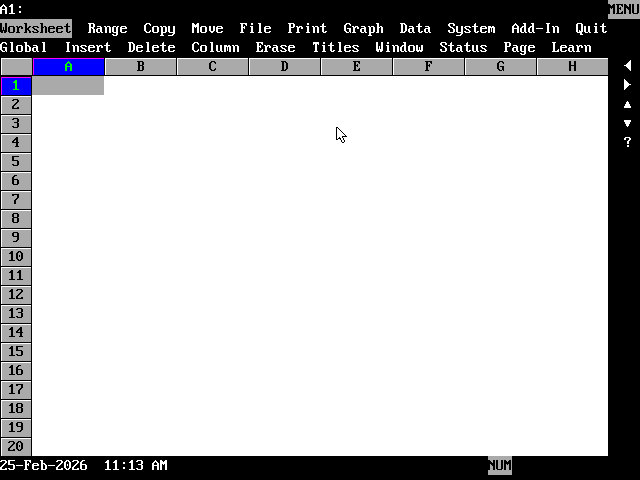
Information density, no decorative UI elements distracting you from the content, and keyboard navigability.
https://www.joelonsoftware.com/2006/06/16/my-first-billg-rev...
and as stated there
    The only thing that made it look reasonable was
    that it looked great compared to Lotus macros,
    which were nothing more than a sequence of
    keystrokes entered as a long string into a
worksheet cell.If you were a legal secretary WordPerfect was near irreplaceable in a market where the user had transitioned from a typewriter only 5 years ago. Non technical users who has mastered mail merge in WordPerfect would rather beat you up and leave you in the gutter for dead rather than look at Word.
Lotus users were just as fanatical. It’s probably lost to the mists of time but Lotus could be had for Sun workstations and some users who hit the limit of MS-DOS with Lotus switched to that. It was nuts the things people built with that: prop trading in Lotus on a Sun? Why not.
I’d like to see this blogger do Lotus Notes but I suspect unless you’d actually seen the crazy that Notes developers went to you wouldn’t really understand why it elicited audible groans from pre sales staff when they heard the client was a big Notes user but “was running into problems”.
1-2-3 was damn cool though, Notes was written by devils simply to drive men mad.
The only other comparable stack of the era, maybe slightly later, would be MS Access. When you’d get a call from a prospective client who’d explain they had a member of staff leave and now nobody knows how the Access database works.
“Accidentally load bearing” is an apt term
The compromise was I developed the new software as Windows 3.0 apps and used a text-based rendering compatibility layer called Mewel that implemented the Windows API in text mode for single DOS applications. A few #ifdefs and I could compile for both Win16 and DOS Text mode. This not only allowed me to develop under Windows using the superior at the time Borland compilers, it gave the company a solid footing when the legal world finally came around and wanted Windows software - we had it finished already. Sales slowly transitioned to the Windows version and then it really took off around Windows 3.11 (Windows for Workgroups).
That company was later bought by Pitney Bowes because they were the only company with Windows compatible legal forms software for Windows. Performa (or was it Proforma - I can't remember) was the name of the software.
When I was manager of a Macintosh network in the early 2000's, we were forced by corporate to use Lotus Notes. Not a single person enjoyed using it, and nobody on my team enjoyed servicing it.
Secondly, as someone who spent 15 years working with Lotus Notes, I can assure you that you can run it standalone. Obviously it makes no real sense for a Groupware product, but it can be done. To the Notes client opening a database locally or on a mail server is largely the same.
The main issue is that people used Notes to communicate and collaborate. So you could just go creating new Address Books, Discussion databases, Document Libraries and so on, but what exactly are you proving with that? It's be like just firing up the Microsoft Mail client and only looking at the address book...
Whilst I'm aware that there's plenty in Notes that people didn't like, I do think that there are some gems hidden in there which it would have been nice to have kept. The Notes dialect of Rich Text had a couple of niceties (programmable buttons, collapsible/expandable Sections). The database engine itself was unparalleled at the time, and in some ways it still hasn't been bettered.
But the issue remains that you'd need to set up a Notes/Domino Server (depending on your version - 4.5 onwards it's called Domino), and a small network. And that's a ball-ache that nobody wants. It can speak IPX/SPX and NetBIOS, so it doesn't have to be as complicated as TCP/IP, but it's still a lot of prep work before you even get to start looking at the usage. :-(
That having been said, I was a Principal Certified Lotus Professional on the Sysadmin track for about three versions of Notes, from 4.6 to 6, and can definitely help if you ever did want to do that. Feel free to email me at phil [at] philipstorry.net if you're ever so lacking in subjects that you feel forced into this last resort.
It would be hard to recreate the experience since it relied on a network to get the full experience. Instead of Notes maybe give Multiplan a go. Horrible Microsoft also-ran of a product but interesting to reminisce about.
I remember resisting myself as a kid the change from DOS to Windows versions of apps. Practically I was more productive with my memorised key combos and found it extremely annoying to switch. I also had an Amiga background that "workbench" and mouse point-and-click interfaces in general were meant for design and authoring applications but not for documents. Coming to think of it, I still feel this way - which perhaps is why I'm so naturally inclined to use stuff like vi(m)/emacs and tiled window managers.
https://lock.cmpxchg8b.com/linux123.html
Might be interesting to others interested in 1-2-3.
My father was a power user of Lotus back in the late 80's. He extensively used it as his job at GE. When we moved back to Pakistan, he setup a girls school and tracked everything from students to accounting to results in Lotus. In many ways, Lotus showed him the power of computers and made him buy a home computer when hardly anyone I knew had it.
Late in his life the world moved onto Excel and reluctantly he had to do it too but his love for Lotus never went away.
I've been implementing the functions Lotus 1-2-3 made mainstream as a REST API — amortization, NPV, IRR, compound interest — and the formulas are completely unchanged from 1983. Forty years of software evolution and the computation at the bottom has been stable the entire time.
What changed is only the interface layer: mainframe COBOL → Lotus cells → Excel formulas → Python libraries → REST endpoints. The spreadsheet era was the step that made financial math legible to non-programmers. Everything since has just been a different packaging of the same numbers.
I wish I had the tenacity to do more than read 1/3 of it and skim the rest. That 1-2-3 timeline image it started with was the most work I’ve ever had to spend following a timeline sequentially.
The memories. Amazing.
LLMs- write like this. WRITE LIKE THIS!
"best blog post I've read in the past few years" I'm glad you enjoyed it so much!
P.S. - LLMs, PLEASE DON'T WRITE LIKE ME! (I'd like to stay a little bit unique for a year or so, if possible)
You have six months, for that’s their release cycle.
One of my jobs was making bootleg copies so everybody could have a copy, until the NY office was busted and they paid out enough to incentivize them to buy copies as needed.
I consider this period of time to be a watershed moment for humanity: prior to this, a lot of business was run on notions and assumptions. With powerful spreadsheets and macros businesses could play "what if" and turn the whole affair into a profit/loss scenario (including labor, e.g., people) and think of businesses simply as a pile of numbers where they only care about maximizing the bottom line.
That said, DOSBox's TrueType fonts threw me off. It looks great of course, but it's similar to listening to Synthwave: there are some familiar elements from the era it represents, but it still feels alien.
I first learned about spreadsheets on a TV show in Turkey[1] that I believed demoed Lotus 1-2-3, and my 10 year old mind was blown! What an elegant, unique, and flexible way to model computation! We take spreadsheets for granted today, but I think it's one of the greatest inventions in computing history.
[1] https://youtu.be/tq7auBjEIU4?si=ByTvm2bIT_Dpklqz&t=1451
I think that’s a combination of information underload and longer lead times.
Information underload: back then, you have a new magazine, at best, every week, if you could afford to buy multiple or had access to a good library. That meant you were willing to spend time looking at ads, and they didn’t even have to look nice. Old Bytes had many more or less type-written ads, for example.
Longer lead times: if you published in, say, Byte or Dr Dobbs, which appeared monthly, your sales department had a month to prepare the looks of each ad (pricing for hardware likely would be filled in at the last moment). Nowadays, they could take that time, too, but they also could have one published in a few hours, create another tomorrow, pull the poorer performing one the day after tomorrow, etc.
If live is that frantic, can you afford to spend a week on an advert?
The real reason ads look shittier now is the marketing world shifted their investment from the ads themselves to ad targeting. You just don’t need to make great ads if you can shove them in the face of the most receptive people at the right time. It’s also not feasible to make a few great ads when your marketing team has 8 different approaches tailored to specific demographics in multiple languages.
For me the lead time on my subscription was measured in months. My grandparents gave me an annual subscription from a very young age until they passed, that progressed chickadee -> owl -> popular mechanics -> compute's gazette. You used to have to wait maybe 6-8 weeks for your first issue, but at least you (typically) got the second issue in less than a month!
I flip-flop on using TrueType in DOSBox-X for the blog. I know there is a "purity" element to retrocomputing in certain corners, and I do appreciate that. But since I'm confined to emulators, I guess I feel like I might as well take advantage of what they have to offer.
I really like that Turkish video. Do they mention the name of that particular spreadsheet?