This reminds me of another Unicode block with ancient origins: the 64 I Ching hexagrams (U+4DC0–U+4DFF). Unlike ⍼, their meaning has been documented for 4,000 years — yet they carry their own encoding surprise. Unicode actually follows the traditional King Wen sequence: U+4DC0 is ䷀ (Heaven, #1) and U+4DC1 is ䷁ (Earth, #2). Interestingly, this is different from the binary Fu Xi arrangement formalized by Shao Yong (邵雍, 1011–1077), where ䷁ (000000) comes first and ䷀ (111111) last — the very diagram that captivated Leibniz in 1703 as a mirror of binary arithmetic [1][2]. Two valid orderings, encoding two different philosophies of where to begin: with pure creation, or with pure potential.
By the way, DNA also produces exactly 64 codons (4³ = (2²)³ = 2⁶) — the same number. Some have even noted functional echoes: DNA has start and stop codons that initiate and terminate translation; the hexagrams have corresponding structural counterparts [3]. Probably coincidence. Probably.
[1] https://leibniz-bouvet.swarthmore.edu/letters/letter-j-18-ma... [2] https://leibniz-translations.com/binary [3] https://www.goodreads.com/book/show/78369.The_I_Ching_and_th...
I like HN, and I'm not a native speaker.
I do use LLMs to refine my wording, but I am not an LLM.
I dislike the character imparted to your words by the LLM, though. Knowing that it is artificial makes me feel it's more of a waste of time to read it. But I will try to ignore it.
In the case of the i-ching it's literally six bits of binary (expressed in yarrow stalks).
In genetic codons there's four symbols instead of two, and three places instead of six, so the effect is the same. (Does base 4 have a name?)
And yes, base 4 does have distinct names in this system — and they're all in Unicode (though HN may not render them):
Two digits give you the Four Symbols: Old Yang (U+268C ), Young Yang (U+268F ), Young Yin (U+268D ), and Old Yin (U+268E ). Add a third digit and you get the Eight Trigrams (U+2630–2637 ), a core symbol of Daoism. Double that to six digits and you arrive at the 64 hexagrams — the I Ching, the Book of Changes, which many Chinese have believed could be used to divine the future.
Actually, Taiji, Yin-Yang, and Daoism are deeply related. Dividing Taiji gives you Yin and Yang — humanity recognizing something out of nothing, order emerging from chaos, duality arising from the void. You learn what "good" is, then you know "not good"; we coined "LLM," and we also invented "not LLM." They always come in pairs — that's the fundamental rule. We're essentially dividing iteratively, building our culture and recognition by inventing new names, mappings, and combinations to carve distinctions from some "embedding space." And we humans, including LLMs, learn from those names.
So the progression is: Void/Chaos/Taiji/(Singularity?) → 2 (Yin / Yang ) → 4 (Four Symbols) → 8 (Trigrams) → 64 (Hexagrams). At its core, it's philosophical thinking — and personally, I believe there's great wisdom in it. For example, we should never be trapped by names and should always think beyond it.
(Shameless plug: I came to know about this about a year ago and still find it fascinating. I even built a site about all this — https://ichingdao.love)
Kind of. And as a guy with a solid science background, I just don't buy into that kind of interpretation.
But if it is numerology, I believe I CHING divination is more like a commit-and-reveal scheme — you can't infer the future from the proof alone. You might only get to verify it once the future actually plays out. Kind of like a zero-knowledge proof — it gives you a proof/advice based on a possible future, but you gain nothing from it since the underlying computation is NP-hard. So better to treat it as a kind of thinking framework — like SWOT or scenario planning, but from a different cultural tradition.
LLM spotted
And without that comment, we wouldn't have talked this much. LLM is the friend.
-- Paraphrased from The Restaurant at the End of the Universe by Douglas Adams
Every once in a while you run into something like this and realize the standard is not just for text encoding but also a kind of archive of specialized notation from different fields.
It makes you wonder how many other symbols are sitting in the table that are still mostly unknown outside the niche communities that originally needed them.
Unicode's entire point being to make "normal software" handle those symbols ;)
For years Ł support on Python on windows for example broke sometimes when imported from poor quality Excel files haha
> From that apparent beginning, the Angzarr was swept up into the Monotype typeset catalog of arrow characters (...) It is unknown why Monotype added the character, or what purpose it was intended to serve
> In 1988, the International Organization for Standardization added the symbol to its Standard Generalized Markup Language (SGML) definition, apparently pulling it from the Monotype character set.
> In March 2000, the Angzarr symbol reached wide distribution when the Unicode Technical Committee, in collaboration with the STIX project, proposed adding it to ISO/IEC 10646, the ISO standard with which the Unicode Standard is synchronised. The Angzarr was proposed in the ISO working-group document Proposal for Encoding Additional Mathematical Symbols, although no specific purpose is listed for the symbol.
My guess is that the people proposing the addition of new maths symbols[1] weren't going to decide on inclusion or exclusion of a symbol on the basis of being familiar with it themselves or not, since that was likely true for many symbols that happened to only be used in fields of mathematics that they were not working in. Meaning they had to rely on some other kind of "authority" to infer that a symbol was used by the larger maths community. With that in mind "being part of the Monotype catalog and part of SGML" seems like a pretty sensible heuristic to go by.
Another consideration might have been that they simply wished to have complete coverage of the symbols that SGML encoded, regardless of familiarity with the symbols involved. And of course both could have been true.
Maybe this is the opportunity to invent and suggest a symbol for Altitude?
Consider the Moon as viewed from NYC at time of comment [0], it is hiding below the horizon. If you were to look at my website and then at the sky you might become upset that I am reporting the shape of the moon, but obviously it can't be seen. Hence why the website reports the angle below the horizon roughly half the time it isn't visible.
Adding Azimuth and Elevation when the Moon is above the horizon would be for completionism only and not the real enterprise use-cases served by ANSI compliant renderings of the Moon.
[0] https://aleyan.com/projects/ascii-side-of-the-moon/?lat=40.7...
Ah, of course :)
A lot of old German sailor maps (e.g. from the Hamburg or Bremen maritime museum exhibitions) contain Azimutal angle descriptions. The globe on an azimutal map is projected from the North Star in the center.
This way you could more easily calculate the angles you would need to use the Sextant (which was focused on the brightest star, the North star). They also used circles (the tool) to calculate relative speeds, current drift etc with it.
I thought this was kind of common knowledge, as a lot of museums have that sorta thing for children in their exhibitions to try out.
The article quotes the Didot system, specifically, which focused on printing travel maps and is known not only in the French speaking world for its timely accuracy [1] as it was also using that very same map system.
Maybe read the article next time?
[1] https://en.wikipedia.org/wiki/Didot_family
[2] https://fr.wikipedia.org/wiki/Histoire_g%C3%A9n%C3%A9rale_de...
Yeah but did any of the four previous articles say anything about it?
Neither the wikipedia page for the Didot family, nor for Histoire générale des voyages shows the Angzarr symbol, I've carefully checked on all the scans on these pages. In fact, any occurrence of the symbol would pre-date the current earliest known example (1963) by 200 years, and that would be a great find. If you have an actual reference, please let us know!
"Haussystem Didot", the title of the catalog, refers to a letter setting by the printing agency Didot, which is the one I linked on wikipedia.
The Gallica scans are linked in the wikipedia article. Each of those chapters has hundreds of pages.
I highly doubt that you eye scanned thousands of pages in French handwritten and mixed typesetted ... within less than a day. You definitely must be lying, they take months to read.
[1] https://ionathan.ch/assets/images/angzarr/Berthold%201900.jp...
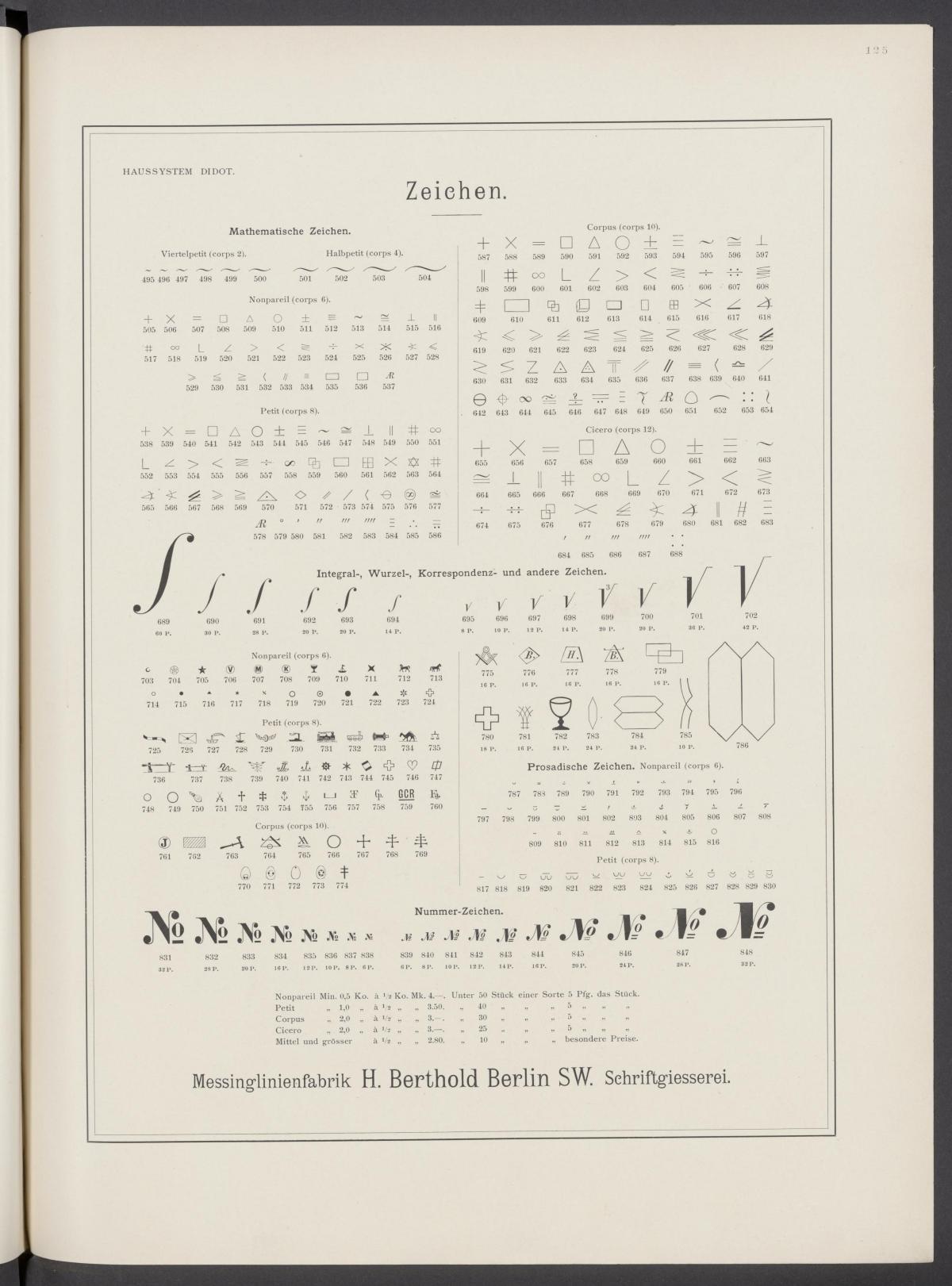
I went through a bit of it and saw no instance of the symbol. If it's in there, would you mind saying which chapter and which page? Or some hint about what context people could find it in? The maps I saw (maps were pretty easy to find, too, since most of the page numbers for them are "NP") didn't seem to use this symbol.
> Neither the wikipedia page for the Didot family, nor for Histoire générale des voyages shows the Angzarr symbol, I've carefully checked on all the scans on these pages.
You have linked these two Wikipedia pages[1][2], implying that they confirm your extraordinary claims of how obvious and well-known this symbol is. I could in fact check within a single day that the symbol does not appear on any of the 15 images linked in these pages.
So unless you can produce evidence for your claim that "that symbol was used as a notation symbol in those star charts and azimutal maps?", it is quite disingenuous to expect anyone to take it seriously. Expecting someone else to read "thousands of pages" to confirm or deny YOUR claim makes it even less worthy of consideration.
If you do have actual, material evidence for your claims, everyone in this thread would very much like to see it.
[1] https://en.wikipedia.org/wiki/Didot_family [2] https://fr.wikipedia.org/wiki/Histoire_g%C3%A9n%C3%A9rale_de...
You may be too young to remember, but there was a time when a lot of software had their own way to encode emoji if they supported them. This sucked for interoperability - especially when using common protocols like SMS.
Some of these implementations were essentially find/replace and would turn various strings of characters commonly occurring in code into emoji. Someone reading your mail containing code on their portable device or other weird client would see parts of that code replaced by emoji. Maybe you had to format your code a certain way, inserting spaces tactically, to avoid accidentally ending up with an emoji. I'm glad we put that behind us for the most part.
Living in a world where you can just copy-paste some text containing emoji (or not) from one software into another is honestly great. Same for all these other symbols that may be embedded into text.
If a software has to come up with their own text-embeddable encodings to represent symbols (to allow for copy-paste or sharing) things often end up less than optimal.
Emojis obviously got in from Japanese character encodings, and imho the world is off better for that. Though many of the extensions of the emoji set really don't seem to get what emojis are used for. Similarly, chess and shogi pieces as well as symbols from Western playing cards go in through previous encodings, and domino tiles got accepted based on being conceptually similar. A bit questionable imho.
On the other hand the Azimuth sign seems to satifsy the "would appear in OCR scans", based on being published in font catalogues. Even if nobody has come forward with a book it appears in, I don't think they made and advertised lead type characters for fun. It has to have had some use in printed publications of some type (probably scientific, from the surrounding context)
A sextant can be used to obtain the relative horizontal angle between two landmarks, but it is much easier to use an azimuth ring. A sextant is designed to be used vertically. Holding and using one horizontally is difficult and time-consuming in comparison and is probably a less than a 1% use case, used only during the training of apprentices as a theoretical exercise (source: professional mariner for many years and daily user of a sextant back in the day). A comparison would be using a screwdriver to drive in a nail; you could do it given enough time, but a hammer is much easier.
I believe the explanation is much simpler: the glyph simply represents a variety of angles measured from north (the common meaning of azimuth) avoiding the use of any lettering (like “N”) or the use of a compass-like symbol which would be difficult to represent at such small scale.
Also (pedant warning for another poster) Polaris is not the brightest star, it’s around the 40th and has no practical use for navigation other than “north is roughly that way”.
You can see one here: https://sextantbook.com/2019/01/13/a-french-hydrographic-sex...
The linked article is by W.J. Morris, and his book on sextants is in my opinion one of the standard works and much recommended.
The way I see it, it appears to be an arrow curling around the vertical axis, representing the turn from the angle's start to the angle's end. In that sense, the modern curvy arrow actually makes more sense than the original jagged one (which maybe was easier to typeset - or maybe just disproves my theory).
https://de.wikipedia.org/wiki/Richtungswinkel
https://de.wikipedia.org/wiki/Azimut
"Haussystem Didot" in the article's referenced typesetting catalog refers to the typesetting of the Didot family's printing agency. And they used that symbol 1700 and onwards in their map navigation descriptions in these books:
https://fr.wikipedia.org/wiki/Histoire_g%C3%A9n%C3%A9rale_de...
I am gonna repeat myself, but search for the Gallica links in each of those books to find the scans. There you can see earlier usage and evidence that as I pointed out in other - downvoted comments - that this was commonly used for sextant navigation instructions.
I did not find any evidence for earlier examples in any of the very few scans I looked at, nor does a search through the Google Books scans give any indication for words that seem related to the concept.
This would be such a fantastic find! Could you point out a specific example?