The board is riveted in, but there are enough screws to hold the replacement in place. Removing the board is a shockingly violent process, but it worked for me.
Keyboard: https://www.amazon.com/dp/B0CQBVMM3X (price has gone up).
Video of rivets breaking: https://i.tonybox.net/9f2083b218d5.mp4 (you can see I missed a screw and slightly cut my hand here too).
After a nasty gash from a washing machine, which impacted my typing for a week, I got a pair of these:
https://www.amazon.com/Mechanix-Wear-Utility-Gloves-Large/dp... $14, may save a doctor visit
I use them when working with sheet metal. They are high-dexterity. Thin and flexible. Steel threads are woven into the fabric. McMaster has a variety of high dexterity gloves - fingerless, insulating, cut-resistant.
or do you mean integrating it into a different laptop a la framework? that could be cool, but would also have to think how much the chassey stiffness/specific construction contributes to the feel
p.s. has anybody here tried (the external) magic trackpad? the macbook trackpad is infuriatingly good
This video is a good overview: https://www.youtube.com/watch?v=pGmMpEEP5ls
Broke my keyboard, a few days later i had a new one that didnt even take a minute to swap. Wanted to upgrade my GPU twice, didnt even take 10 minutes. Biggest difficulty was swapping the motherboard, but even that was easy.
The ports i need change all the time, and i can just swap them all the time :D
While a framework might be a bit expensive, overpriced even, i think the repairability and upgradeability is worth it for me
Sure you can replace the keyboard on a Framework fairly easily but I'd bet MacBook users run into the need for it less (comparing modern models; we all know the butterfly keyboard era was a dark age for MacBooks)
My first GPU had an issue where the fans had a really annoying whirring sound and it got replaced.
I had a (pre-)release motherboard (one of the last FW16 pre-order batches) which had an issue with uneven heat on the CPU, also got replaced.
In both cases i could just use the Laptop like normal until the new parts arrived so i had no "downtime"
This really sums up the reason I stuck with MacBook hardware even during the dark days of the end of the Intel era: I can have a new MacBook in basically any moderately developed city in the world inside an hour, and in fact did so twice when something catastrophic happened on work trips. Waiting a few days to fix something or get some custom-order-only laptop would not have been an option.
So for me fixing a keyboard i spilled cola on fast, cheap and without sending the device away is far far far more important than replacing an entire laptop when it disintegrates into dust.
"Write on paper" when you're on a consulting site for a client is not an option - much less when you bill by the hour.
I've actually had the situation where someone spilled a drink in my Mac and I was due to give a conference talk three hours later - that was actually recoverable because I could buy a new laptop with approximately the same configuration immediately, and didn't ruin the week.
I have indeed had my laptop repaired very quickly in the UK though (I still order them with British keyboards as 30 years of muscle memory does not go away). The Apple Store in Bath just took care of it.
Not that repairability isn’t great, but in 16 years of Apple devices my only needed repair was their atrocious butterfly-style keyboard, and Apple footed the bill thanks to the Class Action Lawsuit.
We merely have to wait on Apple to continue debasing its OS, and then many other options will look preferable. Or perhaps Linux on Apple Silicon will eventually become stable.
It's worth mentioning that the Neo finally does away with the pairing of topcase and keyboard that has been present ever since the launch of the plastic and unibody macbooks! Probably to comply with upcoming EU regulations.
However, it's not planned obsolescence either. It's just math. Building things to be repairable costs more money and time. There is very little incentive to do so, because most customers simply do not care. Thus, Apple does not bother. Nothing conspiratorial about it.
Most people do the following:
* Take it to Apple * Apple says it will cost $X * Customer says 'yes' and gets it repaired OR customer says 'no' (and proceeds to buy a new one)
That's what the vast, vast, vast majority of customers do.
Also, this might be the case in rich places like silicon valley or the US in general. But most of my friends would come to either me or the less official repair shops when Apple gives them such an outrageous quote. Because most of my friends don't just have $700 for an unexpected incident just lying around. That's a lot of money.
I agree most people don't care about self repair but the majority would care about cost of repair, and the ability to go to unofficial places for cheaper options.
I mean I still get friends coming to me with early 2010s hardware and asking if I can speed it up. Sometimes I install some old memory I had lying around or an old SSD to replace its spinning drive. These things help a lot.
As others have already alluded to, drills and self-tapping screws exist, as do replacement keyboards without the top case.
In many other machines, it is common for the factory to use rivets on initial assembly, but to service you drill them out and replace with bolts or screws. This is the expected procedure and even described in the service manual. I actually did this a few weeks ago for an old fan.
I'm advocating for right to repair as anyone else, and not fond of Apple's decisions in general, but this seems like a tempest in a teapot.
That's surprising. I haven't had many brands of laptops, but I haven't seen rivets where screws should be. Not talking about Macs here.
You can basically buy 2 Macbook Airs for the same price as Framework 13 and keep one in the draw if you are ever scared that one breaks. That's how bad of a deal Framework is or how much of a value Macbooks are.
Try configuring a Framework yourself and you'll quickly find that even the basic configuration goes over $1400. Any upgrade on the CPU and you're already at $1770.[0]
You can usually get an M4 Macbook Air 16GB for $750 - $800 on sale. So you can get 2 of them for the same price as one Framework 13 and still significantly outperform it.
Framework is an idealogical buy. It just isn't worth it otherwise.
[0]https://frame.work/products/laptop13-diy-amd-ai300/configura...
You are comparing dissimilar things, anyway. On a recent Macbook, you are hard stuck with MacOS. If you don't want MacOS (or ARM for that matter), Macbooks could be free and it's still the worse deal. Macbooks are subsidized by pushing you into the increasingly locked-down software/hardware ecosystem, where Apple is rent seeking. Paying for a firewall, or virtualization environment is mostly unheard of in the Linux world. It's like a cheap printer, where the real cost is DRM protected ink.
On a Framework you have excellent support for both Windows and Linux. You are free to do whatever you want.
The recent base Framework 13 would cost you $1,170, Ryzen AI 5 340, with 16GB RAM, 512GB SSD and 4 full featured (USB4) USB-C ports.
You can buy RAM and SSD for many other much cheaper Windows laptops too. I don't see why anyone should buy significantly overpriced Framework laptops.
You are comparing dissimilar things, anyway. On a recent Macbook, you are hard stuck with MacOS.
You can argue about how Framework is better here and there but in reality, Framework only makes sense for 0.001% of laptop buyers, maybe less.
> macOS is excellent
> If you're a dev, macOS is also generally superior to Linux since dev tools often come out on macOS before Linux.
Lol. Sure, buddy.
Lol. Sure, buddy.
I got a framework 16 with a handful of upgrades for $1400. I added 96GB of RAM purchased separately for $300 (before the shortage). I also got a 4TB NVMe for $300. What do those upgrades cost cost in a macbook?
I think most people care more about their OS than their hardware specs, so they defend their purchase like it's part of their identity and it's hard to have a rational discussion.
Edit: If you're talking about the Intel model, I agree with you. The Ryzens are fantastic.
But if you're talking about slow RAM, you're right. Apple doesn't sell slow RAM on their laptops.
It might still be worth it for those who hugely value open source and repairability but as for value I think its save to say that Apple is currently in a league of their own. Even if the altest os update is a flop.
Also, the Macbook has improved repairability. While its still not great its better than a few years ago.
Is it though? I'd agree the hardware is less capable but if your Macbook anything is really just one 'top case' repair away from being more expensive. RAM failure is 'motherboard replace', the display? it is similarly expensive to replace.
So I would agree that it is more expensive to purchase a Framework laptop than a Macbook laptop, but also feel it is more expensive to own a Macbook laptop than a Framework laptop. Also I just replaced the screen on my FW13 not because it was broken but because they have one with 4x the pixels on it now. That's not something I could have done with the Macbook.
If'd rather not take a low risk of a big repair/replacement bill and you don't mind helping Big Fruit make a bit more of a profit, you can pay them $50-150/year (depending on model) to take that risk. Multiply that by the number of years you expect to own the device to come up with a "real" cost including repairs/replacements.
It's not just repairs, to upgrade a Mac you have to throw away all that perfectly working hardware just to get a new mainboard.
Or you can spend 50 euros more and get an entire new laptop that is not only much more powerful than your old framework but is almost as repairable: the neo.
At some point your argument begins to work against you, you should just have talked about the keyword repair being cheap. Not how you can get a new motherboard for "only" 530 euros.
You forget to mention - less powerful than his old FW 13 with new mainboard/CPU.
Macbook Neo 31% faster ST speed and a bit slower on the MT.[1]
I wouldn't call the Neo less powerful than his 530 euros upgrade. In fact, I'd much rather have the faster ST speed in this kind of laptop. Most of the apps you're running with this class of laptops will be ST bound anyway.
You can literally get a brand new Macbook Neo using Apple EDU pricing for the price of a slower AMD motherboard upgrade. This is why Framework is an absolutely terrible deal overall. I'm not even convinced that Framework is better for the environment since Apple laptops last extremely long and will very often have second and third hand buyers.
[0]https://frame.work/nl/en/products/mainboard-amd-ai300?v=FRAN...
[1]https://browser.geekbench.com/v6/cpu/compare/17360869?baseli...
and
> ... you can pay them $50-150/year (depending on model) to take that risk.
These things are related, Apple knows what the failure rate in the field for their hardware is, and they "price in" that failure rate into their AppleCare costs. On my iPad pro, that's $90/year.
That said, it is entirely a 'bet' on your part as to whether or not you're in a position to cover costs of repair/replacement in the event of damage. That depends on a lots of factors and includes how much you can tolerate not having the equipment for a while, Etc.
That was my goal buying a Framework… to get to refresh hardware regularly as better stuff came out rather than waiting 10 years to buy a new laptop.
Will it work that way in reality? No idea, but I thought it was at least interesting enough to take a gamble.
I can drop it down to 1050E without the ram if i take ram from my older laptop.
Upgrading or fixing this is very easy. RAM/SSD i can take with me over multiple generations of a laptop.
I can't do that on a macbook, if anything breaks there (screen, ssd, ram, keyboard, battery bulging...) I might as well buy another.
Then there's the issue of macos... you're stuck with it, if you don't like it, it's a dealbreaker.
There's also issue of waste... I can make a router/firewall from an old framework mobo. I can't do that with a macbook.
Normal users don't profit from anything you listed. They do have to buy a notebook with all components, and thus currently have to pay more for linux/windows hardware compared to Apple.
Also, RAM isn't backwards compatiple. Literally had this problem with my old ddr4 not fitting in the newer ddr5 slots when my ddr5 acted up.
They can get their technical friends to set up a laptop for them and profit from what I mentioned.
> They do have to buy a notebook with all components
Sure, first time they do that, then they can reuse.
> and thus currently have to pay more for linux/windows hardware compared to Apple.
Sure, first time they do that. If they try framework, there are plenty of other cheaper options with pretty good specs.
> Also, RAM isn't backwards compatiple. Literally had this problem with my old ddr4 not fitting in the newer ddr5 slots when my ddr5 acted up.
Of course... but once you have something with ddr5 it should last you a long time, same as DDR4 did.
Now... you missed another point, some people just don't like or want MacOS, as nice as hardware might be, it's not acceptable software wise.
As for normal people, they'll just buy whatever is cheapest. If they even bother since phones/tables have already taken over.
I'm not sure laptops will have a market other then power users going forward...
I don't value open source or repairability that much. I just want to develop server software, and on macOS I always end up with the same janky VM-based workflow I suffer through on Windows. On the desktop I have no reason to waste my time with macOS, and I don't use a laptop often enough to justify reincorporating macOS into my life.
I had this problem in my Framework. I fixed it by... holding the laptop upside down and mashing the offending key for several minutes. Didn't work immediately, but now you wouldn't tell that it was ever broken. I've managed to panic-order (~€80) another keyboard though, so now I have a spare.
For context a laptop keyboard is build like this:
https://www.iqsdirectory.com/articles/membrane-switch/membra...
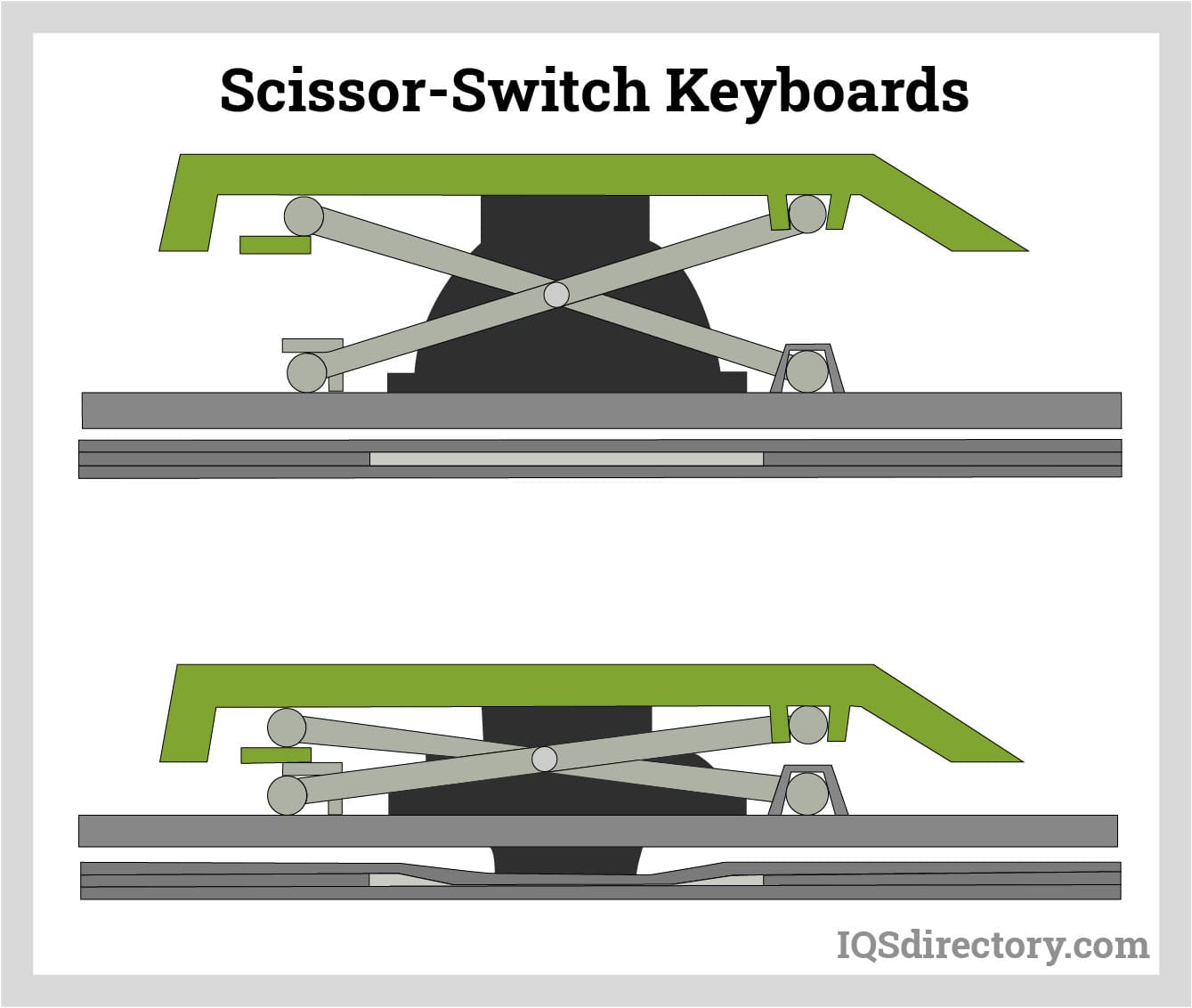
This problem is caused by the layers sticking together. In the case of the Framework 16 the "d" key sits on top of a foam pad which in turn is placed on top of a heat pipe, so this area gets particularly hot under load. The layers are often made from PET, which starts softening anywhere in the range of 65-87C - so easily within range of a laptop heat pipe.
By mashing the key I was hoping to detach the layers and apparently it worked.
That being said for gaming I use an external keyboard now, because the one built-in is made by an external supplier and I don't think they'll start using a more heat-resistant material anytime soon.
I got to experience Apple's customer hostile practices.
Many years ago l decided never to buy an Apple product again.
The future is now, old man.
A quick search shows that it's ~$500-$600 to fix the screen if it does break; I didn't bother looking up the keyboard but I'd assume it's much, much less.
So basically, on the off chance that your MacBook does shit the bed in the most expensive way, you save ~$150 or so? But in the almost-certain case that your Macbook is fine, you're down $450?
That is not a great deal at all, haha!
_The_ point of that the article you're commenting on, is that a keyboard replacement on a MacBook is very expensive. Why would you make that assumption?
The "most expensive way" to shit the bed is also not the peripherals of the computer dying, it's the logic board giving up the ghost.
Have done riveted keyboards on non-Mac machines before and would be surprised if an independent shop charged more than about $150 USD for it. It's not that hard to do.
You're right about the logic board being an extremely expensive fix, but it's also significantly less common than something like a keyboard, USB port, speaker or screen.
This is also something extremely Australian-specific, but consumer guarantees would probably cover any logic board damage within the first 1-3 years anyway, regardless of AppleCare warranty.
For accessories I don’t see the point, those are effectively disposable wear items.
Ironically a large part of deciding to migrate to an iPhone from android was final frustrations with even Google purchased devices under warranty coupled with hardware quality requiring repairs. My wife’s experience with AppleCare won me over.
If nothing else it’s first party insurance. I will never purchase device insurance offered via a third party ever again. Either its first party so I’m dealing with the place I bought it or nothing at all.
Unless for some reason you know you will be breaking your device much more than the average person.
Insurance is for things that are unlikely to ever happen but would financially ruin you if they did.
My laptop I'm on the fence about. It's a $3,000 machine that isn't especially robust if dropped, but I haven't broken one in a decade or two. Probably won't pick it up on the next one I buy. The unrepairability of modern Macbooks is what got me to buy it in the first place though. An old Thinkpad I could self-insure for quite cheap because I had the ability to replace any component failure myself. Not so true on the Macbook. I also see it as travel insurance - I can walk into any Apple store in a major city and in theory get a replacement device on the spot. Of course that theory has yet to be strongly tested.
"Peace of mind" is not free.
Paying ~ten bucks a month to insure my phone and not have to worry about it getting damaged is worth it to me, even if I could afford to replace it if I broke it; because now I just _don't worry about it_.
If you say you worry about the cost, shouldn't you worry even more about the higher cost of the insurance? Sure, for one item the variance is higher if you are uninsured, but if you have several such items, variance goes down, and you are saving all the more money.
I literally toss my phone to my couch or my bed from across the room dozens of times a week without worrying about misjudging the throw (which happens more than I’d like to admit), toss is on the ground at the gym, have no problems taking long baths with it, washing it under the sink if it gets dirty, and do dozens of things I would not do if I had to pay a full price if I ended up actually breaking it.
Having AC+, lets me treat the device with the level of carelessness that is worth the price to me.
Math-wise with how durable recent flagship devices are, you are probably correct that I’d be better off financially to just accept that I will break a phone every couple of years and just eat the cost.
But psychologically, I’m happier paying ~120bucks a year, than $500 in repair fees once in a while.
You are right that it might still feel better to you to pay regularly instead. That's subjective.
Knowing that you will likely end up paying less in the long term if you don't pay the insurance might help getting over that feeling, but that's a personal choice in the end.
AC+ includes what they call "Express Replacement Service", where you will send you an entirely new device as part of your claim, and they'll reuse your old one for parts.
If you _just happen_ to accidentally fall with your phone in hand right after the new ones come out, the delta in price between "a scuffed up, used 1-year old phone" and "brand new refurbished device from Apple" is higher than the price of the insurance and incidental damage fees.
Not sure about Applecare but Lenovo has support packages where if your thinkpad breaks they'll send a technician over to your place to fix it within 24 hours. That's definitely worth it for a work device IMO.
Unfortunately, AFAICT, these repairability issues are largely due to the move to thinner and lighter laptops. Replacing my MILs Microsoft Surface tablet was a pain in the butt. Had to cut the case open and tape it back together. But that thing was insanely small and light. My MIL liked it because she has a lot of trouble carrying anything very heavy.
> Here’s hoping governments regulate laptop manufacturers to actually make repairable machines in the future.
So there is already a solution on the market but for some reason the immediate desire is for the government to get involved and start regulating laptop keyboards?
Great idea! Though I'd suggest to use RightCmd instead of Capslock, it's more ergonomic - you use your right hand just like before.
(and yes, it's both insane that the hardware is not repairable and that the OS software sucks so you have to use some other apps)
I sent it back for repair to the manufacturer, they gave me an "estimate" that it wouldn't be repairable, and generously offered a replacement with a refurbished one, at $10 off the price of new (plus shipping, of course). I declined the "repair" and asked for the camera back.
When it arrived, the stickers I had put around made it clear it hadn't even been open. Having seen enough Louis Rossmann, I brought it to a camera shop around which is doing microsoldering. They replaced a single capacitor (after making me sign papers that it would probably never work again, and charging me quite a bit - still better than wasting an otherwise perfectly functional camera). The unrepairable camera was repaired.
It is so disappointing and unsurprising that a manufacturer wouldn't put even remotely any effort into actual repairs, that a street shop with actual expertise will happily do. I've come to expect no expertise from any service department I communicate with. Sending something for repair is almost a sure way that it will be broken even further. When even replacing the top case in the example of that mac seems overkill, when they could probably replace the faulty key with skill and will.
I guess that's a matter of incentives, given that in mass market, repairability is not something people look into when shopping.
Turns out it was a fatal irreparable failure. A capacitor overheated and left a small crater on the surface. Because I took it to the shop, the warranty sticker was void. Had to buy a whole new GPU :(
Unfortunately a Macbook is a hard requirement for travel simply because of battery life, at my desk I use my Windows gaming rig for work.
https://de.ifixit.com/News/115827/new-thinkpads-score-perfec...
Any purchase is a gamble, macs are one of those gambles that seems more risky with its difficulty to repair, however I guess the expectation is that it's less likely to need it.
I too looked at Framework and like the idea, unfortunately in my case the supply chain was too slow to be tolerable, before even considering the price-performance ratio.
I strongly support the idea that the EU should force vendors to make consumer device repairs cost-effective and available or open source and expose their component interfaces in exchange for the right to sell in Europe. After all, the EU brought us USB-C, so we know regulatory pressure works. Thanks, EU!
That’s all it took with my Framework laptop, and I’m very grateful for it. I was in a good place financially when I got it, but now I’m not. I feel a strong sense of relief that if an accident occurs and I need a repair, it won’t set me back too much.
IMO, Apple hardware was never the company's strong point. And they refused to supply individual replacement parts.
https://www.ifixit.com/products/macbook-pro-14-a2442-a2779-a...
> The aluminum upper case and installation screws are not included.
I would assume you likely need those too, as the article also mentions.
Maintainability is actually not a mandatory standard, but a design trade-off; the biggest problem with the MacBook is not this, but rather that Apple does not allow other means of repairing the MacBook, such as various certification chips, etc.;
I have an ASUS Zephyrus G15 (2021), GA503QM. I’ve been using it extremely heavily for five years. After about three years the left arrow key gradually stopped working. I adapted. Some keys have become a little less reliable, too, most notably E, and it’s nowhere near as crisp as it was when new. But it’s still a decent keyboard, which definitely wasn’t the case for two of my three previous laptops after even three years.
Anyway, a couple of weeks ago I tried getting a replacement keyboard on Amazon, not clearly identified as inauthentic (looks identical to the original; perhaps you should guess it, as a brand name is attached, WeFly in this case; but I know some of these things do claim to be genuine parts despite that). Worst new keyboard I have ever even heard of, barring those dumb roll-up keyboards. F2 a little sticky, have to press it straight. F and J requiring firm pressing to activate. Space not activating at the ends. And maybe worst of all, 2KRO (the original is NKRO!), with horrific ghosting. When you touch-type, you frequently have three keys active at once. Typing “you” would get a bonus F11 activation around half the time. “he ” a bonus N activation. Mashing the keyboard put the laptop to sleep, which doesn’t even make sense, and badly messed up key pressed state (though that’s possibly a software problem). Some combinations activated keys which don’t even exist, like Numpad 0.
With difficulty I was able to return it and get my money back. (I also got a refund on a counterfeit battery purchased at the same time—branded Wistar but unquestionably labelled as a genuine ASUS part, it was labelled in depth as 90Wh, but reported a design capacity of 74Wh and behaved so. Not sure if you can even find that information under Windows—maybe in Device Manager? So alas, for now I’m back on my original battery which is down to 51Wh capacity.) I wrote detailed one- and two-star reviews on Amazon, which were approved, and then deleted (one same day, one after a few days) for no apparent reason.
I’m trying to talk to ASUS to see if I can get a first-party replacement, but they don’t sell them independently at least, and can’t tell me a price, so I have to try talking to the local service centre. Hopefully it’ll be possible and not too expensive. Definitely not going to try third-party again for the keyboard, though maybe for the battery I’ll try one clearly marked as third-party.
Since reinstalling the original keyboard last week, a few days ago both Control keys stopped working, and the right tweeter (which gradually died a year or two ago) has started producing white noise when powered up. I should try reseating cables and such. It’s definitely fairly invasive surgery to replace the keyboard. The keyboard, incidentally, is fastened to the case by about 70 tiny screws (mine had 71 holes but only 69 screws). For now, I mapped Right Shift to Right Control, and have since been discovering that I used Right Shift more often than I realised!
Also, don't buy asus again. If you are looking for repairable laptops, dell, hp and lenovo are the only decent brands when it comes to repairs & parts (make sure the not to buy the cheapest consumer models).
If your laptop can be powered by USB-C, even better. If the battery system doesn't have usb-c output, buy a GaN charger (mine is a 140W GaN charger and its amazing). They are super efficient and don't generate much heat.
Fixed-installs (or grid tie-in) requires electricians and sometimes rewiring some parts of your home's circuitry. Huge operation if done right but generally not needed if you only have one or two panels and a portable battery system.
There are very good benchmarks on youtube with the portable solar + battery setups.
Please let me know why this specific comment was down voted.
Case in point: I don't put a lot of stress on my laptop keyboards.
you need to visit the confessional for that
No charge. I was pretty grateful!
(first video I found on a search)
https://www.youtube.com/shorts/WYT7YIh00Xk
I know in the Butterfly days those keys would break when you removed them.
This is such a good idea that it makes other peoples machines nearly useless for you
All credit to https://tonsky.me/blog/cursor-keys/
If Apple is the BMW here, what is Framework? It's definitely not a Toyota.
Fought with them for weeks. Escalated. They lied and said they were doing a no cost replacement. Had to fight the charge. Then they lost my return.
So much so that I’ve started switching to Linux and de-googled phone. (Switching off of iPhone just to go to google seems like the greater of evils)
The non Apple ecosystem is much more mature than last I checked but still irritating. De googling was my biggest challenge. Getting a viable replacement for Mac OS was the easy part.
And what do you mean they lost your return? Like it got delivered and then it was lost? Surely they gave you a working unit at that point?
I've had a bunch of experiences with Apple repair and always always been fast and great. I mean, they're definitely the best service of literally any corporation I've dealt with, by far. Sometimes you get unlucky I guess with a particular rep or something hard to reproduce, but it sounds like you got extremely unlucky? It definitely isn't representative in my experience, not even close.
unfortunately, the karabiner workaround will work for a little while, but the rest of the keys will start failing until it's impossible to remap the keys :/
My previous MacBook Pro keyboard was a butterfly keyboard and also broke, but got replaced for free. I don’t feel I am a heavy user as the MacBook Pro is mostly connected to an external keyboard and am pretty annoyed by apples keyboard quality (based on my sample size of 2).
I still just ordered a MacMini M4 (I know the M5 is coming but we've got something like 20 computers at home, including servers, NUCs, laptops, desktop, etc. so I may not mind buying a M5).
Still... Apple, from the bottom of my heart: FUCK YOU.
Otherwise fuck apple I'm not paying 700+ to fix a key.
Overpriced COTS garbage.
if you thing government regulation will help you you are lying to yourself that's not how the world works
went to ebay bought the key, replaced it with tweezers after removing it from above without disabling the keyboard (I know, a little brutish) and it worked again for years.
give it a try
However; this particular laptop I am using right now is a used Dell and runs on linux.
My main computer, I built by myself.
But yes I use AWS, google etc. I just try to use less :)
Anyway, simply noting the impacts of their decisions doesn't seem deserving of an "ism"—surely there should be a normative component to make this a proper ideology—I haven't told you what to do.
Look my point is that commodity fetishization is real, it protects our entire economy, and once you look deeper/underneath the hood/covers, many reasonable prices become violations of our personal values. With such insanely complex and largely offshore supply chains, laptops and phones (and servers etc) become very problematic devices that we nonetheless rely on.
Much as a laptop would suit me, I opted for a mini and a large display.
Come keyboard time, I was ready to spend $$$$$ for an Apple keyboard, but the only backlit ones come on laptops. I'm using a Logitech now, with the option of charging it all the time, else the lights dim themselves to conserve battery.
Yes, I was 19 once. And three times after that. But there we go again, stuff designed for 19 year-olds.
How about this? (image at imgbb.com)

I'm happy with the downvotes if they're for the JK laptop keyboard mashup.
Otherwise, pretty much as others have posted. Peripherals otta be peripheral, not welded in place.
I worked around the dilemma.
Twice.
An iPad pro has a keyboard, trackpad and BT mouse.
And I have a doorstop iMac because of a somehow dead display. (repair $$$$$ )
I very much favor separate everything.
Peace.
[0] https://www.ifixit.com/News/116152/macbook-neo-is-the-most-r...
I'm now on a Framework 13, and it's been pretty fun so far.
Apple has been doing this since forever and people keep buying its hardware.
You cannot replace a screen even if you buy a genuine one because Apple locks hardware ID via firmware, so only they can replace that!
Apple own customer is the reason why Apple does what it does best: You rent your hardware, you don't and never will own an Apple hardware!!
The author doesn't mention ever contacting Apple to get his keyboard fixed. Maybe he could have gotten pleasantly surprised?
"Here’s hoping governments regulate laptop manufacturers to actually make repairable machines in the future."
However, this quote is not a surprise at all, and goes perfectly in line with Swedish philosophy. And the philosophy of this message board as well.
Anyway, did he contact Apple to see if they could help him out? Because sometimes Apple fixes these things for free.
I've had very good and very bad experiences with Apple support for hardware failures. It's worth trying to contact them, instead of calling for more government regulation.
Not great support on Apples side there.
Hence my comment about defeatism. Sometimes you have to push a little bit before giving up and crying for the government to come help you. Big companies aren't unbending stone statues.
No, this is a bad solution. If you want a repairable machine, buy one. They exist. Others have already mentioned Framework, but there are other options that aren't that far down the spectrum either.
One of the things macbook users praise the most is "build quality", which often means the solidity of the device, lack of flex, etc. These quality features are, in part, achieved by the same choices that make it hard to repair. Ease of repair and "build quality", are to some degree (although not entirely) tradeoffs against each other.
I say this as a framework owner who would never buy something as irreparable as a macbook. Regulation is not the answer here.
It’s time to accept regulation actually does work when you have a competent government.
This is how you end up turning a chunk of your food supply into fuel to subsidize crops which aren't all that good at being distilled into fuel in the first place...
Elected officials (and some appointed, like SCOTUS) keep changing laws and precedents to allow more and more money in politics. They can't quit all that dark money - without a lot of funding, you don't get elected. Usually the best funded candidate wins.
There was an anonymous oped from a congressman some years back which bemoaned the reality - that 60% of their time was dedicated to meeting with donors for reelection campaigns instead of working on real problems.
This is the same story told by Tom Morello, guitarist of Rage Against the Machine (at the end of the early life section): https://en.wikipedia.org/wiki/Tom_Morello#Early_life
Key line: "He had to compromise his entire being every day."
Instead, Australia is best described as pigs at the slops trough.
A nation that seems to only want to vote for leaders who have a public humiliation kink.
https://en.wikipedia.org/wiki/Heights_of_presidents_and_pres...
* People elect morons because we have been slowly destroying our education system since the 50's and we can barely turn out anyone who can think worth a shit. That's by design, as local elections overwhelmingly swing Republican, and Republicans on balance gain from an ignorant electorate.
* Additionally, we are now bombarded with "information" from wake to sleep every single day, and beyond the actual problems which are already stressful enough, we also have a whole bunch of made up culture war nonsense that mainstream and alternative media loves to discuss, both to fill airtime and because researching and covering nonsense is far less work, less legally actionable, and garners more attention overall. Information overload affects people too and makes them more likely to choose easy/quick things.
* Dark money is also a HUGE issue because it permits capital to influence elections like never before. It's no coincidence all of this shit got turbocharged after Citizens United.
* Gerrymandering is also a huge, huge issue wherein Democrat votes are simply disregarded or packed into single districts, which helps local elections shift further right constantly.
* The courts are also hideously corrupt. The Supreme Court is utterly failing to reign in the Trump administration on everything short of wiping their asses with the constitution, and that's not shocking considering how many of them were appointed by Trump and confirmed by the inept Congress.
And then any time Democrats do manage to acquire something resembling power, they have so many fires to put out that they can barely get us back to an even keel before another "outsider" dumbass comes in and starts screwing it up again.
How is electing Trump any different than George Wallace having a slogan of “Segregation Now! Segregation Tomorrow! Segregation Forever!”?
There was no ignorance. Everyone knows that the government has a “monopoly on [legalized] violence”. If they can elect people who will turn that violence against people they don’t like, they are doing it with full knowledge.
Voting based on who the (to be) elected hate instead of on actual policy is ignorant towards the serious matter of the art of leading a state (politics). Being malevolent regarding politics would be to sabotage elections or trying to dissolve state organs.
Then in 2008 Mitch McConnel said, literally to reporters, "I will make Obama a one term president" and declared their job was to not let the government do anything.
And just like that, it became Republican Party Doctrine that you do not cross the party line or else you get fired. This was absolutely supported and highly praised by their constituents! As Democrat politicians continued to work their assess off crossing the aisle, finding any way to keep the country functioning as half of the government declared strike (the irony).
But for some reason we aren't allowed to say this. Republicans directly say their plan and strategy and malice to the camera and we get punished for showing their voters exactly what they vote for.
Democrats are still trying to make deals, because half of them are literally just republicans with a (D), but if you ever ever ever ever cross the aisle as a Republican, even to fix a problem your base has spent decades screaming about, you get primaried.
Republican voters have done this. The republican party has chosen to do this. They own this.
That's the problem. People don't want to blame the voters because there's no solution. We are grasping for something that is possible to fix that isn't just "Somehow americans are especially bad at doing very basic things for no reason"
I’ve done my part, I have voted for “progressive”/safety net policies and the US has gone in the opposite direction. This isn’t some shrill unthought out plan.
I’m actually in the country now I plan to retire to for six weeks and I’m coming back for a month in the summer, part of the ex-pat community and meeting people, my wife and I have been learning Spanish and I speak it okay and I know the processes for establishing residency here
I’m over dealing with the American people. As a minority, I find the entire attitude outside of the US refreshing even as the only Black couple in our expat group. For reference, my still living parents grew up in the segregated South.
Second, it had nothing to do with the Supreme Court. The theory was that the airwaves belong to the public and the FCC has jurisdiction. It never applied to cable channels like FoxNews
Third, the current FCC is going after broadcast networks for not being fair under the rule
Now most things go over the shared network (InterNet) so that problem should have fixed it self, no?
The Internet is not a limited resource and not owned by the public and licensed to broadcasters. More than one company can lay cable.
Do you really want the government policing what can be said on the internet?
The difference matters.
Like who?
Not defending Trump, to be clear, just saying US imperialism and fascism has much deeper roots and that removing Trump is not going to fix any issues the rest of the world has with the USA.
Much of the government including Macron himself are involved in corruption scandals. Others are involved in rape scandals. Others in fiscal fraud. But you're correct they're not as open about it as Trump is.
I remember reports at the time on the Intercept and other media about the entire kill chain. If i remember correctly, the policy was to count anyone who was not proved to be a civilian as an active enemy in the body count. There was this DOD/CIA press conference announcing they made a targeted killing and that their target assessment was mostly based on the individual's height.
Then there's of course Obama famously and publicly joking about his children's lovers suggesting they should behave or would get killed by « predator drones ». [2] Let me know if you dig interesting links on the topic!
[1] https://www.cfr.org/articles/obamas-final-drone-strike-data
[2] https://abcnews.com/WN/president-obama-tells-joke-jonas-brot...
I also think drone strikes exacerbate public outrage much the way mass shootings do: if we want to decrease gun deaths, limiting AR-15s isn't the way to do it because the vast majority of gun deaths are handguns. But mass shootings upset people, so we outlaw the guns that upset them. Similarly with drones, people don't get as upset about tens of thousands killed in a broader war, they're put off by the smaller number of casualties caused by drones.
You would think that if the policy was as flawed as you describe it would be easier to find evidence of it now?
A lot of invective, but nothing in practice that really indicates not tolerating.
Most of the world never tolerated it. Even when western governments tolerated it, the population did not; see also the huge worldwide demonstrations against the Iraq war.
I think the difference in perception is because the european oligarchy is now being effectively treated as was previously the rest of the world, so they're now taking a stance because they feel threatened, whereas they previously saw themselves as aligned with the US government no matter what.
As an ex-expat to US, I never could stop smh over how Americans are not making it a number 1 issue for themselves. Private prison, private healthcare, gun industry, all types of small industries keep US government in their pockets and the society, as a whole, in a complete gridlock, unable to meet its actual expectations.
If you have 10 friends and ask them where they want to eat for dinner and six say let’s go to an Italian restaurant and 4 say “let’s kill Bob and eat him”, you still have a shitty group of friends.
It only takes one controversy to tip the scales. All governments have a propensity to want more power.
Some governments have more effective checks-and-balances than others. The EU is a much looser confederation than the US, with significantly more power still invested in the member states (many of whom themselves are also loose confederations of semi-autonomous provinces...)
Yeah, just like with Chat Control and such, it takes vigilance and informing people around you in order to deny these sorts of things from happening, but we can take some respite in it not happening. The USB-C regulation changed things for the better by forcing the most obstinate member of the mobile phone ecosystem to adopt the connector. The replaceable battery regulation will force manufacturers to make their devices more repairable, and that is a good thing.
Discounting that because of political mistakes that were only narrowly avoided seems frankly myopic. You can't just argue against all the good things the EU has done with "whatabout Chat Control"
Given that it's the EU making those regulations, it looks like the government only has to be semi-competent. Maybe the only requirement is that they're not totally in bed with the big corps making money.
Said differently, it is much easier for the EU to be impartial and competent when regulating Apple or Samsung than when regulating Volkswagen or Stellantis...
US companies just hit that barrier more often historically because they got used to "lobby it and it goes away" attitude to law, and when it doesn't work we have harpy screeeching about EU using laws to tax US companies that do not want to abide to law in place where they are doing business
They are still regulating the auto manufacturers pretty harshly, and without any particular favouritism, even though that is letting foreign players like BYD eat the lunch of the domestic manufacturers (who mostly seem to have bet the farm on a US-led return to fossil fuel dominance)
Context: I'm not a EU-native, I've migrated to here.
It disturbs me a lot when people keep repeating the "incompetent government" narrative when it comes to the EU, but when you compare it to the dictatorship that I escaped from, they still seem way more competent, surprising when the big advantage of a dictatorship is supposed to be increased efficiency while reducing personal rights.
Personally I cannot name a better government (or governing body, given that we are talking about the whole EU) anywhere else on this planet.
I feel I'm incredibly lucky to live here even when the economy is getting tougher. The only thing that worries me and makes me consider leaving is the right-extremes, which to this day, thankfully had limited influence.
Sorry for the digression, but I just wanted to address this repeating pattern. It's possible that you have very valid reasons to call them semi-competent and that I'm overreacting.
Not to mention Eastern Europe until the wall fell. All dictatorships in different forms. So yeah we've had our share as well.
The problem with the EU is that it seems to be becoming more susceptible to industry lobbying. As of late they are reducing environmental laws (the banning of ICE cars), weakening GDPR and DMA/DSA etc. Not very happy with that. Ursula herself was all about her 'green deal' during her first administration and now she's breaking it all down.
I think that particular one is because they realized their timeline is impossible to hit without utterly crippling EU
> weakening GDPR and DMA/DSA
There was always a lot of push for that, it is very much "yes/try later" on those legislations, we got the biggest traitor of the freedom out (UK) but there are still countries either interested, or incompetent enough to think the pushed ideas are a good thing
https://jacobin.com/2025/05/ve-day-wwii-fascism-liberalism
There's a storm coming.
In my origin country too unfortunately. But not where I live.
When it has been the Left that has largely governed Europe for the previous few decades to bring it to the point where it is now where the economics and defence capabilities of nations that once ruled the world are now laughing stock on the global stage.
Absolutely Europe ruled the world economically and militarily.
...and yet it gets repeated!
I'm not worried about the right ideology. Last time I took a political test, it told me I'm slightly right-leaning, but that changes every time I take such tests :)
I said that I'm disturbed by the extremists who plan to take away my legally earned rights.
European countries have rules and requirements like most other countries. I looked at their criteria, it sounded fair, took the deal and now I'm here. I pay my taxes, obey the rules, even applied for citizenship (takes ages), and I expect my rights to be protected as well, as long as keep my end of the deal. Those people threaten that golden rule.
Some seem to be obsessed about ruling and military power, and from the outside, they seem to believe that you only are allowed to move in this world if you kill/defeat the previous residents.
Those are the people I'm scared of.
Probably not if you're one of the public.
Imagine how the world would look if the EU mandated rs-232c ports on all devices. Or 3.5" headphone jacks. Or the use of D batteries for all electronics. How about ms-dos compatibility?
OTOH they can be a major pillar in a well-orchestrated anti-reuse, anti-recycling, anti-environmental money machine for some manufacturers.
>Choose another vendor
Good advice, I already did once Woz left ;)
This is the free market. Free as in, regulated to allow and encourage market entry and competition (as with replacement keyboards), not free as in unregulated. When you look back at when 'free market' was first strongly mentioned as a term, this is what it meant.
Also good to remember that Apple is a company of good devices and tremendous marketing, not a company of tremendous devices per se. That entails a lot of subjectivity and awkward tribalism.
All it takes to see that government regulation never works, is to look at how far behind the EU is in terms of GDP growth compared with the US and China who both have a significantly lighter touch when it comes to regulation.
The EU is f*cked, and will become a little socialist region, with manual and tourist industry jobs, where rich people from the rest of the world go for a few weeks of vacation.
I left the EU a long time ago, and I've earned so much money after leaving the socialist madness, that I recommend all young people I meet to do the same.
And regulation generally certainly works when it come to regulating and splitting up monopolies and oligopolies, workers right and etc. (US has plenty of both even if its occasionally idiosyncratic)
On top of that, Europe isn’t a country. To have less regulation, you need more of it. Unifying regulations, or else you have dozens of completely different jurisdictions. To a large extent, you still do, even with the EU. You can’t sell to the general public in English. There are so many more things holding Europe back than ”need deregulation”.
Can you actually see the words you are typing? War is peace?
As far as I'm aware, that hasn't been socialized in the EU.
Don't forget about the time micro-USB has mandated. Was that "competent government"?
Besides, it’s easy to sell one’s freedom to a competent government, but it’s insanely hard to get it back when it rots. This has been the case of many welfare states. “Let’s force them to do the damn thing” is the very root of all social conflicts, not a magical solution. Being able to withstand it is a commendable exception, not rule.
However, trying to use an argument that this is 'an issue of physical force' is a ridiculous way to make an argument for that perspective. All laws eventually come down to that, so it is pointless to debate that for every discussion on what the law should be.
So I don’t think it’s ridiculous, I think it’s efficient.
> get in my face if I don’t follow their rules
If a shopkeeper asks me to leave because I refuse to follow his rules, he's exercising his right to control his own property, he's not initiating force.
> You’re selling your freedom to big corporations.
I'm not selling my freedom to corporations, they can't throw me in jail, or take my property by edict. The government, by contrast, holds a legal monopoly on force.
I am not an American, so I cannot diagnose declining life expectancy, homelessness, poor food, and other problems from afar. But I do know this: personal problems don't give one a moral claim on other people's labor. Need does not justify compulsion, and citizens are not sacrificial animals.
> I am an unfree European blinded by communism.
You hinted that Europe's communist past was somehow not a cautionary tale.
> The perfect example of cognitive dissonance!
Dressed-up ad hominem. You have no idea what I do or don't hold in my mind.
Only because there is a court system provided by the state and because there is regulation that says that soup doesn't contain glass. Otherwise the manufacturer can just say "You didn't want glass in your soup, sucks, but for us glass in soup is part of the accepted distribution. Be happy that you got additional glass for free." .
I see it exactly the other way around. I want this to be clarified upfront, not after I’ve already cut my tongue. What I don’t understand is why market participants are being given special treatment here. There are laws, and they must be followed. That applies just as much in other areas.
> personal problems don't give one a moral claim on other people's labor
Which problem is personal and which isn't? You seem to be twisting this to suit your questionable argument.
> You have no idea what I do or don't hold in my mind
But I read what you write and interpret it. Just as you read what I write and interpret it. Here’s another ad hominem for you: in your worldview, there is no morality at all. At least, none that is consistent. People like you behave toward the state like moody teenagers toward their parents. You don’t want to be told what to do, but you wouldn’t survive a single month without the institution you so despise.
Laws are contextual, they depend on more fundamental principles. A regulation that says "you must use this specific screw size" isn't a law in the same sense as "you shall not murder." When a "law" violates the principle of non-initiation of force, when it tells a manufacturer how to exercise his property rights under threat of imprisonment, it's not really a law but edict.
The issue is who decides and when. A court decides after harm occurs, based on evidence of actual negligence or fraud. A regulatory agency decides before anyone does anything, based on hypothetical risks, and compels compliance under threat of force.
> Which problem is personal and which isn't?
A personal problem is one that doesn't involve the infringement of rights against another person. Most problems are personal. One's homelessness doesn't give one a right to another's property. The moment you say "your need obligates me," you've crossed the line into compulsion.
> in your worldview, there is no morality at all. . . . People like you behave toward the state like moody teenagers toward their parents.
That tells me enough about the depth of your study on this subject. Morality is a science of identifying the principles by which a rational being sustains his life. You're not discussing that science, you're reaching for a metaphor.
> But I read what you write and interpret it.
"Cognitive dissonance" is an accusation about the state of my mind, not an interpretation. You don't get to call me internally contradictory and then say "I'm just interpreting."
You're right that civil judgements (and, though you haven't mentioned it yet, reputational brand damage through public exposure) are important checks on harm, but they break down in particular circumstances. In the first place, they're not a fair fight: corporations are able to limit, or even prevent, access to the court system by forced arbitration, jurisdiction changes, or intentionally running up attorney fees beyond what any plaintiffs can afford to risk. They also have ($£€¥, again) larger megaphones than any individual can reliably command.
The toy example of glass in a soup can makes for a perfect case, but civil suits are impossible to pursue where harms are long-term, diffuse, cumulative, or simply too difficult for a jury of lay-people to understand. For instance, we all know that lead is harmful, but when multiple sources of lead exist it's impossible to prove (to the standard correctly required by the courts) that this company's lead caused your particular illness. It's similarly impossible to prove that any particular cancer-causing agent caused any particular cancer, even when we know statistically that it has raised the cancer risk profile of millions of people, and therefore been a causative factor in many deaths.
If we insist that the only mechanism for redress be individual companies held to account in individual cases, we either give up on the idea that corporate behavior can be aligned with the public interest, or (worse?) we make sure that politically-disfavored companies will be scapegoated by the media or the courts, while better-connected players get away with anything at all.
Please allow me to forestall one possible counter-argument: if you, as my Libertarian-ish relatives do, reject outright the idea of "public interest", then we won't have much to say to each other: our world-views are simply too different. Otherwise, I'm interested in what you have to say.
That said, here is my principle: at any time, the government is orders of magnitude more powerful than any corporation. I think it is proper, in some cases, for the government itself to act as a plaintiff, to aggregate evidence, bring suit, and prove causation statistically. I can't delimit that role precisely, but I side with you that in some cases only the government has access to all necessary evidence.
And no, I don't agree with the idea of "public interest." Any claim that "the public interest" supersedes private rights means that the interests of some men are to be sacrificed to the interests of others.
As a practical matter, that's untrue in many, many places around the world, and there are no reasons why it couldn't become true in the USA, or any other advanced democracy. Even if you don't think that is yet the case where you live, can you at least agree with me that many leaders of / investors in large corporations want it to be, and are working towards that end?
I think your position in your second paragraph is at odds with your position in the third.
> your second paragraph is at odds with your third
No. The government acting as plaintiff is still retaliatory force: harm occurred, the state helps identify the perpetrator. That's not "public interest" overriding private rights, it's the government protecting individual rights by standing in for many individuals who share a common injury.
And yes, corporate leaders want political power. That's cronyism. They want to use force because they can't win in a free market. It's a road to dictatorship, but the road is laid by the principle of "public interest," not unlimited profit motives.
There's no such thing as "the public," only individuals. When one treats "the public" as a blank check to override private rights, one is really saying: some people get sacrificed to others. The taxi industry lobbying to ban Uber isn't about safety or competition. "Affordable housing" mandates that force landlords to subsidize strangers aren't compassion. This institutionalized cold civil war won't end until the state stops pickign winners.
> standing in for many individuals who share a common injury.
Sounds like a synonym for "public interest" to me! Is that a semantic difference, or do you think there's something substantive to it?
I'd like to know how you'd handle the case of a new industrial plant (let's even say it's a brand new technology) that will exhaust lead into the atmosphere. Does the government have to wait until there's demonstrable harm, and then lodge a suit in court? Isn't it... cleaner (for want of a better word, and no pun intended) to have a law in place that says "No Lead-spewing (as defined by [reasonable technical standard]) Allowed", and prevent it being built altogether? From another angle, under which paradigm would hypothetical investors prefer to operate?
In fact, and this is true, industry often requests regulations be put in place, because they'd like to be certain that their investments won't be subjected to the uncertainty of (private or public) litigation. Yes, this can be malign (in the cases of corruption, or regulatory capture, or incumbents freezing out smaller competitors), but at its most basic the request can be seen as benign: "we'd like to comply with community standards; please write down what they are, and we'll follow them" - no violence required or implied. It's also, and to my way of thinking more importantly, a way to break out of prisoner's dilemma equilibria, where all players can agree the sector as a whole will be better off without defectors, but appeal to an outside, neutral party to keep themselves honest.
I'm also curious about what seems to be your premise that The Courts are separate from The State. That's not how I think of them at all! I mean, aren't they, kind of by definition? After all, if one ignores a judgement - even civil - isn't the ruling ultimately enforced by, well, Force?
"Public interest" today implies a conflict with private interests: a new sports arena, "affordable" housing, protecting domestic jobs. So no, government-as-plaintiff doesn't count.
Personally, I'd define the public interest as interests common to all men: freedom, not sacrifices of some to others. But that's not the modern meaning of it.
> Does the government have to wait until there’s demonstrable harm
Anticipating harm is proper when the decision is irreversible. Example: nobody has a right to physically block a public entrance. That's a right violation you can prohibit in advance. Same with pollution: objective laws ("you may not emit substance X beyond concentration Y") set a clear boundary without dictatign production methods.
But there's no harm to anticipate in, say, Lightning vs. USB-C.
> your premise that The Courts are separate from The State
If you got it from the way I contrasted courts with regulatory agencies, I actually contrasted the way the state can wield force: retaliatory (proper) vs initiatory (improper). Other than that, the courts and state aren't separated.
You are correct about where I (over) interpreted your view of the court system. Apologies for that, and thanks for the clarification. However, I still don't think I understand the distinction you draw between "retaliatory (proper) vs initiatory (improper)". Would you then say that there shouldn't be a permitting / approval system (because that's anticipatory), so enforcement should be limited to taking pollution readings and acting (in retaliation, natch) after a facility is built? Even if you can sustain that position in principle, I think it would be impractical, across a number of dimensions, in reality. But, it's possible that I misunderstood that point, so please explain further.
I also note a segment from one of your earlier comments, where you advocated for "total separation of state and economics". In my view this is utterly impossible. Regulating pollutants is an intervention that (properly, we agree!) works to the economic disadvantage of pollutors. Even more fundamentally, a (functional, large scale) market economy depends entirely on the state's ability to adjudicate and enforce (at least) contractual terms. I don't think your view can be sustained.
> your second paragraph is at odds with your third
Well, well. That didn’t take long.
The teenager was a carefully chosen comparison. The state’s authority over the citizen is similar to a parent’s authority over their child. This is quite humiliating and emasculating. And I agree with libertarians on one point: if the state is against you, you don’t stand a chance. A healthy approach to this has two components. (1) You make sure that the authority is benevolent or at least allows enough leeway for a good life. (2) You create enclaves of freedom. The teenager hides his weed and smokes it secretly, or smokes his cigarettes on the way to school. The citizen leaves some income untaxed and runs a red light now and then. What does the teenager who categorically rejects parental authority do? Run away and become homeless? The difference between them and an adult is that the latter should have enough sense to realize that the romantic notion of a life free from the burden of authority ultimately leads to sadness, coldness, loneliness, and misery—or, if it succeeds at all, merely re-establishes structures in which forms of authority are entrenched. Libertarians feel most oppressed by the state every time they have to wait at a red light or obey a speed limit. They fail to see that, in doing so, they are submitting to a principle of order that is necessary for road traffic to function at all.
> Is that a semantic difference, or do you think there's something substantive to it?
That is a very important point! Philosophers distinguish between the particular and the universal. Libertarians recognize only the particular and reject any notion of the universal, because it negates all particularities. For them, a group is always just an accumulation of individuals. A genuine community—which consists precisely in the participating individuals restricting themselves to some extent for the sake of the community—is inconceivable to them as something positive. Hence the infamous Thatcher quote: “... and who is society? There is no such thing! There are individual men and women and there are families ...” That is an ideological divide that cannot be bridged through discussion. I’ve gone over this enough times already.
But... Yeah. I'm in much more agreement with your point of view, and he's still Wrong On The Internet, so here we are. :-)
You describe people who advocate freedom as both mystics indifferent to reality and pragmatists without principle. Which is it?
This is a common conservative trope. We don't need regulation because customers can always sue. (Famous interview with Milton Friedman.) Good luck finding a lawyer who will sue because of some glass in your soup can, or, for more serious cases, who can out last (or match the spending of) a billion dollar corporation. Yes, sometimes the underdog wins. Rich people can sue, and may not need the governments regulatory help. For most people, there is absolutely no recourse, particular for technically complex things, like prescription drugs.
The idea that the legal system can consistently make better informed technical decisions than government scientists is not well supported by the evidence.
What does that mean?
Fun fact about the common law in fact is that it came into existence because the English government after the Norman conquest needed a unified theory of law for the king's courts that was distinct from manorial and canon laws. 1154 Henry 2 the Plantagenet ascended the throne and wanted a code of law that would apply everywhere in the realm as opposed to local laws, the aforementioned manorial laws, as well as being secular, unlike canon law.
So without the government, you wouldn't have this common law your legal theory relies on.
Oh, that's if it wasn't actually a shell company in the first place that has no assets.
A good portion of the things you mention existed before we had food regulations, you could sue the business if you had issues with them. The problem is the vast portion of the population is far too poor to do that. Regulations stop the harm before it happens.
As I said earlier in this thread:
> Determining the best means of applying the principle of suing corporations in practice is an very complex question that belongs to the philosophy of law.
Ah yes, the school of theory that says it's better to clean up the spilled milk after its been contaminated with uranium waste.
Further, the principle doesn’t deny retaliating in advance when violence can be objectively anticipated.
Add to that a company can cause a trillion dollars of damage while having only a billion dollars on hand. Criminal charges don't fix things, if they did there wouldn't be murderers in jail.
The... government?
If this vested power remains unchecked and unlimited, the government will violate the rights of its own citizens. That's why we should limit its power to retaliatory use.
Standardization is a very valuable asset, I don't deny that. But:
1. Standardization is not limited to forced standardization;
2. It's better to live in a world not fully standardized than to accept the premise that it's right to violate rights for a good cause. The "good cause" shifts the question from "should rights be violated?" to "what kind of violation do you want?" Once we accept that, we lose to totalitarianism. A man who says "let's violate a tiny fraction of rights" would lose to a man who declares "let's violate rights of thousands."
How do you account for the right to clean water and sanitation [0] without state infrastructure, just as an example?
It feels like you care a lot about violence and force, at the expense of (imo) more important issues societies face.
[0] https://www.unwater.org/water-facts/human-rights-water-and-s...
Trying to wield sacrifices at the point of a gun (by an official or legislator) is the most important and disturbing modern issue. It paves the road to all actual social conflicts, unrest, and misunderstanding.
And it's unjust to assume humanity wouldn't help unless forced to.
By calling upon sacrifices, the first target would be engineers, plumbers, and utility workers. Forcing the people who actually produce and deliver clean water isn't justice.
Punishing and preventing it is the core purpose of the state.
If USB C had been so important to me I wouldn't have bought iPhones all those years.
Lightning was a dead-end connector that was only kept around to keep the Made-for-iPhone moat drawbridge up.
USB-C makes the right design choice in putting the springs in the cable. Those wear out over time. I've never seen the male part of the female USB-C break, but I'm sure it's possible. But reversing this would require that the springs on the USB-C cable are on the outside, and those are quite fragile, so that sounds like a worse idea.
USB-C is mostly a good design.
I know anecdotes don't mean anything, but I have. Every USB-C phone I've ever had, apart from my iPhone that I currently use, ended up with having completely worn out connectors after two-three years of use. They stop holding cables in firm enough and start only making the connection when holding the cable at an angle.
The Lightning port iPhone that I used for 3 years however handled my usage just fine (just tried it now and it feels just like it did new), and the USB-C one I've had for half a year seems to be holding up fine as well. These I used with a mix of cheap Aliexpress cables and the genuine Apple ones.
Who gets to decide that I have to treat my devices that I pay for like fragile glass vases.
I do both QA and Development and pretty competent at both. I almost never make broken things or poorly thought out because I know this negative feedback loop will continually make the situation worse. Lack of empathy for people that use products just leads to issues like Windows taskbar not even being able to search for applications. Its all the same thought process that leads to the result.
The flaw is that USB-IF didn't require marking faster cables. Putting a blue ring, stripe, or dot would have solved the problem.
It was a mistake to conflate flexible power delivery and data transfer, you rarely need both at the same time. It's possible to design a better and cheaper 3 or 4 pin power delivery standard that can use higher power. But the law now says USB-C and good luck ever changing that.
2. Nobody was going to add a second port for charging when USB can handle fast charging already. And if you need to charge in a damp environment then use wireless.
3. I'm pretty sure you can add a second port and the EU law doesn't mind at all
And assuming USB 2.0, how much cheaper do you expect a simpler port to be?
Throughout its life, Lightning suffered from "black pin plague" where when springs in the port wore out, the power pin would start arcing. Now you have a cable with poor connectivity on the power pin, and you use this cable in another Apple device and it starts arcing on that device as well, causing that device to start transmitting this disease. It was a terrible design and USB-C does not have it.
https://ioshacker.com/iphone/why-the-fourth-pin-on-your-ligh...
And our helpdesk had more broken lightning connectors than anything else in shop that's ~ 50/50 PC/Mac
I understand the added difficulty of making a version with a different port. Again, if it was Uber superior, it would have made for very good advertisemebt for apple.
You didn't say why this is a bad solution. The government mandates that cars get safer every year and fatalities are down 78% from the 1960s. Whenever government regulates things to benefit people, people tend to benefit.
> One of the things macbook users praise the most is "build quality", which often means the solidity of the device, lack of flex, etc.
It seems like the Macbook Neo has a lot of those properties as well for a very inexpensive device that is extremely easy to repair.
Forcing a particular trade-off on everyone is entirely the point. It's the point of car safety, it's also the point of minimum warranties, electrical emission regulations, safety standards, etc.
That "what if" cost is going to be built into the cost of the laptop. Repairability doesn't always keep the cost low. The purchaser will definitely have to foot the cost otherwise it isn't sustainable.
None of that is relevant in this context: The parts are available, but the laptop is designed and built such that the alone keyboard cannot be replaced.[1]
[1] Not sure if this is possible on that specific laptop, but with a steady hand, a tiny drill, maybe a magnifiying glass too, you can maybe drill out the rivets, then replace the keyboard, then either re-rivet it back again or tap very tiny thread into the laptop and use screws.
What makes the repair more complicated is that 1) you need to take out basically everything to get to the keyboard. There are many different screws, luckily ifixit has a disassembly guides with their sizes. Still it was a bit painful to reassemble. 2) One of the things you need to take out or at least lift is the glued in battery - this took a lot of careful prying with thin plastic sheet and dousing it in ipa. 3) backlight is glued on to the case in an extremely fragile way, so it needs to be replaced with the keyboard or will probably look uneven after repair. (i reused the old one as I don't mind it but still, it could just have been glued to the keyboard itself and it would be easier to repair.
We define the rules of the game and companies that can best implement those rules will succeed. That is capitalism.
It’s easier and more profitable for companies to make a product that catastrophically fails around about when the new model is out. So that’s what they do. Until just now when the EU is reeling them back in line.
Why not? I don't understand how it's legal for manufacturers to produce absolute trash that can't be replaced and will just end up in a landfill. I think 7 years is far from enough, but because computers evolve quickly maybe 15 years is ok. For the rest of electro-mechanical goods, 50 years should be the baseline.
If a car or fridge from 50 years ago is still working with proper maintenance, that should be the minimum to be expected from products released today.
A ton of normal users will simply never bother to repair their own laptops no matter how easy it is, but you don't even have to recycle your own bottles and cans to see the effectiveness of bottle deposits work. Someone will usually come and recycle them for you in any big city.
Or to just mandate devices that doesn't need to be dispose so often.
> A ton of normal users will simply never bother to repair their own laptops no matter how easy it is
Doesn't matter, because simplicity contributes directly to prize and when you can get your existing device fixed for cheaper than getting a new one, you likely will do it.
Right now if you have two broken MacBook Neos, one with a broken motherboard and the other with a broken screen, you can make one working MacBook Neo without even needing to solder anything in just the time to takes disassemble both and reassemble one (which has been demonstrated in minutes).
It is not a given that being repairable results in worse build quality.
Most of the PC competitors of the last 15 years have struggled to even come close to achieving similar build quality.
I'm not sure who this mythical competitor could be, who is supposed to not only match unibody aluminium MacBook build quality, but also solve repairability, and come in with a final product that is cheaper?
That if it was possible to improve things, someone would have already done it. And they haven’t, so it must not be possible.
That feels a bit extreme… Maybe I’m misunderstanding?
But the tone I get from discussions about repairability and performance is that it would be trivial to make the device, if only businesses wanted to.
However, given the fact that it hasn’t happened yet from a variety of alternative manufacturers, the probability seems very low that the ideal device is possible with current technology at a price that is viable.
Basically, it is a competitive market (or was), and what won out was what was possible. Barring some leap in technology, it is unrealistic to assume we can do better without suffering tradeoffs.
The €14k Dacia Sandero ships with camera-assisted emergency braking and lane assist. By the time you get up to a €24k MG 4, you get full level 2 driving. These don't seem like very high price thresholds
Cars have much longer lifecycles that the repurposed consumer technology in the ADAS. A camera module is cheap, but a camera model for this particular make/model/year is outrageously expensive if not unobtanium 10 years later. Theres the famous f150 story where the tail light housing with blind spot monitoring cost $5k.
You know that safety for pedestrians is also a very tightly regulated car safety category, right? Obviously, there's not much that can be done if you get hit by a car going 70mph, but the fact that most people should survive a 30mph impact with a modern car is mostly thanks to regulations requiring crumple zones specifically designed to protect pedestrians in a collision. And yeah, there are huge trade offs - I imagine people would generally prefer a car that doesn't need incredibly expensive repairs after a minor collision because everything at the front just crumpled, but then they would be guaranteed to cut off legs of any person hit - it's a trade off.
Or mandate in car cameras that record the driver to a blackbox to determine if the driver’s negligence caused others to be damaged. Also a cheap implementation that would immediately make drivers be more attentive.
Only partialy agree. As in - yes I agree in principle, but I don't agree it would be trivial.
My sister had insurance with a black box policy, where everything she did in the car was recorded. And on her drive to work, she would always get a threatening email saying "we've recorded you going 70mph in a 20mph zone, if this continues we will cancel your policy". We had to ring them up and demand the GPS trace, and guess what - at one point she was going on the motorway above a 20mph road, but the system probably just did "what is the speed limit at X/Y coordinates" and was getting 20mph for the nearest road. We've had to do this several times when she had the policy.
My own Volvo XC60 frequently tells me I'm going over the speed limit as it thinks the road I'm on has a 50mph limit when in fact it's 70, and in another place it thinks it's 30 when in fact it's also 70.
Not to mention that the speeds entered on Google Maps are often just wrong and take forever to update. And it's funny when people like Harry Metcalf say that every new car he tests insists that his own private drive has a 20mph limit when obviously there is none. Imagine if you couldn't turn that off!
So yeah, very easy to implement(and it's a great idea!) but in practice it's one of these "looks easy on paper, but in reality it's super hard to do reliably".
It's slightly worse, slightly more flex, thicker and heavier vs an Air in spite of having a smaller battery and more empty space. It's all trade offs.
If you want repairable, please buy a Framework or Lenovo. Backseat industrial designing through legislation is not the answer.
Again, why not? It's not mandating design, just minimal standards for repairability that should be obvious. If Framework and Lenovo can do it and Apple can do it on a $600 laptop, why can't everyone do it?
> why can't everyone do it
What everyone is missing: Because other manufactures do not have to; the profit margins are too good to give a shit, and they allow some pretty fierce competition within the target demographic:
<soapbox>
Sadly, the general public still just wants the cheapest option to consume their bullshit content, even if it needs to be replaced a year from now after their cat walks on it and causes critical damage.
The MacBook Neo is brilliant in that Apple takes a share of this market with a premium and affordable product that is basically just their previous generation phone, with the expensive bits likely sourced from their exchange program or surplus supply. Products that at some point the same people would've loved to have, but couldn't afford. Now repurposed with a larger screen, sporting the envied Apple logo, at an affordable price, and targeting that same demographic as the hot new thing, just one generation later.
I have a feeling we'll see this pattern continue, and it's genius. Minimizing waste, maximizing profits, and giving the consumers what they want, while maintaining a gap between low-end and high-end -- people that spend $$$$ still want to feel special, of course.
Don't get me wrong, the Neo is great, especially for us hackers, but it is absolutely not meant for us in any way. What is in our favor: it does, at the very least, raise the bar for these other manufactures that product absolute garbage.
</soapbox>
Someone needs to be a reference as to what is feasible in order for a standard to be established. Apple, Framework, and I guess Lenovo are the ones doing this these days. RIP the others.
???
What makes this "backseat"? When it comes to consumer products, legislation is often the only answer in most cases.
What makes this case different? Why should there be an exception carved out for laptops?
But it _could_ save us from Lenovo or Dell or any other company copying Apple's design practices (and the latter largely already has), while, as another poster mentioned, not mandating design per se, but rather just setting minimum standards.
You can still legislate parts availability and availability of docs.
You can legislate parts pairing or outright ban it
There is plenty that can be done, just need competent lawmakers
If anything, the extra material for the case would be the perimeter length times the perimeter wall width times the height.
That's what they did?
Perimeter length = 2*335mm + 2*235mm
Wall height diff = 2mm
Wall width = 1mm
(2*335 + 2*235) * 2mm * 1mm = 2,280 mm^3
The delay setting in your profile (mine is set to 2).
New Feature: Delay - https://news.ycombinator.com/item?id=231024
For instance
(3m+5m)(2m)/(2(2))=5m^3
How about all the energy waste for manufacture of what are "engineered" as effectively disposable components & assemblies in numerous facilities?
Also scattered local emissions, not only at the factories and delivery ships & trucks, but consumers kick up all kinds of exhaust and waste just earning the money to participate in such a scheme. And way more so for short-lived products that are the least bit overpriced compared to how they could be from the same factory.
That's widely incorrect. EU mandates some active systems (TC, ABS) and some basic level of physical protection, but majority of gains there have been driven by manufacturers trying to ace eachother in EuroNCAP rating
EU makes sure woefully unsafe car can't be sold, sure, but most of the progress here has been manufacturers, and non-car-related road safety improvements.
On some metrics. On affordability, new cars are considerably more expensive. Whether that's a worthwhile tradeoff is beside the point. The GP's point is that there's no free lunch, and your example doesn't address that.
For my part, cars are more comfortable (bar all controls in a touch panel and ever more propietary software) and fuel efficient
The fear is that regulations ossify industries and that's why heavily regulated industries like healthcare, education, and transportation have seen basically no innovation in 50 years. If you mandate that all electronic devices must have USB-C cables, how can anyone invent something better than a USB-C cable? And for what, so people don't have to have multiple cables? That's not even in the top 100 problems that a government body as large as the EU should be concerned about.
> Whenever government regulates things to benefit people, people tend to benefit.
Healthcare, education, transportation, and housing would all be counterexamples depending on how you want to frame "benefit."
> It seems like the Macbook Neo has a lot of those properties as well for a very inexpensive device that is extremely easy to repair.
This is counter to your point, no one regulated that Apple make the MacBook Neo easy to repair. Apple is incentivized to follow the market.
That already happened with Micro USB. The EU initially mandated that manufacturers agree on a standard socket, because the absolute zoo of charging ports back then was counter-productive and only generated e-waste. Ultimately they agreed to use Micro USB, but obviously that's not what's used today.
These regulations are not just dumped on the manufacturers - there's a period of consultation and a grace period to implement them. If something actually better came up, you'd eventually see it mandated.
While I generally am quite content with that particular mandate and it does more good than bad, I would have to disagree on this. Something better doesn't come from nowhere - hell, USB itself has gone through a long and arduous path until it came to the (messy) standard it is today. This is essentially banning any other standard to grow and be improved upon with feedback and iteration.
It took Apple a looong time to adapt USB-C, which was already running circles around Lightning five years after the introduction of the latter. Ironically Apple participated in the development of the standard. They just couldn't be arsed to implement it.
Multinationals don't do anything unless they absolutely have to. Apple notably all but threatened to move out of the EU due to USB-C regulations. They were actively preventing their users from having a better standard because it hurt their bottom line in the field of accessories.
Wut?
Not to get distracted, but aren't these three all incredible examples of innovation over time? Healthcare alone is significantly better than it was 50 years ago and it's not really close. 50 years ago, this hip new treatment called electroshock therapy was being used to "treat" being gay. It was also within touching distance of getting a lobotomy for depression or anything else your husband thought was a problem.
You could maybe argue mRNA vaccines or semaglutides are big innovations, I think we've made a ton of progress against HIV, and it seems like we've made progress against cancer, but when you factor in how much government money goes into this research and compare it against the advancements we've seen in computational technology it's a lot less impressive. You could buy a raspberry pi for like $50 today that outperforms every computer made 50 years ago, whereas the cost of most medical imaging has actually increased [3]. Likewise the inflation adjusted cost of college degrees and building new rail lines or really any infrastructure has increased precipitously since 1970.
1. https://www.cdc.gov/nchs/pressroom/releases/20250416.html
2. https://www.ucl.ac.uk/news/2022/jul/no-evidence-depression-c...
3. https://www.jacr.org/article/S1546-1440%2822%2900710-4/fullt...
Fair to push back ... but your assertion implies one of the greater fallacies of free markets.
Free markets don't magically work like that.
When there are only a handful of participants in any given market, they don't provide all the options as we would like.
It's 100% true that Apple makes some 'good tradeoffs' for build quality - but it's also 100% true that they make tradeoffs for vendor lockin.
Lightning connectors are great examples of that.
The answer may be regulation. It depends, and it has to be careful.
While it's a very 'iffy' situation with respect to keyboards, if we move the conversation to 'batteries' you can see how we might want regs that enable some way for consumers to mechanically replace batteries - and definitely 3rd party repair - and plausibly enable standard 3rd party batteries.
These companies have incredibly monopoly and monopoly power, they reason their margins are so high is partly because of demand, but also because of 'market power' which can significantly distort innovation (think apps on iPhone, totally captured market etc).
Unfortunately it's never so easy as 'always regulate or always not'.
It's a good solution. Even if you don't want to repair your meachine, it would be worth more on the second-hand market meaning less ewaste for society in general.
> One of the things macbook users praise the most is "build quality", which often means the solidity of the device, lack of flex, etc. These quality features are, in part, achieved by the same choices that make it hard to repair. Ease of repair and "build quality", are to some degree (although not entirely) tradeoffs against each other.
The neo gets pretty glossy build quality reviews and is one of the most repairable macs in decades.
Woz was well-aware of this from HP's legendary performance at the time.
It's just not easy to stay on the most correct path when there are so many shiny distractions.
Now the Neo sounds like a step in the right direction.
>one of the most repairable macs in decades.
With the Neo they could be jumping right back on the right path from a distance. Which is an improvement but it does also show they could have been doing it the entire time if they had the serious commitment to mission-critical users.
The only real way for it to be a game-changer is if they actually change their game :)
I had mine replaced 3 times over the 6 years I used it. Sometimes with some complaints as I had replaced the LCD with a matte panel (the plastic macbook used an atrocious quality ultra-reflecting TN screen with shit viewing angles). But they always did it for free after some pressure.
So I can imagine they wanted to be ahead of the game this time because the EU will set a deadline and they hate doing redesigns. I can't fathom why they hate doing that so much though. I worked in manufacturing too and we did small tweaks periodically, every 2-3 months or so there'd be a minor hardware revision to take comments from QA into account or to optimize for pricing & availability of components. Usually not the kind of redesign an untrained eye actually would notice. But Apple somehow just hates it.
However, if all participants (in this case manufacturers) in a market conclude that:
(1) product B has a lower profit margin than product A, and
(2) product B is superior enough to eventually become the dominant variant and
(3) the market size is fairly static and
(4) the first mover on product B is unlikely to maintain a lead for very long,
then all participants would choose to suppess product B, even without having to resort to collusion.
Not only that, if the manufacturers consider regulation to be a market in its own right, i.e. it is available for purchase (which it de facto is in countries where lobbying is legal), then market forces will also drive regulation away from product B.
To me, this explains why some products peak in build quality sometime after innovation plateaus, and the continue to diminish over time (usually measured in decades). Some household appliances have already reached this stage. For Apple products, this phenomenon may still be in the future.
Not to mention manuals/instructions. Regulation discussed here is about these too.
Also as consumer, I would argue the marketing done by apple is just scammy. They keep praising how much carbon saved or sustainable new machines are. But in fact, a minor issue becomes a massive electronic dump.
I also like Macs, I own several of them. Repaired a few. Mostly replacing batteries and keyboards. For example 2014 Macbook Air had a normal battery, no sticky business. Meanwhile 2020-2025 MacBook Air has sticky stuff, making repairs harder.
The best part is, 2014 macbook air has 54 Watt/hr battery, 2020-2025 models are 53 watts/hour. The lasting battery gains are coming from Apple silicon efficiency as well as modern BMS.
Simply put, regulation is the answer. Apple makes it difficult because they can, and also because it creates revenue. Of repairability was the source of income, you would see 10/10 repairable macbooks with no (significant) tradeoffs. (ie. it could be a few grams heavier for added screws)
But that means Windows or Linux, not macOS. There's serious trade-offs that you're dismissing because you personally don't need macOS, but that's not the case for everyone.
#hn-bingo
I could go on for hours. It’s a buggy mess these days and I miss Lion and Snow Leopard desperately.
None of this sounds like a hardware error. Something like notification scrolling is simple bad programming and bad QA. You scroll the list of them, but when the mouse cursor ends up on a gap between them, the new scroll event doesn't apply. They're all individual even though shown together.
Or a black screen on wake - that has the mouse cursor and login prompt, it just sometimes doesn't load the wallpaper or does it slowly. Not hardware - just something buggy. It's unbelievable when I compare to Leopard or whichever version it was introduced the rotating 'cube' of login screens, which always had wallpaper and loaded fast. Here we are fifteen years later with incredibly better hardware and the thing lags.
Same for the rest.
And yes, Tahoe is shiny hot garbage piled on top of so much broken software, just to push an effect trick. I'm not sure how I feel developing with SwiftUI when Apple clearly can't make it work for their own apps.
The only way you actually depend on the platform is if you do Mac OS / iOS development.
However, I happen to work on a project that requires both Windows and Linux, so I get reminders every day of why I should stay on Mac OS as desktop.
Caveat 1: no, I'm not upgrading to Tahoe or iOS 26.
Caveat 2: I wouldn't dream of running a server on anything but Linux. Desktops with a GUI though...
The problem that fucks us over is that Mac OS only has to be better than the competition.
https://cloud.google.com/blog/topics/threat-intelligence/dar...
By the way does that mean you can root a phone that's on iOS 18.6? :)
I'm with you here, but I'm having a _much_ better time on my Linux machines (KDE and Cinnamon Mint) than on my (unbelievably-powerful-but-for-what) M4 Max MBP. It's so much cleaner, even without having upgraded to Tahoe, and imagine that I don't even like tinkering that much, it just works.
Must admit I've only looked at the default desktop in Ubuntu in the past years, and that's ... disappointing.
Maybe I should look at how KDE is these days, but it's a second class citizen in most major distros isn't it? Except in this Mint i've never tried.
I also have this fetish for cool and quiet. Can I run KDE on a box that idles at 10 W and never turns the fan audibly on?
Well, Cinammon is the windows manager for Mint, it's the barebones experience that's the closest to Windows (?) style, it's mostly what you see is what you get, but still very customizable.
KDE used to be extremely buggy 5-6 years ago and since testing it on my Steam Deck, from my experience, this is no longer the case. It's a bit more feature-rich and flashier than Cinnamon.
> Can I run KDE on a box that idles at 10 W and never turns the fan audibly on?
No laptop I'm aware of will do this, no idea about ARM adoption.
Personally I'm glad to have a windows manager that doesn't force dumb decisions down my throat. On MacOS I have to wait for half a second for the focus to land on the next window when I switch desktops, the only workaround exists as a minor feature recently introduced to BetterSwitchTool called instant desktop switching or something. And it's to be mentioned ofcourse that for all similar fixes you _must_ give full screen recording and accessibility permissions to 3rd party software. And don't get me started on the stupid windows management (maximize != full-screen, minimized windows not recoverable with keyboard only etc)
Oh the 10 W is my mac mini. The macbook pro idles at 5 W, display included :)
> you _must_ give full screen recording and accessibility permissions to 3rd party software
Well what do you expect? If Linux/KDE had a permissions system you'd have to grant it too.
> maximize != full-screen
Um. Yes. They should be different. They've been different ever since we had windows on screen in any system that I'm aware of.
Not that I'm a major fan of window management on Mac OS, I just got used to it.
Sure, but Framework doesn't run the OS I want, doesn't run the chip I want, doesn't quite meet the form factor I want. It's not an effective market because I can't pick and choose.
The problem here is vertical integration. If you want anything from Apple you have to buy everything from Apple.
And the answer to that is: regulation.
You’re actually saying: “I want Apple’s software, and I want certain chips, and I want a certain form factor. And if Apple won’t build what I want, I will pass a law to make them build it for me!”
Come on man. You will make tradeoffs either way. The answer isn’t: force a company to build what I want them to build.
The chips argument is contrived, the OS argument less so, but it's all just network effects at some level, and it's important for competition and effective markets that we prevent the largest networks from locking people in and forcing them to make a lot of other unrelated decisions.
How were you not able to do this without an iPhone?
To not recognise this as a limitation is to be wilfully blind to network effects. The "green bubbles" issue was a huge issue in the US. Similarly, WhatsApp not being open is a huge problem in forcing people onto Meta's platforms.
Did they fire the guy who designed the magic mouse? What about the one who designed the iPhone 4 antenna? Are they still working there? The butterfly keyboard? The class action Apple lost over the Macbook 2011 design flaws? Should I go on?
Having said that, it seems obvious that there is a tradeoff between repairability, price, and compactness. And Apple offers devices on different points on that triangle.
While a single device for a single user will not need daily repairs, when you think about these devices being deployed in a school system, there very well could be a steady supply of repairs to perform. Streamlining that process does matter.
It's almost like Apple was trying to comply with new EU laws while still making the repair seem a little intimidating, to push users toward professionals.
15 years ago Apple was making unibody laptops with great build quality, and changing out the battery, hard drive, and RAM was trivial[0]. The argument that they made for removing replaceable batteries and making things less reparable overall, was always space constraints. Mounting brackets take up space they didn't have. I don't think that argument holds up. Since 2010 the large optical drive is gone, SSDs are now much smaller, and RAM is integrated and also smaller. They should have plenty of room to work with to bring back reparability, for the few things that can still be meaningfully serviced.
[0] https://www.youtube.com/watch?v=mU44Ay7Q0b8
If I was streamlining the process I'd use an electric screwdriver and a 3d printed screw holder.
You dont need a 'professional' repairman to screw things in. Most people aren't intimidated by screws, that's silly.
SOCAMM2 is a great form factor for user upgradeable DRAM. The fragile pins are all on the relatively cheap interposer. Id like to see an equivalent standard for NAND. M.2 uses more z height than necessary. Especially for 2 sided support.
You're making an oversimplification. You could make a heavier, thicker device with those same qualities that was repairable.
Not everything you personally dislike needs to be illegal.
MacBooks are great as long as you have the money. OP could keep looking for 3rd party repairs, etc.
I'm having a hard time seeing why making stuff more difficult to repair just so that people are incentivized to throw it away and buy a new one, should not be illegal. If not for the anti-customer attitude, at least for the amount of waste and environmental destruction it results in.
Even then, if I want a new ultra thin device that doesn’t have replaceable storage or user input devices, that’s my right to buy.
Who is going to magically determine what replaceable means ? From the post it looks like OP tried to fix it incorrectly.
Does apple owe op a new laptop even if they damaged it ?
Why are you so adamant about protecting your "right" to buy a worse product?
Should the government have a reparability board ? Who gets to be on it ?
If it pleases the King , may I buy a laptop while traveling and bring it home.
An argument could be made for a refundable recycling fee. Say 5% that gets returned when you take the device to a recycling center after your done with it
And who's talking about banning private import of laptops? You do know that you can regulate national sales without controlling absolutely everything right? Whoever bothers to travel to a different country just to buy a worse laptop should be allowed to do so, it's whatever.
Regarding "recycling", that's all a show in order to seem more environmentally friendly with very little actual impact. You can look up how electronics "recycling" usually works in practice, which normally entails sending the waste to third world countries to have some precious metals extracted using dangerous and not exactly environmentally friendly processes.
[0] https://www.youtube.com/watch?v=vufLW4xOsS4
[1] https://www.youtube.com/watch?v=CJ8BjHOdI8g
In the US this is why so many wagons have turned into SUVs which have more lax fuel efficiency requirements. They find ways around the regulations.
All Apple laptops have hard soldered SSDs. SSDs have to go bad eventually.
Should the government force apple to only sell laptops with replaceable ssds ?
The most environmentally friendly laptop is a used Thinkpad. But I respect others have a right to buy what they want.
Back to the original point, the laptop isn’t even hard to fix. OP just didn’t do there research.
Should the government force Apple to sell laptops with replaceable SSDs? Perhaps. What's the upside of having to desolder it when it goes bad? What's the upside of riveting the keyboard to the frame?
You're also dodging the question of my right to buy vegetables with high levels of PFAS and drink water with high levels of lead.
> Back to the original point, the laptop isn’t even hard to fix. OP just didn’t do [their] research.
The original point was never whether some guy did a good job fixing his laptop or not, but rather whether there's any point to riveting the keyboard, and more generally, whether it's worth defending companies' "rights" to sell intentionally crippled products and pollute the environment.
There's more to the world than banned / not banned.
In this instance, people might want a sensible pragmatic government to levy against companies that have high numbers of items ending up in eWaste processing (or discarded in fly tipping) and offer reductions to companies that invest in eWaste processing and collection.
There are also legitimate total lifetime cost of item models that suggest clean, fast, simple manufacturing that leads to a product hard to deconstruct might actually be "cheaper" in time, resources, and energy across a large consumer population than a functionally equivalent item designed to be "unbuilt" and rebuilt (ie repaired).
This seems like a total fantasy. Do you actually have any examples of non-repairability making the process cheaper?
Sure there are lots of economical incentives to making stuff that you use until it breaks and then throw away, but that's just because the cost of e.g. mining metals or taking care of e-waste are externalized, due to using unethical labor in third world countries. If the "large consumer population" of the west actually had to bear the real cost of the electronics they produce, things would be vastly different.
Apple can keep their unrepairable macbook. Butc should not be marketed as "green product". It should pay extra as ICE cars, be excluded from educational markets, public institutions etc...
I'm probably going to go with Framework myself whenever I do upgrade. Still using an M1 air, which suites my day to day needs, I don't develop on it, as I can remote to my desktop from anywhere.
Thinkpads are a counterexample.
I came to terms with it, mostly. I buy AppleCare. I’ve had my screen on my M1 Mac replaced twice.
I agree with the sentiment tho. I had the rubber foot come off the bottom of a MacBook Pro, Apple wanted $350 to replace that $1 part. I found other solutions
Yea exactly. This is why I switched from Apple to Framework.
I like MacOS better than Linux, but it was worth the hardware trade off for me.
The macbook is quite easy to repair, it's just insanely expensive because they made the choice that, for user experience, they attach the keyboard to the machines body.
You can have ease of repair and build quality, but then you give up portability I guess (bulky and heavy). And also cost goes up
Lol what.
Nothing about apple design is a sacrifice to repairability. The only reason they make it hard to repair is because when your Mac breaks, you go buy another one. Can't afford it? Then you are not "classy" enough to own a Mac.
I swear, there must be some epidemic where Mac fans are losing their marbles even more so today.
You are wrong.
There are Apple laptops, and other devices, that were relatively easy to service and were lauded for their build quality.
(btw: people claiming that it has to be this way because of "waterproof": just no. Devices have existed before the whole glue sealing non-sense Apple introduced and exist now that are equally waterproof without glueing it all together to keep user's from the hardware. And even if you think it is that, it still wouldn't make sense to glue laptops and desktop pcs together who don't even claim to be waterproof)
At least there is a bright side: The EU Repairability Law is still pushing companies to make their devices more repairable - by demanding that professional repair must be possible from independent professionals and tech manufacturers must also provide repair parts for x years.
I'm sorry but your argument conflicts with reality at this point: regulation works better for expectations on hardware.
By extension, are you also an antitrust enforcement denier?
Also by extension, do you understand the term late-stage capitalism?
Because if you truly believe that regulation isn't necessary, then you are either ok with, or unaware that, unregulated capitalism ends in monopoly (or duopoly to keep up appearances). A free market only has a chance of existing under regulation, otherwise it's immediately gamed to maximize profit, which leads to runaway wealth inequality (the antithesis of a free market).
In other words, a €730 ($835) top case replacement is only allowed to exist because your worship of deregulation prevents the very competition that you yearn for.
I don't normally word my comments this strongly, but we seem to have lost our BS detectors since yours is the top comment.
Remember that it's ok to change your mind. So I'm not criticizing you, but the mindset that's allowing fundamental mistakes to not only go unchallenged, but be celebrated.
I think I’d really enjoy this. Yes, please do this.
s/denier/opponent/
s/late-stage capitalism/socialist propaganda/
If you're asking genuinely:
1. It's wrong to assume beforehand that the other party is irrational.
2. To refute the other side, you have to engage with their strongest argument.
This is an intellectual issue, and no intellectual issue could be resolved by dismissal.
But vendor lockin mandated by management is way more powerful than powers of engineers, apple ain't immune to this since its accountants and lawyers running the company.
I'll give it a benefit of a doubt and won't claim its a PR comment and just a uncritical fanboy one, but its pretty close.