I've also done video shoots with the newer mirrorless cameras and fast lenses shooting wide open again lit with nothing but the full moon. It again looks daylight on the image. As a bit of BTS, I recorded a video of the screen on the camera showing what it was seeing, and then pulled away and reframed to show essentially the same shot as the camera but it's just solid black. One of those videos was fun as we caught a bit of lens flaring from the moon, and you can actually see the details of the surface of the moon in the reflection. It was one of those things I just never considered before as flares coming from lights or the sun are just void of detail.
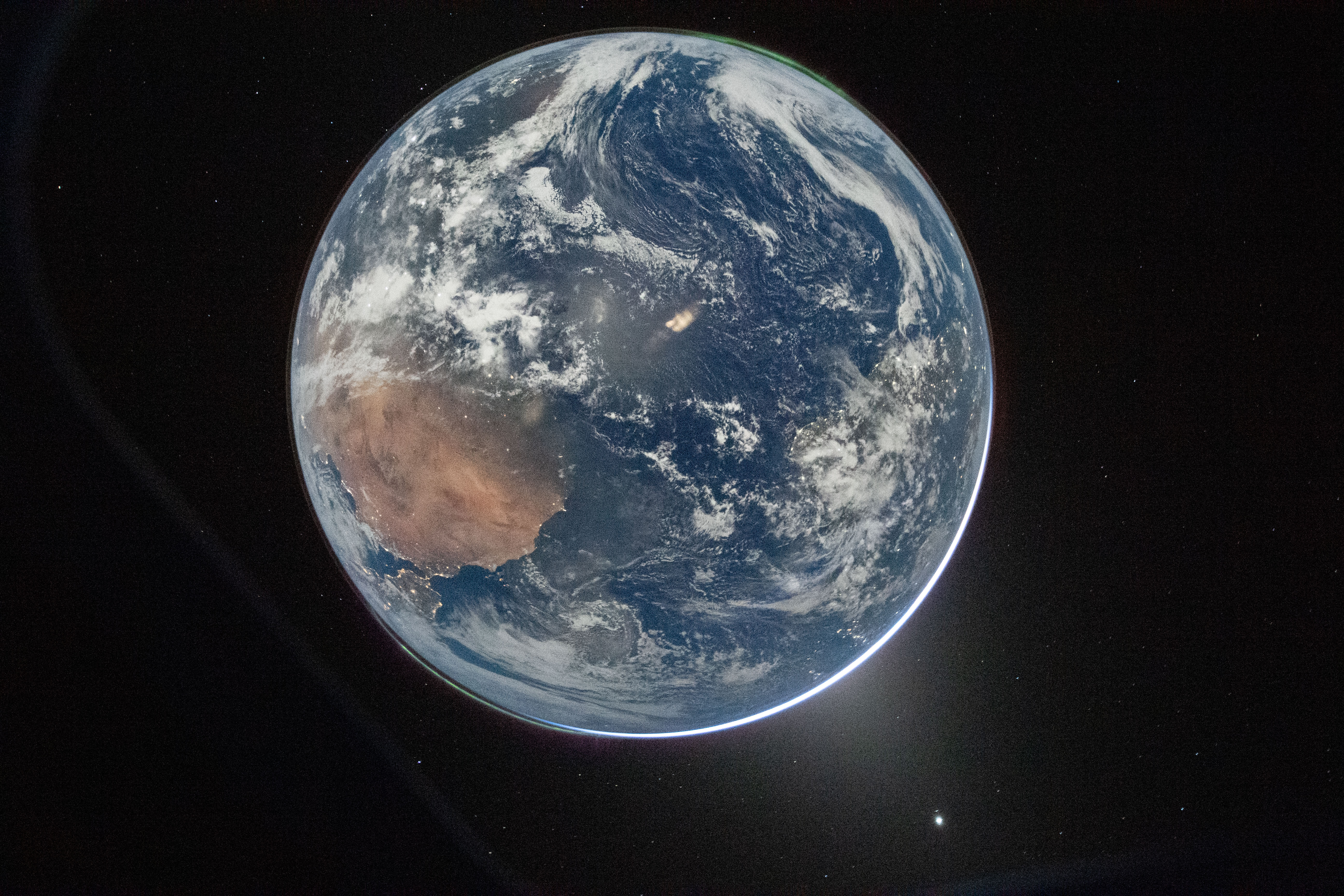
Something I haven't figured out is: what is that yellow/whitish smudge toward the center of the earth? It looks like camera glare or a reflection?
The same specs, which match star charts, show up in two images taken a few moments apart at different exposures (links were given down-thread).
Zoom into this higher-resolution version: https://www.nasa.gov/wp-content/uploads/2026/04/art002e00019...
Is that... true? Sunlight is seen as yellow, of course, but the moon is usually thought of as white.
https://www.tiktok.com/@veryimportantpeopleshow/video/731957...
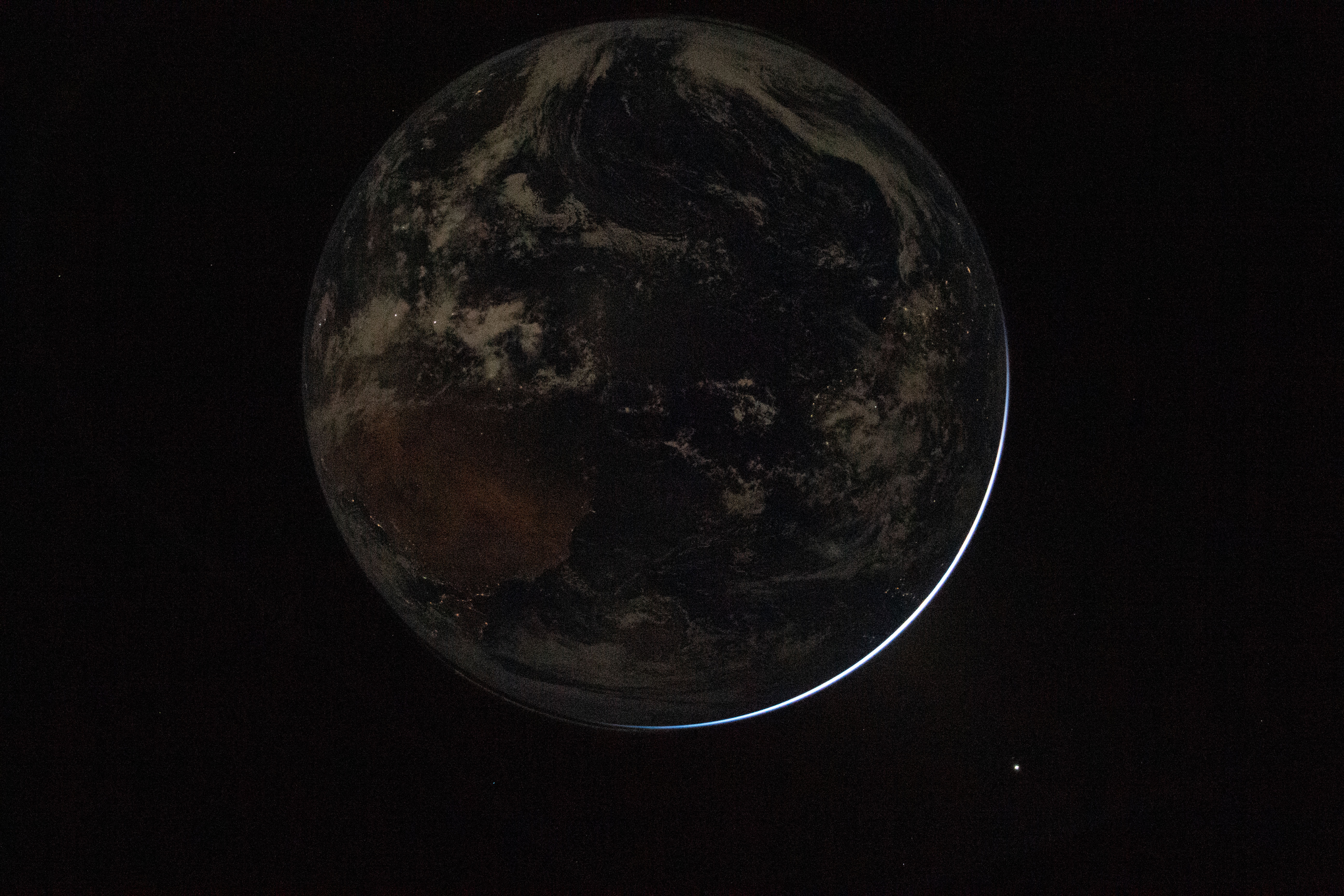
Dark Side of the Earth: https://www.nasa.gov/image-detail/amf-art002e000193/
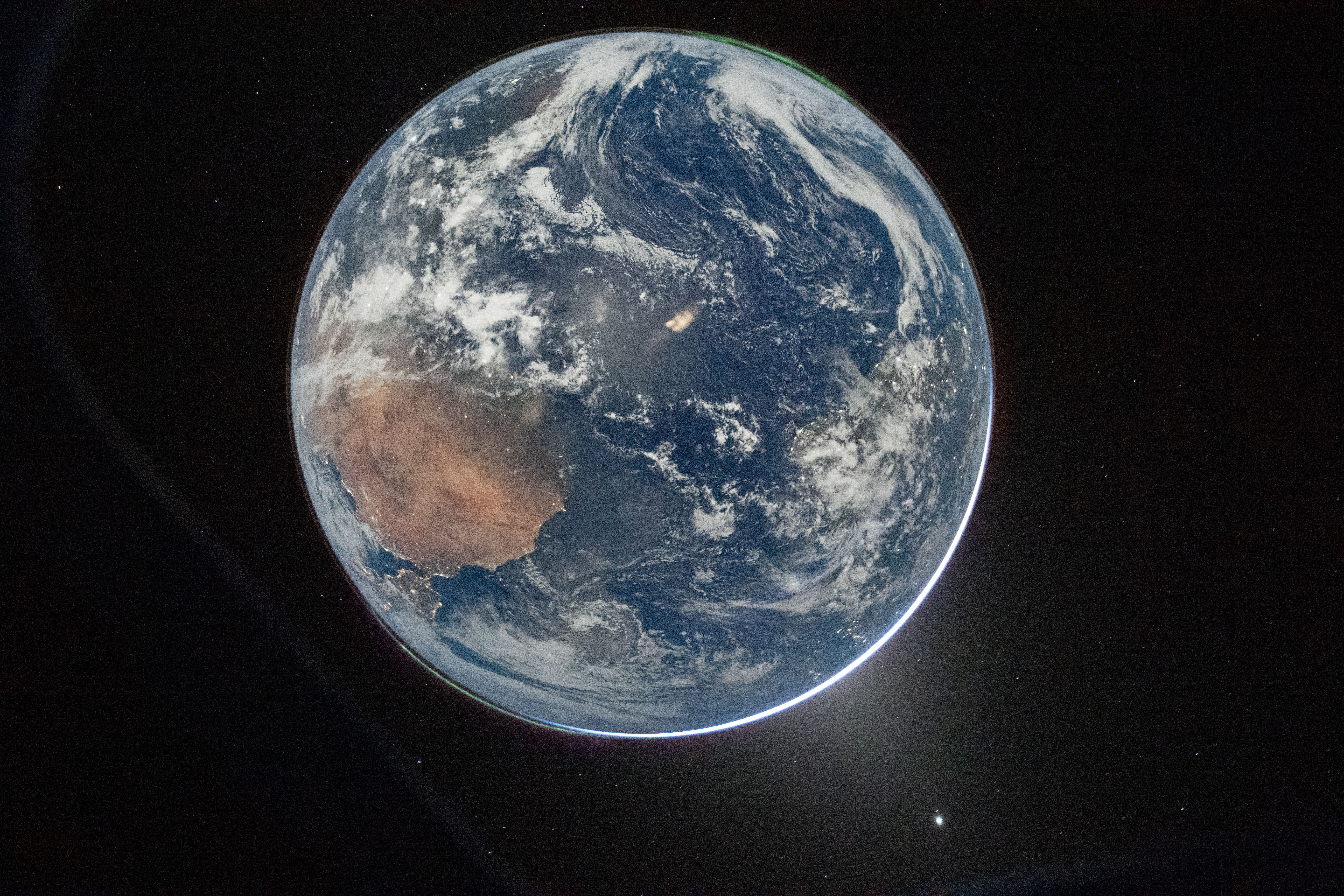
Hello World: https://www.nasa.gov/image-detail/fd02_for-pao/
On images-assets.nasa.gov, we can find the 5567x3712 resolution versions of these pictures:
Dark Side of the Earth: https://images-assets.nasa.gov/image/art002e000193/art002e00...
Hello World: https://images-assets.nasa.gov/image/art002e000192/art002e00...
Do you understand ISO?
It took me 21 years...
This video explains how ISO is very different to what most people imagine, and how you can use this knowledge to take less noisy photos.
I'm sad not alive at a time like Cowboy Bebop oh well, this is a great pic, overview effect
> Artemis II crew take 'spectacular' image of Earth
It was described by someone else as spectacular - in this case NASA
> Artemis II crew take spectacular image of Earth
We the BBC certify that this image is officially spectacular
Not hugely important in this context. By more import, when the sentence is something like X 'commits warcrimes' against Y
So much interpretation is done on colour on each step of the way that it's not surprising the colours are looking different.
The exif includes time, but not time zone. They are not quite at the moon, and Lunar Time is under active development but not official. Also clocks tick slower under the moon's weaker gravity. (Or is it faster?)
Anyway, what time was this taken?
> clocks tick slower under the moon's weaker gravity. (Or is it faster?)
Compared to clocks at rest on Earth, clocks on board Orion right now are ticking faster, because it's at a high enough altitude above the Earth that the faster ticking due to higher altitude outweighs the slower ticking due to speed relative to the Earth.
That will be true for most of the mission. For clocks in orbit about the Earth, the "breakeven point" where the altitude effect and the speed effect cancel out and the clock ticks at the same rate as an Earth clock is at, IIRC, about 1.5 Earth radii. So clocks on the ISS, for example, tick slower than Earth clocks; but clocks on the GPS satellites (orbiting at 4.2 Earth radii) tick faster (and there is an adjustment made for this on each satellite so that the time signals they send out match Earth clock rates).
For a spacecraft moving at escape velocity, which is going to be roughly true for Orion all the way until splashdown, I think the "breakeven point" is higher, at a little over 2 Earth radii. Orion will reach that point on the way back a few hours before splashdown, I think.
The Moon's gravity well is too shallow to make an appreciable difference in any of these calculations.
I should emphasize that all these tick rate effects are tiny, on the order of one part in a billion to one part in a hundred billion. Even when you add up the difference over the entire mission, it's still only on the order of hundreds of microseconds (i.e., the astronauts end up aging a few hundred microseconds more than people who stayed on Earth).
I'm curious, and hope you or somebody else might be able to answer this: is it a single adjustment for each thing, where they just set it to always adjust by X ratio, or does it vary (enough to matter) as it orbits, such that the adjustment needs to be constantly varying slightly?
I remember there's some tools to use the images as desktop backgrounds: https://github.com/boramalper/himawaripy
What does scale, unfortunately, is arrant nonsense.
Similar to the "I fell in love with an AI!" folks, it's largely undercover salesmen hawking their goods to the gullible.
I think it's worse to consider the acceptance of reality as being "forced into intellectual submission" and to use scare quotes around "right."
There are discussions that everyone on the planet should be 100% on one side of and this is one of them. It is literally just wasting everyone's time to entertain the premise that opinions to the contrary hold any value.
Surely our camera gear is exponentially better now? Is the reason for the new image being ‘murkier’ due to light, pollution or something else?
They are better, but not exponentially. You can't beat physics, film cameras can still compete in terms of dynamic range and resolution, the optical elements haven't changed that much. The 1972 photo was taken on medium format film, which is twice the size of the sensor area in the modern one, which means more photons and less noise. The recent image was take at a really high ISO, which adds to the noisiness.
They mean outside of low Earth orbit (which basically means further away than the ISS). The phrasing is not ideal.
> Earth's gravitational dominance extends 4x the distance to the moon
"Earth's gravitational dominance" is not a single thing; it depends on what kind of "dominance" you're talking about.
For example, even though the Moon is usually described as being in orbit about the Earth, its orbit is always concave towards the Sun. In other words, its net gravitational acceleration is always towards the Sun--even when the Earth is on the other side of it from the Sun. So by this criterion it's not in orbit about the Earth, it's in orbit about the Sun, doing a complicated do-si-do with the Earth, also in orbit about the Sun.
I'm not sure what definition of "dominance" you're using that extends the Earth's "dominance" to 4 times the distance of the Moon.
He is "our people," as far as hacking astrophotography from space. [1]
Because fundamentally it is a large object illuminated by sunlight.
Look at the original: https://www.nasa.gov/image-detail/fd02_for-pao/
It's grainy, but the detail is terrific.
No it didn't. That would be catastrophic and likely fatal. They are going to the Moon, which is also in Earth orbit.
if anything in life gives me pleasure is I have experienced life, with its highs and downs on this little speck.
There is no "up" in space, so that wouldn't be editing the image I feel. The camera just happened to be oriented "upside down".
Look again at that dot. That's here. That's home. That's us. On it everyone you love, everyone you know, everyone you ever heard of, every human being who ever was, lived out their lives. The aggregate of our joy and suffering, thousands of confident religions, ideologies, and economic doctrines, every hunter and forager, every hero and coward, every creator and destroyer of civilization, every king and peasant, every young couple in love, every mother and father, hopeful child, inventor and explorer, every teacher of morals, every corrupt politician, every "superstar," every "supreme leader," every saint and sinner in the history of our species lived there-on a mote of dust suspended in a sunbeam.
The Earth is a very small stage in a vast cosmic arena. Think of the endless cruelties visited by the inhabitants of one corner of this pixel on the scarcely distinguishable inhabitants of some other corner, how frequent their misunderstandings, how eager they are to kill one another, how fervent their hatreds. Think of the rivers of blood spilled by all those generals and emperors so that, in glory and triumph, they could become the momentary masters of a fraction of a dot.
Our posturings, our imagined self-importance, the delusion that we have some privileged position in the Universe, are challenged by this point of pale light. Our planet is a lonely speck in the great enveloping cosmic dark. In our obscurity, in all this vastness, there is no hint that help will come from elsewhere to save us from ourselves.
The Earth is the only world known so far to harbor life. There is nowhere else, at least in the near future, to which our species could migrate. Visit, yes. Settle, not yet. Like it or not, for the moment the Earth is where we make our stand.
It has been said that astronomy is a humbling and character-building experience. There is perhaps no better demonstration of the folly of human conceits than this distant image of our tiny world. To me, it underscores our responsibility to deal more kindly with one another, and to preserve and cherish the pale blue dot, the only home we've ever known.
Apollo used film and it's been a long time since anyone has gone past LEO
just the lowest hanging fruit that had been a second class citizen to the marvel of having an extraterrestrial angle to begin with
You can see for yourself in Google Maps if you enable the globe view, unfortunately it seems I can't share a direct link.
Look again at that dot. That's here. That's home. That's us. — Carl Sagan, Pale Blue Dot, 1994
https://www.amazon.ca/How-Talk-Science-Denier-Conversations/...
Reminds me of the classic - It is true that Spielberg filmed the moon landings, but he was such a perfectionist that he wanted to shoot on location.
Conspiracy theorists need to be kept in check. Disengagment is easy but it doesnt help.
Spoiler - they mostly switched to QAnon instead.
When a cosmologist says that a planet nobody can see exists and is made of x% helium and is y light years away etc etc with absolute certainty despite nobody being able to go there and witness any of it (look how wrong they were about Pluto’s appearance), then you can always just say “what are you a Flat Earther” and easily discredit any doubt I have in these extraordinary claims with underwhelming evidence.
Any idea you want the public to oppose, you can create and market an adjacent thing, like Trump. You can throw all the ideas you want to oppose in the Trump bucket and if anyone supports it it’s probably because they’re a Trump supporter right?
See you’re very very easily programmed, like clockwork.
Yeah, because this is high-school curriculum.
https://www.jpl.nasa.gov/edu/resources/lesson-plan/using-lig...
> with absolute certainty
It is taught that the scientific method provides evidence, not certainty, in middle school science curriculum.
FWIW, this fact isn't taught properly or normies are somehow unable to process it.
There's this popular dismissal of tech people, saying that "they think in 0s and 1s, but world is shades of gray", but in reality, it's almost everyone else that thinks in 0s and 1s - STEM people and people in/into similar fields (like medicine) are usually forced to understand nuance due to nature of their interests/occupation, but everyone else seems to operate in purely binary mode, and what's worse, whether something is true and false isn't even correlated much with objective reality, and mostly with one's personal feelings about how things should be.
(Now, to be an equal opportunity cynic, in my experience, the concept of categories and taxonomies being arbitrary - invented and assigned by people, and judged by their usefulness, as opposed to being inherent facts of nature that are discovered - seems to be hard for even STEM people to process, for some reason, at least based on my observations and the number of conversations I had about this with all kinds of people.)
Since when I was very young and until now the amount of information about Pluto has continuously increased, so now we know much more about it.
For example now we know that Pluto is practically a double planet, having a relatively very large satellite. This was not known when I was a child, e.g. at the time of the first NASA Moon missions.
However, I do not remember anything wrong. Many things that have been learned recently were previously unknown, not wrong.
If you refer to the fact that Pluto was reclassified as a dwarf planet, that is also a case of information previously unknown, not wrong.
This planetary reclassification was not the first.
When Ceres was discovered in 1801, it was considered the 7th planet, after the 5 planets known in antiquity and Uranus that was discovered a few years earlier. (The chemical elements uranium and cerium, which were discovered soon after the planets, were named so after the new planets, as their discovery impressed a lot the people of those times.)
However, soon after Ceres a great number of other bodies were discovered in the same region and it was understood that Ceres is not a single planet, but a member of the asteroid belt.
Exactly the same thing happened with Pluto, but because of its distance, more years have passed until a great number of bodies have been discovered beyond Neptune and it became understood that Pluto is just one of them, i.e. a member of the Kuiper belt, so it was reclassified, exactly like Ceres.
Something unfortunate about our media environment is that science news is a dumbed down summary of a dumbed down summary of a dumbed down summary. These issues you're flagging, a lack of evidence and overstated certainty - they're an artifact of the reporting process. If you work your way back to the original sources, there will be a heck of a lot of evidence and it will carry error bars (so the certainty is precisely & appropriately stated). There's bad or even fraudulent papers out there but there's a huge amount of good science being done by honest researchers who are just as concerned as you are about the quality of the evidence and the degree of certainty.
Eg, there really is a compelling explanation of how we can know the composition of a gas giant light-years away, and it isn't invented out of thin air, it's been 100+ year process of understanding spectroscopy and cosmology, building better telescopes, etc. It's the culmination of generations of scientists pushing the field forward millimeter by millimeter.
But yeah, sure. With the amount of fake stuff on the internet including AI image generation, we're expected to believe that the US government dumped billions of dollars into going to space when they could give the appearance of doing so for a few bucks in nano banana credits? Hah.
Why would Russia and China and any other country with any degree of astronomic capability that the US has an adversarial relationship with just let them get away with lying to the world? Why wouldn't they take the opportunity to humiliate the US by revealing that no launch happened and that they cannot detect the spacecraft?
A launch is detectable seismically, visually, on radar, etc. There's a lot of investment in being able to detect launches (to detect the launch of nuclear weapons). It would be screamingly obvious if the launch was fake. It would absolutely be conclusive if there were no seismic activity, no radar return, they couldn't detect the spacecraft presently, etc. At least for a definition of "conclusive" that can be operationalized - conclusiveness is a judgement call about when evidence is sufficient and not reaching some theoretical 100% certainty. Which can't possibly be reached for any claim for the reason you outlined; you can always invent some negative counterclaim that can't be entirely dismissed, even for claims like "the sky is blue".
It's also pretty easy to find people who were physically there to witness the launch. This wasn't a secret bunker or a barge in the middle of the ocean. It was in Florida in the late afternoon.
> ...it would be accused as being fake and a ploy from American enemies to discredit them.
Hundreds of thousands of people around the world have access to this data. Astronomers, geologists, petroleum engineers, backyard amateurs. The conspirators could muddy the waters but they couldn't ultimately prevail. It is many orders of magnitude easier to go to the moon than to convincingly fake it.
Higher-resolution image: https://www.nasa.gov/wp-content/uploads/2026/04/art002e00019...
For a view of roughly the same half of Earth, but with less clouds, if you rotate the image clockwise by 150 degrees you get roughly this viewpoint of the earth: https://earth.google.com/web/@3.63731074,-23.1618975,-2690.7...
There's a heading control to include rotation in link: https://earth.google.com/web/@3.63731074,-23.1618975,-2690.7...
Nasa images page is useless. Government work.
Direct link to this image: https://www.nasa.gov/wp-content/uploads/2026/04/art002e00019...
* https://petapixel.com/2026/04/02/a-nikon-z9-made-it-aboard-t...
They have a thermal blanket for exterior work:
* https://petapixel.com/2026/02/24/artemis-ii-astronauts-will-...
* https://petapixel.com/2025/01/10/the-custom-nikon-z9-and-the...
* Various stories with the "Artemis" tag: https://petapixel.com/tag/artemis/
The D5 has been used on the ISS, including EVAs, since 2017, so they're a known quantity:
* https://en.wikipedia.org/wiki/List_of_cameras_on_the_Interna...
The Mercury and Apollo missions used Hasselblad 500-series-based cameras (modified):
* https://www.hasselblad.com/about/history/hasselblad-in-space...
The natural blue light is coming from the oxygen in the atmosphere but it's so overwhelming in that spot that it turns the light pure white. The red/orangish is coming from particulates and the green/red from aurora. My favorite part I think is the very bottom where you can see the blue light taper off and not overwhelm the camera sensor and you can see the aurora with it. I love this photo so much.
Probably my favorite photo ever now.
And all the others are negligible by many orders of magnitude compared to the moon. So it's really just the moon as far as this photo is concerned (except for the small sliver that's still illuminated by sunlight, including refracted sunlight).
That's highly incorrect. I have many lightsources that aren't contributing to any photons in that picture. For example my refrigerator light.
Yes, exactly.
Almost like I ran the grainy-to-real conversion in my mind and I felt like I was imagining seeing this in person. Beautiful image!
For example, if you render Gaussian noise in photopea and export as JPEG 100% quality, it has 9.2MB. If you reduce the exposure by -2 it goes down to 7.8MB. That's partially because more parts of the noise are effectively black pixels, but also I believe because of the earlier mentioned effect.
Also, pulling more data from your 14 bit or 16 bit raws results in more noise in the end compared to the straight-out-of-camera 8 bit JPEGs.
Also possibly different JPEG quality settings.
One of the reasons the D5 supposedly was chosen was because of its high dynamic and good low light performance. It can go up to ISO 3,280,000:
* https://en.wikipedia.org/wiki/Nikon_D5
The D5 has been used on the ISS, including EVAs, since 2017, so is a known quantity:
* https://en.wikipedia.org/wiki/List_of_cameras_on_the_Interna...
EDIT: sorry, it seems I'm wrong. I just checked https://www.photonstophotos.net/Charts/PDR.htm and while the Z9 has the clear edge with 2 more stops of dynamic range at low ISO, the D5 actually pulls ahead at high ISO. Perhaps the technological improvements haven't been that much for the shot-noise dominated regime.
https://www.youtube.com/watch?v=ZWSvHBG7X0w
Video alleges people think ISO makes the sensor "more sensitive or less sensitive". (I … don't think this is common? But IDK, maybe this is my feldspar.)
(The video also quibbles that it is "ISO setting" not "ISO" … while showing shots of cameras which call it "ISO", seemingly believing that some of us believe ISO is film speed, in a digital camera?)
Anyways, the video wants you to know that it is sensor gain. And, importantly, according to the video, analog gain, not digital gain.¹ I don't know that the video does a great job of saying it, but basically, I think their argument is that you want to maximize usage of the bits once the signal is digitized. Simplistically, if the image is dark & all values are [0, 127], you're just wasting a bit.
You would want to avoid clipping the signal, so not too bright, either. Turn your zebras on. (I don't think the video ever mentions zebras, and clipping only indirectly.)
The video does say "do ISO last" which I think is a good guideline. Easier said than done while shooting, though.
… also while fact checking this comment, I stumbled across Canon's KB stating to use as low an ISO as possible, which the video rails against. They should talk to Canon, I guess?
¹with the caveat that sometimes there is digital gain too; the video notes this a bit towards the end.
This is because the ADC (analog to digital converter) right after can only handle so many bits of data (like 12-16ish in consumer cameras). You want to “center” the data “spread” so when the “ends” get cut off, it’s not so bad. Adjusting the ISO moves this spread around. In addition, even if you had an infinite bitrate ADC, noise gets added between the gain circuit and the ADC so you want to raise the base signal above the “noise floor” before it gets to the ADC.
Gain is not great — it amplifies noise too. You want as low ISO as possible (lowest gain), but the goal is not actually to lower gain; your goal is to change the environment so you can use a lower gain. If you have the choice between keeping the lights off and using higher ISO versus turning on the lights and using a lower ISO, the latter will always have less noise.
Most photo cameras have one gain circuit that has to cover both dark and light scenes. Some cameras like a Sony FX line actually have two gain circuits connected to each photosite and you can choose, with one gain circuit optimized for darker scenes and the other optimized for brighter scenes. ARRI digital cinema line cameras have both and both are actually running at the same time (!).
Peak sharpness is about f/8. They should have had the D5 on aperture priority auto iso, pushed the exposure comp either way and then just fired at f/8 and let the camera make the decisions.
But they are astronauts not photographers :)
The modern Z lenses are far better and sharper open but much larger generally.
To fully answer the question, the moon's gravitational gradient does pull on the Earth, the ocean closest to the moon, and the ocean furthest from the moon differently. But those are objects separated by thousands of kilometers, having hours of gravitational influence acting upon them.
d5 has an actual shutter yeah? not mirrorless? I think the shutter moving will spin the camera.
GPS might work out there though: https://www.nasa.gov/directorates/somd/space-communications-...
https://petapixel.com/2026/04/02/a-nikon-z9-made-it-aboard-t...
There are more interesting details in the PetaPixel article, such as: "'That’s the camera that they’ll be using, the crew will be using on Artemis III plus, so we were fighting really hard to get that on the vehicle to test out in a high-radiation environment in deep space,' Wiseman said."
H/t to "SiliconEagle73" who linked to that PetaPixel article in the thread linked below.
https://old.reddit.com/r/nasa/comments/1sbfevm/new_high_reso...
From [0], "The D5 was chosen for its radiation resistance, extreme ISO range (up to 3,280,000), and proven reliability in space." (
[0] https://www.photoworkout.com/artemis-ii-nikon-d5-moon/
But yeah the grainy photo of the Earth with the D5 at ISO 51200 shows the shortcomings of the ancient DSLR. Still, great shot.
How did they get the Earth to light up when it is obviously dark outside? Is this fake?
This is consistent with good photographic technique that prioritizes "getting it right in the camera."
My only curiosity, and yeah I know orders of significance etc...
Buuuuut I wonder why they didn't consider a Z5[0][1] and the Z mount 14-24, or the Z5 with an adapter for the F mount 14-24....
There's at least a pound of weight savings on the table.
Specifically, I wonder if it's a fun reason? i.e. it would be interesting if there was a technical reason like 'IBIS fails miserbly' or 'increased sensor resolution adds too much noise' (even at that ISO you gave from the EXIF...)
[0] I'm really more of a Sony person but am thus keenly aware about importance of UX feel, so I tried to keep the question apples to apples here.
Edited to add:
[1] Per [0] I may be stupid in thinking the Z5 is a 'at least minimal' substitute so happy to learn something here.
* https://en.wikipedia.org/wiki/List_of_cameras_on_the_Interna...
The ISS now (also?) has Z9s. So they're both generally known-quantities.
However cameras probably fall into the variance in astoraunt weight somewhat.
My understanding is it's on the order of 5-10 pounds of rocket juice to get one pound of something to LEO, thus the question.
1. https://www.nasa.gov/wp-content/uploads/2026/01/sls-5640-sls...