https://eukaryotewritesblog.com/2021/05/02/theres-no-such-th...
You'd think that now that we have LLMs, the actual in-your-face empirical evidence of a system that can effectively navigate the complexities of the real world without being fed, or internally developing, rigid ontologies, that people would finally get the memo - but alas.
If you're interested, check out Rupert Sheldrake:
https://www.sheldrake.org/files/pdfs/papers/Is_the_Sun_Consc...
Part of the same Solanaceae/nightshade family also includes bell peppers and eggplants. To help confuse the Tomato plant and the Tomato vegetable further.
Young Eucalyptus trees have leaves that are rounded and are arranged opposite to one another. However, when mature the leaves of a Eucalyptus are lance-like and are arranged in an alternating fashion. This to me is quite unusual.
Those things are tough, and they grow really fast in the right climate.
In areas where they are introduced, they also become quite invasive by practicing something called alelopathy, whereby they introduce toxins into the soil to prevent competing tree species from taking hold.
While I'm at it, Eucalyptus trees have very very dense wood which means the wood burns very hot. This makes it even worse for forest fires where Eucalyptus trees dominate.
(I knew my botany studies would come in handy someday. I just never knew when!)
But at the same time the wood is also very dense, so makes great campfire wood, but doesn't burn so much in a forest fire, which is a bit ironic...
Forgive my ignorance, but I had understood the density of the wood meaning that the trunks of the trees were less likely to burn in a forest fire (which eucalypts encourage by shedding large amounts of dry bark)
See E. grandis, E. tetraptera, E. chartaboma, E. deglupta, E. pulverulenta for examples of diversity
Some are incredibly tall with really smooth skin, some are basically bushes, some have really messy papery bark; some even have rainbow bark! Some have really long leaves while some have extremely short tightly wound round leaves
A beautiful living thing which my perception of its rythmic swing has lived on with me for decades. Trees are lovely.
So Monocots don't have rings. Anything else that is a tree in a tropical forest has rings. It does not matter where they grow. The rings are smaller in slow growing species, and are different structurally in conifers, but this is all.
https://www.indefenseofplants.com/blog/2017/12/12/the-travel...
https://www.woodlandtrust.org.uk/blog/2025/08/ancient-yew-tr...
Two examples right from downtown São Paulo,
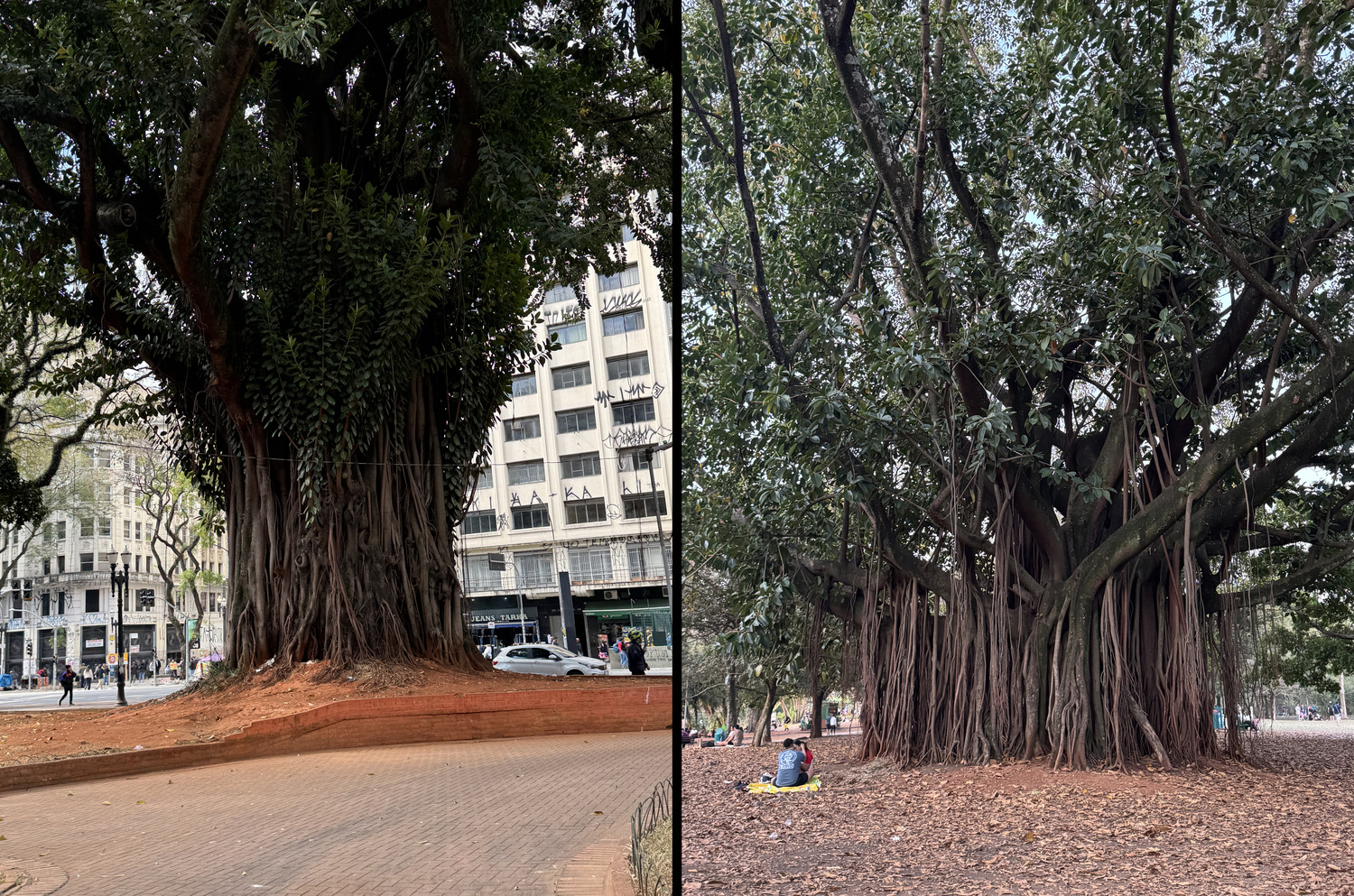
[0]: https://imgur.com/gallery/what-kind-of-plant-is-this-grew-le...
everyone should have a copy of Identifying Wood on their metal bookshelf
A wikipedia dive session is likely to get more and more specific into trees (attacked by twees!); an encyclopedia flip session is more likely to go across a wide variety of subjects.
[1] https://en.wikipedia.org/wiki/Wikipedia:Database_download
> Recent 2024 analysis confirmed it is at least 16,000 years old, with possibilities ranging up to 80,000 years, making it one of the oldest living organisms.
https://en.wikipedia.org/wiki/Metasequoia_glyptostroboides
I started 2 sprouts I bought by mail order, after one growing season they were nearly 3 feet tall. I got them mail order from Jonsteen Nursery, they have been specializing in various redwood saplings for many years. https://sequoiatrees.com/
It makes sense now that the species was discovered in the 40s