I've subsisted on photos from the Apollo missions and artistic renditions for so long that seeing the modern, high resolution real thing to be quite stirring in a way I didn't expect. It actually does make me believe that the future could be quite cool.
The US spends almost that much on net debt interest each day (~$3 billion/day[0]). Not that adding to the debt helps at all, but the old proverb about being penny wise and pound foolish seems relevant
Acceptance of over costing and under delivering is exactly why the US is stuck with SpaceX as its prime space launch provider. It's only through the miracle of the vanity of billionaires that there's even a realistic second choice (Blue Origin) that might develop.
It's also this type of attitude that let's us be in a situation where we honestly don't know how well the heat shield will work on reentry (SLS launches are so expensive, and so slow to build and prep to launch, that we cannot fit in a uncrewed mission between 1 and 2 to test or validate fixes or models).
If Artemis as a program succeeds, it will be despite the incredible graft, pork, and ass covering, not because of it. I want Artemis to succeed because the achievement will be beautiful and amazing, and I want everyone to be safe and sound. I want Artemis to fail, to force a reckoning. I still believe that America has great things to offer to the world, but it's not going to be able to do that by muddling it's way through and cobbling together random pork filled programs into a vaguely inspiring shape.
New NASA administrator Isaacman has redone the Artemis program. The changes were announced at the Ignition event a few weeks ago:
https://www.nasa.gov/ignition/
If you read one thing, read the sides on building the moon base:
https://www.nasa.gov/wp-content/uploads/2026/03/2-building-t...
The goals it to fly often - adding a SLS launch to 2027 and a second launch to 2028. This drops the cost-per-launch, which is mostly fixed. It redoes SLS to make it less expensive and more capable. It moves the lunar space station down to the surface of the moon.
And it's budgeted at $10B/3 years, which fits into NASA's budget.
Isaacman took the Artemis program and fixed it. The reckoning came, and it's looking good.
Spends, or accrues?
If you want to make the US financially solvent, cut defense. Defense LAPS every other budget category. Whether you want to take the conservative position on why that is (our allies freeload on our defense spending) or the Progressive one (the U.S. is an empire in decline and every major empire through history has spent vast sums to maintain itself why would the U.S. be different) doesn't change the fact that our military budgets exceed over a dozen other nations' combined, the vast majority of whom are allies.
I suppose it matters how you lump things, but for federal spending:
  - $678 B, Social Security
  - $478 B, Medicare
  - $425 B, Net Interest
  - $419 B, Health
  - $412 B, National Defense
  - $320 B, Income Security
  - $184 B, Veterans Benefits and Services
  - $75 B, Education, Training, Employment, and Social Services
  - $53 B, Transportation
  - $43 B, Administration of Justice
  - $15 B, Other
The Biden administration's FY2025 defense budget request was $850 billion for the DoD, with the total national security budget reaching over $895 billion. The FY2026 proposal submitted by the Trump admin is 1.5 trillion for DoD.
Except for social security, health, medicare, debt interest
This is not a lot of money on a nation-state scale. It's equal to giving every person in the US about US$12.
This is way bigger than just putting people on the moon or hubris. It's the prerequisite for everything we've also said about Mars. Elon just muddied the waters so much that people are so negative about anything else.
Gavin Newsom alone wasted (laundered?) billions of dollars in California. The United States can send 10 rockets per day and wouldn't even feel the financial impacts of it. The states individually waste millions per day.
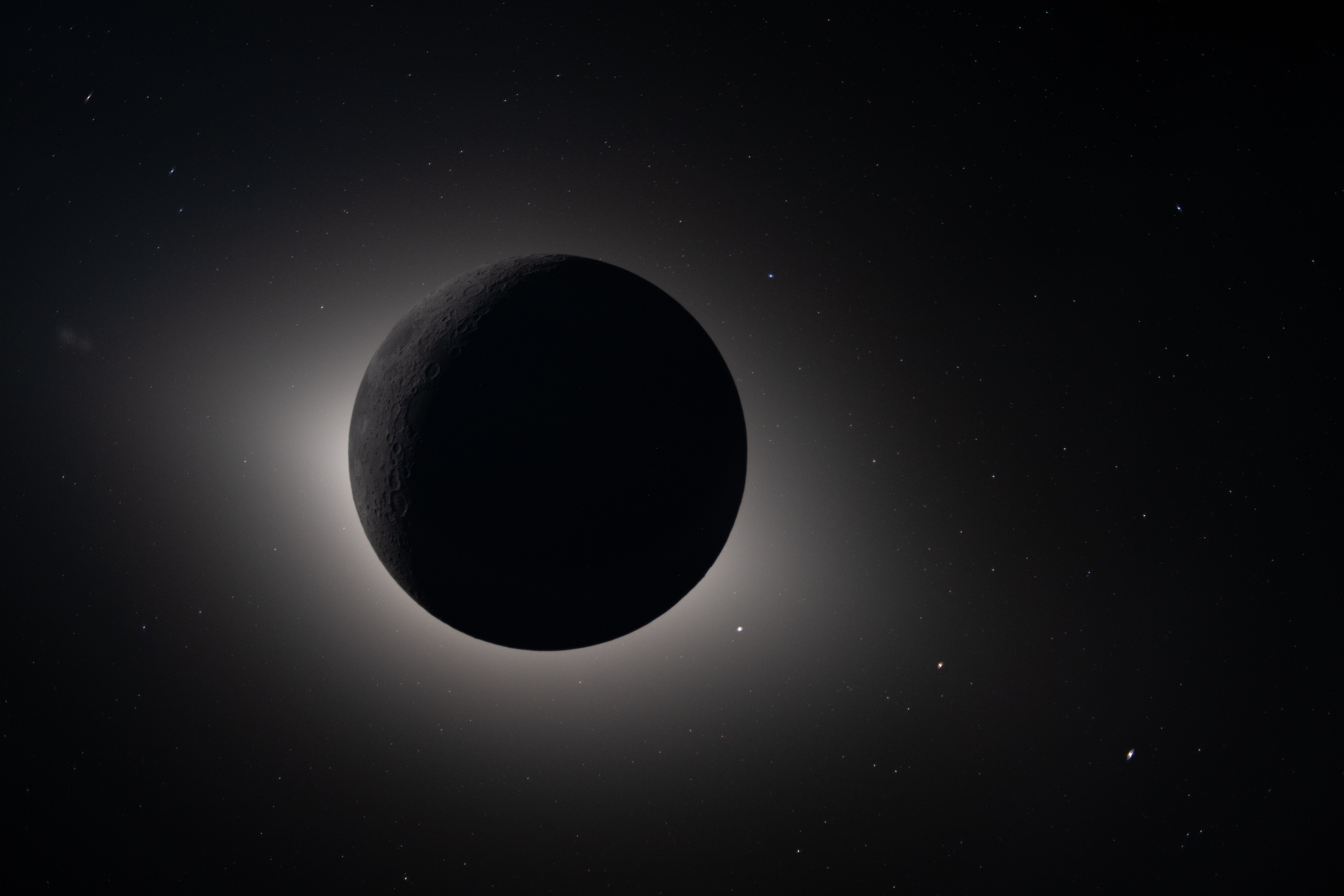
I was also very curious of their descriptions during the eclipse where the Earth shine was lighting up the dark side of the moon to such a surreal look they couldn't really describe it. They were even commenting that they didn't feel the photos being taken were doing it justice either.
I also was wondering if they will make any modifications to the capsule since covering a window to block the Earth shine caused concern on the ground from some of the readings they were getting. Assuming it was overheating as they redirected air flow to the window. Then again, the following missions won't be so concerned with a single fly by so probably not something they'll address.
I think it would’ve been a super cool throwback to the history of lunar exploration; maybe it’s just me but I think it would’ve been really exciting. It would basically be the like visiting a UNESCO (moon?) heritage site.
Since all the Apollo landings were on the near-side of the Moon, they were in fact less accessible to this crew.
My disappointment lay chiefly in their L.O.S. periods, because in 2026 why does Earth lack operational satellites that could relay comms from the other side? Or a space optical/radio telescope that would benefit massively from the darkness and shielding of a Moon-sized body? No humans necessary for that. Of course, you couldn't power such a craft with solar power...
1. The moon eclipsed, with the Orion capsule (outside POV, from GoPro) - https://images-assets.nasa.gov/image/art002e009567/art002e00...
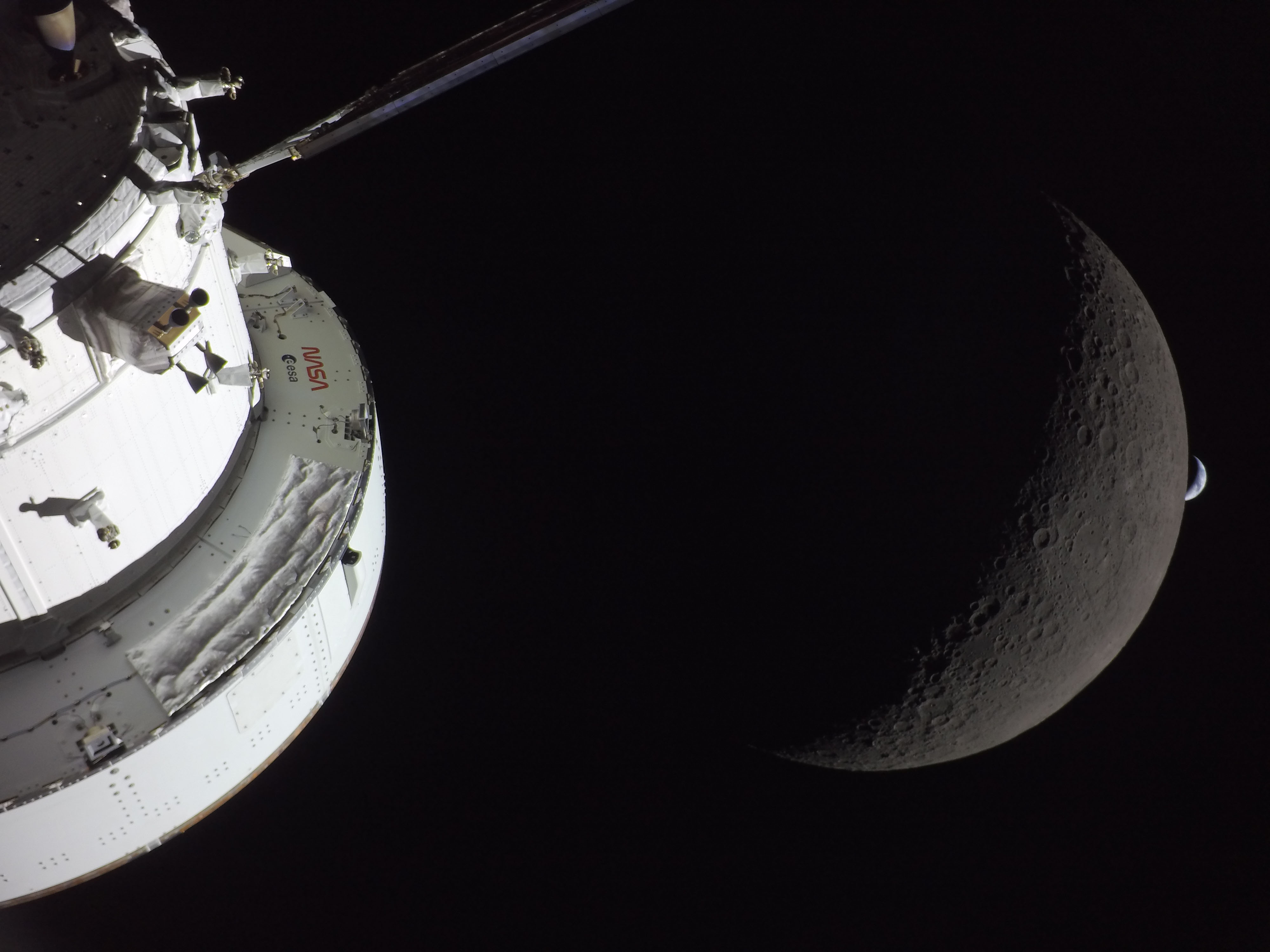
2. The moon eclipsed, with the Orion capsule, and Earth crescent (outside POV, from GoPro) - https://images-assets.nasa.gov/image/art002e009567/art002e00...
3. Crescent Moon, Crescent Earth (my fav!!) "A New View of the Moon" - https://images-assets.nasa.gov/image/art002e009287/art002e00...
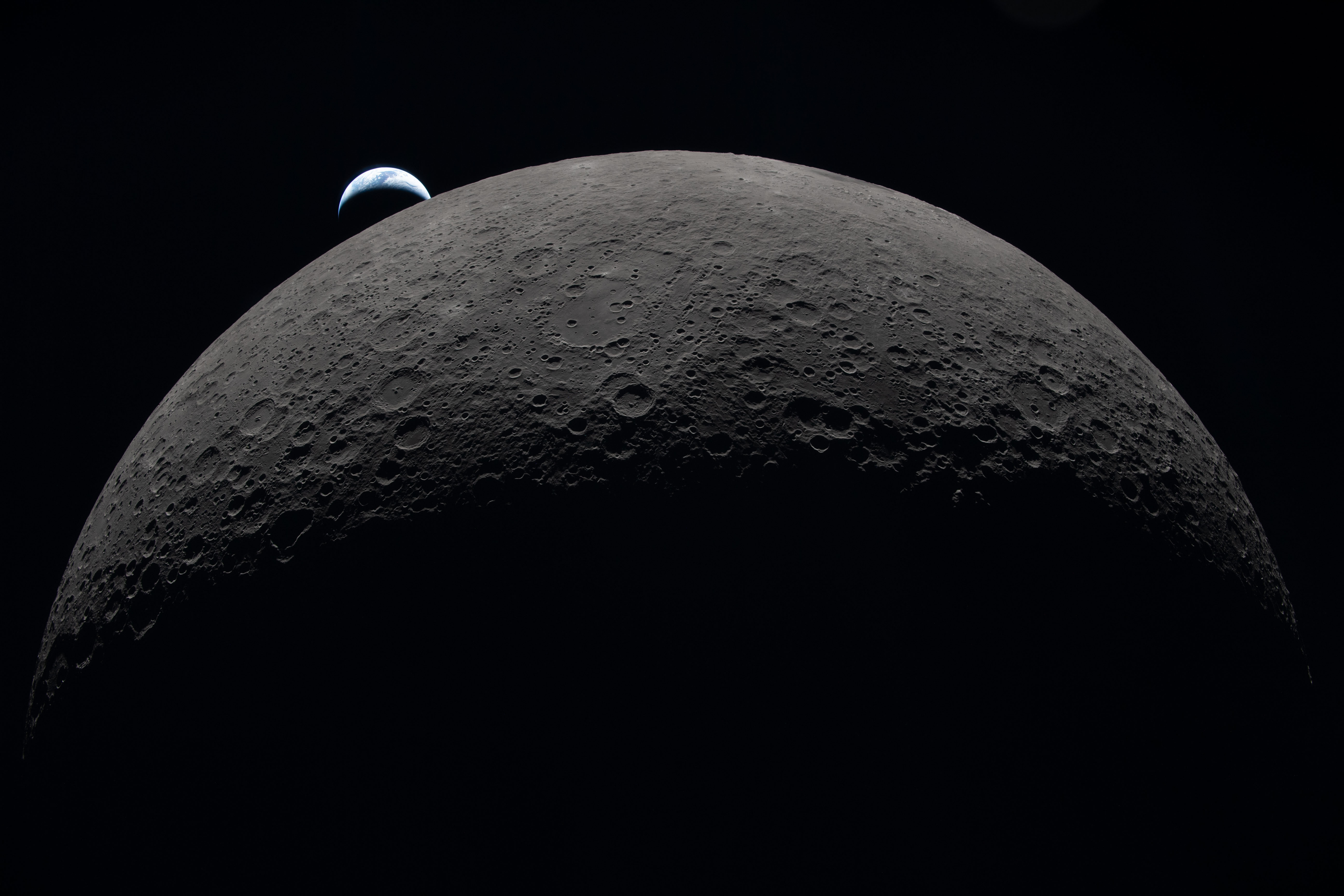
4. Artemis II in Eclipse (new fav!) - https://images-assets.nasa.gov/image/art002e009301/art002e00...
Ignoring the orbital period implications, I think it'd be bigger news if either US or Europe, or Asia couldn't ever actually see the moon.
[1] The Earth does move in the moon's sky a bit. If you are on the near side but getting close to the far side, the Earth will be below the horizon sometimes.
I imagine most bodies rotating around a second object will eventually lose their angular velocity.
Uninformed, but not ignorant and perhaps even interested. I hope your response started with "No, actually, even cooler: ..." and you made a space fan that day.
[0]https://images-assets.nasa.gov/image/art002e009301/art002e00...
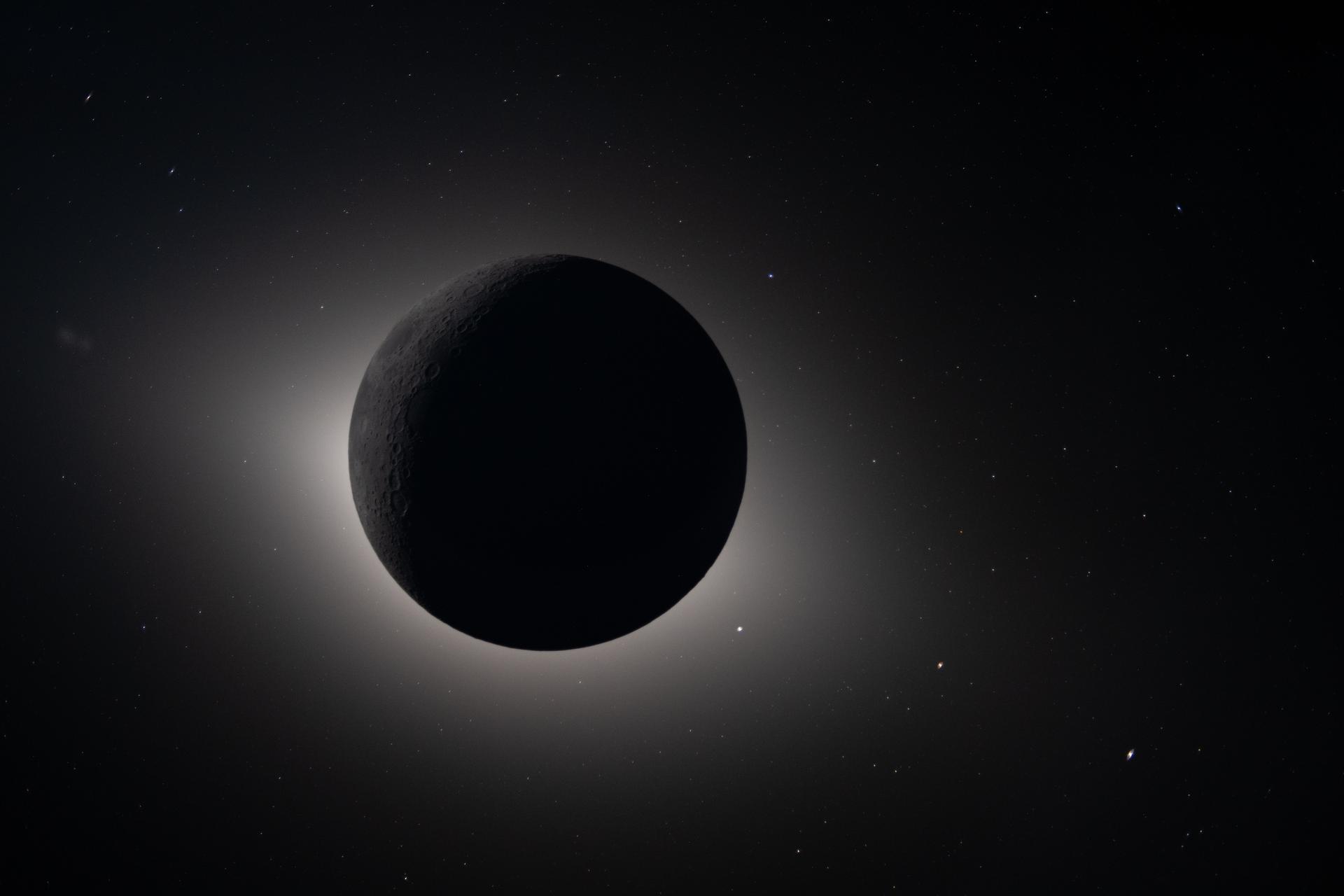
Edit: After further looking and some zooming into it, I'd say the bright dot closest to the moon is Venus, the next one has a red tint making it Mars, and then the last one would be Saturn with the rings. There might be a couple of galaxies in the upper left corner. I was quick to dismiss and blame on compression. The benefits of not having to shoot through atmosphere. I wouldn't have expected that detail in what I'm assuming to be a fairly fast exposure
Looks to me as if a meteorite came in at a shallow angle and basically skipped across the surface. Leaving dimpled craters as it bounced. Looks very similar to rocks skipping on a pond. Am I correct or is there another explanation for these?
But the real question is: Who of those 4 clogged up the toilet? That's what the public demands to know.
[0]https://www.hasselblad.com/about/history/hasselblad-in-space...
Edit: Found 'em: https://images.nasa.gov/search?page=1&media=image&yearStart=...
edit: exif data shows some are from a Nikon. I just want to see them all!!! My greedy line still plays
Still, the pics are mind blowing. Out of this world, tbh