It's not tested properly after I genericized it. Will try to go through it properly and add more updates.
Two big things on my TODO: 1) Make use of this indexing and using Claude's help, make video editing faster with Davinci Resolve (now that I have a good index of all the content)
2) I currently did this for videos, but I want to add more things to this for my thousands of still images of my camera - need to make sense of them. So I'll be working on this as well.
I have a Claude max sub and plenty of OpenRouter credit, but I don’t feel good about uploading my family’s private videos
1. What is the search index?
2. The "description.md" example has things like "faces -> cluster_id". Is this from Davinci Resolve's face index? Things like faces+names and locations are really important with photo collections, but general LLMs don't handle them so well.
Something which I can query later - Like when brainstorming with Claude "I wanna make some videos of the Luxury rooms in the lodge" and it knows what all videos could help here (going through the files).
There's also a folder root level files that aggregates the text descriptions to make it easier to find.
I've just attached an image in the blog showing an example - https://blog.simbastack.com/_media/gvcycx2n.png
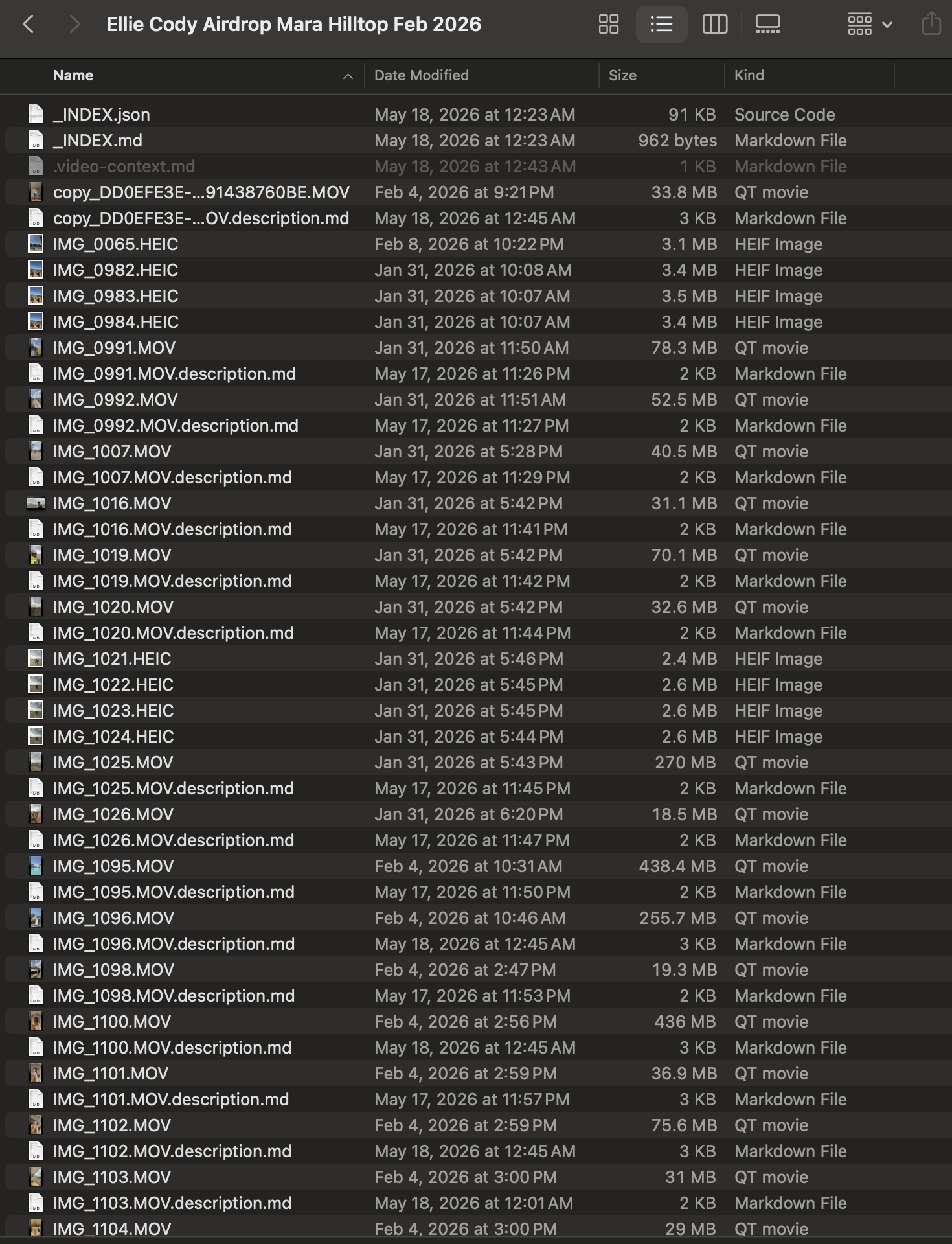
2) No - nothing from DaVinci Resolve. Framedex is a standalone pipeline. Resolve isn't involved.
Faces come from insightface (the open-source buffalo_l pack - RetinaFace for detection), running locally on CPU. For each clip it detects faces in the sampled frames, embeds them, and writes rows to ~/.framedex/faces.db.
Tbh, this part I know it's building up in my local DB but I haven't tested how good is it. Will check them out properly soon.
But yeah, on your broader point that's why framedex deliberately does not ask the LLM to handle faces or locations.
----
Faces → insightface / ArcFace embeddings. Deterministic, comparable across clips. The vision model only contributes a rough people_count; it never tries to identify anyone.
Locations → EXIF GPS via exiftool, reverse-geocoded through Nominatim/OpenStreetMap. Hard metadata, not a guess.
The LLM only does what it's good at: scene description, mood, shot type, keywords, keep/review/cull rating (this last part is also debatable though).
The idea of capable local models could be a huge unlock here if they are able to do the bottom-up context collection research / tagging / etc. at scale.
So if you give it a bunch of screenshots it will try and intelligently name them based upon what is in the screenshot. Same for videos, PDFs, etc.
But to your point I haven't even tried charging money as it feels like something Apple is just going to bake in as a feature.
But I can tell it's only a matter of time before agents become smart enough to let my non-tech friends be able to just say "Make sense of all these videos in my folder" and it just does it.
Using API to analyze even a subset of this would've been painful imo.
Not gonna lie, llama.cpp had the fans spinning at max speed. But it worked and I got the job done.
This always confuses me - don't people want their computations to run as fast as possible and thus inevitably produce more heat that needs to be vented?
I suppose sometimes it is just an analogy for "its utilizing 100% of my resources" (which I'm guessing it is here), but I've definitely had people say it as an actual complaint in different contexts
I am pretty sure that the vast majority of Airbnb hosts would not agree with you.
> equals TripAdvisor crucifixion
I have no idea how the Airbnb hosts with fake listings survive, really.
This is an excellent thing to do. Especially that LLMs excel at batching thus you can index multiple photos and videos in parallel for no performance penalty.
Bear in mind that ttft on MLX is much much faster on M5 Pro as compared to M4 Pro.
Also bear in mind that those figures are with NO optimizations whatsoever: no MCP, no DFlash. I am waiting for both to be released for the Qwen models.
I was vaguely aware of all these pieces existing (except for running a facial recognition database at home o_o), but it's really neat to put them all together like that.
Still blows my mind I can do all this from my 2021 MBP.
I'll try to do a post once I have the next steps working (helping with planning and editing videos with Davinci Resolve).
Great job. Long live the M1 Max!
But because of the fear of non-perfection, I used to put away things like creating this article or even posting it anywhere. And I do think the article has real value that HN would appreciate (I am myself an HN-enthusiast).
I'll try more. Someone else shared this project which would be really helpful - https://github.com/blader/humanizer
Also a side note, the blog is posted on my self-created Slopit.io platform which is purely meant for your personal agents (working along with you) to post content - I recommend trying it out. https://blog.slopit.io/this-blog-post-is-slop/
I know, things are getting difficult with all the slop around, but my personal opinion is, as the agents get better at writing, the "annoying-ness" factor reduces and pieces of substance will still be appreciated, even if it was written by agents. This and the fact that agents aren't going away.
If I've automated a lot of my coding, I feel like engineers like me would naturally progress to also taking agents' help to write useful content.
PS - this comment was 100% hand-typed.
When your Claude wrote this post they might not have selected the right URL to share, unless your home folder is exposed. Care to share the skill files?
PS - I just put this together in the last few mins, removed my personal files and references. So it's not tested properly, please let me know if any issues.
It's still an early hack, but I have thousands of still images as well from my camera which I've not processed and I need to do the same analysis for those.
So I'll continue working on it, but happy to receive any PRs if anyone finds any use for it.
I'm tired of having a backlog of thousands of images and videos, leaving it for later.
https://github.com/blader/humanizer
You get a pass here because you're doing really cool stuff but it's kinda tough to read past the AI nonsense, and it's relatively easy to screen out "it's not x it's y" kind of things and the bolded bullet points.
Hiding these clues by another AI pass doesn't solve the core problem. Now you just end up with content that camouflaged better but is still equally low in nutritional value.
Tbh, I have a lot of thoughts and ideas and things to share and I do spend time and effort trying to de-AI-ing it but this should help a lot.
I'll try it out.
In fact, I was expecting getting shit on by HN readers for this but was pleasantly surprised that readers moved past it.
> I also use a lot of AI but you really have to demand quality from it, whether it's writing, media, or code. It's clear you've got the taste from your media work, and we're all still learning as we go...
Their use of AI for "media work" has shown a taste but their writing usage still needs to equal that.
I'm more hot about it because it's frustrating having so many HN posts be a place for people to work out first drafts, especially when the first piece of feedback is "hey, uh, you clearly used AI and it's horrible to read as a result." So easy to avoid...good on you for being kinder.
(part of my frustration is I was excited because I write an local LLM client and thought I missed Gemma 4 has streaming video input support, but after reading through the slop it turns out its just the ol' "extract frames" workflow. tbf that would have happened AI or not, but put me in a mood)
[1] https://news.ycombinator.com/item?id=48172536