Openrouter Fusion API
60 points by tdchaitanya 5 hours ago | 20 comments

dsl 27 minutes ago
Heh. I built "Fusion" a few months ago as an MCP using OpenRouter. The idea was to give Claude a "panel of experts" to go talk to when it got stuck.

After extensive testing and benchmarking I discovered that when you ask one model to judge another's response you don't actually get a better answer. You are just asking it "how closely does this resemble the answer you would have given me." Additional rounds and all the "obvious" solutions that pop into your mind reading the proceeding sentence are essentially just cranking up the temperature.

I did find a solution, but it is insanely expensive. Maybe if this gains traction I'll release mine.

reply
michaelbuckbee 59 minutes ago
I ran a quick eval to see what this looks like qualitatively vs just calling Opus 4.7 or GPT 5.5 directly.

As expected, Fusion was 7x slower and 4x the cost.

This isn't a knock against it, just that it I think this places Fusion into a "use it only when you need it" category.

https://3fpi5avcqq.evvl.io/

reply
IanCal 43 minutes ago
Which models were you using under this? If you used the quality default as exists in the interface, it makes sense that it was ~4x the cost as it'd be 3 frontier models judged by one of those.

The idea would be to use fusion with simpler, cheaper models.

reply
nielsole 24 minutes ago
Sounds like fusion would be a really good distillation target?
reply
galsapir 9 minutes ago
yeah its really counterintuitive i think; i.e, getting the right framework and structure for this to work probably isn't trivial, models really hate playing well together. i wonder how their version would fair in real world use.
reply
arizen 27 minutes ago
Some anecdata on Fusion: I run same query I used for Fable on OR Fusion and results were worse.

It felt, like Fable was able to kinda grasp very deep knowledge/intelligence layers and outline solution not only in agreeable way, but rather it proposed to prioritize solution items, with discarding some of the items, which made a lot of sense to me.

While Fusion felt more like a bit diversified answer of the same class of pre-Fable SOTA models, without touching the depth of knowledge/intelligence layers, which Fable was able to get, in my very limited tests I did, while Fable was accessible.

reply
andai 2 hours ago
Context:

Surpassing Frontier Performance with Fusion

https://news.ycombinator.com/item?id=48525392

And a slightly better UI here: https://openrouter.ai/fusion

On OpenRouter's fusion API your request is routed to several models simultaneously and a judge model combines their answers into a final response. This significantly boosts performance, at the cost of time (at least on the one benchmark they tested, a deep research benchmark).

They have a Budget preset consisting of 3 cheaper models (which roughly matches Fable on that benchmark, costing half as much), and a Quality preset of 3 expensive ones (which beats Fable, but costs twice as much as Fable).

Pareto graph: https://openrouter.ai/blog/images/blog/fusion-benchmark-cost...
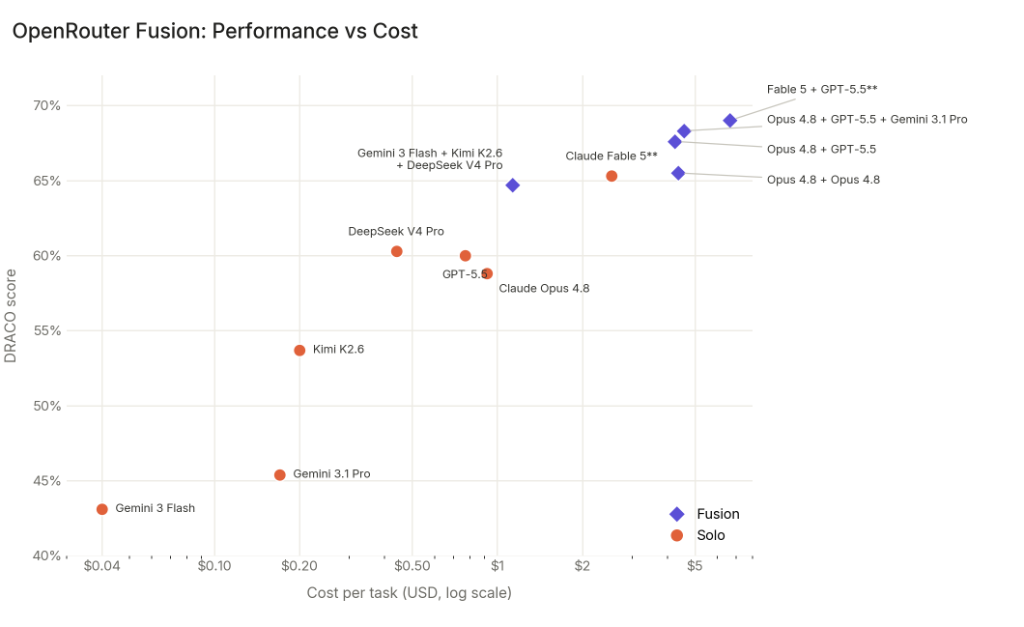
Curiously, fusing a model with itself also boosted performance (2xOpus4.8 roughly matching Fable on the benchmark, but costing twice as much as Fable). There's a further, smaller gain from mixing different models. The main gain seems to be from additional test time compute.

Would love to see more research on this, especially focusing on the cheap models that came out recently (e.g. Fusing DSV4 with itself, or with Mimo), and to see what the tradeoffs look like between running a fusion (parallel test time compute) vs increased reasoning or turns.

reply
sigmoid10 2 hours ago
Interesting how well a panel of Fable 5 + GPT 5.5 beats the frontier of either one, but if you add Gemini into the mix the panel of three performs worse, not better. To me that sounds like Gemini is worse at the given tasks but better at convincing judges of its solutions. Oh and a Panel of 2 Opus 4.8 models is almost exactly as good as one Fable 5. That smells suspicious. Do we know if that might simply be what Anthropic is doing behind the curtain?
reply
qsort 2 hours ago
Yeah, GPT 5.5 + Fable beating either individually is belivable, but 2x Opus > Fable is what makes me a bit dubious about the whole thing. They might be measuring skills that are too specific or benefit a lot from more tokens being thrown at them. Also Claude Code (the harness) is not the best at the moment, that might be part of it as well?
reply
waysa 2 hours ago
> Oh and a Panel of 2 Opus 4.8 models is almost exactly as good as one Fable 5. That smells suspicious. Do we know if that might simply be what Anthropic is doing behind the curtain?

I wouldn't be surprised if Fable/Mythos is a model distilled from a Panel/Council of Claude instances. Recursive self improvement is something all AI labs must be working on in some way or another.

reply
wongarsu 29 minutes ago
> Curiously, fusing a model with itself also boosted performance

Back in the GPT2 to GPT3 era this was a pretty common thing to do. You are effectively taking more samples from the space of likely outputs. If your model can do the task 60% of the time just take 5-10 samples and implement some kind of majority voting

It became less common to use as models got high accuracy on problems where combining results is trivial. But with a more complex judge (a competent LLM) you can still get better results by just sampling more of the output space and picking out the best aspects

reply
jorvi 2 hours ago
I don't know if it is still the case with current models, but a few generations back Microsoft had some research results where asking a model to iterate N times would significantly improve performance, with the optimal point being 4 iterations.
reply
Garlef 2 hours ago
> but a few generations back

Out of interest: Was this still before CoT/thinking-mode became the norm?

reply
rektlessness 25 minutes ago
I tried OpenRouter Fusion with the budget model option but swapped out DeepSeek v3.2 for DeepSeek V4 Pro. The results weren't that bad. An interesting take on quorums for sure. However I did notice a tool call to Claude Opus 4.8 for 1168 - 237 tokens, and $0.0118 cost, which I cannot account for because Opus was not in my selection and only revealed in logs. Strange.
reply
maccam912 8 minutes ago
Same for me! I bet they use opus to synthesize the final answer somehow? Regardless, it was unexpected.
reply
eknkc 44 minutes ago
I opened the page and prompted it `Which 3d printer is the best`. I mean this is a stupid question but I was looking at some 3d printers so it popped into my mind.

Seeing this log is interesting: https://link.ekin.dev/6RzYGGX7

It came up with a decent response but I guess Opus or GPT 5.5 would do fine anyway. Gotta try it on different stuff. But this feels like it would work great on some situations.

reply
bushido 38 minutes ago
Interestingly I've had a similar experience with agent teams/swarms, albeit they can get much more expensive depending on the workflow.

I found that Fable didn't have as much of an impact when put in a team.

But it was/is a very pleasant model to work with 1:1. And was the first time I didn't use my primary team based workhorse in months, across 10s of sessions last week.

reply
galsapir 7 minutes ago
really interesting that its basically almost 80% claude opus..
reply
Havoc 2 hours ago
Interesting. Will definitely use this.

One scenario I can see it working is writing markdown specs before the coding starts and analysing it for gaps. That’s so few tokens that throwing as much LLM against it as possible is worthwhile regardless of cost per million tks

reply
egeres 2 hours ago
I wonder if these fusion techniques could help to run better local AI by streaming tokens from multiple machines and combining them
reply
insumanth 2 hours ago
[dead]
reply