Could you teach a 5 year old to drive a car? A 10 year old? A 12 year old? To drive a car requires being able to read, to have judgement about ice or rainy conditions, to anticipate a child running after a ball. By the time a human in in their mid teens they have acquired the base knowledge...
Small models need to have enough base knowledge to be able to be good enough -- even in a seemingly narrow regime. Where is that? Obviously they don't need all the obscure knowledge of a frontier model but there is some base level which is probably more than it would first seem.
Millions of people do drive who can't read. It's very common in parts of Asia, Africa, Latin America, etc, especially rural, but even in cities.
There are places where oral exams and audio-assisted testing is allowed. And there are places where people just drive (and drive fine) not bothering with a license.
Emphatically, it does not. Passing your drivers test may require being able to read, but plenty of illiterate people around the world drive just fine.
There is a reason we made all the common road signs recognisable purely by shape/colour, after all.
And whole lot of people have done stupid shit like that while perfectly able to read, many even with masters and PhDs.
Though it is true you don't need to be able to read to operate a vehicle, you /do/ need to be able to read to operate a vehicle safely.
And for those who can read: could you teach someone how to drive using an LLM? Sure. Safely? Probably not.
[0] https://www.transport.nsw.gov.au/operations/roads-and-waterw...
Not really. You just need to be able to decipher the sign, which is trivial, even if you can't read it or spell it.
Especially important in places like Europe, where it's common for the driver to be able to read, but unable to speak the language of the country they are currently driving through. I can't speak any Polish, but can travel on Polish roads just fine
1: https://en.wikipedia.org/wiki/Prohibitory_traffic_sign#No_en...
But in situations that could be ambiguous, I think this is a regional difference - the US, Australia, part of the rest of the Americas use lots of text on road signs (including literal "wrong way" signs); Europe and much of the rest of the world use far less text (including purely pictographic "wrong way" signs). Especially important in Europe where drivers just can't learn 20+ languages.
It's also trivial to do a u turn even when you can read, know what the sign says, and you feel like doing one because no car is coming anyway, and millions of people do that everyday too.
I would be interested to see a formal study of this. I say this not out of anything other than a observation that I think the only real blockers are a) judgement, and b) physical reflexes/strength. As a kid I was certainly aware of ice,snow, and rain, because I road my bike year round and had low confidence in my own ability to control my bike on snowy or wet terrain, especially during season changes. That translated into learning to drive in northern Canada in the winter and applying those lessons to driving.
In an environment devoid of consequences, I have seen kids operate driving simulations (both real simulations, and video games) with a degree of precision that is shocking, including seeing several 9-11 year olds play the simulations and games with a much higher degree of confidence than adult drivers. Children have an awareness that the simulations are consequence free, unless given other motivation. Adults that are consistent drivers have muscle memory and preconceived expectations that govern the decisions they make when playing the game. I am curious about the level of training and exposure required for children to overcome their lack of awareness of the hard limits and consequences of driving and driver error, versus the amount of training and exposure required for expert drivers that are novice gamers to stop applying their learned experience to consequence free simulations.
(i'm above average in both)
Different times though.
This requires not only knowledge, but also the control systems that develop with the prefrontal cortex. LLMs don't do much control yet.
Conflation. That's to drive a car safely. To just drive a car one only need know to press gas to move, press brake to stop, turn steering wheel to change direction and maybe use a gear stick to shift into drive/park (car can be modified to abstract that away). Not much more complex than riding a bicycle; maybe even less since no need to learn to balance.
I'm glad to see more domain-focused SLMs, we need more of them! A programming focused MoE should work well across many languages.
It is a cheap specialist for closed-world, verifiable reasoning tasks like math, self-contained coding problems, and similar.
"Closed-world" means the needed information is already in the context. It is not a tool-using agent that can discover missing context. "Verifiable" means answers are hard to generate but easy to check.
So no open ended research, repo wide agent work, factual Q&A, or SVG generation. More of a compact reasoning module for bounded problems.
    Solve the following first-order ODE for f(x):

    ((-1 - 2*x)*f(x)*tan(1 + x - exp(-61 - 2*x)*f(x)/x)
    + exp(61 + 2*x)*x*(1 - x*tan(1 + x - exp(-61 - 2*x)*f(x)/x))
    + x*tan(1 + x - exp(-61 - 2*x)*f(x)/x)*f'(x)) = 0

    Find the general solution f(x).
    f(x) = x*exp(61 + 2*x)*(1 + x - arccos(C/x))

    C is an arbitrary constant.
I just tried the quantized Q4_K_M from [1] in my RTX 2070 Super, it ran at 110 tok/s with 1800 tok/s prefill, and found the same solution to your prompt. It generated valid LaTeX for the answer but its reasoning trace uses mostly compact ASCII math notation. Took 3min 22s to answer, spending 22k tokens almost all on thinking.
[1] https://huggingface.co/prithivMLmods/VibeThinker-3B-GGUF
I really like the idea of small models that can reason but do not have too much knowledge. Also, no emphasis on tool calls. I think the agent should do the heavy lifting and reach half way.
I use really small models, like Qwen 3.5 0.8B to 9B - no tool calling, no MCP, no skills, nothing. No multi-turn chat even. Models are given very specific tasks using a vast number of system prompts and all the response handling is done in the agent(s).
> these findings motivate the Parametric Compression-Coverage Hypothesis, which views verifiable reasoning as compressible into compact reasoning cores, while open-domain knowledge and general-purpose competence require broad parameter coverage over facts, concepts, and long-tail scenarios.
These kinds of models might be more useful as tools to be used by larger orchestrator models, than being the orchestrators themselves.
Here's what I got
https://9ol.es/tmp/pelican.png
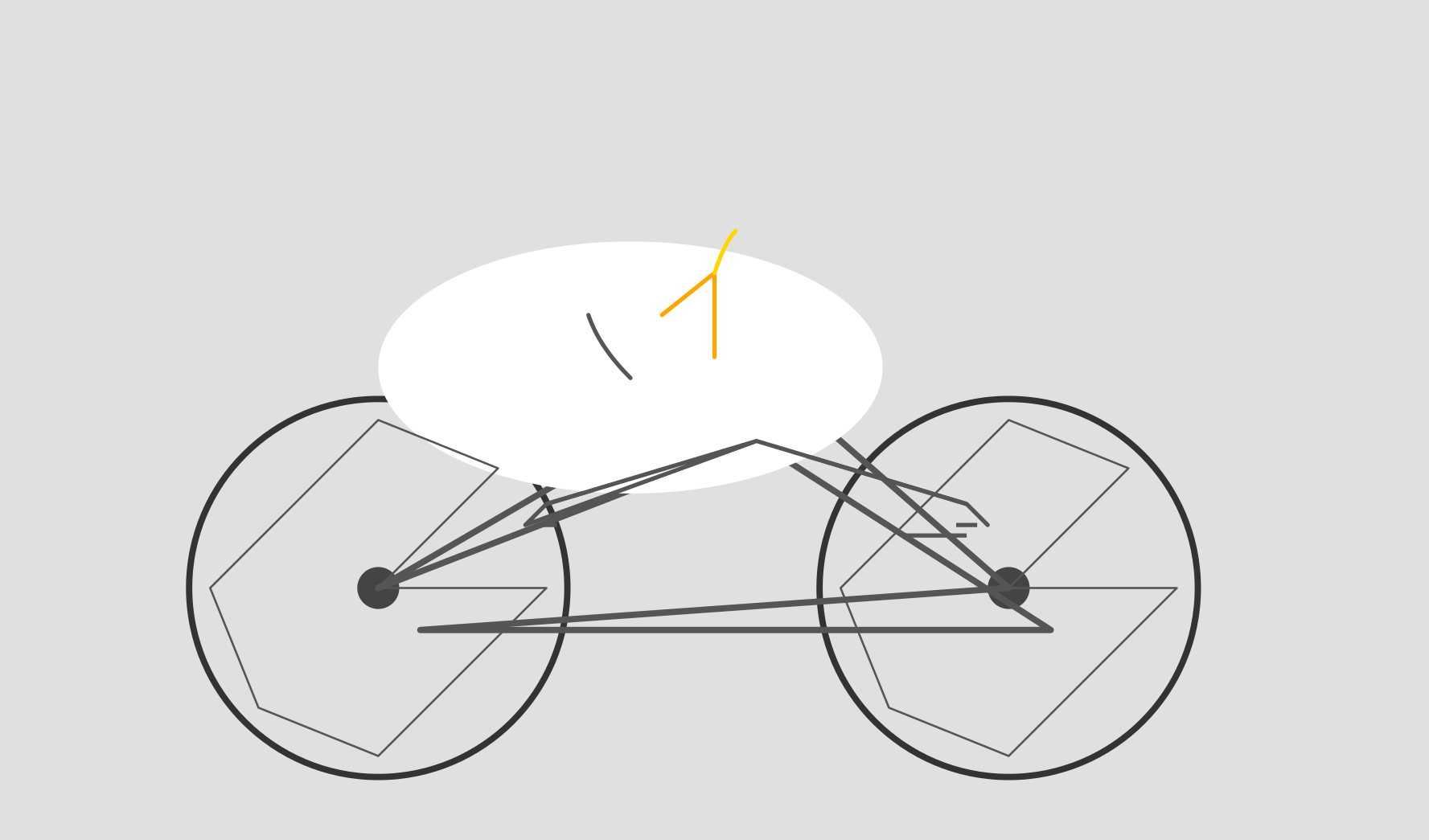
with https://9ol.es/tmp/prompt_pelican.txt
using prithivMLmods/VibeThinker-3B-GGUF:Q4_K_M
It would look really dumb if someone asked it that, but that's fine. You're trying to make a model that is optimized for efficiency for a specific task. As much as possible, you should prune uncorrelated things.
Assuming tool calling hasn’t been entirely stripped out of this model.
(Edit) No tool calling, per this comment: https://news.ycombinator.com/item?id=48640189
That's also more aligned to its leetcode style training data, the code under test is fully in the context window. It might be interesting to have a bigger tool use model go through the effort of collecting the context, and feeding it into this kind of model for analysis only. It becomes more of a thinking tool, instead of the orchestrator.
It might appear not, but actually, the process of reasoning is not an isolated act. The right and wrong way of doing things is codified in social evolution that absorbed all facets of life. Why should you optimize a piece of code for performance? Why performance is needed? What is a bug? What features and UI themes would be more intuitive for humans?
There is a butterfly effect. Everything affects everything to some extent.
Sadly that's not how LLMs work, since all they do is "token prediction". At least the models we have to today ...
Some amount of knowledge is required for reasoning. Maybe such model can dynamically knowledge domains to have taxonomy. For example, model can't effective reason about development task, if it has no knowledge about development best practices. But population of New York or recipies can definitely be loaded run time with tools.
If "all the knowledge" is what our models now do, what exactly would be the most extreme "none of the knowledge +search" ?
> language specifications.
It would load in all the knowledge to figure it what "language" means, then it would continue trying to decode what "specifications" means.
That might sound absurd, but to figure out the population of New York It's either: Just going to google it, or derive from primary sources.
But how is it ever going to interpret the primary sources? It needs to understand the question, how complex a question is, and how complete an answer is and how things relate. Thats just _too_ much language.
There might be a way to compact this down into a LLM-native language such that the request of `the population of New York` or `use best practices` is encoded without our messy human language for a reasoning model to work with, but the encoding itself has to be done by the "all the knowledge" llm. Now it seems we just rebuild something related to MoE with extra step afaict.
Turns out that without the world knowledge to have a base of facts, it is not.
First, if you know nothing you don't even know what you're missing or what to search for.
Then, without unlimited context, you have to do research for every task all over again every time.
RAG on the initial prompt would be the first thing to try.
> Then, without unlimited context, you have to do research for every task all over again every time.
Thing is, we're really really good at building very fast search engines. Doing research all over again every time shouldn't be a problem.
Even the most basic questions such as put a ball in a cup and place it on a table upside down then pick up the cup and put it in a box.
Requires knowledge of things not mentioned in the question (notably gravity).
Strict definition of all terms quickly gets you into a quagmire of complexity. Some base level of knowledge about things is required for you to give it instructions. If it only knows how to reason, it lacks any idea of what to aim to achieve.
There is quite a pronounced disconnect between the vast stores of written data that models are trained on and robust consideration of a topic. I do wonder if the path can be directed by the order of training.
For example if you train a model to basic literacy using tinystories, then math and philosopy texts, then psychology, and sociology texts, and then finally the mass data of everything from conversations and rants, to code and fiction.
Does that end up with a significantly different model to one that is trained on books on acting, creative writing, and fantasy novels, before introducing the same final mass data set.
How much does it's current ability allow it to contextualise new training data?
That plus this model should give you a very powerful and focussed assistant.
Even recent massive models do not work anything like a smart human does at the moment so why are we assuming this can?