I've started buying PCBAs from Ali, where the vendor advertises the exact chip set in use. It's often cheaper than domestic options.
Listings for assembled hubs (whether ali or domestic) almost never include information about the hub's actual characteristics, unless you're looking at a 300+ hub sold to audiophiles.
I'd really like a source for a true 7p hub, with MTT, proper power, per-port overcurrent and power switching, but I can't seem to find one, especially since vendors tend to rev b2c products with no notice (one of the name-brand ones I bought had been downcosted shortly before I bought it).
It helps a bit to spot and avoid that exact exterior design, but often those devices are designed to reuse the same mold as more-expensive ones and/or keep changing the design based on the purchasing customer.
So you end up on AliExpress looking at 5 identical hubs, but the cheapest one may have a different PCB inside.
Or you look at 5 different hubs, with all of them having the same PCB inside...
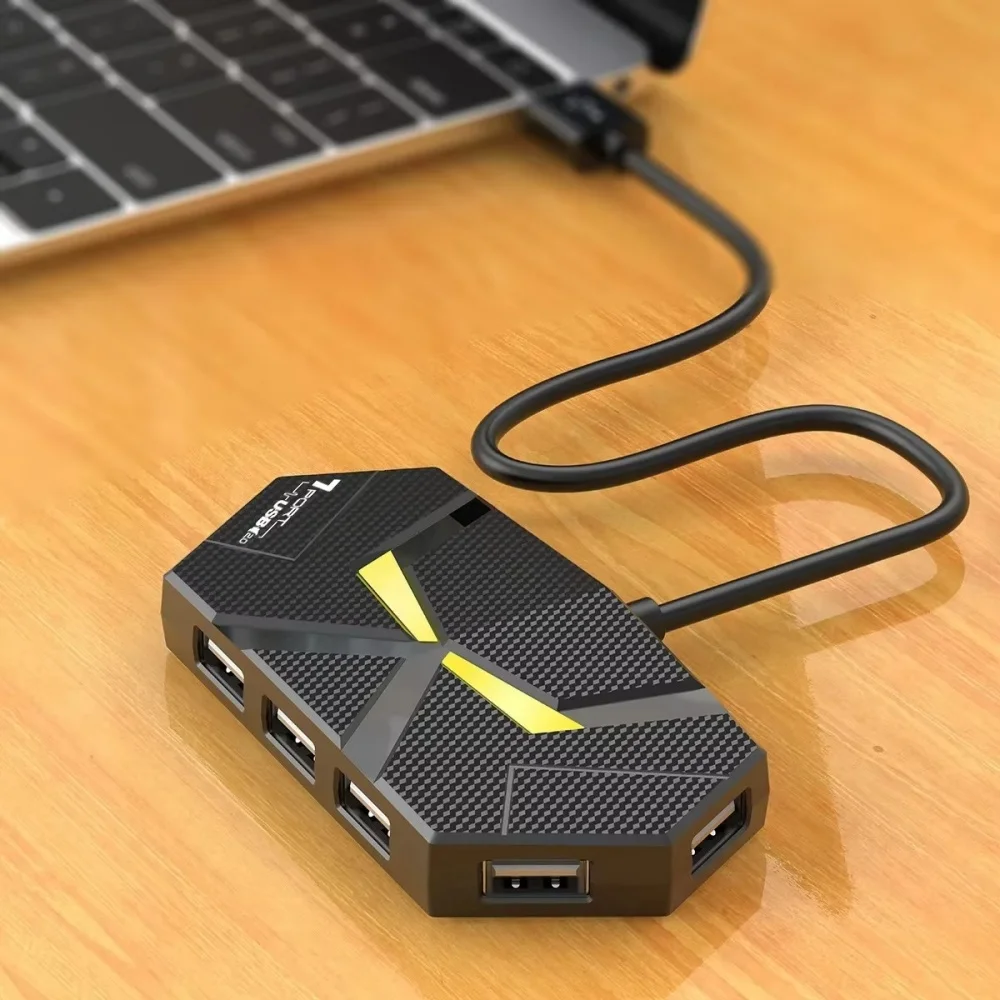
This crappy 7 port hub is one of the only ones that "works" to reprogram the chips over USB. Direct connections and other hubs cause it to always appear as a HID and never appear as a thing that can be reprogrammed.
I’m interested.
https://github.com/markomarkovic/nena-ilo-lili/blob/main/doc...
It looked like that, I can't guarantee they're all created the same though, also it has RGB lights for some reason.
https://ae01.alicdn.com/kf/S6b270a53da9b4179af73036c5f6f9c89...
USB 1.0 had a model where you really could enumerate 127 devices attached to a hub. The USB 3.0 makes no promises for what should be possible with hubs and if you actually try it you find that at some point plugging in a new device makes other devices drop out. Like I've never been able to plug 7 devices into a 7 port hub.
Otherwise they become the weakest links in your setup
Apparently that use case is very complicated with USB even in modern times :(
On the other hand it's useful for space constrained embedded projects. I got a small outdoor enclosure for a Pi Zero, to which two RTL-SDR sticks are attached - too much to supply via the Pi's USB-OTG power rail alone. With the Adafruit microUSB OTG hub [1], I now only have one power supply going into the hub that backfeeds the Pi Zero... one cable less.
If you're looking for a good USB3 hub, look for one with a short thick USB cable, metal chassis. If it has HDMI it's a good since because you're unlikely to pump that via USB2.
Just stop subsidizing international shipping period seems the smart play. If they want to undercut their own high-end domestic competition and destroy foreign competitors then they can at least pay fair rates.
Always surprises me when people pay essentially nothing for a product and then complain about quality.
EU is cracking down on foreign webshops at least, setting rules for advertising, increasing import taxes to avoid flooding the local market with many individual packages that circumvent spot checks for basic electronic safety and (EM) emissions (what the FCC looks out for as well), etc.
Gemini strongly disrecommends buying this product[1], but it's not clear if the opinion is based on Dr. Gough's review in-part.
This, of course, leads to another arms race where listings like this will be "AI optimized". They may have prompt injections, or simply specifically claim that issues like backfeeding are resolved when they are not.
And it also makes the AI companies an arbiter of what products are marketable.
Also, all of the brands (cheap or expensive) will sometimes mess up the cost-cutting and make something reliable by accident. Buying cheap gives me more chances to get lucky in this way.
Some direct reviews between 2 and 4 stars are also sometimes useful. Always discard the 5 star ones...
It was advertised as having a 2600mAh battery, but when I opened it up, inside there was a 1700mAh cell. Also no sign of purported weatherproofing, as the lens was not even glued in.
I have a 2000mAh cell in the same form factor (approximately 500Wh/l, so believable) on its way from China, which makes me wonder how did they come up with that 2600mAh figure.
The same capacity corresponds to different mAh at different voltages, maybe they are playing games with that.
Also, it's not the voltage, but over-current that reduces overall produced energy.
Typically the mAh is listed at some standard discharge rate, unless the cell is specifically advertised as a high-current draw cell. But either way an honest supplier will provide the draw/capacity table for you, rather than cherry pick the best one.
Anecdote: back in 2004, a friend brought home a cheap digital audio player from her vacation to China. IIRC, it said on the front panel that it could play back MP3, MP4, and MP5.
Price isn’t the only axis by which products are evaluated.
Aliexpress eBay and even Amazon are full of listings that have high prices, just waiting for someone naive enough to mistake them for quality products. They don’t sell much or at all.
When people find a cheap product from a known brand they jump on it because they know there’s a higher chance of it being okay, and if not there’s a higher chance that they can return it or get warranty support.
When people buy a JUPQRKBOT branded Amazon special for a too good to be true price, they know they’re playing a different and much riskier game.
When I run into this issue in any product category, I can solve it by searching for a solution from an "industrial" or "commercial" supplier. It'll cost 10x, but it'll usually work, and if it doesn't you'll at least be able to talk to someone who knows what they're doing.
In just about any product category, there is very little quality difference within the same order of magnitude in cost.
I got a box, some usb cables that have a female end and are fitted to mate to the box. If you are curious, it’s a box made for pro-audio equipment with precut holes. The holes are made for xlr ports, and the usb cables are terminated with xlr ports.
Now I have a usb hub where all four ports are wired directly to my motherboard’s ports. I probably should write a blog post with a parts list.
If you go higher level, of course there's Thunderbolt docks, but you can't make them cheaply, so they're generally good.
I'm somewhat sympathetic because from what I can tell engineering something capable of pushing that much data requires some exquisite engineering for every part of the process (chips on your computer, your computers port, your cables, the dock, the cable into the end device and the device and its port and chip). But still, they present these products like they're bulletproof.
It's possible I've had bad luck. A Caldigit TS3 had issues with dropping external drives and becoming unresponsive, then died after 2 years. Caldigit TS4 bricked itself after about a year. Got an OWC Thunderbolt Dock now and it just decides sometimes to stop communicating to anything new plugged in until you power cycle it.
But if you have that AND a USB bluetooth dongle, a USB ethernet adapter, USB DAC with SPDIF output you run into the "USB-C is best effort at best when you plug in a lot of devices" problem... Which never gets talked about, though if you talk to Copilot or Gemini about it they will tell you don't waste your time with USB 3.
This isn't usually a problem for most of my devices. My Thinkpads just alert me and say they're not charging at full speed, ending up negotiating something like 58W or so. Similar things with other devices. However, I've got one machine that will not even attempt to charge unless it definitely gets 20V/3.25A, which this dock just will not negotiate to for non-Dell devices.