The Last MPEG-4 Visual Patent Has Expired
127 points by LorenDB 7 hours ago | 29 comments

at1as 5 hours ago
Moving in the right direction, but unfortunately it's still quite a few years before H264 is off patent, globally:

https://meta.wikimedia.org/wiki/Have_the_patents_for_H.264_M...

At which point, the continued march towards higher resolution and bandwidth video will probably limit their utility

reply
ronsor 3 hours ago
> At which point, the continued march towards higher resolution and bandwidth video will probably limit their utility

Just as the patent system intended: maximum extraction was enabled while the product was useful.

reply
goalieca 2 hours ago
Now if only copyright didn't last forever..
reply
ronsor 2 hours ago
The Berne Convention has permanently burned us there
reply
userbinator 2 hours ago
I don't think video resolution will increase all that much in the future, except for niche uses, as the resolution of the human eye becomes a limiting factor.
reply
makeitdouble 37 minutes ago
I read "resolution" as pixel count more than DPI.

As it becomes cheaper to capture and process higher res content, we're bound to push it to bigger displays (VR included). I guess the human eye will be the limit when we're at retina levels of DPI on a sphere.

reply
theandrewbailey 6 hours ago
> While the US and EU patents around MPEG-4 Part 2 expired in recent years, until today there remained one patent still active in Brazil.

Since MPEG-this Part that is hard to keep straight, this is the MPEG standard backing Xvid and DivX codecs. So let's encode video and torrent like it's 2002!

reply
CharlesW 5 hours ago
FWIW, Via Licensing listed this patent as standards-essential to several MPEG codecs (AVC/H.264, HEVC/H.265, VVC/H.266), and it's also listed for VC-1 (a SMPTE standard).
reply
p1mrx 5 hours ago
The openness of those codecs depend on the last patent expiring, not the first.
reply
CharlesW 5 hours ago
Of course.
reply
dylan604 2 hours ago
> So let's encode video and torrent like it's 2002!

Let's have a meet up a Circuit City!!

reply
xattt 2 hours ago
I’m not sure how to get there. Do you have Microsoft Streets and Trips directions I can print off?
reply
p1mrx 5 hours ago
Note that MPEG-4 part 2 is H.263/DivX/XviD, not H.264.
reply
jchw 5 hours ago
Yeah. I think h264 is coming soon, too, though. Most of the remaining known h264 patents expire next year, with only one patent extending out further.

I do believe that more modern codecs like h265 and AV1 have a lot to offer us, but having h264 be fully unencumbered by patents will be nice. By modern standards it is very well-supported in both hardware and software, computationally cheap to encode and decode, and still does a good enough job for most use cases. h264 doesn't seem like it will be displaced any time soon to the degree that h264 once displaced its own predecessors, though obviously that's not to say that we don't see or won't see more adoption of newer video codecs across the internet in general, just that I think the h264 long tail will be one of the longest long tails of a video codec.

And thanks to the availability of codecs like AV1 which are effectively not patent encumbered (seems there is no practical reason to take the threats otherwise seriously) it seems the era of patent encumbered media formats is slowly coming to a close. Good riddance.

edit: Bit of a mess but here is some source for the h264 expiration.

https://meta.wikimedia.org/wiki/Have_the_patents_for_H.264_M...

So it seems 2030-11-10 is the date where h264 (version 3) will become patent unencumbered world wide, a bit earlier for the U.S. The other profiles/newer versions like AVC/SVC will take a while longer.

reply
Dylan16807 4 hours ago
> computationally cheap to encode and decode

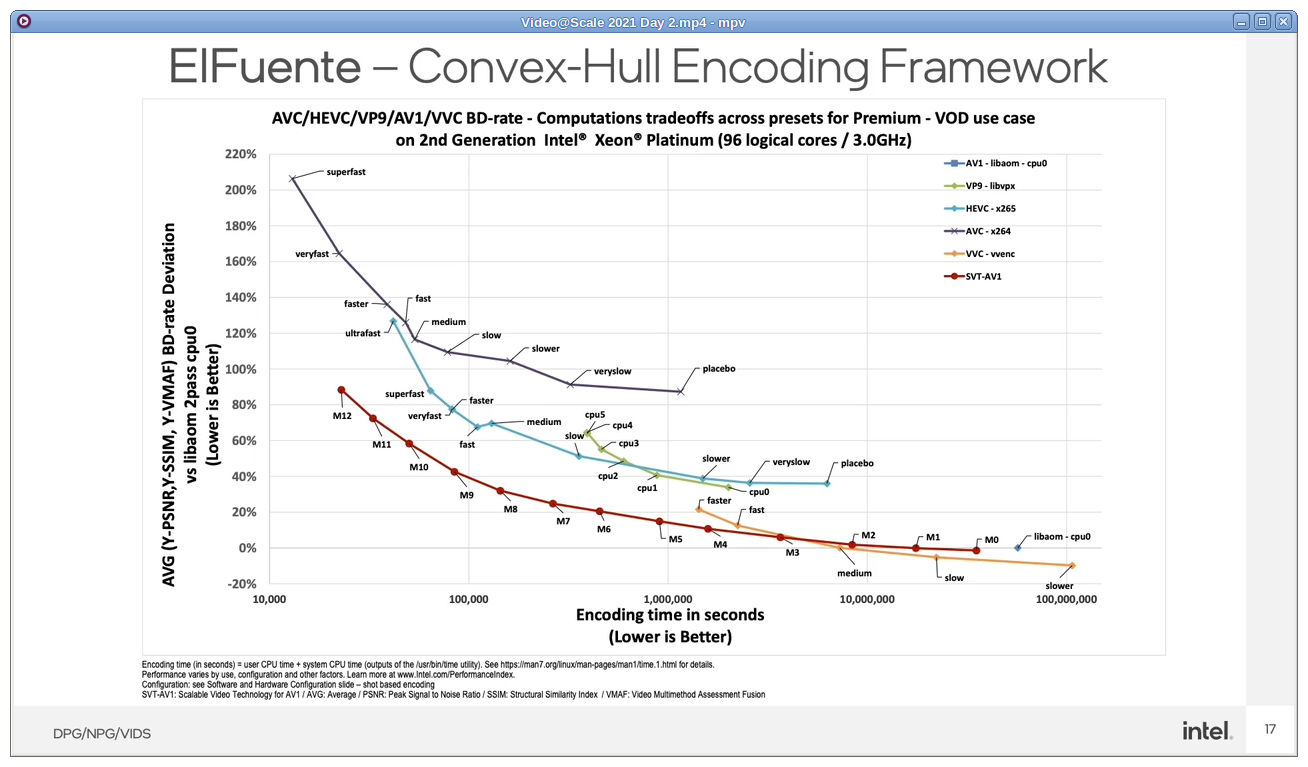
Well I'm not sure about decode, but as of a few years ago weren't h.265 and AV1 able to do much better compression than h.264 at almost all levels of compute? https://people.videolan.org/~unlord/SVT-AV1_BD-rate.png And h.266 encoders can probably go faster now too.
reply
jchw 4 hours ago
I would hope so! Otherwise the Pareto front wouldn't have moved in ~20 years which would be rather hard to believe.

However, at the same time, h265, h266 and AV1 are all vastly more complicated, and will have less broad hardware acceleration support than h264, which, again, even if it is not optimally efficient use of compute, just doesn't require a whole lot by modern standards.

So I'd argue there is really no reason to be rushing away from h264 unless you have a compelling reason. There are some obvious compelling reasons in some cases; nobody is going to be terribly surprised that an entity like Netflix is eager to switch to codecs that will save bandwidth, because at their scale saving bytes definitely adds up, bonus points if it can increase the quality at the same time.

On the other hand, though, unless you are absolutely sure you can switch to only new codecs, you will probably want to keep some h264 encodings around to act as a fallback baseline for legacy devices. And thus, you also have to take into account the complexity brought on by needing to store and maintain multiple encodings - in many use cases, like simple <video>s thrown into website backgrounds, I can see just eating the extra bandwidth costs and keeping it all h264 as a valid strategy.

reply
Dylan16807 2 hours ago
Well a lot of the improvements cost more computation. I wouldn't be surprised if low-computation video had only improved slightly, but it seems like it has improved a lot. The advantage of h264 is hardware adoption much more than actually being computationally cheap, it seems? Well, maybe. The thing is, I don't know how the decoders scale. Can you make a decoder for a constrained AV1/h.265 in the same hardware space or maximum CPU budget as an h.264 decoder and still see very big advantages?
reply
userbinator 4 hours ago
just that I think the h264 long tail will be one of the longest long tails of a video codec.

I think MPEG-1 and 2 (from which MP3 comes) might be even longer.

reply
drmpeg 23 minutes ago
MPEG-2 video is still very much alive. In the US, almost all terrestrial OTA broadcast (ATSC 1.0) and all SD channels on cable systems. Even Comcast VOD was all MPEG-2 (including HD) until they shut down the QAM version in 2023.
reply
userbinator 4 hours ago
DivX/XviD yes, but not H.263. Patents for H.263 expired long ago. This is MPEG-4 ASP, which is a superset of H.263.

(Source: have written a H.263 decoder as a learning exercise.)

reply
anthk 3 hours ago
H.263 was used as the former codec of Netmeeting (and maybe some other VoIP software too).
reply
userbinator 2 hours ago
H.263 was definitely a standard in videoconferencing and low-bitrate video in general (YouTube and many other streaming sutes used FLV1, which was a variant of H.263) prior to H.264.
reply
rcarmo 5 hours ago
Good. I have been poking at rcarmo/go-264 but was hesitant to tackle encoding :)
reply
nikanj 3 hours ago
It's so weird to look at the patents list for H.264 and see multiple patents granted after the H.264 specification was released. Was the situation similar for MPEG-4?
reply
wmf 2 hours ago
The patent pool system is really bad. There's no incentive to weed out bad patents.
reply
userbinator 2 hours ago
Those patents may not necessarily be required to encode or decode, if they're just a new way to implement some part of the specification.
reply
midnightbobarun 6 hours ago
Very nice, I hope this means increased support for it in open source projects
reply
rurban 5 hours ago
But they sold xvid decoders already for the last 20 years. Every Chinese dvd players could play xvid already. Just not >1 b-frames
reply
anthk 4 hours ago
Too late; software patents in Europe were void so most people grabbed XVID/DIVX encoders from Debian Multimedia. PKF and the like.

And, yes, I remember w32codecs until MPlayer's bundled set superseded them. And mencoder for sure ;)

reply