And as a small aside, idk how one can write sentences like this and not immediately revolt and switch to metric:
Since a gallon of fresh water weighs roughly 8.34lbs, we estimate this puts the entire weight of the system’s water somewhere between 170 and 250lbs.As a scientist and an adult immigrant to the US, I came to appreciate both systems as useful for different objectives.
Celsius/Metric is neatly rooted in science - where it truly shines by removing /most/ of the conversion factors (but does it? we still have, today, speed of light that should be 1, Avogadro and Boltzmann constants are just odd numbers you memorize too) - but doesn't match neither everyday weather and life (0F being "coldest you'll experience in a place humans commonly live" and 100F being "hotest", and close to wet bulb temperature and, through a fluke of an undiagnosed fever of Fahrenheits' wife, nice threshold for fever).
Fahrenheit/Imperial is actually relatively convenient to machining, industry and agriculture (but not engineering or science) - how much of that is actually fractional measurements (1/16th makes a ton more sense than 0.0625), and how much are the "fingertip/decent meal/daily water intake/sustains a person" idea of an inch/lb/gal/acre.. is quite intuitive. Far more so for composite units. 1 PSI is intuitive - you know what force to exert at what area of a piston, same for torque'ing to 80 lbs-ft.
But.. it makes a ton less sense when you separate N from kg (yeah, I am a physicist, I know why, it just makes less sense when building stuff in a dirty corner of an industrial revolution), then somehow apply it to a whole square meter to get a Pascal, and now you need decimal fractions of a million of those.. to represent what you actually see. Quick, do you think you can plug a 2cm diameter garden hose at 0.5MPa with your thumb to spray your dog?
CGS system was quite popular and useful, IMHO for that reason, at the time when Europe was actually manufacturing stuff and inventing them in barns and factories. But it was essentially "neither" - bastardization of sacred kg and meter - lost to SI.
US keeps inventing and making stuff in garages and fields.. and it shows in its devotion to imperial system. But I can see convincing mechanics to 1/8th of a cm and 40g way before I can see them taking up 1.25 mm and 0.04 kg.
I accept that psi is more intuitive in many cases than Pascals. But I remain unconvinced about Fahrenheit. I reside two places during the winter. One has temperatures around 0C, and the difference between -1C and +1C is much more important than the difference between -1F and +1F, it's the difference between rain or snow! The other place regularly sees temperatures around -25C. In both places -18C is just some random uninteresting temperature, letting it be 0 is... disturbing.
In my experience, DWC systems support plants fine without the pumps. I used them for years before trying Kratky, and sure enough, the plants still grow. This might vary by species. I have had pump failures as well, but never more than 36 hours or so. In any case, it wasn't enough to harm the plants.
An aside: I just looked up Kratky (to be sure I had the name right) and the image results are pure insanity. AI generated nonsense. There's one where the image generator used perfectly clear containers and included some sliced limes in the media, haha. And soil.
Starting a hobby like hydroponics will probably be so confusing with garbage like this all over the place.
edit: The lime-aid dirty Kratky system
https://easyhomehydroponics.com/wp-content/uploads/2024/09/c...
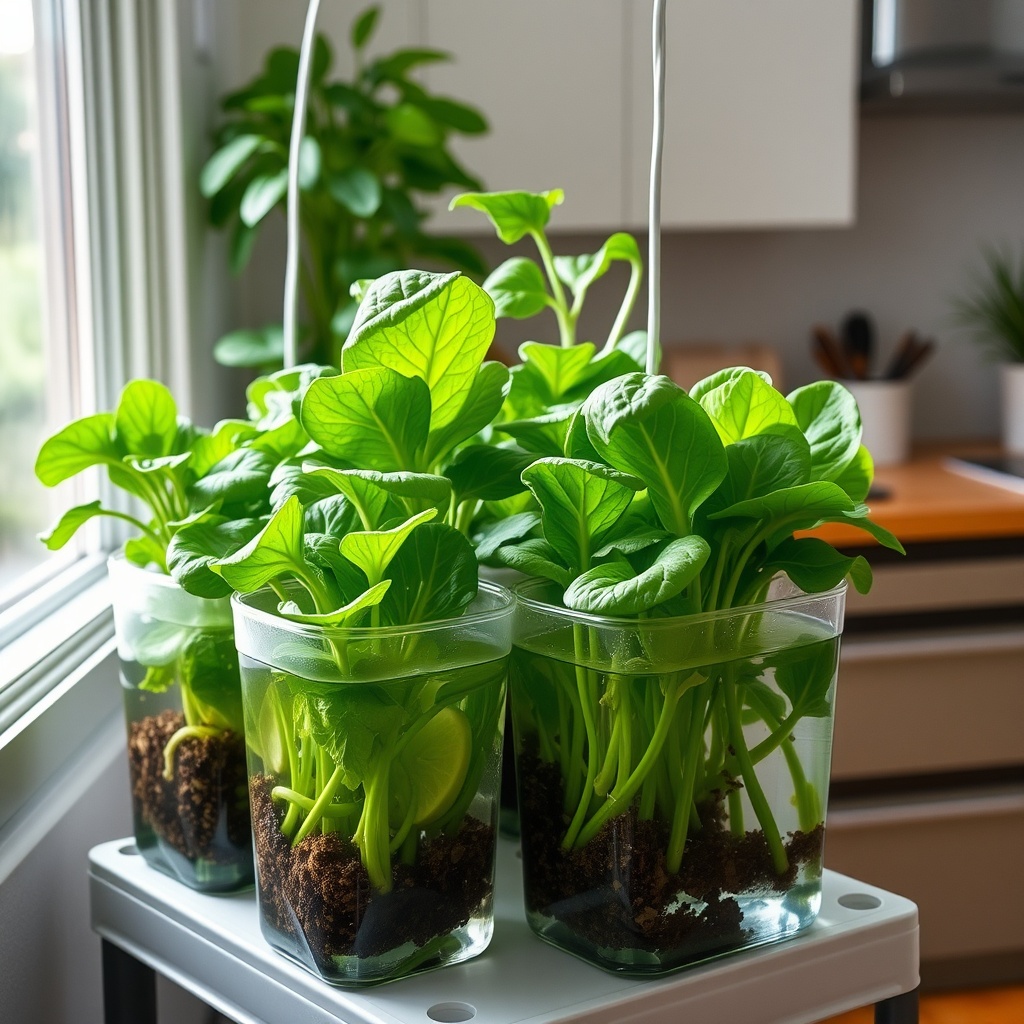
The O Garden seemed an interesting modern spin (couldn't resist the pun):
https://www.coolthings.com/ogarden-rotating-indoor-planter-w...
(but I think they went under? The footprint was kind of extravagant)
I still think someone needs to work up a unit designed to fit next to a refrigerator --- bonus points for circulating filtered air so that the heat from the fridge is harvested for the plants.
The other option I've been curious about is a window unit mounted like an in-window air conditioner (maybe you could combine the two? harvest the condensate and heat for the benefit of the plants?)
HU 42: TOR switch. 41-40: management server (2U). 39: git server for `fish` (1U). 38: build server for `fish` (1U). 37-28: fish (10U). 27-24: plan9s. 23-14: plants. 13-5: plumbing. 4-1: UPS.
Don't put your UPS under a fishtank, folks. It becomes an IPS when it gets wet.
You know, maybe I should reconsider having my UPS at the bottom of a rack that contains one server in the middle with liquid CPU cooling... Or just add a liquid sensor between them somewhere perhaps.
Contrary to popular belief, one drop of water on the case of an electronic rarely breaks it. You do need to get a substantial amount inside the electronic to break it.
I remember building a water sensor kit as a kid and going to the bathtub to try sensing water and my mom rushed in and stopped me because I was putting electronics near water.
...also, maybe I'm reading too much into this, but why not "a programmer and her quant bf"? She's the one who wrote the article on her own blog, and this is primarily a community of programmers.
I reviewed photographs of the home lab setups, and I evaluated ingredient/supply/equipment lists. I even inquired at my credit union's branch whether they could sell me silver bullion, which was hysterical in retrospect.
Then, as I slept on it a few nights, I had nightmares of this electrolysis lab just getting out of hand, taking over my bathroom (where there is actually no space for anything else) and just ruining my dull, ordinary life. I don't even have any roommates or family living with me here.
So of course I decided not even to try this. This NYC apartment seems similarly constrained. If I were their landlord, I would dread finding someone running this kind of crap. Insurance and liability are the biggest problems here. They should go purchase a home if they want to play around.
I'm not aware of any new york apartments I've lived in that forbade having pet fish or plants.
If tank fails, you are liable for water damages and home insurance DOES NOT cover that. We were flodded by neighbours, the damage was $20.000 in cheap east europe commie block.
Plus bigger tanks need structural support in floor (steel beams).
Also steel is completely unnecessary unless you're doing something wild like that guy in NYC with a 17,000 gallon home aquarium. If you're just throwing a 200 gallon or so on a second floor, an enginer might not care at all if its across the joists or has a wall below it, but even if its completely open below, the "support" might just be a joist of a different design, or an inch thicker or one extra joist. Steel is really not nessecary
The Pfizer building in NYC almost collapsed after they tried to build a swimming pool on the roof. This happens semi-regularly when building owners ignore, or don't consult, engineers about rooftop swimming pools. Every owner wants one and doesn't want to be told no.
I dont think they got to the pools. I worked for a company that did a bid for the electrical work. Edit: there was a pool. Didnt have on plans at time
Second edit: looking at wrong plan. There was a pool but it was basically a blank plan with annunderdesigned roof.
Whether an aquarium is covered by home/renters insurance is specific to the policy and aquarium size, not consistent enough to make statements like this. This aquaponics system is essentially a planter on top of a low stock aquarium.
I will say that the shelf supporting the aquarium seems inadequate to the job, increasing the risk.
> With similar concerns in mind, we also decided to limit the tank size to 20 gallons, as the grow-bed above also contains an additional ~10 gallons of water. Since a gallon of fresh water weighs roughly 8.34lbs, we estimate this puts the entire weight of the system’s water somewhere between 170 and 250lbs. Considering the weight threshold of the industrial shelving, and given that we live on a high floor in our building, we decided to constrain the system to this size to minimize the flooding risk.
Citation needed. Very bold sweeping claim
Source: https://www.thezebra.com/ask/renters-insurance-coverage-aqua...
Imagine the lawsuit if you rent out an apartment that you own, and your „very intelligent“ tenant produces water leak damages, in a nyc high rise with potentially ALL owners underneath you affected.
For landlords worst are dogs. With wooden floors soaked with acidic urine, all surfaces scratched and chowed. Thanks to ESA bs, you can not even charge extra security deposit or extra rent! And normal tenants avoid your building, nobody wants to live in laud smelly zoo!
But as a form of agriculture it’s a spectacularly bad idea at home.
This setup is about 1 square meter of NYC space, that’s about $18k. Meanwhile agricultural land goes for about $2/m2, or 9000x less. Then you spend $700 in parts to set up the 1 square meter, even if you put the system on cheap rural Kentucky land. Then you pay $170 a year to power the system for again, 1 square meter.
Meanwhile the 1 square meter produces like less than $100 in annual produce.
Green house farms like in the Netherlands have perfected this growing method and it’s quite effective. Home food production is a joke by comparison just like home anything production of a commodity product.
So fun DIY projects but as a serious way to grow food it’s terrible, not economical or sustainable. I tore down my project the same year I built it, taught me a lot but made no sense to continue.
When you buy a couch, are you thinking "will this couch offset the value of the square footage it occupies" or "will this couch be comfortable and match my décor?"
I'm glad someone is doing something fun in their home.
I am also glad that someone has the luxury of just buying whatever couch suits their decor - but you’re being awfully flippant by presumption that that’s a normal state of affairs.
By and large people buy what they can afford, not what they fancy, especially for something big like diet other.
When I bought a couch, I had a budget. What I didn't do was walk into the store and ask myself how this couch is going to pay for the square footage it occupies. It won't. It can't, that's not the point of a couch.
By the logic in the top comment, nobody should own a couch because it doesn't generate money that would offset the cost of the space it occupies. That's my issue with the top comment.
Nowhere in the OP is there a suggestion that they are doing it with the intention of saving (or earning) money. Nobody, no matter what their means, buys a couch because they think it will behoove them financially to do so.
OP made an aquaponics thing because they wanted to. I bought a couch to sit on it. God forbid.
And on that note, buying something cost-optimized to your space is itself a mark of privilege. My first couch was the nearest free one to my home, since I didn't have a car. It was much too big for the space I put it in. But it's what I could afford, which was nothing.
It seems that there's someone in New York eluding suffering by messing around with aquaponics. Good for them.
Growing a bunch of potatoes in a barrel would be a lot more bang for your buck with that goal in mind. To really optimize costs and labor, though, as you say, you need a greenhouse and/or a big old field, just like always. There are no small-scale shortcuts. Not yet, anyway.
It makes me a bit sad that even with modern tech we haven't really made it much easier for people to produce their own food. But it's a reminder that our food production requires large scale collaboration and cooperation. Maybe that's a good thing.
If seen as a hobby it isn't more pointless than 3d printing dragons.
2. I eat unwashed basil leaves and other greens growing outside, I eat them by first putting them under my tongue, my seasonal allergies (I am allergic to everything but mold) have plummeted over the last 3 years of this. The folk remedy of farmers market honey did nothing for me.
I did sublingual drops a decade ago and there was moderate improvement but for medical reasons I can't get a prick test again and I haven't been able to find a provider that will just make drops for me based off my original prick test.
It's impossible to find what plants capture the most environmental allergens on leaves or in edible flowers so I just have a collection, I figured that made more sense than licking a swamp cooler.
Anyway, I've gone from taking Allegra most days to only 2 months out of the year.
A lot of "specialization" looks more like enforced helplessness where the world around you seems to be full of mysterious magic outside your one specialty and often your specialty is very many levels of abstraction away from anything obviously useful to an end user (i.e. some brand of navigating office bureaucracy).
Many things aren't actually all that hard to do yourself nor do they take up all that much time or energy. And there are many things which aren't actually possible to distribute to end users so what's possible by yourself is so much more than what's possible to sell.
Generally, yes you are right. Home farming (eg vegetable gardening) generally isn't economical. That doesn't mean it's not valuable. Besides being fun... I do think home gardening some resilience to the food system.
Aquaponics is, in general, not really a viable commercial method. Or rather, the plants are just a filter for the pinds...not a true secondary product.
Still... aquaponics is fun.
However, I think that by reducing it purely to a monetary number, you are not measuring things correctly. Part of the output of doing DIY things is the knowledge, experience, and fun that comes from doing it. If you insist on putting a dollar sign on that, I’m sure it ends up being much more equal.
One one hand it's a fun DIY project for some people.
On the other hand, every other year somone rediscover vertical farming that makes no sense except for very niche products.
So probably 99% of the users are clicking directly to the comments and upvoting the inane GP comment to the top, and the “no one reading this” is actually almost no one.
The article itself is clearly just a hobby learning fun project.
The point is that it's fun and you learn something.