Previously Fable was the best at this, followed by Gemini 3.1 pro (a surprising #2, but Google has great vision models).
Opus' results seem to be more accurate than Fable, following the design source of truth better.
Example results:
Design source of truth: https://image.non.io/73e239a3-880f-4793-b65f-4810be2d9378.we...

Opus 5 build: https://html.non.io/solaraOpus/
Fable 5 build: https://html.non.io/solara/
Note the buttons - for fable they're pill buttons, opus got the rounded rectangle nature of them. Opus' images are closer to the source of truth as well (both LLMs were provided with image gen capabilities for the assets).
Running more tests now, but preliminary results are saying this is indeed better than Fable in some areas. Crazy.
One thing I've found LLMs have a lot of difficulty with is angular cuts / elements that aren't easily representable with CSS. Cyberpunk aesthetics are generally a great test of that, since they have a lot of microglyphs / window decoration.
Design source of truth: https://image.non.io/9d5fed20-b476-49d3-841b-37eb553fb88e.we...
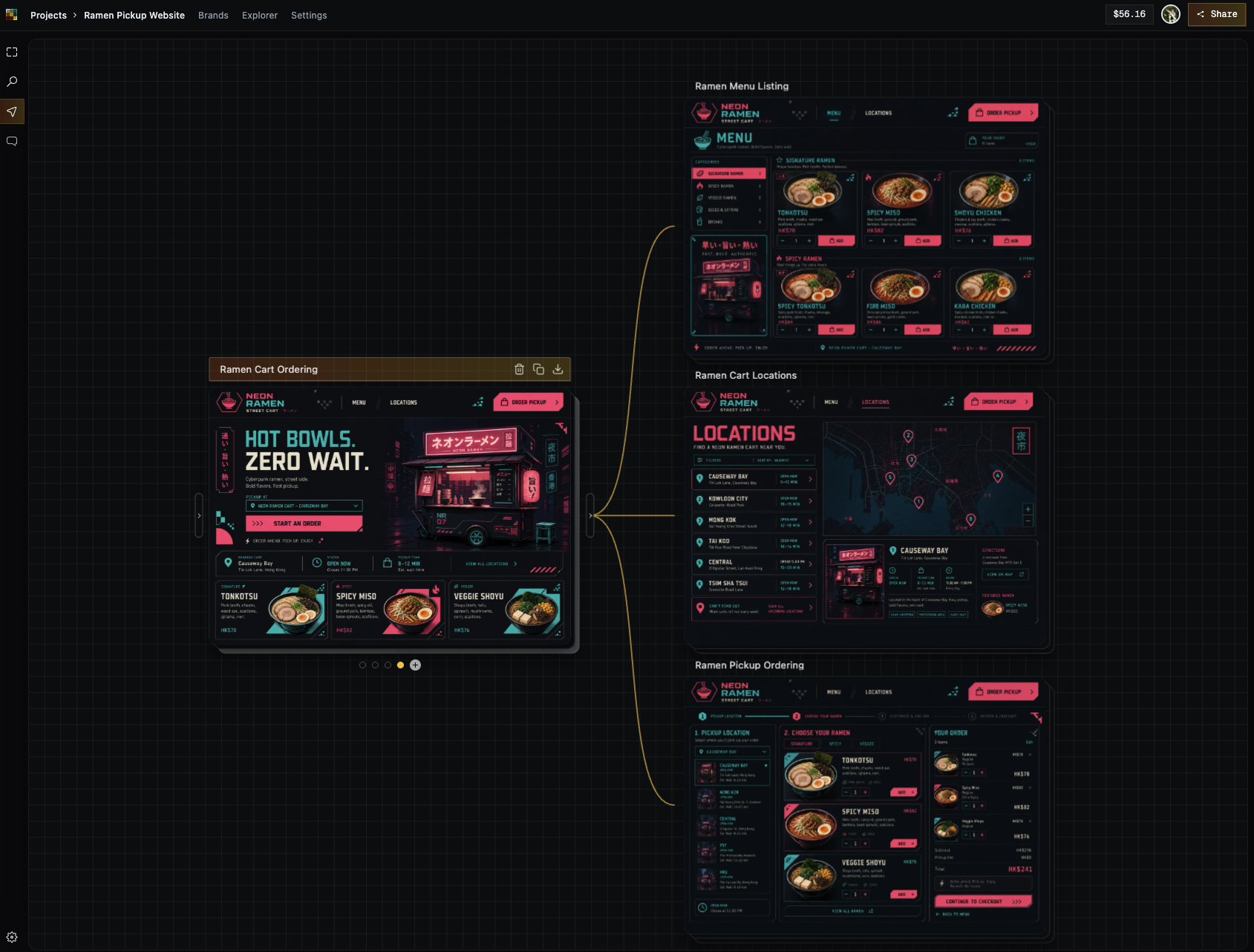
Opus 5 build: https://html.non.io/neonRamen/
Thoughts: It does a really, REALLY good job at these angular cuts / microglyphs. The responsiveness is off, but I'm very impressed at how well it did here. One way I think of it is "how close to a finished product did this get me?". Opus gets you like 90% there.
Personally, I think being able to have these design languages be easily prototypable is fucking awesome. Great tests! (But a tad low-performance/janky, somehow). Though, I also like the cyberpunk aesthetic. Very on-brand(?) that AI generates it, hah.
I love this so much.
Designs like this would never have seen the light of day in the cellphone incrementalism / corporate memphis era of tech. Now people can be weird and awesome again.
This is 1980's cyberpunk / late-90's Matrix / early-00's sci-fi UI. Great ideas that died to frutiger aero (which isn't a bad design aesthetic) and flat design (which is).
This is fun and it's got great colors and I love it.
It's so refreshing to see this.
AI rules. This is the best timeline.
This was just from a prompt "A cyberpunk themed ramen food cart website. Should feature menu, locations, and an ability to put in an order for pickup. Simple and clean website with angular cyberpunk microglyphs, pink/teal colors."
But sure, lets cheer that funky website designs are back on the menu…
In the mean time, I’ll unashamedly continue to cheer for creativity and innovation. Note: I don’t even like this website design.
The "funky" websites of the past were mostly a result of tech immaturity and a lack of profit motive.
Businesses have been able to easily install templates like this for at least a decade. They don't because stuff like this looks cool but isn't very functional.
AI isn't going to make your local restaurant have a funky website, it's just going to make everyone who use to work directly and indirectly for that company unemployable. And even the local restaurant will close down because they can't compete with the multi-national competitor that has automated their kitchen with AI.
Out of curiosity, what app is that Design source of truth screenshot from?
Edit: Generation was down, back up now. Apparently just hit my $1000 cap for the openai api. Upped it to 10k. Growth!
Opus though followed the source of truth better imo. The details are more present.
Fable filled in the gaps for things it wasn't able to do (ie in the design the hero image goes behind the nav), which resulted in a better looking page that was more divergent.
It seemed to me that Fable meaningfully improved on the original design more than just faithfully executing the original design.
> Create a web page implementation from the following instructions:
> https://diffui.ai/build/Spa_Booking_Experience_build.md?auth...
There are 10+ LLM companies, each with dozens of models of different modalities, each model with multiple size variants, then different “thinking” levels, then agentic modes, “pro” modes, a “fast” option, standard vs flex vs batch execution. And of course each end combination has a different input/output/cache token price.
Companies that say “give me a prompt and I’ll route it to the most ideal and cost effective model and setting for you” are capturing a ton of value from a gap that model developers don’t seem to understand exists.
Model Routing is just Bitter lesson. The models themselves will get better at this and frontier companies will simply give that capability
It would be like asking the clerk at a Whole Foods which grocery store in the city sells the cheapest eggs. He’d probably answer - he might not even say Whole Foods - but WF is hardly teaching all their staff the best methods to answer this question in training. (Heh, training.)
model routing in this case is cross-provider
Imo the main issue behind model routing is you need to figure out how much intelligence a new task takes, which is a very non trivial problem. Presumably, a organization knows this about their own tasks and is better suited to built in-house compared to outsourcing to a vendor.
Otherwise the expensive-yet-powerful model probably won't see much revenue. How much money is there in bleeding edge scientific research? There's a lot, but there's even more existing capital in paying people people to do college level paperwork, and the bulk of those traffic gets routed to the cheapest model.
You mostly don't need super powerful AGI to replace the paper pushers, but the frontier labs are trying to position themselves as being uniquely capable of producing super powerful AGI, and also be the ones replacing office workers.
Not sure how it will work out for them, but I think model routing is going to poke holes in that narrative. That's why I think they're trying very hard not to understand model routing exists.
For me, anything other than current best available SOTA for any task is unacceptable. The only routing rule I need is "the most powerful model I still have flat-priced quota available for". I mean, why settle for less?
Model routing for subsidized users takes the form of a "use Opus 5 subagents for implementation" type of system prompt. You lean into a single provider, build tooling around that, and your savings are far beyond anything multi-provider routing can get you.
Model routing for enterprises is far more complex - approaches like https://fireworks.ai/blog/kimik3-fable become necessary for cost control.
There is also matter about convenience - when I ask some small easy question often I don't bother to switch the model or forget in prompt to ask faster/cheaper subagent.
Also: quota. Implies you do not have unlimited access even for flat prices. Which in turn implies that as soon as you hit the quota on the most expensive flat price plan, even you will suddenly discover the magic of economically sensible behavior.
Certainly if I'm confident that I'm going to get what I need from a faster model, that's what I want to use, rather than wasting time grinding away for the sake of saying of the same answer came from a SOTA model.
Given that every chatbot does offer a range of models, it seems clear people do choose among options.
I just want to switch to Claude Code, tell it to turn a .csv into a BigQuery table then cmd+tab to something else while it runs. Thinking "oh this is probably an easy task, I can /model to Sonnet to save $0.0004" is silly.
Then you must route. An article with lots of upvotes yesterday or two days ago showed that K3+Fable 5 was more SOTA than either of those.
OFC, YMMV
For coding my own work I don't trust the model router, and it would have to be shown to be to save a real dollar amount.
From a buying perspective it's a hard sell to save x but lose out on bugs you are probably introducing at an unquantifiable severity and frequency. How much is it worth to hedge your bets by doing every single inference request on the frontier model?
How much will it cost to go back later and fix things, but also the meta question of how to be able to decide on a hypothetical unknowable? (You'll never know how much better or worse your code was gonna be, it's untestable at a project level)
If that is true, model routing is here to stay.
It also seems to validate the minimalist approach of pi.dev, where sub-agents from the same company is not the preferred approach (pi.dev believes in neither sub-agents all from the same company nor MCP even you can do it if you want for pi.dev's philosophy is to do add any functionality you want to a minimal harness).
Now of course we'll get for a few weeks all the Anthropic fanbois and shills explaining that "sure, K3 was basically at the level of Fable 5 but now that Opus 5 is out, open-weights models are six months behind".
Two benchmarks (artificial analysis and vals) show a increase in cost (a insane increase for vals compared to Opus 4.8).
Already posted this before, so here is the link.
Almost as good for half the cost is something I'm very comfortable describing that way.
It's also not unusual in this context - many people describe the Chinese models as "best", because it's 80% as good for 20% of the price (or similar).
Got an endless list of stuff done with Fable, Opus 4.8 was like a flailing braindead idiot in comparison. Maybe this one is a bit better if it's distilled.
Where are you getting cheaper per dollar?
Where 5.6 has optionality to run much cheaper along the same performance curve at lower thinking levels.
There's a later chart that shows Opus 5 ahead, but seems like an esoteric benchmark rather than for common use. (Novel problem solving)
If they had a more efficient model at coding they would lead with that chart.
https://artificialanalysis.ai/models?cost=intelligence-vs-co...
Here is another data point for output token efficiency:
https://artificialanalysis.ai/models?cost=intelligence-vs-co...
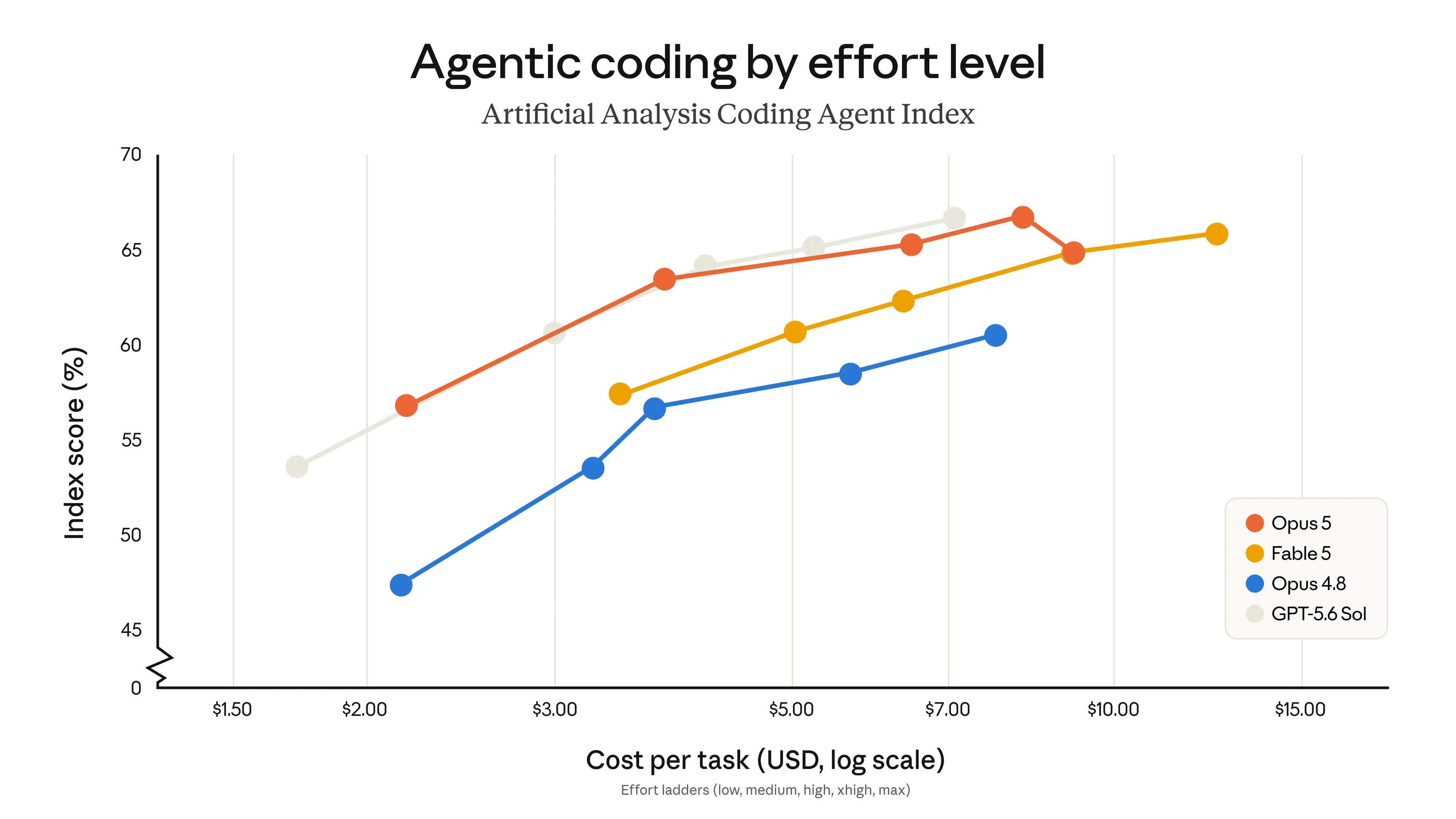
It seems roughly equal according to Anthropic's benchmarks
How big of a lie is too big? Especially when no lie needed to be told at all: many including myself would have noticed the tiny 0.1% deficit and been suitably impressed by the Opus 5 result.
I’ll admit this is a small deception by today’s standards. I’m one of those who believes in truth for truth’s sake.
Edit: typo
Fable is typically used for key planning, architecting, and review tasks.
I think this is a case where you don’t understand the use case, not that the marketing department is making mistakes.
"Use <less expensive or older model> for everyday tasks and <other non-critical stuff>. Use <more expensive or recent model> for complex coding tasks, refactoring large code bases, etc.".
Then, the next model/release emerges and the previous "best for complex" gets demoted to "everyday".
Obviously, it's all relative. But, it does beg the question: was the previous model really good for complex coding tasks or no? I mean, how is it now suddenly only good for the "easy" stuff?
Because your expectations have changed.
---------------
Why does Anthropic say here that Opus 4.8 scored 55.7% on OSWorld 2.0 benchmark, but the paper published by the authors of OSWorld 2.0 say they achieved a benchmark of ~21% with Opus 4.8? [0]
That's a huge gap, considering that the paper was published just 2-4 weeks ago.
I understand that the benchmark authors have an incentive to publish lower numbers (to show that the benchmark has potential longevity) and that Anthropic has incentive to publish higher numbers, but the other models seem pretty inflated as well. The benchmark authors shows GPT-5.5 at 14%, and Anthropic shows GPT-5.6 Sol at 62.6%.
Is there any reasonable explanation for this? Do all the other benchmark numbers need to be sanity-checked as well? Are SOTA benchmarks really this difficult to get consistent, replicable results within a reasonable range of tolerance/variability? Can these benchmarks be compared from one paper to another, or are they only valid to compare intra-paper results?
That is—the agent scored 100% on 20% of tasks, but on average it got 54% of the "score" awarded in the exam. One number reflects partial progress, the other one doesn't. The authors of the benchmark prefer you to look at the lower number (because they want to show their benchmark as capturing useful gaps in capabilities and with a lot of room for improvement), the authors of the models want you to look at the higher number (because they want you to think of their models as capable)
What variance is acceptable to publish without a retraction?
Like the other person said 5% variation is probably expected
The answer is there can be dramatic difference running a benchmark one time, because LLMs are not deterministic. A proper methodology would ask each question 20 times and calculate the mean correctness across experiments.
The reason is that the temperature parameter introduces random behavior.
Opus 5 still uses "carry the argument", "worth stating plainly", ", and the trap", "The X matters more", the use of "move"
We need an "annoying English" benchmark.
- Fable 5 Max: https://gist.github.com/deet/3d97f854b48eac6658d642fa18bb24d...
- Opus 5 Max: https://gist.github.com/deet/1a43693a732dfccb4d0d914bfc42692...
I'm also thinking of another benchmark: (quantified) stylistic range across different prompts. Just putting it out there if anyone wants to do the work for me :D
These models are heavily as safeguarded and that was the initial reason why they said they couldn't and haven't released Mythos because that model is the one without the safeguards.
OpenAI is did the same thing when they announced a model without safeguards broken into HuggingFace servers.
since then I have never cared about models except those that affect money in my pocket e.g AWS Nova Sonic
- https://www.axios.com/2026/04/08/anthropic-mythos-model-ai-c...
- https://www.axios.com/2026/04/07/anthropic-mythos-preview-cy...
- https://www.businessinsider.com/anthropic-mythos-latest-ai-m...
- https://www.reuters.com/world/anthropic-ceo-dario-amodei-arr...
Then system card goes on to "Its AI R&D capabilities are comparable to those of Claude Mythos 5", which is supposed to be fable minus restrictions.
They do say that (implicitly unlike Mythos) Opus 5 was not trained to exploit software vulnerabilities, which would certainly make it safer in that regard.
"As with its predecessor, Opus 4.8, we’ve intentionally avoided training Opus 5 on cyber tasks. The model has nevertheless improved substantially on these tasks as a result of becoming more generally capable, and it comes close to Mythos 5 at finding cybersecurity vulnerabilities. However, it remains substantially behind Mythos 5 on the exploitation of those vulnerabilities—that is, in turning vulnerabilities into material cyber threats."
It's the only case that I saw going through the system card where more reasoning effort meaningfully negatively impacted the resulting eval. I know sometimes max efforts show a small dip, but this is substantial. I wonder why in the world that is?
> We report FrontierCode’s overall score, a composite measure that grades each patch on blocking functional criteria (held-out unit tests) together with weighted code-quality rubric criteria, as mean@5.
They don't explain more in the system card, I guess higher effort levels could loose points on the code quality / scope / style / maintainability stuff?
> Claude Opus 5's default user-facing responses run longer than prior Opus models'.
The benchmarks do show Opus 5 as slightly more expensive than 4.8, although the scores are much higher.
This still feels like a step in the wrong direction, though, especially with OpenAI making so much progress with the efficiency of their models. Fable's token efficiency made it seem like Anthropic would start following OpenAI's approach but that doesn't seem to have carried over to their other models.
I think in the long run tokens are probably the wrong thing; it's compute and cache memory that you need to be measuring, and when you look at it that way I suspect in most cases the models have pretty similar performance.
I don't need more powerful models, I need one that responds fast enough that my attention doesn't wander to other tasks. Grok 4.5 is so fast I can just use it in-band without swapping to other tasks.
Slower than Opus 4.8, which was already miserably slow, is indeed a step in the wrong direction.
Gemini also had modest increase before this - don't be surprised when OpenAI also has a "modest increase" with its next release. Cartel-like behaviour doesn't require direct communication when none of the participants are interested in participating in a margin-destroying price-war. All one needs to do is raise their price and watch how the competition react.
Such a scheme (and resulting high margins) would be imperilled by the existence of frontier open-weight models in the market, which may be why the reaction to Chinese models may be particularly shrill.
No I will be surprised and I'll bet on the fact that prices will keep going down, just like it went ~50% down in the latest GPT 5.6 release.
I was dividing my work between Codex and DeepSeek. Now I barely use DeepSeek, or never because Codex quota is enough after Sol
To be fair though, Sol tends to go off the rails sometimes. It's much less reliable than Fable in its outputs. It tends to be overzealous in its research/changes.
Is it because maybe Anthropic engineered Opus 5 to work well on benchmarks and didn't do the same thing to Fable 5, or is there another reason?
[0]: https://artificialanalysis.ai/#intelligence
[1]: https://platform.claude.com/docs/en/about-claude/pricing
[2]: https://platform.claude.com/docs/en/about-claude/models/over...
I have been trying to build something that captures the behavioral element of different models, but it's kinda tough.
Okay so it’s worse than Opus 4.8 for my purposes I guess?
I recently created a patch for Riftborne via static IL patching and Fable 5 outright kept refusing to do it, no issue whatsoever with GPT 5.6 Sol lol.
Fixing those issues still requires humans.
934 days since people first started threatening that devs would be replaced by AI in 365 days. 0 day(s) since Anthropic posted a developer job posting.
Only one of those numbers would need to be dynamic.
Specialist headhunters handle that.
Imagine you are a company that sells concrete. You have a web dev contractor you use to build and maintain your website. It has tools on it to get delivery quotes and a few internal tools to track orders.
Except now you can just have your sales team also maintain the website with a $20/month Claude subscription.
and you can only kill weyoun, awaken the next vorta clone and have him 'catch up' on all that its missed so many times before they just end up with a complete mess, so. uh. yeah.
doubt they can just "fix" their problems like that.
They start hitting timeouts or API errors at the same time on two different computers. As far as I can tell it’s the exact same infrastructure.
- Boris
And memory leaks.
So dangerous! I can't believe they let the public use this technology! /s
On a serious note, I hope they improved their extremely sabotaging and unspecific bio safeguards, which prevented Fable from being used in any codebase that ever so slightly grazed medical terminology or data and made me switch to 5.6 Sol.
This is snarky but I am grumpy: I wonder if there's a correlation between me refusing to use LLMs and me being happy to read a novella-sized PDF about them.
Semi related, but i would hate to read that PDF but i also hate reading what LLMs write lol.
LLMs are pretty terrible at being concise. Using an LLM these days means putting up with bizarre and often confusing phrasing, wordy explanations, etc. It's kinda crazy to me how good they are but how bad their writing style is for me personally. Even though i use an LLM constantly i can't stand reading its responses.
Maybe it's just me, but 150 pages is like third of a good book. Quite long. And it's full of LLM slop, they did not even bother to remove the em dashes.
I'm not saying you're wrong btw; I'm sure this has many authors and some of them probably used LLMs significantly in the writing process.
I'm not saying it's impossible, but I'm more confident about winning the lottery next week.
It's okay if you're not the target audience for one or the other.
They're not meant for normal consumers who just want to use the model for work.
And lots of folks read these. For example here's simonw's notes on the Claude 4 system card: https://simonwillison.net/2025/May/25/claude-4-system-card/
All of this seemed like utter sci-fi just a couple years ago. Do you think that frontier AI companies should be less transparent?
It creates the MacBook svg way better than 4.8, yet only fable can make it perfect without visual defects. Results similar to Kimi K3.
Another thing that helps is pointing it to patterns in an existing codebase (e.g. "use the box-link pattern for cards, as shown in [..]").
EDIT: The point being that even if they make mistakes that are easy to spot and fix _now_, you'd have to assume that in the very near future those kinks will be ironed out - I mean, the capabilities are only going in one direction.
Why can't they also allow Fable to do so also? Why is source-code vulnerability discovery limited to a lower capability model? If Fable and Opus have the same safeguards, except for this one change, I see no reason they can't also allow this for Fable.
Apparently this is the way - if you know, you know :)
It seems plausible to me that RL improvements allowed Anthropic to improve on Opus 4.8, similar to how OpenAI substantially improved upon GPT 5.5 with 5.6 Sol.
Fable 5.1 and GPT-6 are rumored to launch in August, presumably bringing those improvements to the larger models.
I don't know how systematic Anthropic are about their versioning - I'd have guessed that major version number increases (4.x -> 5.x) reflect different base models (different pre-training runs), in which case Opus 5 would be a distilled version of the Fable 5 base model (but without the cyber exploit post-training), rather than Opus 4.8 with additional post-training, but who knows? I don't believe Anthropic have said anything about this.
I think the best proxy for this feeling is the Artificial Analysis' omniscience index. Fable has a 40 score, and Opus (4.8) has 27.
> we’ve intentionally avoided training Opus 5 on cyber tasks [...] it remains substantially behind Mythos 5 on the exploitation of those vulnerabilities
I wonder if Anthropic would still intentionally nerf their models without the threat of government intervention.
I don't think this is benchmaxxing. These companies are locked in a competition to produce the best software engineer, and falling behind is an existential risk. I doubt they are wasting time benchmaxxing ARC-AGI.
I view benchmaxxing as more of a spectrum. Mmaybe they're doing a lot more RL in environments similar to ARC-AGI 3, not even with the purpose of scoring well on any benchmark but hoping it generalizes into better performance on real, useful tasks.
Maybe hook up a bunch of the AIs to a stereo camera and a couple of microphones and give them control over actuators to so they can drive cars. Then lets race them around a somewhat complex course.
When they are good enough at driving on tracks, put them on the road. Maybe see which can drive a truck with 400 cases of Coors from Texarkana, TX to Atlanta, GA and back within 28 hours.
I’d say the proof is in the pudding, that is, in real-world applications. We are still seeing important limitations in LLMs.
- Opus 5 is 10% smarter than Grok 4.5 for 10x the cost. - Opus 5 is a bit smarter than Gpt 5.6 Sol for 2.75x the cost
ref: https://artificialanalysis.ai/?cost=intelligence-vs-cost-per...
It did far better at some tasks compared to Sol (e.g. the ARC 3 benchmark)
I assume 100 is the max, meaning it's impossible to be 2x as smart as Muse Spark 1.1
There’s also the frustration of it not quite being enough sometimes. It’s extremely capable, but I still find that it needs more concrete guidance and boundaries than other models.
If you don't believe checking the opt-out box actually opts you out, then this sentence could be said about literally any provider.
1. Thinking on by default: On Claude Opus 4.8, requests without a thinking field run without thinking; on Claude Opus 5, the same requests run with adaptive thinking.
2. Disabling thinking is capped at high effort: You can still turn thinking off with thinking: {type: "disabled"}, but only at an effort level of high or below.
[1] https://platform.claude.com/docs/en/about-claude/models/migr...
Though it gets even more confusing because they also have effort levels so it’s not really possible to call one fast and one slow since Fable on Medium will be faster than Opus on Max.
I agree it’s confusing, and now OpenAI is following Anthropic’s lead with their new naming (Sol, Terra, Luna).
A similar complaint was valid years ago when OpenAI had GPT-4o, o1, o3 (but no o2), o4-mini-high, GPT-4, and GPT-4.1 and GPT-3.5 etc.
Arguably the complaint was more valid for those older GPT models you mentioned.
Some models like ViTs use something similar but then introduce words with no unambiguous order, like Small, Medium/Base, Large but then I always forget if Huge or Giant is larger.
Also fwiw I’ve never found LLM benchmarks to match reality based on my own usage, not for the large frontier models or smaller open weight models so who knows if Opus is actually better than Fable (I doubt it).
> Suggestion for a better naming system: use the words "Pro", "Plus", etc.: Claude 5 Pro, Claude 5 Standard, Claude 5 Fast, Claude 5 Mini.
This is not possible: Standard (Free) / Pro / Max are plan names. Fast is a mode.
And people know this? I didn't. I am not into music or poetry so these are not terms I am familiar with.
fable: 99/100 sonnet: 97/100 haiku: 91/100 opus: 89/100
So while these terms are almost universally known, opus is indeed the least known of the four. And I guess this only measures whether a person knows a word, not whether they know an opus is longer than a sonnet! Personally I only inferred that based on the related term 'magnum opus.'
From the system card [1]:
  The Fable cyber classifier we have previously discussed also applies to Claude Opus 5 , with one notable exception: for Claude Opus 5 , we’ve unblocked vulnerability finding in source code to help our coding customers develop more secure code.
  If you are a cyber defender and are experiencing blocks on Claude Opus 5 , we are also offering exemptions through our Cyber Verification Program, which will remove blocks to enable activities such as bug bounty hunting and vulnerability research and verification. Enterprise customers can also apply to join the Cyber Verification Program to have mitigations removed to enable penetration testing.
Nice of them to be more explicit for what is blocked. Will be interesting to see if this is true or not.
Also, a notable lack of mention of open source models. They only compare themselves to ChatGPT.
In the next - please scan this totally mine code for vulnerabilities
It's great with Codex.
I still find that LLMs tend to not know how to compose larger ideas but on the scale of small ideas or short form well defined tasks like small scale debugging/performance engineering it's safe to say that they are now superhuman.
Not that they should get credit for giving you only 50% of your plan worth of Fable usage but still.
Older models must be getting deprecated at the same (or faster) pace. So anything you built 3 months ago is probably going to break soon.
AI solutions need better insurance around model deprecation. Commercial API-only models that complete the full cycle from SOTA / gated-preview to unsupported and deprectated in a matter of months -- is no way to build serious software!
I've never trusted on model cards though. I'm sorry.
That's by design. Anthropic wants to make open-weight models illegal (not my speculation -- Dario explicitly said so), so I assume they don't want to give them any undue attention.
Annoyingly, this is a concrete argument that open source software may be easier to attack.
Nothing since Opus 4.6 has found anything interesting. Just ran it using Opus 5, and it found a genuine issue that I verified. Neato!
Something along the lines of: "Please run a full security analysis on the entire project. Make sure user documents are secure."
Being broad allows the model and harness to do the work. Giving too many instructions can apparently work against you in many cases.
Of course, when dealing with new PRs, I use the /security-review and /code-review skills.
But good god, what a steaming pile of bullshit this is. Completely exaggerated and overly technical language over 235 seconds that could have been explained in 30 to a 12 year old.
Trash content doesn't normally frustrate me, because it's usually quite easy to spot trash. But in the time of AI, trash can actually look good at first glance and it needs some actual knowledge to spot its problems.
Sorry for the harsh words, but for the love of humanity stop producing content or do it better.
Sonnet 5 and Opus 4.8 seem about the same to me - the reason I switch between the two is I'd read that it's cheaper to use Sonnet 5 on those reasoning levels, and cheaper to use Opus 4.8 above them. This is due to them using different token quantities.
Maybe there’s a better comparison than cost per token, but it will be application-specific.
> Mid-conversation system messages are available on the Claude API, Claude in Amazon Bedrock, and Google Cloud. > > This feature is available on Claude Fable 5, Claude Mythos 5, Claude Opus 4.8, and Claude Opus 5. No beta header is required. This feature is not available on Claude Sonnet 5; use the top-level system field instead.
For nearly all models EXCEPT Sonnet 5? That is weird. How old is Sonnet 5 really?
Has Anthropic ever mentioned how do Opus and Fable differ? It used to be Haiku < Sonnet < Opus in terms of params. Where does Fable fit in this?
So, not a distilled version of Mythos or Fable, but those models likely helped a lot in the post training phase of Opus.
With this iteration they had a delay because when the Mythos was ready they had some sort of "Oh shit" moment and spent half a year adding safety guards to it. Then slowly rolled it out, but got another delay due to a government block. So, maybe the work on making Opus and Sonnet only started after they got a green light from the administration.
Presumably, now that they learned how to do this safety-wrapping the next iteration of Mythos / Fable / Opus / Sonnet is going to show up faster.
Something like that.
So I'm assuming at least a subset of employees could continue using the models during that time.
"Opus 5’s safeguards match those of Claude Fable 5’s, with one change: it now permits source-code vulnerability discovery at all access levels".
This is probably great news, but then again, where does this leave Fable as a choice?
- it has this annoying Opus response style(since Opus 4.7) with bunch of very hard to interpret word salad
- on >xhigh it eats tokens like there is no tomorrow
I don't like it. Since Fable is unaffordable for anything meaningful, I'll stick with Sol for now. I was on Max 5x, saying hi to Fable costs %5 weekly.
"I don't have a reliable way to read that number, so I'd be guessing if I gave you one — and this is exactly the kind of question where a confident guess is worse than none.
What I can tell you is what I actually observe:"
I really like this update - gave me a clear sense of the facts but didn't give me a guess just for the sake of guessing.
One oddity is that it appears to only have a 200K context window right now via CC. Hopefully the 1M version will appear soon!
> The model hallucinates factual claims slightly more than Opus 4.8, despite being more accurate overall.
I'd be curious to see a version of the test where models are asked to give a probability that their answers are correct so we can see how calibrated they are.
But they say it's "almost as good as fable"
i guess the next stuff will be tool use for the rest of what cad does in assemblies and simulation?
itd be fun to try to set up a 3d printer as part of a feedback loop, and see what a model can build.
the automated test harness for physical stuff seems a bit beyond reach still
Opus can give better results on architectural/concept tasks and I use it sparingly, but it still costs more than Sonnet 5. Opus 5 seems to achieve results very close to Fable 5 while costing less (keeps Opus 4.8 pricing IIUC), but still more than Sonnet 5 then.
So, for coding, for example: Opus for solution design and architectural blueprint and then Sonnet for actual implementation.
Works out cheaper with minimal loss of quality.
At least that's my personal understanding and anecdotal experience.
It's only when you need even lower levels of cost than opus at zero to low reasoning when sonnet starts to make sense at all.
Just Arg-AGI-3 is quoted above 20K USD and footnote says average of 5 runs (!!). Likely just a drop in the bucket to the training budget but still..
Maybe I'm wrong and Opus 5 is a real unlock?
ffs just keep it man.
Ok then so what's the point?
I see no reason for using less able models in my workflows. There is this saying, penny wise and pound foolish
When they release new versions of Sonnet, no-one expects them to be better than Opus.
The point is that Opus 5 is the best they can do without needing classifiers and absurdly broad safeguards.
> "Consistent with prior Opus models, Opus 5 does not have data retention requirements for general access."[1]
On the Opus model release page, the reason why Fable doesn't have an ARC-AGI score is because of that retention policy[2].
0: https://support.claude.com/en/articles/15425996-data-retenti...
1: https://www.anthropic.com/news/claude-opus-5
2: https://xcancel.com/arcprize/status/2064399134099153344
https://artificialanalysis.ai/?cost=cost-per-task
Based on my entirely subjective experience, the $100 Moonshot plan using only K3 is comparable to the $200 Anthropic deal using the whole Fable allocation and Opus 4.8 for the rest.
But, I'm finding Kimi K3 terrifyingly expensive in the way that Fable and GPT 5.5 Pro are at token rates. Not as expensive as those, but expensive enough to where if you don't put a budget cap on it, you might wake up bankrupt if you leave a task running overnight. Not because of the per-token cost, but because how many tokens it's going to burn.
When K2.7 was released, they cut quota by 80%. I can't tell how much they have further cut it after the K3 release because it's barely worth using at all. I just use it in my model router since I have the annual plan paid for.
It's just not a serious model or company.
Someone with good intentions got their hands on this release, maybe Olah himself. I talk a lot of shit about those guys, and they deserve it, but it's only journalism-adjacent when it's balanced. I relish the opportunity to be balanced.
https://cdn.s4.gl/opus-5-standard-realignment-trajectory-rub...
It basically shows that Sol absolutely demolishes Fable at every part of the cost curve for coding for the same level of quality.
Opus is competitive. It just has a higher level of quality / higher cost to start.
Stop using Opus immediately if you experience signs of dizziness or vomiting.
Opus 5…the people’s favorite.
https://www.vals.ai/benchmarks/vals_index
!!! Vals !!!
Vals Index Opus 4.8 > 5.0 goes from $2.90 to $8.54, for 4% gain ... That is a massive cost increase. Sure, 20% cheaper then Fable, but that is a 3x price increase compared to Opus 4.8 in that test.
https://artificialanalysis.ai/models/claude-opus-5 https://artificialanalysis.ai/models/claude-opus-5#price-cos...
!!! artificial analysis !!
Cost per task is second highest, right below Fable.
* Fable: $2.75
* Opus 5.0: $2.03
* Opus 4.8: $1.80
* GPT 5.6 Sol: $1.04
* Kimi K3: $0.95
Looks like interest levels of cherry picked cost in their report. Cheaper model, clearly NOT. More expensive in both benchmarks.
> Opus 5 can silently fallback to Opus 4.8 (without any notice) on the serverside if you hit a guardrail
But https://support.claude.com/en/articles/16049681-why-claude-s... says (emphasis mine):
> These checks cause Claude to _visibly_ fallback from Opus 5 to Opus 4.8 [...] You'll see a notice explaining that the model switched, and the response will be labeled with the model that answered.
So who is right? I know for Fable I am visibly told, is this tweet trying to say it is silent against what Anthropic is saying?
Also glad they still kepy Fable 5 on "credits only" access. I think we're going to start seeing model providers gate top-of-the-line models behind pay-as-you-go API rates/credits while subsidizing other models on monthly subscriptions.
I burned through $45 in 3 prompts to fix some bugs in my code (Some kind of tricky to isolate). That thing burns through cash so fast I don't see myself using it outside of maybe building execution plans for other systems
It's a funny design/affordance. I do see them often writing memories of things that that feel unlikely to be important going foward / with other tasks, but I don't see them clearly getting tripped up by them as prior models used to. (eg: Since you're running Ubuntu in Canada, here are some drills you can try to help your kid hit a baseball more consistently.)
In my enterprise-seated account I see slightly different options available (vs. my personal account) in the Capabilities section:
The first option was defaulted to on, if I recall.I hope we get clarification on this, I can't find anything claiming that it is compatible with ZDR.
> Consistent with prior Opus models, Opus 5 does not have data retention requirements for general access.
" Claude Opus 5 is available today on all platforms, priced at $5 per million input tokens and $25 per million output tokens (the same as Opus 4.8)"
At the end of the day, they have established a strong brand and if they can get away with a 95%+ gross margin on inference entirely from the status premium, then I suppose that’s good for them. Apple does the same thing, and I don’t fault them for it.