It seems a healthy economy has a lot of wide circularity .. money circulating is a good thing, a result of a functioning market, tracking the flow of real goods / services. But large corps circulating paper 'self-deals' or debt-swaps seems like a bad thing - a creative accounting practice designed to pump up their stock price/valuation.
How can we _quantify_ the difference ? I guess it would need to match the cash / debt flows against the movement of actual goods and services ??
Not an economist, feel free to weigh in, suggest links.
https://www.youtube.com/watch?v=lwcM0By4aJQ
https://www.zerohedge.com/markets/bursting-ai-bubble-collaps...
diagram : https://cms.zerohedge.com/s3/files/inline-images/AI%20ecosys...
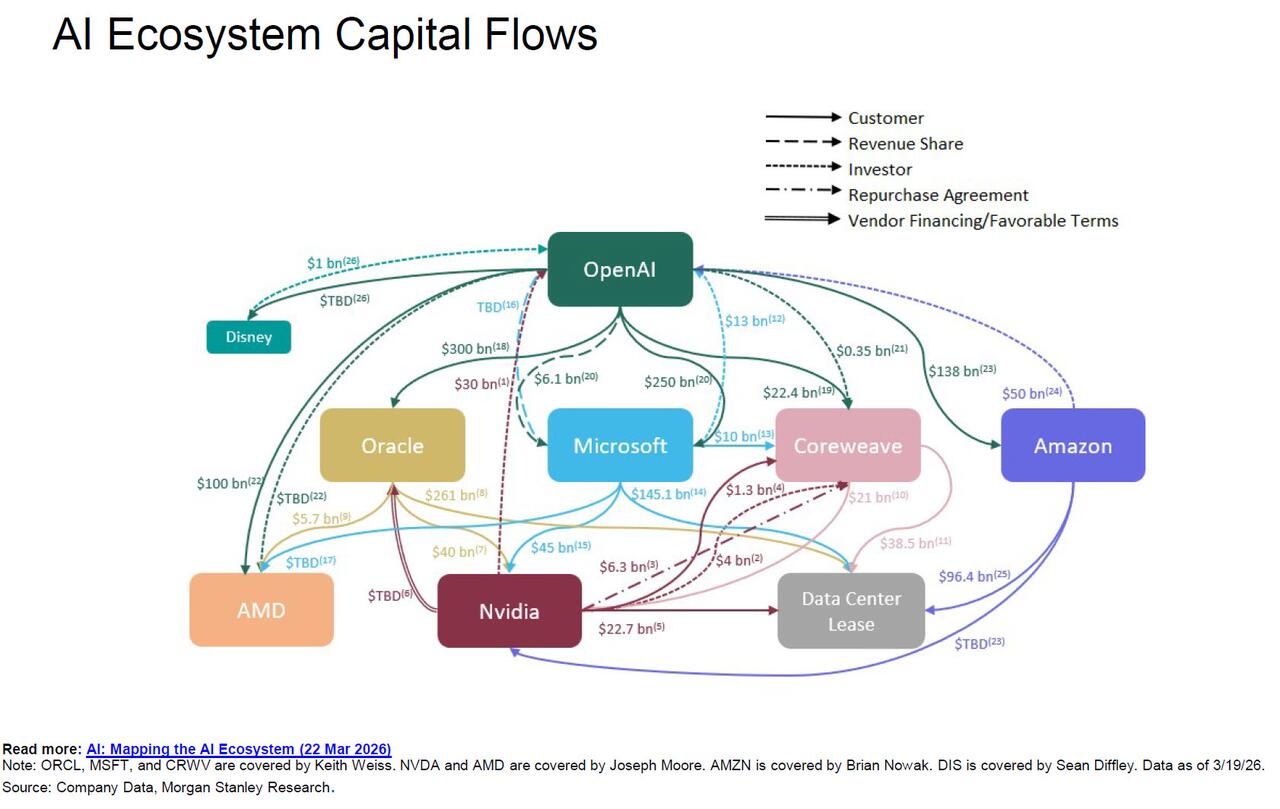
My point is, Id like to know how circular or not they are - clearly a lot of money is actually being spent on GPUs/datacenter build/electricity, Id like to know what fraction that is.
MLMs exist in the same murky waters and tread the same ephermal economics by pushing useless product but hiring people to hire people to hire people, etc.
Expecting demand to stay equal over longer stretches of time in IT is an interesting bet as both hardware and software tend to depreciate in value extremely rapidly, unlike oil from the example. Or water. Both are limited in nature.
Commodifying something that is the fraction of its value the next year might be possible, but I don’t see how. Perhaps MS Windows or Office are such things, but might not compare.
There are more limits to demand. For example what humans can process. The AI might write the finest prose and the best software but have nobody to read or use it.
https://news.ycombinator.com/item?id=48873836
370 points| 18 days ago | 182 comments
I actually think Nvidia's deals have been above-board, generally speaking, because they are transaprent.
Less true for Meta and Terawulf.
Is HN really this fast!? Everybody already skipped the hard questions whether LLMs are intelligent? 'It' can already be commodified?
So how much time and effort it took from these companies? A couple of years and millions spent on PR? And LLMs are "intelligent" all of a sudden, is what everybody says nowadays?
Especially applicable for programmers: naming things is not only hard, it's also important, and can be very insidious. Remember, marketeers also name things. For example, naming the internet 'the cloud', some 15 years ago.
I can't stop thinking about a quote of one of my favorite authors (Theo Kars): "Progress can only be technical in nature, because knowledge is transferable and wisdom is not." [translated from Dutch]
Think of it like this: if you can offload a task to an AI model that requires reasoning or representing a nonlinear system, you are offloading intelligence.
More significantly: many major advances in scientific or mathematical programming were heralded as a thinking computer! 50's numerical scientific programming, 60's Lisp+ symbolic programming, 70's logic and symbolic algebraic programming, 80's unifying all this with encyclopedias and NLP like Mathematica - all of this is clearly useful and cool, all designed to offload intelligence... and, with modern eyes, we see plainly that not a single shred of intelligence is required to execute any of it. The AI researchers of yesteryear consistently made cool computer programs and consistently overestimated their progress at cracking human intelligence. It is plain as day to me that ANN researchers are making precisely the same scientific and philosophical mistakes as yesteryear's symbolics researchers, and even Alan Turing. This does not diminish from the coolness of the computer programs. But pretending these systems are intelligent, even "verbally" intelligent, is bad for society.
It's bad for computer science, too. None of the progress in LLMs or ANNs gets us any closer to making a robot as smart as a cockroach. I doubt any of us will live to see that milestone.
First cash/dollars are considered bad so they collapse in price. When the psychology shifts, suddenly the dollar climbs in value and itself bubbles over, causing a recession.
When Cash becomes king, for whatever reason, it behooves the economy to sell of all other assets and buy Cash.
The closer to cash you get (1Y high grade commercial paper, 1Y Treasury, 3M Treasury, 1 month commercial paper, money market, savings account, dollars under a mattress...), the better you deal with such circumstances.
... but then again... if they are leasing the compute then it implies their own AI work isn't paying off?
In short: I agree with you.
Which is an awful lot of “ifs” to be hedging a bet on, especially at nation-state scales.
Here's a quick reality check. Several companies have formed with a goal of creating and AI engine that can think for itself and reason through difficult or previously intractable problems.
In order to accomplish this goal they have used scrapers to hoover up content from a multitude of sources, many of which can be seen as being the ground truth source for their discipline. A lot of this content, most of it, was copied and is being used without attribution to the original sources, without permission from the content owners or publishers, and in violation of copyright laws.
Look at all of this for what it is. It is a knowledge base, like a collection of Lego parts, each of which is important to the goal but none of which will get you there without the other parts in the proper relative position. Once you have collected all these parts and stuck them together you have an LLM. If you are careful in your parts selection, that LLM can be useful for answering specific questions that are properly framed so that the LLM can make use of the contextual information in formulating a response.
There's nothing intelligent about being able to answer a question correctly when the answer is effectively right on the tip of your tongue. You're just drawing from your knowledge base and regurgitating.
Glomming all of it together only gives you a huge knowledge base. There is nothing intelligent about that knowledge base. Knowledge is not intelligence.
You have an AK today, an Accumulated Knowledge base.
We may never reach the point where it is ever intelligent enough to reason alongside of, or better than those whose life's work went into the foundation of the AK base.