Advancing the price-performance frontier with GPT‑5.6
397 points by tedsanders 4 hours ago | 259 comments

GodelNumbering 4 hours ago
"Half the money I spend on advertising is wasted; the trouble is I don't know which half." -John Wanamaker

This applies even more strongly to model choosing. I know for a fact that majority of my work doesn't require a very strong model, but separating the trivial and non-trivial tasks is a famously hard problem (if at all decidable).

reply
in_a_society 3 hours ago
I don't see why it should be all that difficult. All you have to do is first find a library that implements a decent solution to the halting problem and you're off to the races.
reply
njcornell 2 hours ago
You can use my script p-noteq-np.sh too if that helps.
reply
gck1 15 minutes ago
Luna is comparable to GPT 5.4 from 4 months ago on many benchmarks. I know many who have said during that time, myself included, that if that's the model they had to use for the rest of their lives, they'd be fine.

GPT 5.4 is/was a very capable model.

reply
fractorial 4 hours ago
Cosmically apt username given the substance of this comment.
reply
carimura 3 hours ago
Exactly. I haven't reached the "let 1000 agents bloom" mode yet, so currently I'm spending real headspace managing agents doing work, and that work is all important, so why "settle" for sub-frontier models for that work? Maybe I'll get there for non-coding work.
reply
bryanlarsen 3 hours ago
Highlighting https://news.ycombinator.com/item?id=49113236 in response.

HN could be run as a BBS on 70's hardware. Instead of using a CPU with ~10 thousand transistors, you're likely using one with ~10 billion to do basically the same thing, and you don't think twice about it.

reply
pimeys 2 hours ago
If you have agents and users, you can run evals and see how far the models go. Luna is not greatest in tool calls, but if you define your problem well and the tools well, it is comparable to Gemini 4 Flash with much lower price tag.
reply
satvikpendem 2 hours ago
Luna is good as an end user model for simple tasks like classification, but not as a coding model. Also do you mean Gemini 3.6 Flash? 4 doesn't exist, and Gemma 4 exists but doesn't have a Flash option.
reply
pimeys 25 minutes ago
Yeah, been running too many evals in the past week I start to mix the versions up. Probably should sleep...

We run an agent company and outside coding the new Gemini 3.6 Flash and GPT 5.6 Luna are very interesting. Luna can do a bit of research and create reports. Gemini is great for computer use.

For programming it's all Kimi K3 now.

reply
throw2ih020 3 hours ago
> separating the trivial and non-trivial tasks is a famously hard problem (if at all decidable).

Famously, this is also a problem for human coders in sprint planning.

reply
londons_explore 3 hours ago
I get frustrated with a poor quality model leaving my codebase littered with wrong comments, which then later trip up smarter models.
reply
hellojimbo 3 hours ago
[dead]
reply
JarJarBeatU 3 hours ago
[dead]
reply
odiroot 3 hours ago
You just need a very strong frontier model to do triage of your tasks.

/s

reply
wmf 3 hours ago
That's not necessarily a joke; the article proposes exactly that.
reply
preommr 4 hours ago
> Starting today, GPT‑5.6 Luna, our fastest and most affordable model, will cost 80% less,

I don't have the words.

I genuinely thought we were in a stage where we were plateauing and going in for 5-10% improvements over months. Seeing spikes like this makes me question about where the floor really is.

reply
jpadkins 3 hours ago
When model intelligence reliably hits 90%-95% of current day knowledge worker tasks, they are going to burn those weight to silicon and we will see another 10X improvement in price/performance frontier.

The dynamic GPU clusters will be used for the 5% of tasks, and pushing out the frontier. Also there will be a set of knowledge tasks that are not done today (because they are too difficult for most knowledge workers), that will start being done in the future.

reply
jrflo 3 hours ago
Burning the weights into silicon would be many orders of magnitude increase, not just 10x. It's kind of crazy that this hockey stick the AI hype bros talk about seems more and more every day like it might be real
reply
jaggederest 3 hours ago
https://taalas.com/ has done it already for a wildly obsolete model. 14000 tokens per second.

https://chatjimmy.ai/ is their interactive. Tiny context, very dumb, but absurdly fast. Imagine this as a tool call for claude code for trivial changes - the tool call from the harness takes longer than the execution.

reply
ElijahLynn 2 hours ago
Wow! You weren't kidding,

I just tried it too and 14,098 tokens in .05 seconds, I barely blinked and it was done. There was no typing at all appearing on the screen. It just showed up.

https://chatjimmy.ai/chats/01dc66a4-4b1b-4dea-bb5f-926855e37...

reply
WalterGR 58 minutes ago
That link isn't bringing up your chat, FYI. It just shows the default new chat state.
reply
christophilus 52 minutes ago
Wow. This is absolutely wild. I didn't expect that.

If we get to anywhere near this speed for the equivalent of the current models... I don't even know what to think about that future.

reply
iamjackg 3 hours ago
Holy crap, I was not prepared for how fast it responded. I just wrote "Just wanted to see how fast you are! Can you write me a quick story about a tiger who lives inside a block of cheese the size of a house?"

I pressed Enter, and the response was instant.

> Generated in 0.037s • 14,205 tok/s

This is unbelievable.

reply
kooi 17 minutes ago
"Stochastic gradient descent algorithm in Haskel"

"LMS algorithm in bash"

Just barfed it up lol.

Amazing.

reply
jcul 3 hours ago
It's crazy. Are they doing any precomputing as you type, I wonder if you paste a block of text is it the same speed.
reply
nerdsniper 2 hours ago
I pasted and instantly hit enter on this prompt: "I generated a filter set using REW v5.31.3 using real-world sweep tone measurements from the room I'm listening in . How can I use it as my MacOS output equalizer so that my spotify music is adjusted for this room and speakers"

and it gave a very reasonable answer in non-perceptible time.

reply
throwuxiytayq 2 hours ago
No, it really does take ~0.03s to generate the answer. Try your browser's developer tools and watch the requests.
reply
baal80spam 22 minutes ago
Just wow, I made a similar request. Result: Generated in 0.042s • 14,201 tok/s

This is crazy.

reply
8cvor6j844qw_d6 3 hours ago
I'd like to imagine the things that can be done with this speed and the current frontier models.
reply
throwup238 46 minutes ago
Fully interactive games where you can talk to every NPC by text or voice and have an LLM drive the story (with your own meta prompts to guide it, if you so wish). Maybe even have them generate assets on the fly too.

I’m still trying to figure out coding agents. I can’t even begin to imagine the things it would enable. Even the most mundane ideas like LLMs-in-HiFreq-trading have huge implications.

reply
ElijahLynn 2 hours ago
Truth, it feels like we're in the dial-up age of LLMs right now. And this Jimmy AI is fiber.
reply
Dig1t 2 hours ago
Seriously, if Fable or even Opus was this fast that would be a real game changer.
reply
reducesuffering 23 minutes ago
RSI will be models better than Fable running faster than this, you won't even need a human in the loop to figure out what to do. The high level goal will be accomplished better than the human in an instant
reply
HDThoreaun 3 hours ago
For what its worth the frontier lab models can surely be a lot faster if they wanted them to be but theyre supply constrained so theyre doing stuff like multi tenancy. Since you cant self host them no one outside the labs really knows speed as a solo tenant
reply
ericd 17 minutes ago
You can kind of get a sense by running these things at home - I'm currently running Laguna. One interesting thing is that per stream doesn't actually slow down that much with multiple concurrents, because the bottleneck remains the memory bandwidth until pretty significant request depths, and then eventually you hit the GPU's limits. It's one of the big forces that pushes for centralization in this stuff, the fixed costs to run one are huge, the marginal costs of additional tenants, relatively small.
reply
Yopolo 3 hours ago
And don't underestimate how much money Google, Microsoft, Amazon and Meta still have to spend on this tech.

Blocking Fable for sure made it very politicl a lot sooner than i expected it to happen.

and because China already has massive problems of getting access, they are pushing it on hardware too like what Huawai did without EUV.

It seems China is already able to do DUV a lot sooner than others expected.

reply
re-thc 3 hours ago
> It seems China is already able to do DUV a lot sooner than others expected.

That's the media and in particular US KOLs of all sorts driving the wrong impression of China and other places. China and many other places for example have fast public transport that the US doesn't and can't even imagine today. They're not behind.

China's DUV still isn't that production grade (mass produce-able) so don't get that hyped up the wrong way (in a different direction).

The whole China-is-behind with tech and in particular semi wasn't that they can't. The truth is they spent decades in internal politics and corruption. That all got solved with the bans, so thank the bans! Jensen even said the bans were bad.

reply
vjvjvjvjghv 45 minutes ago
Not an expert on this but wouldn’t this be possible with something similar to an FPGA?
reply
kooi 13 minutes ago
Weights can be baked into silicone or programmed into hardware ala FPGA, but the context will always be dynamic.

High speed SRAM is where the $$$ is

reply
FuriouslyAdrift 2 hours ago
Yep it will be ASICs and DSPs all over again. Orders of magnitude changes.
reply
monkeydust 2 hours ago
So which shovels companies are the ones to watch for burnt in silicon models ?
reply
FuriouslyAdrift 53 minutes ago
Imagine the price of a $9 million NVL72 dropped to about $100, used 4 orders of magnitude less power, was the size of ARM cpu, be bundled with pretty much any electronic device, and ran as fast a frontier AI is today.

That's about how disrupting DSPs were to the industries they arose out of (over a very long time frame).

How would that disrupt the industry?

reply
coffeebeqn 3 hours ago
What does that mean though? Like some kind of a ROM memory ?
reply
bob1029 2 hours ago
Stacked ROM can, in theory, be a lot denser than anything that depends on a capacitor and refresh cycle.

I don't think it would be that difficult to manufacture compared to other process tech. HBM is really hard to do compared to other memory types.

reply
re-thc 3 hours ago
> When model intelligence reliably hits 90%-95% of current day knowledge worker tasks, they are going to burn those weight to silicon

Google is already working on a similar idea but more "flexible".

reply
kridsdale1 2 hours ago
Explain.
reply
jmb99 52 minutes ago
I'm not who you responded to and I don't have any info on Google. Nor can I explain in detail due to NDAs. But multiple major players are working on something along the lines of what the parent is alluding to.

The "edge" AI landscape (in particular, what you can do with ~5W) is going to be nuts in about 18 months.

reply
captainbland 4 hours ago
To be fair we don't really know in terms of prices what's real and what's just investor subsidised attempts at market capture at this point. It could well be OpenAI's attempt to drown Anthropic while they've got the halo product if they feel they've got deeper pockets.
reply
w29UiIm2Xz 4 hours ago
Enterprises implemented spending caps and inference providers are lowering prices. Seems they are jockeying for market share.
reply
FuriouslyAdrift 2 hours ago
Partnerships then consolidation comes next...
reply
minraws 3 hours ago
I wouldn't be surprised if they still had some margins since cheaper models are much harder to nail the accurate sizes off, and you still pay 2x for 1M context window.

But if this is even at 400B size it's insanity those inference prices, maybe 10-20% margins, if it's higher I would like to know is it their own chips or maybe they have accurately sized the model to fit on exactly a B300?

Could be a lot of magical things we can only speculate, but from here there likely isn't another 60-70% margin, like I have heard people claim, I would definitely be willing to bet on that.

Could still be a healthy 10-30% margin. Especially with Terra.

reply
platinumrad 4 hours ago
We can guess based on the decisions of other inference providers who serve these models.
reply
handfuloflight 3 hours ago
Do you mean if other providers will cut their prices in turn?
reply
platinumrad 3 hours ago
Yes. For example, third-party inference providers serve DeepSeek V4 Flash just as cheaply as DeepSeek themselves, if not even more so. This is very strong evidence that the low price of the model is not subsidized.
reply
hzbdhdjs 3 hours ago
[dead]
reply
foobar_______ 4 hours ago
Hard to believe numbers. I don't mean that as a critique, but literally I am so impressed. Even if the model is a few percent lower for performance but is 80+% cheaper than competitors and is a US company hosted on US based hyperscaler clouds this is kind of a no brainer. Hard for most businesses to justify otherwise.
reply
rpdillon 3 hours ago
This is exactly the model that DeepSeek V4 Flash followed, and it's been insanely successful as a result, even though it's not frontier.
reply
ignoramous 3 hours ago
DeepSeek v4 Pro & MiMo v2.5 Pro (Opus 4.6 quality models for code) are insanely cheap for agent-driven work due to their super low cached-input prices ($0.0036/mtok) [0]. For Luna, the cached-input price drop isn't disclosed in TFA, but the pricing page puts it at $0.02/mtok, & that's 5x more expensive.

[0] I am constantly surprised how much work pay-as-you-go with DeepSeek / MiMo will get done. I've barely crossed $2 each in a month of use (~200m tokens).

reply
computerex 2 hours ago
Absolutely. Although DeepSeek started announcing "Peak valley" pricing which started making me nervous. I have spent $50 usd in July on deepseek and for that much spend I got SO MUCH mileage.

I feel perfectly content in using pay as you go pricing with deepseek. On the other hand, although Anthropic's models used to be my bread and butter for personal work, they are simply too expensive to reach for these days.

reply
ismailmaj 4 hours ago
it's 80% less cost, not 80% in efficiency gains, could be that Luna was overpriced to begin with, we don't have much info on the models themselves.

Assuming the efficiency gains are real, I feel like something has to give, maybe worse quality due to aggressive quantization/kv cache compression?

reply
heisgone 3 hours ago
Let's suppose each models was subsidized at 70%, so that we only pay 30% of the cost. They would loose much more money per token on the more powerful models. It's in their interest to encourage the use of the less expensive models. Let's say they increase Luna subsidies at 90%. They would still "save" relative to the use of the more expensive models.
reply
mlinsey 3 hours ago
High-performing open weight models being released recently, and your customers looking into working with multiple providers as a result, are a great reason to drop prices on your non-frontier offerings.

Although I'm sure there are some efficiency gains, the technology is too new and labs are scrambling to release too quickly to think that the low-hanging optimization fruit has been picked already.

reply
dannyw 4 hours ago
Been using OpenAI models since ada/babbage/curie/davinci and at least from my own experience, their APIs feel the same.

If you use Codex it's different, the harness has a lot to do with it and there's definitely been changes including recently.

reply
axus 3 hours ago
Something can be overpriced and still lose money.
reply
Yopolo 3 hours ago
5-10% over months would still be quite crazy.

But yeah I do'nt want to know what Kimi 3 is pushing buttons inside Anthropic, OpenAI and Google.

Besides any floor: For every year the tokens get faster and cheaper, we will see new things like properly working AI factories which mimic expert teams. A lot more parallism as well.

reply
827a 3 hours ago
Vera Rubin will be hitting racks very soon, and this is purported to have a 10x improvement in token throughput per megawatt. Of course, old chips don't get replaced with new chips overnight, but I don't think we're anywhere near the floor yet.
reply
FuriouslyAdrift 2 hours ago
AMD MI400 series is already shipping to customers (basically everybody) and it is crazy fast (8x to 10x faster than the previous gen and beats published Vera numbers in FP8, loses in FP4) and 432 GB per chip. 72 chip unified rack architecture (Helios) already shipping and projected to also beat Vera in NVL72.

MI500 series is supposedly already taping out and they're claiming massive increases (we'll find out end of 2027 prob).

reply
cousinbryce 3 hours ago
In a data center that is power constrained but not space constrained they could build out new racks and flip the power from the old racks. Wonder if this will lead to moderately used server GPUs on the secondary market someday.
reply
Yopolo 3 hours ago
I don't think they overengineered a DC like this.

Besides Nvidia Hardware is still sold out and super expensive. Not a single Nvidia consumer GPU got cheaper at all, Nvidia DGX Spark got more expensive too.

It will be swooped of the market the second it hits the market.

reply
gentlewater 4 hours ago
This is gonna put Sonnet 5 in a really awkward spot.
reply
baq 4 hours ago
I use sonnet as a smart grep and haiku never and that’s only when I have to use Anthropic at all
reply
heaney-555 3 hours ago
Luna is comparable to Haiku, not Sonnet.
reply
827a 3 hours ago
Totally untrue. Luna and Sonnet 5 are very comparable: https://artificialanalysis.ai/#intelligence

Luna is an extremely strong model.

reply
re-thc 3 hours ago
> Luna is an extremely strong model.

By benchmarks, which sadly is a poor measure. Yes Luna is a good model under certain circumstances. Whether it is great for general usage is another story. Sonnet is definitely better when prompts are more vague and it needs to decide things. Luna generally sticks to things very strictly and goes off in bad ways.

reply
mediaman 3 hours ago
Yes but there is a big, big market for subagents to consume lots of tokens cheaply and condense information up to parent agents. Luna would not be my choice for planning. But an explorer to comb through a codebase to find relevant parts? Or for enterprise retrieval, where it needs to search across many different types of data to see where to focus efforts for a smarter model? Or to wake up periodically to evaluate some conditions and determine if a bigger model should be spun up? Definitely.

I've previously found flash (for all the hate it gets) to be good for these kinds of things. Haiku was fine but it's ancient.

reply
re-thc 3 hours ago
> Yes but there is a big, big market for subagents to consume lots of tokens cheaply and condense information up to parent agents.

That's again not some "intelligence factor" here. Different agents work for different use cases. Luna wins some. Terra wins some. Sonnet wins some. Flash was really good at exploring.

So I'm not sure what your point is? There's a big market for everything. Even within the market you describe it's likely not a Luna-size fits all either.

reply
Philip-J-Fry 2 hours ago
In my real world use Luna is as useful to me as Sonnet. And it gets stuff done faster and follows my instructions more closely.
reply
3836293648 3 hours ago
Anthropic basically downgraded all their tiers when they released Mythos, no nah, Sonnet 5 is the successor to Haiku 4.x
reply
bakugo 4 hours ago
Sonnet and Haiku were already in an awkward spot, likely by design.

Anthropic's big marketing push this year has been entirely focused on getting people to use Opus via a Claude Code subscription, to the point that Sonnet is almost viewed as the poor man's alternative, and from what I've seen, almost nobody uses it.

Actually, here's an interesting project for all the vibe coders looking for their next front page post: scrape a ton of commits from GitHub with Co-Authored-By: Claude and figure out what the percentage split between Opus/Fable/Sonnet is. I'm willing to bet it's less than 10% Sonnet.

reply
supern0va 3 hours ago
>figure out what the percentage split between Opus/Fable/Sonnet is.

This may be misleading, since I suspect many are using a blend through sub-agents. I tend to bias for Fable to orchestrate and Opus for implementation via sub-agents.

reply
StilesCrisis 3 hours ago
When I'm paying for it, Sonnet. When work is paying, Opus 5, then Fable if Opus gets confused.
reply
petesergeant 3 hours ago
Opus 5 is not strong enough as the top-of-stack model, and feels idiotic after a week or two of heavy Fable usage, to the point where I'm paying for Usage Credits to keep using Fable rather than having to slum it with Opus.
reply
solarkraft 3 hours ago
They have no (other) equivalent to nano, so it makes sense that it’s much cheaper now. It may have been better, but it was also hell of a lot more expensive.
reply
WarmWash 3 hours ago
Totally possible that humans aren't actually that intelligent.
reply
ceroxylon 3 hours ago
As well as the existing intelligence being swayed by emotions, hormones, circadian rhythms, stress, peer pressure, propaganda, and survival instincts.
reply
afry1 3 hours ago
As if ALL OF THAT doesn't represent inherent and crucial elements of judgement, and therefore"intelligence" itself.

We are not purely rational creatures, thank God. Sometimes those "limiting factors" you listed -- stress, peer pressure, hormones -- are crucial elements of informing the problem solving process and arriving at a decision or a solution that actually works.

All an LLM can do is fulfill a prompt, no matter how misguided, backwards, or incomplete that prompt actually was.

"Go jump off a bridge." Hmm. Dying makes me stressed out. I'm not gonna do that.

reply
customguy 3 hours ago
That's a bit like saying a tail is swayed by a dog, as if it could exist without one, or would have anything to do if it did.
reply
subw00f 3 hours ago
Why does it matter? This is completely based on data produced by humans.
reply
arjunchint 3 hours ago
more like they were facing pressure from chinese models, and dropped prices and now their margins are squeezed
reply
re-thc 3 hours ago
> Seeing spikes like this makes me question about where the floor really is.

You mean they increased the price and then cut it back and now it is amazing?

Luna had a price hike vs mini (its previous replacement). The cut now just puts it back in that ball park.

Not that this isn't good news, but what's impressive?

reply
zzleeper 3 hours ago
Had to ctrl+f for someone saying this.

I typically do lots of mini calls for research (100s of millions or something in that ball park). Newer models made that absolutely impossible, and the fact that the older ones are starting to get deprecated made me switch to e.g. deepseek for some of my runs. We'll see if I move back after this.

reply
aesthesia 2 hours ago
Luna's now cheaper than 5.4-nano (for output tokens). That's a significant improvement.
reply
camel-cdr 3 hours ago
this type of thing usually means you are the product
reply
mediaman 3 hours ago
I don't see how this follows. The cost of nails has fallen by 95% over the last century. It's because the cost of manufacturing has fallen. Not because they are selling the information of nail consumers.

Tokens are not normal software, because they have marginal cost, and I think people who are used to software economics really struggle with this. With token generation there really can be manufacturing cost efficiencies where one producer is just straight up better at serving product at a lower marginal cost.

reply
robocat 21 minutes ago
> The cost of nails has fallen by 95% over the last century

No it hasn't!

A century ago, some nails cost 2.5% of disposable income, and now the same nails cost 2.3% - only a little cheaper.

The cost of nails has remained remarkably consistent for a century. The problem is that you have ignored the depreciation of money.

Let's assume California prices and income and pick a bigger retail package of nails as you might use for building a house. The numbers used to calculate percentages: in 1926 a 50lb keg of 4" nails was $2.75 and median after tax income might be $108 per month. In 2026 a 50lb carton of 4" nails is $106 and income might be $4,516. Albeit I assume nails are now more readily available and the quality of nails is likely better; and perhaps I should have compared galvinised nail prices.

reply
visiondude 3 hours ago
there is a ton of downward price pressure from Chinese open weight models
reply
paytonjjones 3 hours ago
According to https://deepswe.datacurve.ai/, Luna at Max at it's previous cost was comparable in both performance and cost to Sol at High.

With an 80% reduction in cost that becomes a ridiculous outlier in efficiency.

reply
Der_Einzige 2 hours ago
Until I stop getting downvoted for asserting that these guys are profitable per token, HN is going to continue being pikau face shocked at easily predictable things that any serious AI researcher would tell you, and has been telling you for years now!!!
reply
buckle8017 4 hours ago
They over purchased hardware.

This is very likely priced below recovering the cost of the hardware but still above operating expenses.

reply
paxys 3 hours ago
That’s ridiculous. Every major AI lab is compute constrained. That’s exactly why nvidia is worth trillions today. If OpenAI had a single extra GPU they’d be using it to run another training cycle or experiment for their next model.
reply
infecto 4 hours ago
What evidence is there?

I have no idea either way but one thing that detracts from these threads is folks claiming things as a fact without evidence.

reply
qntmfred 4 hours ago
sama literally just said they wish they had bought more. the price drops are almost certainly due to good old fashioned hardware innovation (wafer scale with cerebras) and optimizing hardware development based on model architecture and inference costs. other inference providers will try to do the same if they can.

https://www.youtube.com/watch?v=XDB5beon4DY&t=4m20s

reply
pavpanchekha 4 hours ago
Making Luna, which was already very cheap and extremely capable, 5x cheaper is crazy. I use Sol at work but Luna at home, and while there's definitely a difference, it doesn't feel like night-and-day. After a year of ever-increasing prices it suddenly feels (between this, Kimi K3, GLM 5.2) that prices are falling again.
reply
jedberg 4 hours ago
> Sol vs Luna

> it doesn't feel like night-and-day.

I see what you did there. :)

reply
deklesen 4 hours ago
Good observation! Kudos
reply
oh_no 60 minutes ago
I pretty strongly disagree about comparing this to Kimi and GLM, 5.2 was a big price hike for Chinese models, and Kimi K3 was a big price hike to that. K3 was within spitting distance of OpenAI pricing (more expensive than short context Terra, less than long context). And that's after months of OpenAI/Anthropic prices going up.

Now we have an American lab drastically cutting a price, feels like this is the opposite of that trend.

reply
pioneer37 4 hours ago
Its just a matter of time at this point.These companies are working day and night to capture the market.
reply
maxdo 4 hours ago
is kimi that cheap? it's a very expensive model
reply
pixelesque 3 hours ago
It's cheaper currently on many of the inference providers.

Personally, I'm having surprisingly good results with DeepSeek 4 Pro at home, which is very good value for money: it's not as good as Claude / GPT 5.6 (I have Co-pilot license at work), but it's still really useful for code reviews, validating thoughts, and especially designing / writing unit tests for new (and old before refactoring) functionality.

And it's very cheap per task. (Flash is even cheaper, but I've had issues with that on more complex tasks where it starts forgetting things and arguing with itself "but wait, let me read the function again").

reply
fy20 2 hours ago
DeepSeek V4 Pro is ridiculously priced, especially when you take into account caching. According to the DeepSeek usage panel, 50M tokens have cost me $1.38. It's not the smartest and does like to overthink, but if you have well defined problems it's good for coding. Well... except all your data going to China. I just use it for personal projects.
reply
forsalebypwner 44 minutes ago
Yup, last month I did ~150mil tokens on DeepSeek v4 Pro for just under $3
reply
mark_l_watson 2 hours ago
I toggle back and forth between deepseek v 4 flash/pro on FireWorks.ai using OpenCode. Easy to toggle, I default to flash.
reply
oh_no 59 minutes ago
where are you seeing cheap Kimi? pricing I've seen is the same across the board (presumably due to licensing terms) and is in the Terra range.
reply
subarctic 2 hours ago
I tried out deepseek v4 pro via a couple providers from openrouter, and it's always getting 429s. Are you running it on your own hardware?
reply
pixelesque 2 hours ago
I wish!!

No, I'm using it via OpenRouter in pi.dev - I just used it 30 mins ago... Providers (automatically selected): StreamLake and Baidu Qianfan.

reply
Mashimo 2 hours ago
Works fine for me via opencode go.
reply
dominotw 4 hours ago
depends on what you are doing. if you are doing verifiable tasks like fixing bugs then any model would do as long as you write the right verification.
reply
simonw 4 hours ago
> The kernel work helped reduce the end-to-end cost of serving the model by 20%, while its experiments increased token-generation efficiency by more than 15%.

If the cost of serving GPT-5.6 just dropped by 20%, does that add up to literally billions of dollars in savings per month?

We know Anthropic spend $1.25 billion renting inference capacity from SpaceX (in two Colossus datacenters) from the SpaceX IPO, but we don't know how much of Anthropic's inference capacity that is (presumably a small fraction, since they were operating on top of AWS and other providers before the SpaceX deal.)

I've not seen any numbers that hint at OpenAI's per-month inference bill, but surely that has to be in the multiple billions of dollars as well.

So 20% is a really, really big deal.

reply
NitpickLawyer 4 hours ago
~2 years ago gemini2.5 helped write better kernes for itself and (only) reached 1% efficiency gains. Today we're at 20%.
reply
magicalist 2 hours ago
If you optimize program A and manage to wring out a 1% improvement, and I optimize program B and improve performance by 20%, you can see the problem with trying to infer anything from those two numbers.

Edit: searching for the story now, further bolstering the point is that was 1% in training time [1], and the openAI claim is 20% in end to end inference cost. This is a bad comparison.

[1] https://deepmind.google/blog/alphaevolve-a-gemini-powered-co...

reply
NitpickLawyer 46 minutes ago
> This is a bad comparison.

How so? First, kernel writing (or ML engineering more broadly) is a highly specialised task. Not everyone can do it. It shows that models are getting better and better at (easily verifiable) hard tasks. And you can "hire" that expertise much easier than you can hire the equivalent meatbags. And more importantly you can "fire" them as soon as the task is done. And then hire them 3 months later, when the new model drops. And so on.

Second, 20% gains in inference today gives better end results (i.e. lower overall cost) than 1% in training 2 years ago. Today's models are improving mostly via RL. And RL is highly dependant on fast inference (you want many rollouts for each training scenario). Same for dataset filtering, environment generation, distillation, etc.

reply
dust42 3 hours ago
In 2 years from now we will be at 400%. https://xkcd.com/605/ Also, it is called kernels (you have nitpick in your username)
reply
dominotw 4 hours ago
imagine writing that on your resume

> reduced inference cost by 20 percent saving company x billion dollars per month

reply
paxys 4 hours ago
Where are you going to apply to with that resume that’s a step up from your current job though?
reply
petesergeant 3 hours ago
The other place, but for more money
reply
bpavuk 4 hours ago
lots of places, actually. not everyone wants to be attached to the Silicon Valley culture, and that line alone will guarantee practically any workplace. that person is going to find out what work-life balance is :)
reply
paxys 3 hours ago
Sure, but those places don’t need such lofty resumes to begin with.
reply
speed_spread 3 hours ago
With the right kind of credentials, it's not about need, it's about want. Flip the roles and let yourself become an object of desire, an aspirational hire.
reply
tekacs 4 hours ago
In this case, and I don't mean this critically, I guess it would technically be, "Instructed model to find efficiencies... reducing inference cost by 20% saving company x billion dollars per month."

I have no doubt that further work was required to enable this, but it's still very cool to be possible to say that.

reply
andai 4 hours ago
I think they meant that GPT-5.6-Sol can write that on its resume.
reply
da_grift_shift 4 hours ago
Does the model get the credit for its promo packet then? :^)
reply
hirako2000 4 hours ago
Contributed to. Can't be some IC who made a few nice PRs
reply
kridsdale1 2 hours ago
Why not. Jeff Dean and John Carmack exist. Both are L10 SWEs.
reply
bob1029 4 hours ago
This feels like the dialup->broadband transition to me.

I was already a huge proponent of Luna for things like deep research. Being able to run 5x more for the same cost is simply bananas. We are already running 10 parallel agents for hypothesis generation. I cannot imagine 50. The statistics become much more interesting & powerful when you can run so many samples of the exact same prompt+model without breaking the bank.

reply
Imanari 3 hours ago
How do you run 'deep research'?
reply
dannyw 3 hours ago
Deep research is basically a LLM with web search, and a "work really hard" goal-orientated prompt, and some output formatting suggestions.
reply
kridsdale1 2 hours ago
And self forking fan out.
reply
cg5280 2 hours ago
It's a feature offered in ChatGPT and other platforms, though probably gated behind paid subscriptions.
reply
fy20 2 hours ago
Used to be part of the $20/mo plan but it's not anymore (not sure if they removed it completely). However GPT-5.6 is pretty good at researching if you prompt it right, I've regularly had it spend 5+ minutes researching topic with lots of web searches.
reply
kaufmann 15 minutes ago
They placed it in the Plugins submenu.
reply
jrflo 3 hours ago
Very interesting. Can you share more about your hypothesis/research pipeline? I have been using Sol for those types of task because I figured you'd need more reasoning for getting good ideas, but maybe quantity > quality at a certain point?
reply
bob1029 3 hours ago
Here is a rough approximation of the pipeline I use:

Phase 1 - Run X copies of Luna in parallel over the user's prompt. The purpose is to generate a diverse set of hypotheses.

Phase 2 - Run Y copies of Terra in parallel to investigate the hypothesis results, with each receiving them in a randomized order.

Phase 3 - Run 1 copy of Sol over investigation reports.

The goal is to ensure that the agent covers more initial starting points before presenting a final conclusion. If you only run a single copy of Sol and it hooks onto something wrong, it might not recover.

reply
eevmanu 2 hours ago
How do you run this phases and parallelization on each?

Via just ... "prompting it"?

Or do you use any tool in the middle to ensure this agent architecture?

Just curious if there is any workflow-like tool in the middle that is helping.

reply
bob1029 12 minutes ago
There is a deterministic framework that enforces the process. I use the raw chat completion APIs. No "reasoning effort" is applied on top of these requests (it's not even allowed anymore), so there's actually no way to influence this via prompting.
reply
andai 4 hours ago
Do you have a sense of which tasks benefit from more agents and which don't?
reply
bob1029 3 hours ago
Anything related to reading and interpreting the environment seems to always benefit from the addition of more agents to the search party, assuming you have some rational way to synthesize their results.

Taking actions that mutate the environment is a different story. I think this is where you run into diminishing returns very quickly. You generally want one strong agent to act given the results of all the searching that was done. If the plan is clear, you don't need a genius model to execute it.

reply
handfuloflight 3 hours ago
I definitely think you want the genius model to synthesize everything that rolls up to them.
reply
andai 2 hours ago
I think this is an unsolved problem. The most interesting thing I saw here is the Recursive Language Models paper.

https://arxiv.org/abs/2512.24601

There's also a great write up here by the author:

https://alexzhang13.github.io/blog/2025/rlm/

reply
bob1029 3 minutes ago
I used this architecture for a while. The problem I have with it is that starting from one agent and fanning out keeps things mostly aligned with that single reasoning trajectory, even as you get a few layers into the stack. Every recursive invocation is a product of the caller's current state. Diversity doesn't really occur on its own unless the environment (tool calling) is complex/chaotic.

RLM might be more useful on the execution side than on the research side. In fact, these somehow feel like they might be exact inverses of each other in terms of what the ideal architecture looks like. At some point you definitely do need something in the middle that has it all sorted out.

reply
kridsdale1 2 hours ago
This is why in your brain you have trillion threads processing and summarizing sensor data (immutable functions), but a SINGLE thread of “execution” which we call the conscious soul.
reply
__jl__ 4 hours ago
Didn't expect that. Luna pricing is crazy now. I don't think there is anything on the market that competes at this price-performance point.

For our production app, OpenAI clearly is the best provider now. Their API is very reliable and has many nice features. The price-performance of the model lineup is incredible. We used open weights model via Fireworks for a long time (e.g. Kimi K2.5). Fireworks is a great provider but we still ran into issues here and there (Same with Anthropic and Google). OpenAI just works, is fast and in my view has a better price-performance ratio across almost all levels of intelligence.

reply
dannyw 3 hours ago
OpenAI's APIs are extremely reliable for sure. I don't even remember when the last incident or downtime was.
reply
amluto 3 hours ago
This doesn’t quite count as “API”, but OpenAI’s roll out of OAuth device code authentication was poor, to say the least.
reply
quirino 4 hours ago
I generally just check the Price/Performance graph on Openrouter: https://openrouter.ai/rankings#performance#benchmarks. Activate the "Show Pareto" toggle on the right.

I was still using GLM-5.2 in my personal projects, but this just made Luna a very easy choice.

reply
qingcharles 2 hours ago
Hasn't OpenRouter had Luna and Terra on 50% off sale since they launched? I wonder what will happen to that.
reply
quirino 2 hours ago
It's still 50% off apparently. Listed as $0.10 for input (original price was $1.0 without this reduction or sale)
reply
hattimaTim 3 hours ago
The official doc says, Luna = Previous Nano models, kind of. Is it really good at coding?
reply
PhilippGille 3 hours ago
Depends on the reasoning effort, see https://deepswe.datacurve.ai (add Luna via model selection drop down, if it's not shown by default)
reply
hattimaTim 3 hours ago
Thanks for the link!
reply
paxys 3 hours ago
Smaller models are great if you are doing targeted changes in existing codebases. Don’t expect to use it for creating complex architecture from scratch or do major refactors. The larger the context, the greater the drop off will be.
reply
quirino 3 hours ago
According to the link I mentioned above it's roughly as good as GPT-5.4. Haven't tried it in practice yet.

I bet it must be better in some contexts and worse in others.

reply
tosh 4 hours ago
80% price cut for luna is a very aggressive pricing move

makes it by far the best choice for most workloads that do not need bleeding edge intelligence (reminder: luna can be comparable to opus 5!)

reply
heaney-555 3 hours ago
Luna is meant to compete with Haiku. What tasks are you seeing it equal Opus on?
reply
newtwilly 3 hours ago
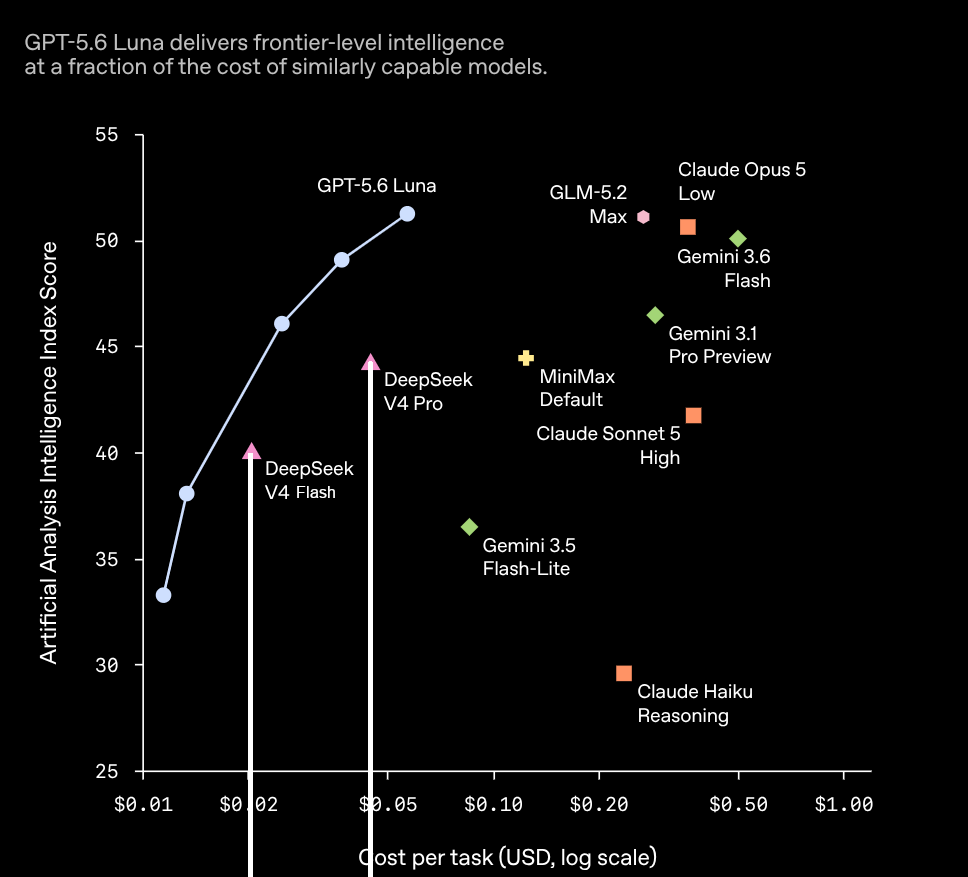
According to the Artificial Analysis benchmark graph in the article, Luna can now outperform Sonnet 5 and Opus 5 low at ~4-10x less cost
reply
dannyw 3 hours ago
You'd be surprised at what Luna can do, especially on xhigh or max. It's capable of working overnight, usually productively, just like Sol.

Haiku 4.5, on the other hand, is comparable to performance to Gemma4 31B (with working tool call formatting) in my experience, and Gemma4 strongly wins on vision and multimodal.

reply
euazOn 3 hours ago
Per Artificial Analysis:

- Haiku: 30 points

- Luna Medium/High/Xhigh/Max: 38/46/49/51 points

That's a massive difference:

- 30 points is Gemma 4 31B territory

- 50 points is GLM-5.2 (744B) territory.

reply
tosh 3 hours ago
luna is way better than haiku 4.5
reply
nateb2022 3 hours ago
I use Luna a lot (over 1T tokens since it came out) and I'd rank Luna (high/xhigh) on par with Sonnet 5, without hesitation.
reply
ls_stats 2 hours ago
Is it though? I saw a noticeable difference between Sol (xhigh) and Luna (max). Sol appears to understand better my prompts, you need to be more specific/clear with Luna.
reply
NortySpock 3 hours ago
> In a compute-constrained world where model demand is growing faster than capacity

I don't buy it.

There have been recent weeks where some of the mid-level models (Hy3, Laguna M.1) are free (true for parts of June and July, see Hy3 in Cyan) . Even then the total token usage appears to be reaching a steady-state.

https://openrouter.ai/rankings#top-models

^ the first graph is tokens per week across all models

I guess we just can only throw ideas at an LLM at a certain rate.

I still have ideas and now I can have an LLM vibe code what I want, but I'm not going to let an agent just run unattended for longer than a few minutes or a few bucks for hobby projects.

So maybe it is a matter of lowering the cost of an LLM so I can let it churn for hours at a cost of pennies... But I suspect demand for tokens is very price-elastic.

reply
Yopolo 3 hours ago
These are free due to some different type of reasons like Nvidida sponsoring free tokens or the model companies.

My company checks the models and pays for Opus through AWS.

You still send the WHOLE context of whatever you want to do to a random endpoint on the internet. If you want to write a good email, you give that context your email address, names, the reason for it etc.

Big companies don't randomly use some random api endpoint to do so.

Anthropics quarerly revenue is still growing very fast. I don't think we have seen even the real potenzial of it yet at all.

Not only are still a lot of countries missing which do not even use anthropic or any other frontier model yet but also all the agentic based solutions enterprise companies are currently building on mass (at least in my industry)

reply
Der_Einzige 2 hours ago
Openrouter is not even CLOSE to the majority of tokens. I don't know where this myth came from that they account for even ~5% of total token spend! It's not true!!!!

Stop rejecting what we have been collectively telling you guys! LLM providers are profitable, and have been for awhile!

reply
ninjahawk1 4 hours ago
80% less for Luna is absolutely crazy, in my opinion we may reach a point in the next year where powerful models on the API could potentially be cheaper than subscriptions. Compute just keeps decreasing in price.
reply
HDThoreaun 3 hours ago
API will never be cheaper than subs because theres a ton of value created for companies by locking people into subscriptions that tend to be sticky.
reply
mark_l_watson 2 hours ago
I prepaid for a ton of DeepSeek v4 flash tokens. When I use them I would like to try purchasing Luna tokens for a while. I like cheap and fast models and since I am retired, if I waste time having to sometimes manually switch to a stronger model, that is OK with me.
reply
wronex 4 hours ago
What are your use case for these? I’m manly interested in coding where more capability is better - give me a 10x model at 10x the price and I’ll take it. A worse model at very low cost has no appeal to me. At-least not for coding. Translation maybe? OCR?
reply
Yopolo 3 hours ago
Agentic layer.

Your support bot.

Your research long running bot.

Your SEO Optimizer bot.

Your incident analyser bot.

Your personal assistent bot.

reply
wronex 2 hours ago
Game play bots (monsters, commanders maybe) would be really cool. But it needs long term support and probably local AI instead.
reply
stri8ted 4 hours ago
Translation, moderation, classification, guardrails, etc..
reply
pbowyer 2 hours ago
Friendly reminder that GPT-5.6 in Codex cannot spawn Luna subagents, only Terra [1]

To fix this you currently need to make your own copy of the bundled model catalog [2] and opt Luna into MultiAgent V2.

1. https://github.com/openai/codex/issues/32031

2. https://github.com/openai/codex/issues/32031#issuecomment-51...

reply
efficax 3 hours ago
"too cheap to meter" and Luna is still more expensive than deepseek-v4 pro
reply
jrflo 3 hours ago
It's marketing hyperbole, but Luna is more intelligent per dollar than deepseek-v4 pro. Cost means nothing without the associated capability
reply
efficax 3 hours ago
is it? i don't know how we measure these things, but here's one measurement that says v4 pro is better than luna: https://artificialanalysis.ai/models/comparisons/gpt-5-6-lun...

presumably it's a much bigger model

reply
energy123 3 hours ago
This has already been updated with the new prices?
reply
pornel 2 hours ago
The intelligence scores are absolute, not per $.

DeepSeek Pro is more capable than Luna regardless of the cost.

reply
firasd 4 hours ago
This is one of the things OpenAI has been focused on for an year or so that led to the doomed autoswitcher in ChatGPT .com (switching models based on estimated task complexity) that was quickly reverted

Whereas Google with Gemini 3.x, Anthropic with Fable etc are happy to just go for 'big model with dense params'

It's hard to guess from the outside of course but just this kind of talking points focus on GPU efficacy is what we see from OpenAI and Chinese open source labs more often than from Anthropic or Google Deepmind and this benchmark chart seems to concur

reply
msejas 3 hours ago
Isn't OpenAI burning billions and have billions more spending commitments? If they managed to downsize so much the cost they should have kept the price the same and become profitable, really weird move, unsure what led to this.
reply
dgellow 2 hours ago
More than $650B due 2030. I don’t understand how it makes any sense that they reduce the price so much, unless they expect seriously such a massive saving and increase in demand from their latest improvements?
reply
otherme123 2 hours ago
Slower grow, or even shrink in usage? Right now, the promise of a future "everyone will use our models and pay whatever we ask" is what keeps $$ flowing towards OpenAI.
reply
paxys 2 hours ago
Supply demand curve is a thing. Cutting price on something does not mean you are going to make less money.
reply
dgellow 2 hours ago
But they still have to cover compute cost, and they already committed to more than $650B in infra expenses for 2035
reply
paxys 2 hours ago
Why assume they are not already making up the compute costs for smaller models?
reply
dgellow 2 hours ago
Enough for such a massive reduction? If yes that’s really impressive
reply
andai 4 hours ago
It says Luna is fastest, but doesn't it take way more steps to get the same job done?

https://deepswe.datacurve.ai/ - (See the Agent Steps view)

Or is the output speed so much higher that it cancels out?

I don't see a lot of benchmarks that record actual time. But on AA, Sol on Low beats Luna on High for Time Per Task.

reply
wxw 2 hours ago
> $0.20 per million input tokens and $1.20 per million output tokens for Luna

This is... ridiculously cheap. Amazing!

reply
Phlogi 3 hours ago
It's a clever strategic move: grab the market of cheap low end models within the product range. It's lower friction to switch a model than a provider.
reply
Pesto 2 hours ago
I truly wonder what kind of model is luna now.

Before I thought it was just an improved version or at least in the same class as gpt 5.4 mini but now it's being priced like a nano model!

I thought about it because Terra has similar pricing to 5.4 and Sol is similar to 5.5.

Luna was already my workhorse before, it performs very well on high/xhigh for most of the tasks, very happy about this drop.

reply
archon1410 2 hours ago
If Luna is so good and cheap, I'm wondering why ChatGPT Free users still only have access to GPT 5.5 Instant. The API pricing for chat-latest is the same as Sol(!),[1] while Luna is 25× cheaper [2]. Even assuming highly inflated API pricing for chat-latest, Luna not being the daily driver on Free and Go plans feels off.

Perhaps users prefer instant responses over thinking models so much so that using a more expensive and less performant non-thinking model is worthwhile.

[1] https://developers.openai.com/api/docs/models/chat-latest [2] https://developers.openai.com/api/docs/models/gpt-5.6-luna

reply
randomblock1 2 hours ago
I bet they'll switch over pretty soon. They always make free users use the older models for a little bit, probably to try to push people to upgrade.

You can actually use Luna without reasoning (set it to "none"). So if they wanted to, they could definitely replace 5.5 Instant with it.

reply
archon1410 49 minutes ago
Good points. Though GPT 5.5 Instant does beat out 5.6 Luna non-thinking 34 to 27 on Artificial Analysis Intelligence Index.[1][2] This could mean it is optimised for non-reasoning perfomance. So even if beaten on cost and performance, it could still be on the pareto frontier for speed.

It probably costs them a substantial amount of money everyday to not replace Instant with Luna, and the people who want larger models will upgrade regardless of whether they get Instant or Luna on the free tier. It is unlikely the amount of people upgrading just to have latest models would be enough to offset the costs.

[1]https://artificialanalysis.ai/models/gpt-5-6-luna-non-reason... [2]https://artificialanalysis.ai/models/gpt-5-5-instant-05-26

reply
infinite_spin 2 hours ago
I've been having issues with it using unreasonable timeouts for tasks that should have failed within minutes, not hours.
reply
arjunchint 3 hours ago
Deepseek Flash is still much cheaper:

- lower input/output token pricing

- the cached token price is $0.0028/Million tokens, which is like 50-90% of tokens

reply
lostmsu 2 hours ago
DeepSeek Flash is a much worse model. Even DeepSeek Pro is much worse.
reply
Decabytes 2 hours ago
Has anyone ever done a comparison between the smaller models like Luna, against the previous GPT 5 frontier models? Have we gotten to the point where the small models are as good as the frontier models of the past, or is there still a way to go?
reply
simianwords 2 hours ago
I ran a prompt with ChatGPT since I'm also curious. The price reduction is crazy.

- GPT-5 high: score 35, approximately $0.37/task

- Luna medium: score 38, approximately $0.01/task

- Luna max: score 51, approximately $0.042/task

So Luna medium is:

- slightly more capable than GPT-5 high;

- approximately 35–40× cheaper per benchmark task.

And Luna max is:

- 16 Intelligence Index points better;

- still roughly 9× cheaper per task.

This reduction was possible within 1 year.

reply
hugopuybareau 2 hours ago
> These lower prices for Luna and Terra are also reflected in how usage is counted against paid subscriptions

Does this seem higher or lower limits ?

reply
incognito124 3 hours ago
While I can't deny this is a huge technological result, and it's laudable they reduced the price because of it, 80% is really a lot. I can't help but wonder, is this because of the model's capabilities, or was the initial system just really sloppy? The public will probably never know the details
reply
xendo 3 hours ago
Does that also increase the token count in their subscription like ChatGPT GO?
reply
gentlewater 4 hours ago
This is awesome. I’ve recently set up my opencode to use 5.6 terra for my main agent, who delegates work to a 5.6 Luna coder agent. So far it seems to work well, and reduce costs a lot. With this price reduction, it will work a whole lot better. Perhaps I can get my github copilot quota to last the whole month now.
reply
kingstnap 4 hours ago
Those prices on luna are killer.

Haiku was already in a ditch.

But this is coming straight for the jugular of a ton of models on openrouter.

reply
peheje 4 hours ago
Might just resub. Will experiment with Luna next sessions. 5 h window is not working very well for me. But if I can drop down to Luna at 20-30 % left and comfortably ride out the wave then.. that might just work.
reply
arcanemachiner 3 hours ago
They got rid of the 5hr quota, it's just weekly quotas now.
reply
gck1 3 hours ago
They're supposed to bring 5h today.
reply
sosodev 4 hours ago
Looks like I might have a reason to use something other than Deepseek V4 Flash.
reply
andai 4 hours ago
I was curious so I photoshopped DSV4 Flash into the graph:

https://files.catbox.moe/csxl32.png

(2 cents to run AA index, score 40)

Looks like OpenAI broke the pareto frontier on the trust-me-bro benchmarks!

(One has to wonder if they used any of the neat tricks from the DSV4 paper :)

reply
purpleidea 3 hours ago
I would pay significantly more to use these models if there was a legal contract that guaranteed they weren't ever terfing them and some way to prove that.
reply
StilesCrisis 3 hours ago
What?
reply
thehamkercat 3 hours ago
nerfing*
reply
baalimago 3 hours ago
We swapped an internal system from gpt-5-mini to gpt-5.6-luna and saw no benefit but 4x cost. Sufficed to say: we swapped back to gpt-5-mini.
reply
gbnwl 3 hours ago
Experienced similar between 5.4-mini vs 5.6-luna in our own pipelines but after spending some time on prompt optimization and testing out various reasoning effort levels 5.6-luna was well worth it. Did you just replace model selection while keeping everything else in place or spend some time on evaling with newer prompts etc?
reply
baalimago 3 hours ago
No we kept prompts as is, just swapped model. The prompt is already quite optimized for the task. How would updating it possibly make a more intelligent model spend less tokens than a less intelligent model? Care to elaborate?
reply
Tankenstein 3 hours ago
Most of the time when upgrading models we have needed to change prompts to get the same performance (let alone better performance). Usually, your prompt is overfit to the specific model doing the specific task. For example often your previous prompt is overspecifying and creating contradictions that a dumber model would just gloss over whereas a smarter model will try even harder to follow.
reply
steveklabnik 2 hours ago
Here is an example of a guide from OpenAI on how you should prompt 5.6 differently than their previous models.

https://developers.openai.com/api/docs/guides/latest-model#p...

reply
StilesCrisis 2 hours ago
So now presumably it'd at least be roughly equal cost, or maybe a little less?
reply
fractorial 4 hours ago
It would appear that rolling my own Anthropic-free harness / serving stack with a closed-weight carve out for Codex models is an absolute win.
reply
swingboy 4 hours ago
This is awesome. Luna is a pretty great model on xhigh.
reply
dgellow 3 hours ago
How is that economically possible? I’m so confused by those prices
reply
anthonypasq 2 hours ago
how many times do you have to be metaphorically hit in the head with a brick before you realize inference margins at api pricing were 80%+
reply
svieira 27 minutes ago
So, does that mean they're selling tokens at cost? Or that they realized they were doing 180% more work than necessary and they're passing the savings on because "your margin is my opportunity" and this is a dog-eat-dog fight, but 80% margins are nice, no one needs multiple hundreds?
reply
brazukadev 29 minutes ago
I was metaphorically hit in the head with the brick of already provisioned computing with a lot less demand than anticipated by multiple MoUs.
reply
jnakano89 4 hours ago
Seems like they cut the tiers(GPT-5.6 Luna) where GLM and Kimi compete and still held margin for their frontier models
reply
alvis 4 hours ago
Basically lunar at extra level can cover all use cases scenarios other than those requiring opus up. Goodbye sonnet and haiku
reply
goldsmith112 4 hours ago
Not sure who would use Terra anymore. Pair Luna High/Xhigh with Sol Medium and that's your power stack
reply
fritzo 4 hours ago
Sounds reasonable. Is there a good benchmark on which make this decision?
reply
espadrine 4 hours ago
I maintain this meta-benchmark leaderboard: https://metabench.organisons.com/

With this new price change, Terra does look pretty Pareto’ed by Luna.

On agentic coding, pairing Sol Medium for architecting with Luna High for coding does kinda make sense. But beware that architecting can be very read-heavy, and Sol is a bit read-pricey compared to Terra.

reply
andai 4 hours ago
Sol as main agent, Luna for coding?
reply
guybedo 2 hours ago
gpt 5.6 luna was already at the intelligence/cost frontier and it's now even cheaper ...
reply
Aboutplants 3 hours ago
Your move, Anthropic
reply
hadlock 3 hours ago
Seems like they're working to destroy the local LLM argument. Right now Haiku is $1/$5 in/out. You can grind out $12,000 worth of haiku (or arguably, sonnet) class tokens in about 5 months on a Blackwell RTX 6000 96GB especially if using concurrency. BUT, but, if you use a g6e.xlarge on aws it's now more expensive than buying tokens from OpenAI @ $0.20/$1.20. It also destroys "the Mac Mini argument", pushing the ROI to ~4 years.
reply
jrflo 3 hours ago
The local LLM argument never really held water tbh. You can get surprisingly good performance for lightweight tasks locally, but you're just fighting economies of scale if you're going trying to beat a datacenter on cost.
reply
hadlock 29 minutes ago
I just gave you the ROI on a retail blackwell card, the math checks out, particularly on overpriced Haiku and Sonnet, what do you mean by "you're just fighting economies of scale if you're going trying to beat a datacenter on cost" ?
reply
simianwords 2 hours ago
Local LLM argument was always ideology first and never ever about economics.
reply
bakugo 4 hours ago
> GPT‑5.6 Luna, our fastest and most affordable model, will cost 80% less

Looks like the Chinese models are really making a dent. Having 3 different price categories with the "most affordable" one still costing more than GLM 5.2 never made sense.

reply
preommr 4 hours ago
I thought the chinese models were cheaper per token, but about the same or more expensive on tasks because they used more tokens for reasoning. Cutting even further, seems like a really big leap.
reply
measurablefunc 4 hours ago
It all comes back to electricity cost. China has cheaper electricity so as long as China keeps pace there is no way for American companies to undercut them. Each boolean operation in China is cheaper than the one in America.

> China: Household rates average around $0.08 / kWh (¥0.53/kWh).

vs

> US: Household rates average around $0.16 / kWh, though regional variation is massive—ranging from ~$0.10/kWh in low-cost states (like Washington or Louisiana) to $0.30–$0.45+/kWh in high-cost areas like California or Hawaii.

reply
cbg0 4 hours ago
This doesn't seem correct.

Estimated final electricity price for large industrial customers in energy-intensive industries:

USA 50 USD/MWh

China 68 USD/MWh

https://www.iea.org/reports/electricity-2026/prices

reply
tokai 3 hours ago
I don't know, non of the chinese models I use are served from China. And they are still cheap.
reply
simianwords 2 hours ago
There were people on HN who still thought that the API prices were being subsidised. The level of conspiracy theory was off the charts on this topic. You would get these price reductions month over month you would still have people believing in crazy stuff.
reply
amazingamazing 2 hours ago
Link to definitive price info?
reply
dannyw 4 hours ago
[dead]
reply
spacebacon 2 hours ago
[dead]
reply
lightinglabs 3 hours ago
[dead]
reply
shevy-java 3 hours ago
The milking games have started. The billionaires want their money back.

Edit: Yes, 80% minus is still milking. Because you empower these greedy mega-corporations. Just look at the RAM prices increase, then you see that the more money you give these hungry dragons, they more they will eat up. Don't get fooled by their "less cost now" advertisement.

reply
measurablefunc 4 hours ago
Model segmentation & distillation like this that asks the consumers to pick exactly which version of the algorithm will solve their problem is evidence for lack of intelligence instead of its presence.
reply
beering 4 hours ago
You really really don’t need to pick. Just use Sol on high. That’s my daily driver and I don’t touch the model picker at all.

Now, if cost is your concern, then that’s a problem in all of computing. Hence why I’m sending you short plain text messages using an iPhone with a many-core CPU and gigabytes of RAM.

reply
dominotw 4 hours ago
it is really hard to know upfront if you have fuzzy task. sometimes i would choose a cheaper model and it will spin and spin with bad outputs ending up costing more had i chosen a more capable model.
reply
cute_boi 4 hours ago
there is mixture of experts which is also another routing. So, simple change in prompt can be a big difference.
reply
sidcool 4 hours ago
They don't mention Grok at all.
reply
andybak 4 hours ago
Don Draper in the elevator meme?
reply
hirako2000 4 hours ago
Of course. All comparison is with what makes them look good.
reply
paxys 4 hours ago
They also don’t mention a hundred other models.
reply
wilg 4 hours ago
What would they say about Grok?
reply
infinite_spin 2 hours ago
Hang on, I need to create a Twitter account so I can ask Grok
reply
qingcharles 2 hours ago
Musk announced Grok 4.6 coming next week, no idea what changes that brings or how it compares to the current 4.5.
reply