Original images: https://image.non.io/neonRamenDesigns.webp
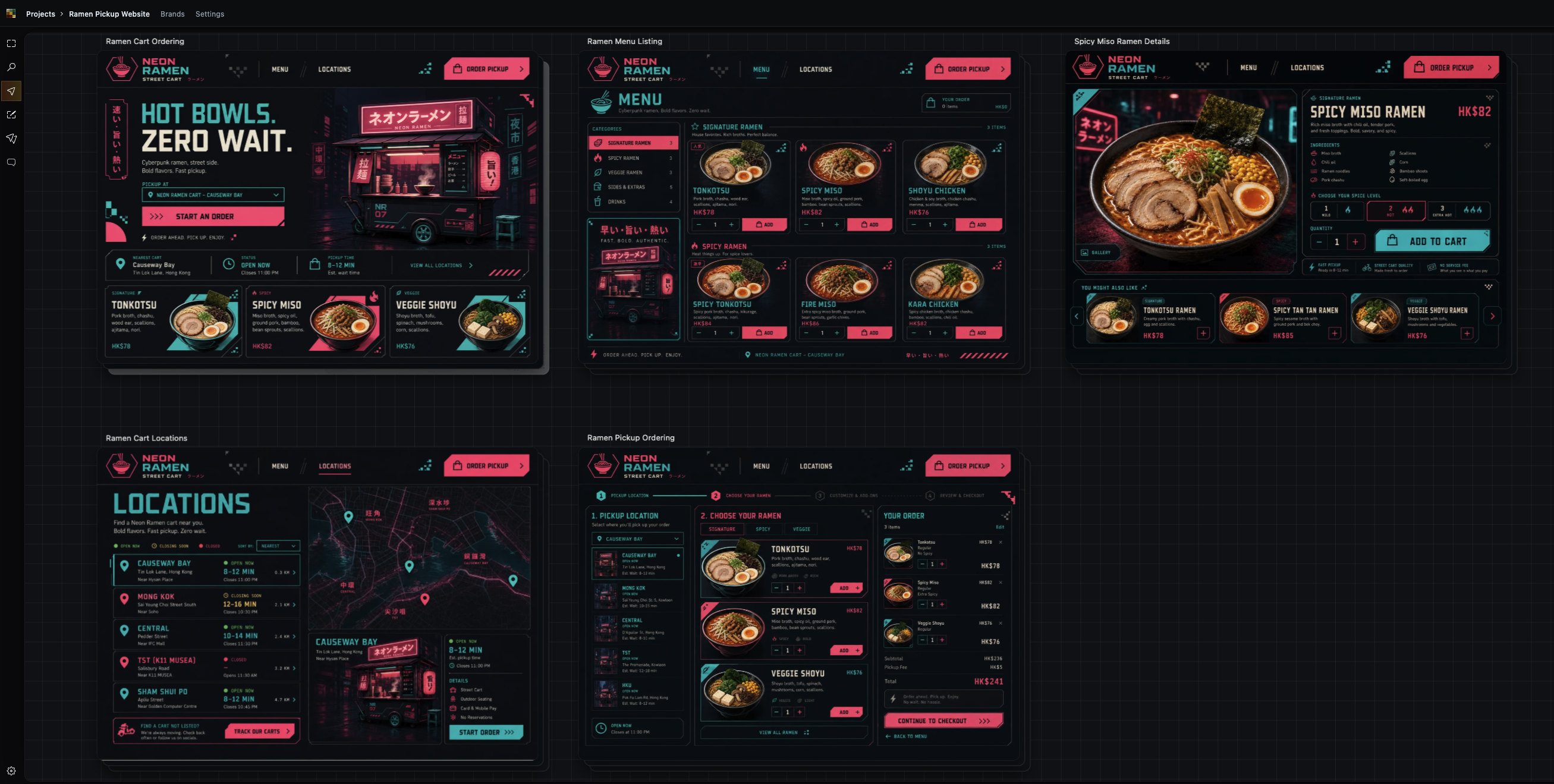
Gemini 3.7 build: https://html.non.io/neonRamenGemini3.7
Opus 5 build for comparison: https://html.non.io/neonRamen
Opus is still best in class for this, but it's worth noting how well Gemini 3.7 does vs a more comparable LLM price wise, which is Grok 4.6: https://html.non.io/neonRamenGrok4.6 . I thought Gemini would blow Grok out of the water (it generally has in the past), but Grok has really caught up.
It's not a bad model by any means, but I just don't know what situation I'd reach for 3.7 Flash first for. Google really needs a differentiator, especially given how hard it is to get an API key from them. They can't be high friction and non-pareto.
Disclaimer: I work in Google so it might be that this link is not publicly well known
At a high level though, as a rule of thumb Google assumes that they're serving companies at Google scale first, and at a human scale second. For other companies it's the opposite. Generally what that means is the first experience you get with a Google product will route you through 8 different dashboards to set up ACLs before you've hired your 2nd employee.
Also:
> Google assumes that they're serving companies at Google scale first
So much this. I'm currently grandfathered in until the end of the year on Google's Search API, but the $35,000 they want to continue usage of my < 1000 personal searches per month, not going to happen. It has honestly been easier to use Anthropic to help me build my own search index & crawling infrastructure than deal with Google.
I think that's actually a very interesting insight that would be helpful for PMs on GCloud to take note of. As a single founder, setting up Google Cloud, it's like they start out by assuming you're bigco, forcing (I assume most) of their users into a arduous process of removing components they don't need.
Google AI Studio is one of Google's solutions to this problem, but in typical Google fashion, it's bolted-on without any clear connection in the ecosystem. If you're also using GCloud, it's hard to remember it's even there.
OpenAI's platform, by contrast, is streamlined, easy to use. With Google, I feel like I need to wade through the documentation first before even using the darn thing.
“Failed to create project, The request is suspicious. Please try again” or “ You do not have permission to create a key in this project”. You can then navigate multiple screens in GCP to make it work but it’s a hassle compared to any other provider (OAI/Ant/OpenRouter or any of the Chinese labs).
It was literally two clicks, and didn't even leave the page: the dialog asked to create a project and type in a name, I did that, clicked submit and then it was selected as the default project. One more click and I had the free tier API key.
Not saying you didn't have that experience at the time, but personally I have had zero issues with AI Studio and consider it the most dead simple/fastest dev dashboard to get started compared to the others like OpenAI/Anthropic (thanks to Google's free tier that lets you skip billing setup annoyances just to play around with Gemini).
Despite what HN threads (that are also frequently confused and talking about GCP instead) portray as universal/widespread issues or the process being complex and time consuming somehow.
Eventually I gave up and run a few hundred million tokens (edit a few billion) through openrouter.ai using Gemini Flash 1.5 to Flash 2.5
Every since price increases on Flash 3.0 I've stopped using Gemini, too expensive for basic classification, sentiment detection, ocr etc.
As other posters said Google assumes you are some bigcorp trying to use their products. The Vertex versus AI studio confusion did not help.
Sorry but it's not worth waking up with a 100k$ bill, fix your platform first.
Biggest traffic day of the decade and our site was down because of google.
Using Google products in general is an effing nightmare as soon as you have to give them money.
The one thing you want in a business is to remove friction when people want to give you money, a concept Google has never been able to understand.
Google being Google, their models tend to be better at finding, organizing and presenting information, from my experience.
I'm not sure what event-based traders are doing now, but back in the day NLP sentiment analysis was all the rage, so I'm assuming they've now incorporated LLMs too.
You reach for it every time you do a Google search
Maybe things there have improved some, but when I was looking it was a huge runaround.
What does this mean? Anybody can get an API key
I'm used to incremental Figma wireframe -> final product and working together with a designer.
EDIT: OKAY I see it's mostly the "image" generation, not so much the HTML... Noticeable in the food photos and the foodtruck/cart photo
i do wonder why gpt sol was not compared here but honestly it's not really known to be the best at UI
a fable 5 comparison would've been also interesting and likely the best.
I guess I need to try harder. :)
Opus can't generate images since A\ doesn't have a diffusion model.
This is the build step generated by my diffusion-based ui tool's copy-for-agent action.
https://image.non.io/12275ee8-71e9-4941-823b-e51fec157b4d.we...
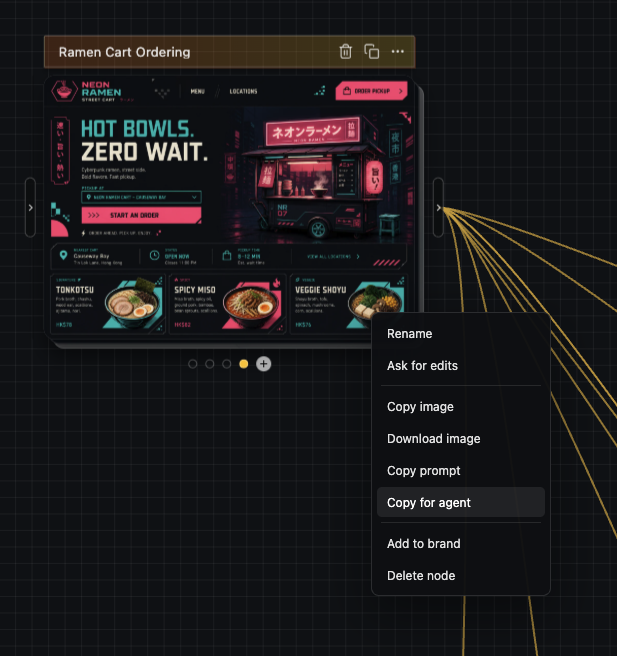
The agent is told to generate assets as part of the buildout. It gets to decide what the prompt is for them / whether to do postprocessing like background removal / what type of asset to generate.
Plus is the ramen in HK even any good?
This is testing if it can match visuals that have already been established, and represent them with all the tools available to a web developer. The ramen example was chosen in particular because there are a lot of things that aren't easy to do with CSS, and require creative strategies: 45deg button cuts, angular repeating pattern elements, blending of raster art and svgs, microglyphs, low contrast subtle elements, etc.
Don't ask yourself whether it's a good design, as yourself whether it's a good test.
It's scheduled to double in price on December 31, 2026, but who would anticipate still using this model five months from now? Especially since 3.6 Flash came out just three weeks ago!
My first effort with default thinking level produced an ambitious pelican, let down by a flawed bicycle: https://tools.simonwillison.net/markdown-svg-renderer#url=ht...
Then I ran it on high, medium and low thinking levels (oddly minimal is no longer an option, which WAS an option for 3.5 and 3.6) and got a pretty excellent pelican for the first two:
https://tools.simonwillison.net/markdown-svg-renderer.html#u...
UPDATE: That was in Safari, but as pointed out in the replies here the pelicans do NOT render well in Firefox or Chrome! Best guess is that's because of this invalid filter in the SVG:
<filter id="shadow" x="-10%" y="-10%" width="130%" height="130%"></filter>
This suggests you primarily use Safari.
While the bike renders, the pelican doesn’t in Chrome and Firefox.
Probably one of the more serious defects I’ve seen with the pelican. It’s one thing when animated SVGs have bugs, but another when plain ones do.
Anthropic for instance announced a couple of days ago that they are making Sonnet's 'introductory pricing' permanent https://xcancel.com/claudeai/status/2086891169217122586
Those kind of workloads would be hit by an end of introductory pricing. And it's exactly the kind of cases that are not very price sensitive. Where we are price sensitive we track new model releases closely, where we aren't other issues get priority as long as llm performance is good enough
I work for Google and their free, internal Gemini API isn't quite as graceful. They once turned down a model arbitrarily and it broke our tests. I had to scramble to fix it, then build warning systems for the turndown as well as a special validator to make sure any upgrades make the same determinations.
> Starting January 1, 2027, $1.50/1M input tokens and $7.50/1M output tokens will apply.
Compare this to Luna which is at $0.2/1M input ($0.02 cached) and $1.2/1M output.
However, I've noticed 2 drawbacks with Luna. Context rot is much more palpable than Terra and Sol. It tends to get confused and go into rabbit holes when it's context gets filled up. In addition, when instructions are vague, it performs poorly and tends to write way to more code than necessary, but that is to be expected of smaller models. In all, for clearly defined, bite-sized coding tasks, Luna's price-to-performance has been insane. It might have very well commanded the price tag of Sol if it came out just a year ago.
I don't think I want a gastown-style "just yolo everything" approach, in fact I really want more control over how decisions are made and with what info. Does this exist?
On complete, it moves the user story from Doing to Done. I also have a MEMORY.md file that the agent read and writes in the beginning of a new conversation and at the end of our conversation to update stale information. These files are referred to every time I start a new conversation.
Regarding forking, I know Codex has such button underneath each message that lets you fork the whole conversation. I usually do that when I want to sidetrack and discuss something.
I use no SKILLS or commands like /goal. I’ve come a long way with just prompts and markdown files. Its all a different way of encapsulating instructions anyways.
How much does that matter if it's reset at every turn?
  Your Prompt 1: Prompt Content 1 -> cache-1
  LLM Response 1: <Thinking>Thinking Content 1</Thinking> Response Content 1
  Your Prompt 2 (client side): prompt-1 + response-without-thinking-1 + Prompt Content 2
  Your Prompt 2 (server side): cache-1  + response-without-thinking-1 + Prompt Content 2 -> cache-2
  LLM Response 2: <Thinking>Thinking Content 2</Thinking> Response Content 2
  Etc...
Edit:
I've realised I was incorrect, the thinking doesn't get passed back and forth but the latent snapshot does which result in using memory just the same.
Gemini[0] for example passes along a snapshot of the reasoning state but it's not the equivalent to keeping all the reasoning tokens in the context.
[0] https://ai.google.dev/gemini-api/docs/thinking#signatures
Edit: Apparently it does take the same space in the LLM latent space so I was wrong.
Large lumbering enterprise with massive inertia. Where innovators leave as soon as they get a better offer.
None of the authors of the seminal "Attention Is All You Need" paper are still at Google.
Fast forward a decade and Google will be reduced to hiring the kind of mediocrities who deign to work at IBM and Accenture.
I've always considered the Flash series of models to be for low-cost, high-volume, mostly text-based use cases (e.g. summarization, parsing, formatting), emphasis on low-cost.
[edit: ah, benchmarks here: https://blog.google/innovation-and-ai/models-and-research/ge...
more of a Terra than Luna competitor which is an interesting positioning. I feel like differentiation at the mid-tier of models is pretty difficult.]
I pay for ChatGPT and Gemini, and while Sol is a total beast with anything text, it still poisoned my cucumber bed. Which I will be bitter about for at least a few years while the bed recovers. Gemini (even flash) is exceptionally talented at viewing photos and telling you what to do/what it is (and telling me I just misidentified the problem with my cucumbers and spraying off the "bugs" actually just spread the bacteria everywhere.)
Luna way cheaper. DeepSeek used to be, but I think it's somewhere on Sol's curve after the price hike.
So it's better than 3.6 Flash, at half the price. I've been pretty excited about Gemini models recently, they just feel so fast after spending most of the day at work waiting for Opus 5.
I think its the same price..
https://ai.google.dev/gemini-api/docs/pricing today has 3.6 Flash at $0.75/$3.75 until December 31st 2026, then doubling.
https://web.archive.org/web/20260809105129/https://ai.google... Internet Archive copy of that page from 9th August has 3.6 listed at $1.50/$7.50 with no mention of the price changing.
The selling point for gemini continues to be speed and particularly end-to-end response time.
Worth noting that OpenAI just announced that they got the full GPT 5.6 Sol model running on Cerebras at 750 tokens per second. No announcement of the pricing though...
Good catch! You're right to point that out. My previous marketing copy missed that specific detail. Thank you for bringing it up!
The application isn’t so complicated that you need opus level reasoning or code writing, we need “good enough” data retrieval and processing with natural language queries and the ability to answer follow up questions.
For that Gemini works well for a decent price.
Edit: and Sol medium actually has the same AA intelligence score as Gemini 3.7, and has >7x fewer tokens, actually making it faster
Unfortunately, it's often not strong enough for heavy refactoring and long running development loops.
I fail to see the usecase where DS V4 Pro is not enough, but Flash 3.7 is - except multimodal.
Luna is similar, and also 8x cheaper. Source: artificialanalysis
The only benefit I can see is the speed, that looks to be outstanding, probably thanks to their TPUs.
Well, compared to 2 months ago, it's no longer 100x more expensive for similar levels of quality...
If they continue monthly-ish releases by 3.9 - by Halloween - they should be close to the best in terms of what you get for what you pay for.
In 2 months, they've gone from basically the bottom of the pack to at least being somewhat usable and competitive.
OpenAI and Anthropic release in a month, and change things. OpenAI is claiming to be close to an Astra release - but that seems like a Fable type release - where they're just releasing a better more expensive model, not more cost effective models.
The only thing that works at scale is gemini flash.
I could probably do text only for my workflow (feature development/debugging for web microservices) but sometimes it is easier to just toss a screenshot into the Claude prompt, so that gives it an edge.
If your workflow is 100%, certifiably never ever going to involve an image, then yeah, this isn't going to be huge.
That's why DS4 already had a huge price hike announcement.
Deepseek as a company can just increase prices for the crazily cheap cache they have, that's their only lever.
I'm currently using omp with Kimi K3 as the planner and DeepSeek v4 Flash 0731 as the implementer, or CC + Fable for planning and Opus 4.8 for implementation. For API(not coding), I just use DeepSeek v4 flash 0731 and MiMo.
I'm pretty happy where I am, but I'm wondering if these new models provide some new kind of advantage
> Coding and agentic tasks: Significantly higher quality on real-world software engineering and agentic benchmarks, improving issue resolution and reducing failed agent loops.
> Web development and stronger design parity: Generates higher-fidelity desktop and web application code directly from design mocks, with strong gains in design adherence and in auditing existing codebases against mocks to verify 1:1 design parity.
> Promotional pricing: Gemini 3.7 Flash will be available at an introductory price of $0.75/1M input tokens and $3.75/1M output tokens. We’re also applying this new rate to 3.6 Flash. Introductory pricing expires on December 31, 2026; after, $1.50/1M input tokens and $7.50/1M output tokens will apply.
Still no sign of 3.5 Pro. Will have to test it, low expectations given every other model from the Gemini 3 lineage, but one can hope. Just struggle to understand the promotional pricing being temporary for four months. Given this industry, I'd be hard pressed if 3.7 Flash was still in use by end of year, so why not make it the official pricing?
It was probably to placate some kind of general internal pricing/revenue benchmark that doesn't account for new model releases. Politicians do shit like this incessantly and it reeks of bureaucracy.
"Hey, we are not in a race to the bottom. This is our usual pricing, but this now is a promotion because we know we're coming from behind and need to entice users."
They're drawing a line in the sand on monetisation and signalling that to everyone, while in reality offering it a deep discount (no idea if profitable or not) knowing that this model will probably be obsolete before then.
Google AI Mode consistently gets me consistently good results and good speeds. It really changes what "googling" is for me.
OpenAI has too much money. They’re spending their money in stupid ways.
today i wanted to link agy to a google cloud project, for that i had to enable 5 different APIs in google cloud UI, then create a subscription for Gemini Enterprise (whatever that is), then link it to a project, then assign it to a user. and after all that, agy couldn't find the subscription.
the best part: i couldn't cancel the subscription. so i just paid $35 for one month and left it.
It can regularly cost more than Fable, take longer, and deliver far far lower quality.
I'm much more interested how this compares to Luna - which on price is terribly - but at least on quality the benchmarks make this look competitive / usable.
If Google continues monthly Flash releases like Sundar said they would, and they continue to have this much of an improvement in cost/quality - then in a few months this could reasonably be very competitive with the best of the best.
It is not there yet, but at least it's super fast, I guess.
Less than half its price.
More than 50% discount.
> Introductory pricing expires on December 31, 2026. Starting January 1, 2027, $1.50/1M input tokens and $7.50/1M output tokens will apply.
Personally whenever I use Gemini I've just been using 3.1 Pro because I've had insane trouble with them getting things incorrect like this. Hopefully they'll fix it soon / they've fixed it with 3.7 Flash.
Also have to compare to the recent Grok 4.6 release, which appears to straight up be better AND cheaper
Hard to understand why anyone would choose 3.7 Flash under these conditions.. is Deepmind still a frontier lab?
Per-token cost isn't a great metric given that some use way more tokens than others.
At this point, I think they're mostly targeting Google One and Workspace subscribers, except doing worse compared to Microsoft because they don't have Microsoft's huge enterprise moat built from their DOS and Windows days.
It did fine on my usual benchmark about configuring old Sparc hardware, maybe output slightly faster than before. Even included something new to check in the firmware.
GPT-5.6 or Claude models haven't delivered to me non-running code in ages.
Whenever I have Gemini in the flow, it's fast, but mistake riddled. I have low confidence in the output.
I've had some success with Opus driving Gemini models. It's pointless for GPT family since Sol is cheap enough or can drive terra/luna for arguably better performance, same speed, and better outcome.
As for all of the talk in this thread about modalities. Every SOTA model takes screenshots and verifies work now. Grok-4.6 does this, Luna does it, etc. They can also all work _from_ a screen shot or mockup provided.
I don't think it's a major selling point when every model can do it well and reasonably fast.
That said, eagerly awaiting "pro" and improvements to antigravity.
I've gotten good results with it, but it definitely is more hands on.
This feels absurd to me (my gut is "I want the SMARTEST model I can get!!"), but often I find that my experience of using a flash/sonnet model for every-day workhorse coding they are better.
Its not the same thing, but when I think of that I am reminded of working with some engineers in the past who are incredibly smart and have PhDs (or to put it another way, over-qualified) and they were crap engineers because they'd just not be able to focus on the task and ONLY the task at hand and would get easily distracted by the "why" or "more interesting" things when I just asked them to fix a simple bug or whatever. Again, its not the same thing at all, but it certainly comes to mind when I think of this or experience a pro/opus model suggesting we make huge refactors when a tactical fix is all that is required etc.
Of course, the opus-sized models are great when it comes to huge comprehension/research/debugging efforts where the deeper reasoning is actually useful.
If it implements something simple like a file export, it just knows that the file should have a meaningful name. Vibecoded feature beats most software's lazy "untitled.png".
So, yes, I want the smartest model even for simple stuff. Maybe especially for simple stuff because the tokens burned will be trivial so the cost doesn't give lower models a comparative advantage.
Consistently, lower intelligence models provide worse results in my own work. But I don't have evals on my side, just vibes.
Google probably crunches more tokens daily than the other labs combined, just because basically the entire global population uses Google (sans china) and Google has shoved Gemini into everything.
I wonder if this counts as evidence against that hypothesis? That multi-modal is struggling to keep up with SotA and the best they can offer is competent and fast?
this is hilarious. it is not 2025 any more, by Jan 2027 there will be at least 3 newer generation of models (from other provider) released already. nobody would use flash 3.7 at that time.
sure we used to cling to gemini models in the past, demanding 2.5 models to continue to serve, but since google betrayed us with those price hike, people already spent their time making their production pipeline less dependent on google since then.
heck, even now I'm not sure I even care if they cut the pricing even lower. there are too many models with cheaper price and similar performance now.
They should call it 'face saving pricing after we realized just how terribly did we mis-price the flash 3.5'
> since google betrayed us with those price hike, people already spent their time making their production pipeline less dependent on google since then.
This is my first hand experience. I spent at least $3000 on gemini-3-flash-preview. And exactly $0 total on (3.5+3.6+3.7)
a decent model with a decent harness will determine when the knowledge base is lacking and attempt to fill the holes; thus the good general models can be very easily brought up to speed on niche domains.
and now we have ai agents to automatic migrate the system with new models. in the past we would need to spend hours to design the prompts, then test the output, then write codes to babysitting it. nowadays any ai agent can do it effortlessly.
Personally, I feel like Google blundered on their pricing because while I was using the free version of the Gemini harness, they took away most of the free limits and made people move over to their Anti-Gravity harness for no apparent reason. I was about to splurge for a Pro sub since I already used Google for extra storage but putting up limits like they did made me not want to trust they wouldn't do more price shenanigans. Now their models are behind and it seems like they're scrambling.
Introductory pricing until December 2026 implies no significant Gemini Flash developments until the next year.
But, I think it’s also based on what they are being used for, most LLM users are still mainly SWEs or similar as I understand and there’s a ton of data to train them for coding.
My point is mainly that was never the pitch that got ai the hype it did and imo doesn't justify the valuations even if we all lose our jobs to ai. Because it no longer seems like they even think its making other jobs go away.
They compare it to 5.6 Terra, however https://cognition.com/frontiercode puts Terra at about 1/2 the price
Also have to compare to the recent Grok 4.6 release, which appears to straight up be better AND cheaper
Hard to understand why anyone would choose 3.7 Flash under these conditions.. is Deepmind still a frontier lab?
Also impressed with Grok for some stuff.
Somewhere in the same neighborhood as GPT 5.6 Tera and Sonnet 5, depending on the bench.
And yet the entire thread here is people bitching that it's neither 5.6-sol nor Opus or Fable 5.
BTW why are OpenAI and Anthropic even releasing models like terra/luna and Sonnet?
Why? Just why?
Is there a... market?
For you can't have it both ways: either Sonnet and terra/luna make zero sense for Anthropic and OpenAI or Google is a player.
I hope so. It seems mind boggling to me that an user needs to surf around different sections (plural) of google cloud console, then this Vertex and do a dozen clicks to issue a simple key.
In my evals 3.6 Flash (pre price change) was usually a bit more token efficient than 3 Flash, so I‘m expecting same or even lower cost-per-task on 3.7.
Maybe a play by Google to deprecate 3 Flash soon.
Google's Opus competitor is 3.1 Pro Preview which is essentially obsolete (competed with Opus 4.6). They do not have a Fable/Sol competitor.
I guess Google's betting on consumers being price-elastic (preferring to tradeoff intelligence for significant cost savings)
FWIW neither is xAI, there is no "big 3". xAI has had momentary peaks (I think they are having one right now) but they have never been able to claim to consistently push the frontier in any particular direction. You can also infer they aren't a frontier lab from the fact that they sell their compute.
I also think Google is still the best at fitting the most overall intelligences into their models, but for some reason it seems like the model architecture is just bad.
Theoretically there is some difference between Fable and Opus or Grok and GPT, but at the end of the day I'd look at the bottom left of my screen and to my amusement find out that for the past 3-4 hours I've been using model ______.
If the results are semi-decent, I'd keep it on, if not - I'd randomly switch the model and try again.
Actual thing that would affect my selection would be a number of unused tokens I have left for a model ____ for this week.
Maybe it's cause I'm using those for programming and log parsing and all of them are decent enough, but other than that - there are no leaps I see.
1. How the new model performs against the other top models in the same category.
2. The pricing of the new model against the other top models in the same category.
If so, now I understand why they didn't want to release this model
What am I missing?
They can't seem to be able to produce a frontier model, fine.
Just be quiet about it and work hard until you manage to put one together.
[EDIT]: Come to think of it. Maybe they're trying to build the Toyota corolla of AI ... let's see if that wins them the battle long term. I personally doubt it.
We still don't have a 3.5 Pro, and along comes 3.7 Flash?!
For Google, this is still gemini-3.1-pro-preview, right?
Same training dataset, same software, same hardware, same architecture...
I'm wondering what they changed actually for the model to be more powerful if the benchmark results are real and relevant.
Maybe just tweak settings or the reasoning prompts and called it a new version of their model?
each new checkpoint can benefit from better reasoning training, RL on specific tasks and more synthetic data
So why do they seem to release around the same time ? my guess is because they time major releases around quarterly earnings, investor meetings and other important business milestones. Once one company announces a major update, the others also have an incentive to ship their latest checkpoint rather than look like they r falling behind.
And it's arguably not crazy, at least if SemiAnalysis's estimates are to be believed:
  * 20% of all TPU shipments from Q3 2026 through Q4 2027 are sold to SPVs serving Anthropic ($150B of contracted revenue); vs
  * ~$12B ARR for Gemini.
Because they compete for the same scarce resource, the result is a resource crunch for the group that's lost: https://www.latimes.com/business/story/2026-05-18/inside-ai-...
Citation needed.
also, why can't a massive company do two things?
It's a variation of opportunity cost. A company that has an opportunity to take $1 and make $1.50 on it can't justify an opportunity to spend $1 and make $1.25, even though a less profitable company may make a good living on that. When considering capital allocation, Google has to consider the opportunity cost of investing more into their highly lucrative ads business. Another company that has no access to such a lucrative business uses different opportunity cost when it comes to allocating capital. It can easily be the case that Google could end up justify being in the business of renting out shovels and end up chased out of the business of using the shovels to create AIs entirely because that turns out not to be where the money is. I'm not saying that's obviously inevitable; I'm saying it's a possible and reasonable outcome.
That's why even though the industry produces giants, these giants can never just eat everything. Even though it seems like they have all the money, it isn't practical for them to try to do everything and in fact limits get hit very quickly for anything other than the primary, lucrative business.
Apparently there is no snappy term for this in the business space, according to such AI searches as I have run.
There are other factors at play, but they're more recent/second-order.
I honestly wonder how long this calliope can keep playing before it crashes to the ground.
(I have no business relationship to anything mentioned here except as a regular retail customer who went bargain-hunting)