They could just set it to 12h mode for americans and 24h mode for the rest of the world, and hid the setting somewhere deep in the menus (hold this button for 3s, then press that button 5 times, and then the other button two times, etc.), so you could change it from american to normal display if needed, and never again press it by accident.
The fact that Casio is well aware that the backlight is just terrible, but haven't fixed it in close to 40 years is hilarious and just makes me love it even more.
Also people who worked in confined spaces who wouldn’t know if it was day or night outside after a days job. My father who worked in an oil rig in Abu Dhabi used one. He gifted me one.
This was 1998.
It’s a little strange that a dedicated button would be needed to switch between them, especially when the math to convert between them is so simple.
You did not know that large parts of the world default to 12h time?
This is absolutely NOT an American thing. I am not American and have never lived there. I am 58 years old, British and Irish, and lived a decade in Nigeria and a decade in Czechia. I have travelled widely around Europe and can get by in 6 foreign languages.
12h time in real daily life is more common everywhere I have ever been. Only minor subsections of humanity -- military people, maybe -- work on the 24h clock.
Ooh that explains a lot.
I don’t have the satisfying answer as to why they dedicated a button to 12/24 hour time but my guess is that it’s simply a cool digital feature and stands out against the limitations of analog watches.
In the 80's and 90's, when sixteen-segment and dot-matrix displays made displaying text easier, calculators started displaying menu items, so you didn't have to memorize the sequence.
Since then, we've moved on to full-color high-resolution displays that can handle any text of any language, and the menus have more-or-less switched back to memorizing a sequence of which obscure symbols to press, I guess because some people think they look cool? Sometimes there's no menu at all, and you just have to memorize finger movements.
I don't know what clever jiggery-pokery you are trying to do, but whatever you typed, it's just turning to tofu on this Macbook, in both Chrome and Firefox.
A few months without doing them, and it was hopeless trying to remember how to do them again.
The beauty of them is that I can pick up any casio model from any year and I know how it works.
That my friend is peak design.
Both countries have now officially switched to the 24-hour format.
It has pretty critical functionality for those, I think the way its labeled on the watch face just makes it sound a little odd.
I used to walk around with a Casio always, I would have welcomed this connectivity, but now I have a Pebble and I like the balance. Could have done without the HR monitor, and with GPS though (some features don't work without phone connection, too many I find). Other than that, perfect for me.
If I remember right, I also made some improvements to the TOTP watch faces. Even maintained the repository for a bit while Joey focused on getting the Sensor Watch Pro out. Merged a lot of stuff.
People have written orbital calculators for this thing. Even the Chrome jumpy dinosaur game got ported.
Is it did that get implemented solely so someone could say "I'll make my own watch, with blackjack and hookers"?
Similar to the current weather feature that grabs the weather for the next 5 days on every sync, I just want to push the local time train schedule just once per day to my watch.
https://github.com/izivkov/gshock_api
The full lifelog (what Casio calls the steps and other metrics) is an opaque binary blob, but we mostly understand it now, so you can access that too.
A base F-91W costs less than half that, and my phone can already track steps with reasonable reliability.
An entry-level fitbit costs about the same and monitors way more stats including heart rate, SpO2. Worse battery life and appearance, but if I wanted that featureset it's probably what I'd get.
The price is a bit high, it is basically just a watch with a step counter. I'd also argue that people who buy Casio watches might have multiple watches they switch between, so you'd only put this on when you want to count your steps, and in that case there are better and cheaper options.
When I look at my watch I want to see the time, not wasted space announcing "Casio Step Tracker" or "Water Resist" ( which isn't even proper English).
I moved to Timex a few years ago as their basic digital watches have nice big numerals for the time display.
You cannot connect the watch to Bluetooth without a proprietary app, and that proprietary app will not let you use the Bluetooth feature without some bullshit called a "CASIO Account". Their privacy policy is a bit of an eyebrow-raiser too.
The absolute state of things.
This is an unofficial app for Casio G-Shock, Edifice, and Pro Trek watches. It allows you to control your watch, sync data, and configure settings without a Casio ID. It offers a faster, privacy-focused, and more powerful alternative to the official Casio app.
Key Features check ------------------ - No Account Required: Skip the Casio ID login entirely.
From https://fdroid.gitlab.io/jekyll-fdroid/packages/org.avmedia....
Yes, it's annoying this stuff isn't open source from the get-go, but it has never been easier to open hardware up for yourself and others.
There should be bounties for open sourcing drivers/apps like these and generally making 'clean'/better interfaces to hardware devices, now that it's so much easier.
Claude Code reverse engineered cheap (Android only) usb and wifi endoscopes here, wrote/flashed/hardware-in-the-loop developed python+arduino libraries, etc.
It's a completely new world.
@wpm, happy to fund the nRF52840 dongle if you want to try this + release code!
Feel free to contribute [0], let me know if it works with the cameras you have or not, etc.! Cheers
[0] https://github.com/Revise-Robotics/supercamera-endoscope
If you ask Claude how to do it, it might already give you some strategy that's reasonable (at least, it's good to see what it thinks)
Make sure to use Fable, and preferably have the Max plan (or plenty of credits)
LLMs can do very good work when they're unattended and optimize towards a goal that's unambiguous / for which you have a reference.
Generally speaking, in hardware, this means having a "rig" ie a testbed where the AI can send commands, observe output, and iterate on its own. You want autonomy, not babysitting (as much as possible)
In the case of this Casio watch, I would start by giving Claude Code context on what you're trying to achieve (read&decode messages sent probably over BLE, reverse engineer the protocol, get to a point where it can send valid messages itself). The goal should be a python/command line tool that can sniff packets, decode them, and send them. (step by step, starting with sniffing)
Get the nRF52840 USB dongle mentioned. Have Claude Code talk to the dongle. Ask it to list devices it sees. Ask it to see/detect the Casio watch. Use the proprietary Casio app and ask CC to record the sequence and decode the messages (explaining to it what you did in the app)
Also: have it do research - has this protocol been cracked/documented before? Is there an Android app for this Casio app which could be decompiled (usually more easily than the equivalent iOS app)?
Reach out if I can help - my offer for a dongle stands for anyone who wants to do this! It looks like a cool watch, it shouldn't be held hostage. :-)
When there’s a will, there’s a way :) I’m not immediately sure re Fitbit Air (that’s nasty if it’s e2e encrypted!), but… maybe it doesn’t pin the server certificate and you can intercept communications?
Seems like you would have fun reversing this! :) reach out!
One of our device FW at first transmit raw data through gatt service, then folk at gadget bridge reverse engineer it, which does not sound good to stakeholder, so we have to encrypt the data between phone-device.
Also you dont really need the nrf52840 dongle if you want sniffing(Also unlikely to work after the pairing process is done), you can use btsnoop on Android phone to record data, then analyze it with wireshark.
Edit: Also, not saying it's a good thing.
What's not clear to me is why they really need to be able to scan for bluetooth. Surely requesting location permissions is worse UX than having the user go to the settings app to pair.
Gadgetbridge is open source provides a lot of "drivers" for different BT devices from Casio, Sony, Pebble, Garmin to Xiaomi and allows to live without monstrous in size and tracking proprietary apps.
Someone like Casio could just sell it for 500$ and collect their future cashflows right away. However, the customer turnout might be significantly less than 55$ they are selling it for.
So the only way to sell it for profit is to keep the data and make a subscription (which may or may not exist yet for Casio).
I also disagree my email address and step data is worth $450 to them.
Let’s be honest. This thing is not innovative. It’s going to be using cheap commodity chips. Its selling point is nostalgia. I find it hard to believe it’s not already profitable at $55.
And Opinion: I wear a factory blackout casio, I like it because it does not have all that great 80's casio text all over the place (I am not sure what is wrong with me) but a downside is the inverted LCD display, it looks very cool, but is also much harder to read, I was trying to see if I could do the mod the other way, back to a light background.
That said, I really like this because the ABL-100WE comes with metal bands and I'd really like another watch with a rubber band :)
https://www.casio.com/de/watches/casio/vintage/product.ABL-1...
I'll take some solace in mine supporting lots more alarms (beep when school recess ends) and a bunch of geeky stuff like sunrise, moon phases, tides, and stuff.
My favorite features:
- Piezo alarm is much louder.
- Countdown time can be incremented by tapping the watch.
- LED color can be changed by adjusting RGB values.
- It features sunrise/-set and moon phase info/calendar.
- I changed the week day names to German abbreviations.
- There are lots of intriguing watch faces that you can compile into your firmware.
Sadly, the project is in some disarray as the originator apparently lost interest and the community isn't moving uniformly. Would love to see such a project for Casio with 4 buttons as this would allow for a lot more interesting use cases ... the pinnacle would be a board for their calculator watches. That would be rad.
The Sensor Watch forum on Discord is pretty active.
https://www.crowdsupply.com/oddly-specific-objects/sensor-wa...
What's going on? Can you give me more details?
[1] https://www.crowdsupply.com/img/87bb/b84945f8-c8fd-4a06-9291...
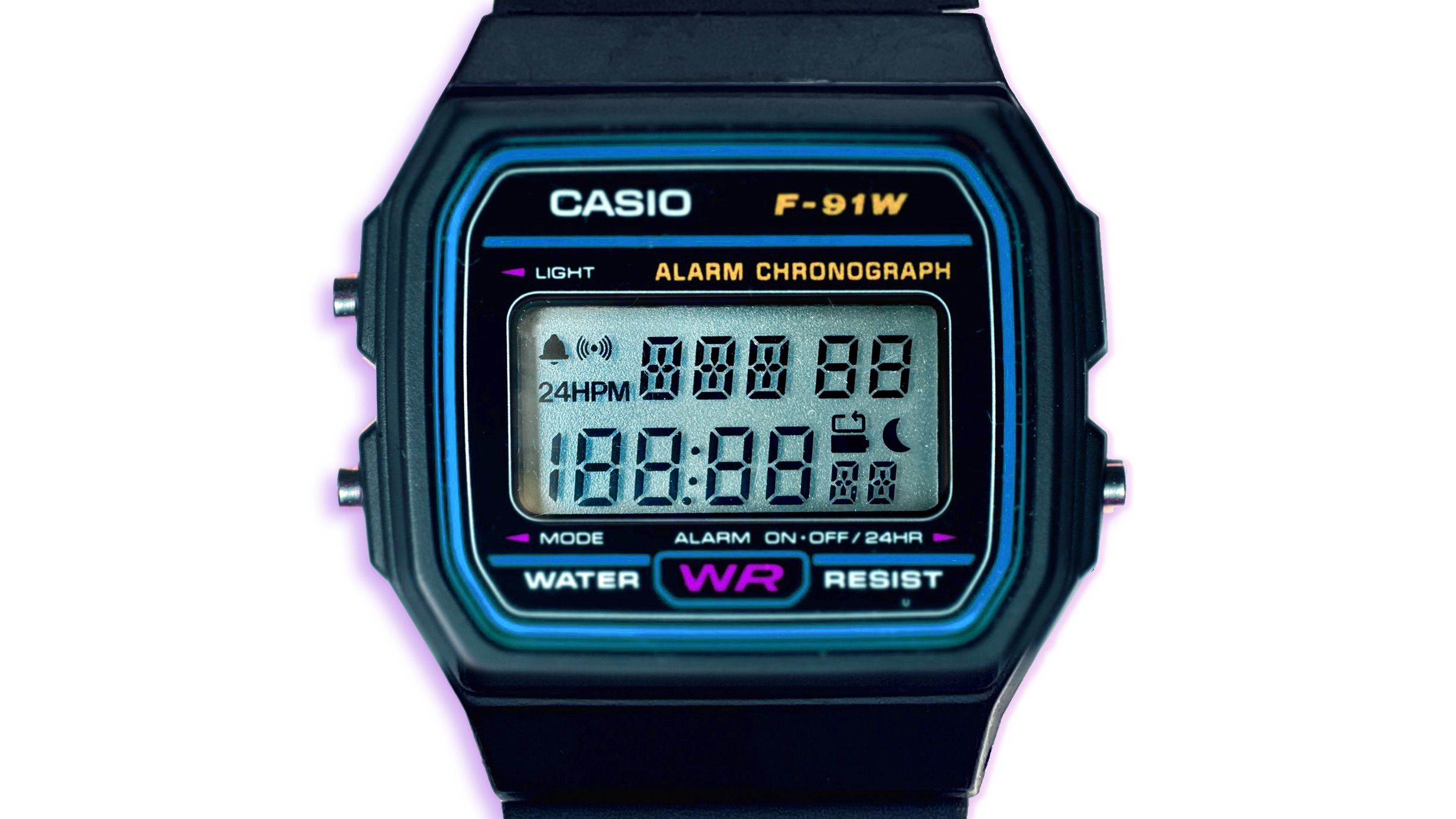
Either way, vastly more appealing than a charge-it-daily "smartwatch" IMO.
US, for now, can keep getting the unconnected F91W $25 lookalike. IIRC, the F-91W has a really small strap. Almost a "ladies watch" size.
It does. A few months ago I bought a F-91W for the nostalgia, but I have a hard time wearing it due to the tiny strap. I just ordered a bigger one strap, let's see how it works.
I don't understand this statement. Is there some reference I'm missing?
I have a Casio PHYS STR-800, nonworking. I got it two decades ago because of the large lap memory (and unusual look, too); I was doing a lot of running, including track training and such.
It short circuited one day. Put in a battery, and it drained the thing in a minute. Put in another one, same thing.
It's been sitting in the top shelf of a bathroom cabinet since like 2011.
  > Power supply and battery life
  > Approx. battery life: 2 years on CR2016
The F201W (which this appears to be based off of) is not one of them.
This, in the silver ABL-100WE-2AEF model, is exactly what he wants. Same Casio, same interface, just now it has step count. He doesn't even need / want the Bluetooth.
(Me, I'll keep rocking my Pebble Time 2. Absolutely love it.)
IE; My apple watch ais the only one that goes out of it's way to make sure I know my steps for the day, and is always "accurate". Which is nice, but gimmicky for someone like me who doesn't analyze my steps.
I imagine Casio went after similar low hanging fruit, as an acceleromater is cheap/old tech, while still being able to feature compete with something like an apple watch.
We just don't seem to have any idea how to track sleep quality even with better devices than just a watch/whatever. Even a binary, is the person I'm attached to sleeping, is hit and miss. And with that in mind you can be pretty sure that the sleep stages etc is even worse.
Yup. I go for walks specifically to leave my damn phone at home. I do bring an Apple Watch w/ airpods in case I need to take an urgent call and for podcasts, but I don't bother with texts or alerts or any other nonsense.
And while step tracking is not critical, if you have health goals that include a minimum number of steps a day I find it incredibly nice to have. I can check my counter before bed, and take the dog for a 30 minute walk if I'm behind for the day. Just a means to hold myself accountable on those crappy low energy stressful days.
The trend is trickling down into other circles as well. People are beginning to correctly identify needless hyperconverged connectivity as a burden rather than a convenience.
Indiglo WATER RESIST 69m ALARM Chronograph
But then I realized that many people do not keep their phone in their pocket, especially women. For them, a watch, bracelet or ring really is the best option.
I hate watches, but one would be better for step tracking - it is more likely to be on me to track information.
"Walking briskly for 30 minutes" is a better measure of something healthy than how many steps you took.
Tracking steps helps me stay on track.
The least apps on my phone, the better. And the least I've got my phone on me, the better. I often leave the house without taking my phone.
I don't track my steps but the wife does... Using a watch.
Why do you automatically assume everybody on earth is as tied to his phone as you are?
Might take another look at these - given the price, it's not a huge gamble to try it out for a few weeks.
They have no idea where they are or what their airtag/BLE neighbors, if present, are doing. They don't grok GNSS or wifi. There's nothing for them to triangulate or trilaterate or tri-anything when they're just sitting there.
So yes: They are indeed pretty tidy about energy consumption. They accomplish this in large part by being very simple in normal operation and leaving the heavier lifting to the world of iPhones with relatively enormous batteries that get recharged ~every day.
Or going to meetups.
which is why i love gshocks, both for design but also specifically the ones with tough solar/multiband 6 (and bluetooth (optional))
they have battery lives in the range of decades (due to solar charging), set themselves (multiband 6 is using atomic clock radio signals) and via bluetooth
you can get gw-b5600-2 and gw-s5600u (auto backlight) for under $200, but usually closer to $100. there are many more models, of course
that sounds expensive, but it's insanely durable construction and battery life means it'll be the only digital watch you'll ever need to buy. and the only configuration it will ever need is the time zone.
Regular batteries may be a better deal but that doesn't include the process of opening the watch, replacing the battery, and then resealing the case.
I'll trade $15 and a 15 minute job once every 15 years for a 15 minute job every 5 years. And no watch with a regular battery will have auto-backlight (for the obvious reason).
And also... if you want a deal, don't buy a $100 watch with auto backlight, capable of setting its own time off of a radio, and capable of ringing your phone when you can't find it.
F91W will do! That's why they're so popular!
https://www.casio.com/europe/watches/casio/product.F-91WB-1A...
https://www.casio.com/europe/watches/casio/product.F-91WB-8A...
For example, there is a "text removal" option on this one: https://www.nocturnaltime.com/shop/p/obsidian-casio-watch-ws...
You should compare this with the F-91W that gets 7 years on the same battery, and hobbyist hardware mods that get years out of the same battery running ARM chips.
My little temperature and humidity sensors that show an LCD 2x the surface area of a watch and broadcast a BLE packet every minute lasts about 12 months on a CR2032 (~200mah). A CR2016 is ~90mah little less than half. And receiving a BLE packet takes way less energy than sending.
Then you have the on-demand stuff that costs a packet or two, like the lost phone finder -- which is what I'm most excited about.
Though, the CR2016 is a pretty big battery vs typical watch batteries, and in some other Casio watches are used as 10-year batteries.
I got one earlier this year, pretty awesome project!
I see and I was wondering why they sold it for £55 only. They collect and sell your personal data.
I'm happy with my original one, thanks.
I haven’t worn wristwatch anymore, since the dawn of smart phones. All my time information has moved into that, in my pocket. That’s my only dependency.
I have seen (Xiaomi) smartwatches that wont allow setting the time without an app (asking to many permissions, and forcing cloud accounts) installed on a linked phone. facepalm
> In a handful of cases the detainee's possession of a Casio watch or the wearing olive-drab clothing is cited as evidence that the detainee is an enemy combatant. No basis is given to explain why such evidence makes the detainee an enemy combatant.
This is also noted on the F-91W's Wikipedia page:
https://en.wikipedia.org/wiki/Casio_F-91W#Usage_in_terrorism
[0] https://en.wikipedia.org/wiki/Seton_Hall_reports#Detainees'_...
AQ training/bomb-making manuals from the 1990s–2000s recommend cheap, reliable digital watches like this as timers for IEDs as they're extremely inexpensive and widely available worldwide, durable, water resistant, and easy to modify as delay timers.
Often these guys would get picked up with two or more watches of the same model, for example. We recovered them in bomb-making facilities and on fighters throughout the GWOT. Ramzi Yousef (Philippine Airlines Flight 434) and Ahmed Ressam (the 'Millennium Bomber') both had them.
https://en.wikipedia.org/wiki/Khalid_El-Masri
> Khaled El-Masri is a German, Lebanese and French citizen who was mistakenly abducted by the Macedonian police in 2003, and handed over to the U.S. Central Intelligence Agency (CIA).
> While in CIA custody, he was flown to Afghanistan, where he was held at a black site and routinely interrogated, beaten, strip-searched, raped, and subjected to other forms of torture.
> After El-Masri held hunger strikes, and was detained for four months in the "Salt Pit", the CIA admitted his arrest was a mistake and released him.
Trick question! It was actually that his name is one letter away from someone else's name, and some manager in the CIA had "a hunch":
> At the end of 2003, El-Masri travelled from his home in Ulm to go on a short vacation in Skopje. He was detained by Macedonian border officials on 31 December 2003, because his name was identical (except for variations in Roman transliteration) to that of Khalid al-Masri, who was being sought as an alleged mentor to the al-Qaeda Hamburg cell, and because of suspicion that El-Masri's German passport was a forgery.
> CIA agents discussed whether to remove El-Masri from Macedonia through an extraordinary rendition. The decision to do so was made by the head of the al Qaeda division of the CIA's Counter-Terrorism Center, Alfreda Frances Bikowsky, on the basis of "a hunch" that El-Masri was involved in terrorism; his name was similar to suspected terrorist Khalid al-Masri.
> When the Macedonian officials released El-Masri on 23 January 2004, American security officers immediately kidnapped him. El-Masri later described them as members of a "black snatch team." They beat him and sedated him for transport using a rectal suppository. "The CIA stripped, hooded, shackled and sodomized el-Masri with a suppository—in CIA parlance, subjected him to "capture shock"—as Macedonian officials stood by."
This is like a statistics 101 question. Google says that Casio has sold over 100M F-91W's since 1989. Let's round down to an average of 2.5M a year, or 25M over the 10 peak years of the global war on terror (GWOT).
You named two terrorists who wore them. Let's say that's an understatement by 200X. Some quick math shows that the percent of terrorists who wore F-91W's is 400/25000000 = 0.0016% positive rate, or conversely a 99.9984% false positive rate. Not good!
Now I never actually took a statistics class, so maybe I got this question wrong. But it's obvious that using the possession of an F-91W as a sign of being a terrorist is a mistake.
(they did have one called "pickup")
Or more recently, to some officials, showing up at a No Kings rally.
No they don't, please don't spread misinformation. If this were true, the watch itself would be banned in the country and/or nobody would sell it.
Your own source says the Pentagon refuted the author's claims because they did not have access to classified information, which I believe would suggest that there is more to the story than merely owning a very common watch and nothing else. Otherwise millions of innocent Americans would be in jail.
There is a very, very good reason this was only "in a handful of cases" and never again.
Another alternative is a smart ring.
I'd love if it was radio controlled and charged with solar. And without phone connectivity.
https://www.casio.com/us/watches.filter.solar-radio_adjust-K...
I bought one with a slick (new) dark red face....which lights up bright pink from the one white LED on the left side of the face.
Even in the marketing/landing page for this watch which is linked in post.....they show the backlight feature, looking like it's missing an LED.
The ABL-100WE has an orange light that stays on for either 1.5 or 3 seconds (configurable) and provides some decent light.
The display contrast doesn't seem to be quite as good as it used to be with older movements, though.
Casio G-Shock GW-M5610U back on my wrist where it belongs.
But hey, seems like people are excited for that, happy for them! Mine will last another 10 years without it.
doesn't mean others can't want a smart casio, but, it's not for me :D
F-91W (old): 38.2 × 35.2 × 8.5 mm
F-B100W-1A (new): 41.9 × 38.1 × 8.8 mm
so I guess I'm staying on my third Amazfit Bip since Pebble Time 2 has insane price
Its still a cheap casio resin watch at the end of the day. If this where to be able to push/pull notifications, the watch would be completely different in cost, ui, marketing, etc.
It would go from being charming retro tech with modern features, to dime a dozen bloatware/fitness tracking hardware.
no such thing besides old Amazfit Bip and overpriced pebble time 2 exists, everything else has either no battery life or looks like brick on wrist (greetings to Garmin and Casio)
It's not great... but it's something?
if I have to choose between used Amazfit Bip for 15-20$ or pebble time 2 with worse (bigger) dimensions, worse battery life (even compared to 5+ yo Bip battery) and not even built in GPS for 200+ $ it's pretty easy choice
pebble PR team enjoy downvoting me
Interestingly, though, the aesthetic reminds me a bit of my W71, which is more boxy and less angle-y than the classic F-91W.
But, I guess their watches were always a bigger business than the synths.
The expensive part of a modern synth isn't the DSP board, it's the industrial design and tooling needed to build the rest of the hardware.
The CZ series was workable, but there really aren't many passionate nostalgic buyers waiting to drop a few hundred - minimum - on an expensive reissue.
Korg 2600 - ~ €1000 Behringer 2600 - €300
CZ Series doesn't have much cachet simply because phase distortion synthesis was the 'we have FM Synthesis at home' cheap alternative to 4 OP FM Synthesis in the 80s. About the only USP they have in that arena is the fact they're responsible for the 'Reese Bass' sound - the 'Wilhelm Scream' of Techno if you will.
They refurbed their Chinese on OTOH.
It's not quite in the ball park of something like the DX 7 or several of the better known analog synths, which have nearly all seen re-issues, mini-versions, software emulations, etc., often several. Damned near every Roland synth from that era has seen a re-issue and official plugin. Yamaha has been more measured in their re-issue plays, but the DX did get a reface DX, along with the CS, CP and YC. FM synthesis has been wildly successful in nostalgia synths as well as novel takes on the idea (e.g. the Elektron FM groove box) and Korg's Opsix (I have two of them, the first gen small one and the big expensive one made in Japan), and Yamaha still ships FM synthesis engines in their high end workstations. And, there's at least four plugins that emulate the CZ (I'm working on a fifth to be released in another month or two).
I don't think all that would exist without some demand. I have a soft spot for early digital synths, and I think a lot of other folks do, too. I don't like to buy from Behringer, but it's the only hardware option out there right now aside from the real thing (I own a real CZ 101, but I wouldn't want to take it out of the studio).
AudioPilz (Bad Gear) even made a video demanding it: https://www.youtube.com/watch?v=Kb8nMZE-bb0
What we old synth nerds need to understand is that there are always new synth nerds leaving the worlds music schools, quite often with a fat wad of disposable income/parents cash, and they want to build their own little studios to make the next mega-hit.
This is the driving force behind Behringer and all the re-issuing goings-on and such.
But the synth world is a fashion scene. Devices and techniques and engines go in and out of fashion.
The recent Gearmulator releases have lit a serious fire under the DSP-synth world precisely because folks really want these old synths, and I suppose its quite fun to take the real DSP firmware and emulate them:
https://github.com/dsp56300/gearmulator
(Disclaimer: have worked professionally in the synth world for decades, I have my biases and also new releases on the horizon ..)
I have a Casio CZ-5000, the 61 key version with sequencer. It’s well made but given its age I’m not sure I’d want to take that to a gig either.
That you can buy them on ebay all day long for less than most cheap synths costs new argues against it being viable.
Edit: But also, the CZ was generally more comparable to lower-end DX synths, like the DX27 or DX9. It was a budget synth in its day, while the DX7 was the pinnacle of digital synthesis for at least a year or two after release, everyone had to have one.
There's also a "Always wanted this, can finally afford it now that I'm rich" niche for the high-end remakes from Korg and occasionally Moog etc.
There isn't a huge "Bought this forty years ago because I couldn't afford anything better and would quite like a modern remake" segment.
Casio do still make pianos and Casiotone keys which include samples and some CZ and VZ series sounds. (I don't know if they're sampled or DSP.)
Korg does put out "nostalgic" remakes of analog synths just as well: MS-20 (complete with patch board), Arp 2600, as well as digital versions like the Korg multi/poly virtual analog.
Casio has been quite successful at not abusing trust in their brand by releasing lower-quality outsourced replicas like HP did with their calculators. Not that HP had much farther to fall but it’s nice to see a corporation that’s not incompetent!
Picking off some low hanging fruit while demonstrating provable restraint can result in a huge money stream that goes on and on. But when the mindset "it's good, but it can be better!" becomes dominant (e.g. through market dynamics, being publicly traded means that ownership perpetually shifts to those who think that income sources could be squeezed just a little harder, or much harder, actually), it quickly turns sour. And when it flips from beloved to "why throw money at those greedy $expletive,plural" it flips hard, and forever.
And why would i need to track my.... steps? Because some corp started this shit as a marketing ploy years ago?
The whole value of them is they are simple, minimally changed over time (you can depend on getting the same model in a decade), functional, with no/bare minimum smartwatch crappery, essentially endless battery, and no planned obselecense.
Not just Pi-like - the Wavestate is using an actual Raspberry Pi CM3 module! https://www.raspberrypi.com/news/electronic-music-icon-korg-...
For what it's worth, Yamaha aren't particularly nostalgic about their cult-classic synths either. I guess that from their perspective, the DX7 and CZ-101 were already obsolete within a few short years. By 1990 the sound had already become quite dated, and technology had moved on. Now that they've become popular again as a cult-classic, the margin just isn't there anymore because of the market share of software, or cheap independent FM/PD synths.
Shameless plug, in case anyone is interested, I've done some work reverse-engineering some of these synths:
- https://github.com/ajxs/casio_cz101_rom_disassembly
- https://ajxs.me/blog/uCOM-87_The_Strangest_Architecture_Youv...
I don't know why I find that era of synth so enjoyable and interesting, but I do. I love every FM synth, but that side of things feels pretty well covered by existing tools. Korg makes the OpSix (and I have two), Yamaha has the reface DX and I think their workstations still ship an AFM engine, and there are at least a half dozen plugins that are mostly quite accurate, and a handful of other hardware options.
Phase distortion just feels more neglected, so that's the one I've been spending time on. I have an excellent engine running, which is more accurate than the Arturia CZ V engine (at least compared to my actual CZ 101, maybe they were comparing against another model, but the MAME engine is also like the real CZ and not like Arturia, so I am inclined to say Arturia got sloppy), but I'm going pretty slow on the UI. Making a nice plugin UI for a synth that didn't have a nice UI is a challenge. You can't just copy the original UI if you want it to be fun to use.
However, in Japan, their G-Shock brand (kind of lower cost, in the US), can get even more expensive than Oceanus. Some of them look like Pip-Boys (Because this is HN, I need to mention that this is a deliberate exaggeration).
There are collectible models that sell used higher than they were new, but for the most part they’re much cheaper
Then there are lines like MR-G. hand hammered metal cases made out of premium materials.
Many of the folks I worked with, could afford good watches, and wore G-Shocks. They were quite proud of them.
I suspect you’ll see them on the Japanese Casio site.
But, I still want a modern Casio CZ. I just think it'd be neat.
The sampler is cool, though.