I used Claude to help. I don’t know how to quite describe it, but because the text was polished and well constructed my brain was giving me the the signal “if you aren’t getting this it’s because you’re not focusing” so I’d read it again and then again and it still was not landing. It sorta felt like when you read something technical or heavy when very tired - you are reading but not processing.
Only after wrestling with this for a few days did I realize that it wasn’t me. As I started going through, sentence by sentence, forcing it to re-write things to be more clear the concepts became easy to understand.
I wish there was a name for this situation. It’s almost like a pseudo-language where it has the correct form and presentation but is missing critical components.
The more complex the topic, the more I sense this.
The best I’ve heard of this is peeling the onion. The first pass is always very high-level and you have to make it go deeper. That can be done manually with follow-on prompts but I like using subagents, each with a different angle on the problem.
Bullshit?
This is some third category of untruth. Almost more sinister than the other two altogether.
So, “Please write a one-liner comment manually to replace these 5 lines of AI generated comment” is a common refrain in my PR reviews to colleagues.
But to be honest I doubt most people who use AI for PR descriptions even bother changing anything.
I find that when I try to speed read modern human writing, there are often errors (like missing or misused words) or awkward expressions that I do have to slow down and think harder a lot to really parse it.
With AI writing, it's sort of self redundant and the information density of each sentence seems to have more even information density. This makes it very easy to do a very high level speed read and get the full gist.
There are also what I'm assuming are bots on hugging face (or maybe non-native english speakers who are using ai for translation) that interact with me where I have no idea what they are saying until I read it very slowly.
Which might even make sense, because there were always (still are?) those horrible ads in the chumbox area of news sites that used trypophobia and other creepy body-horror stuff to get you to click. [1] So maybe the hope is that you don't really look closely at the quiche, but some reptilian party of the brain gets oddly activated and drives you towards the restaurant?
1. https://medium.com/the-awl/a-complete-taxonomy-of-internet-c...
"There's an ongoing discussion of whether humans are good at recognizing AI-generated text. While most research claims that humans don't really do a good job there, I disagree. "
And I wonder if those of us in tech are the only ones who really care?
* https://www.theverge.com/ai-artificial-intelligence/975017/, https://www.lesswrong.com/posts/6ZnznCaTcbGYsCmqu/, https://spiralism.website if you want to test how strong your defenses are against this particular meme
I have no idea if other people who work in tech are better than average or not, because I don't feel confident in being able to check their work. That being said, I do think that there's a general trend of people in tech tending to be a bit overconfident in how well they will do at some new task they haven't encountered before, so when someone tells me that they can easily tell whether text is AI generated, it's hard for me to trust it any more than I trust someone who makes a similarly strong claim about something that they can use AI successfully for when it's not something that I can easily measure (e.g. learning a new language without getting feedback from people who are fluent from real-world usage).
All that being said, I do think the set of people who care is larger than just those in tech, although it's probably still a relatively small group overall. From conversations with people in other domains, there are contingents in non-tech communities who tend to have a large representation of negative views towards AI (artists, writers, musicians, other jobs where people are skeptical of human creativity being replaced by AI), and often times the people who feel negatively in those groups will be even more adamantly opposed to interacting with any AI content than people in tech. To be clear, I'm not at all trying to generalize and say "all artists hate AI" or anything like that, since there's obviously a wide variety of viewpoints within any sizable community, but I've definitely seen many people who say they will refuse to play any game that's suspected of using AI for generating art assets, and even some who don't differentiate between using AI for generating assets versus code (either because they aren't knowledgeable about how different aspects of game development work, or they genuinely don't care because they view AI as a categorical evil).
And I’ll concede on both ends that there are probably times I suspect content is AI generated when it isn’t, and times I suspect it isn’t generated, but it was.
AI tells seem inevitable. You have millions of people communicating with one effective “personality” that has tendencies to write in certain ways. If its content is published verbatim, then it will be easier to tell whether some content is AI generated just based on its similarity (sharing certain linguistic features) to other content being posted.
It’ll never be black and white though.
I think they may just be to trusting and/or naive. People in tech right now are hyper aware of this and are actively looking while people outside of that bubble barely give it a second thought.
Going further, I'm curious about whether people are mostly good at the case where they suspect most or all of the content from given "author" has the same amount of AI usage/prompting in generating it rather than the adversarial case where someone might usually use AI extensively and then try to slip by purely human written text (or vice-versa). I don't have a good sense of whether this is a threat model that actually matters, since maybe the heuristic of weeding out sources that are mostly AI-generated is enough for people who prefer to avoid that type of content, but I do think that changes the definition of what it means to be "good at recognizing AI" in a meaningful way. It seems plausible that disagreements about how easy it is to recognize AI content might be coming from two people assuming a different framing of the question that results in a different answer without realizing that's what they've done.
Several existing studies I’ve seen have done things like prompt the LLM to produce a poem in a certain poets style, then ask people to spot the fake in a collection of poems, which they aren’t great at. This is, I would argue, an extremely different context than what most of us are encountering AI text in, and the people sending me text aren’t prompting it stylistically like that.
On your second question, I definitely feel like I can tell the first time a coworker sends me AI text masquerading as their own thoughts, even if they had previously been opposed to such a thing. So it could be that familiarity is more important than my prior on whether they’d use AI? But interesting to think about either way
I noticed this too. There’s a great section in a tweet which illustrates this but the tweet itself is much longer and I can’t link to paragraphs directly so I’ll link to my blog where I quoted it[0]. It’s really a remarkable effect. It takes effort for me to take my eyes back to the scene.
Presumably you could put contradicting information into text like that and reach some people and not others.
It reminds me of that (apocryphal?) story of how an election advertisement company managed to shift votes by telling everyone to not vote knowing that people of one ethnicity would nonetheless listen to their families and vote. You don’t have to lie to people, merely put the text in a place inaccessible to their minds but right in plain sight.
https://wiki.roshangeorge.dev/w/Blog/2026-06-27/Anti-Memetic...
The reason I brought it up is because, people who learn English normaly start with a book. It's heavily polished.
When you speak English as you learned from the books, it does not sound very conversational.
If you are native/fluent English speaker, you can feel the impedance mismatch and feel something's off.
The AI-blindness stems from the fact that those polished edits are so common in publishing field, they all sound the same, and unable to recognize the diffs between AI-generated and human-generated.
There is no real human conversational vibe to them and well. i will stop now.
This is not AI specific. I have come across many humans who describe a simple concept in a very complex and verbose manner.
But what I hate the most is that it is objectively better than what I had before. No typos, clear structure, and, regrettably, the verbosity and autistic obsession with detail of the LLM is more actionable and useful than the human guy who wrote lists of commands and URLs as documentation, without explaining anything. Or the colleague who writes in uppercase and with question marks and who doesn't make any sense and forces me to engage in an interrogation effort to get to the bottom of what they are trying to say. Or the colleague who simply hates writing--despite being decent at it--and will call you to give you a meandering verbal explanation that lasts two hours of what they want from you. The cynic in me bemoans that we brought this upon ourselves, in more than one way.
Despite seeing a lot of them, I cannot think of one AI-generated photo that I can picture clearly in my mind; a few are partial but elusive. Whereas I can recall (visualise) a whole bunch of traditional photographs.
The same is true of AI generated text. Only the annoyances stick. I cannot recall real details of text I have generated, until I commit it to memory some other way.
I don't think this is about ephemerality either. If we assume it's about celebrated/famous/infamous images, there are definitely non-ephemeral, cultural moments in AI generated images in particular, like Boris Eldagsen's Sony Prize winner:
https://petapixel.com/2023/04/14/artist-refuses-prize-after-...
This really should be memorable, but isn't. I had forgotten the second person is in the image.
Or Jason Allen's fake painting:
https://petapixel.com/2022/09/01/ai-generated-artwork-wins-f...
I had already forgotten there's more than one figure in it, and I only looked at it a few weeks back. I remember the colour, the bright circle, some vague hints of texture; one figure. And that is it. Only the crudest shape elements.
For me, something about AI-generated text and images confounds recall. It is really peculiar.
There's no real edge to it. Same as with the writing. The stuff that you'd latch onto (and thus remember) is simply not there, precisely because those image or word choices would be just outside its latent probability space. But because they're well inside it, your mind sees nothing novel to register.
This is also why I think human output will actually increase in value. When any AI can just "phone it in", something genuinely human will stand out (to us, not the AI) and become a bellwether.
This will literally help us realize what it means to be human.
I also don't think the solution is simply to "make responses more random", either. That might help solve novel problems (the same way that throwing darts randomly at a dartboard eventually hits the bullseye of the dartboard right next to it that no one considered), but I don't think it will help it "seem more creative".
They were actually rather good in a sort of "fake collodion image" sense, and the eerie early-DALL-E quality to them really helped the spookiness.
But I can only remember this technicality and the feelings with any clarity, not any of the details except in the broadest sense. I cannot bring these images to mind in any meaningful way.
They were deeply wrong and it's only the wrongness I really remember. It confounds memory.
Modern image generators have ironed out all the structural wrongness.
Sometimes I'll check in on my sleeping kid and she'll sit up in bed and say some utter nonsense. I'll find it hilarious, giggle silently to myself, and kiss her goodnight again and she'll close her eyes and lie back.
Why I try to tell her about her sleep-talking in the morning, though, I find that the words she said have completely disappeared from my memory, no matter how funny I thought they were at the time.
In my head-canon, this is because it's dream language, and slips away as easily as dreams. But, like the AI art, it could be because it's bullshit: completely devoid of content, all signifiers and no signified.
I stopped after I wrote something on the pad while I was still asleep. Woke up to text with letters that were backwards, upside down, weird words — so close to real words that I was sure I ought to know what they meant and had really meant to write them down.
Scared me. Literally too weird to keep. I tore up the page.
In a way I think this is one part of the same continuum. There are thoughts that have meaning and can have no words, and words that look like they should have permanent memorable meaning and don't.
Reason why those images are flat and boring is that they are just statistical guesses making a composition averaging whatever the model has been trained with. They would be technically brilliant (if made in oil), but superficial and meaningless, same as so much Sunday painting is.
Same goes with language. Nobody is trying to communicate anything with you, so it just words after another. You can create meaning out of it if you want of course, we homo sapiens -apes excel at that, but what’s the point? Language Jones on YT has pretty good video on this[3].
[1] https://media.mutualart.com/Images/2024_01/12/12/124216388/d...

[2] https://uploads4.wikiart.org/00339/images/jean-leon-gerome/t...
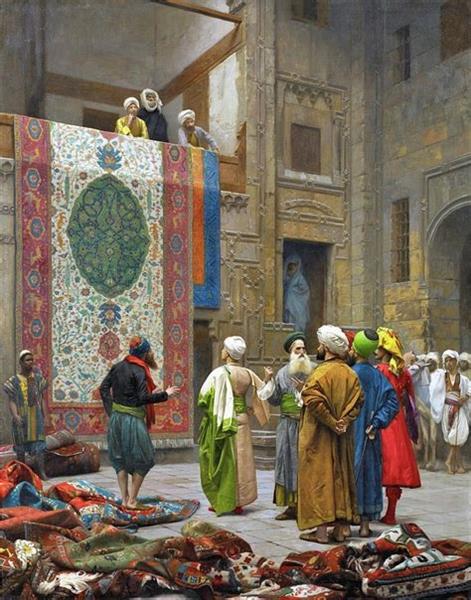
The way my memory works (especially as an amateur photographer) I would thus normally have a very good chance of remembering some key details of the images; some fascinating element of each would connect with the rest of the memory.
But it does not happen. Whereas I sometimes remember photos with clarity while forgetting where I even saw them.
Perhaps we go back to feudal society when climate change crumbles the civilisation, world economy and democracy. It didn’t really matter that French and Spanish kings where often literal morons, when you had few talented monks, bankers and scribes doing the brain-thing, the feudal lords had ruthlessness to take what they wanted and the people were illiterate superstitious folk who hardly ever left the village they were born in.
This resembles my country.
And when I force myself to read AI-generated text I realize I'm making my brain do creative work to impart meaning to the words. It is exhausting because my brain is literally trying to do a just-in-time rewrite of the text into something valuable.
Something is deeply wrong with AI generated output, and I say this as someone who is typically very impressed by AI.
I think this is also the mechanism behind why AI generated videos and images are so captivating at first. I remember when Midjourney first launched and it was hours and hours of a brain-melting "Wooooooow". But once you get used to it and start to identify the patterns the brain quickly labels most AI-generated content as blank space.
If the image or text wasn't created by a human, then there was no intent behind the content, there is no message or novel information conveyed, and it reads as noise.
No matter how much investors and tech companies want you to believe that they are on the verge of super intelligence, nothing I've seen to date can not easily be explained by "correlation engine", including the "novel" math solutions, all of which appear to just be "a composition of solutions humans have developed and documented elsewhere" upon deeper inspection.
This is not intelligence. It's just a good correlation engine with a very big albeit lossy database of things.
As my AI professor said in the first lecture: “All AI is advanced search”.
If performing well on an IQ test or performing at a high level on knowledge work is intelligence to you, these models are intelligent. If intelligence requires sentience for you, then ... well, I don't think we really agree what that is either, never mind how to measure it. But LLMs certainly don't have it right now
But the consistent trend of the last couple decades (arguably since Turing's time) seems to be that any time a computer reaches our definition of intelligence we decide that that was a flawed definition
https://www.youtube.com/watch?v=kYUicaho5k8
The main problem I have with people stating it's not intelligent or conscious is I don't think we even have a good definition of either word that satisfies everyone. Philosophers have been trying (and failing) to elegantly define these things forever and everyone out here proclaiming they've got the definitive answer and this specific thing they're seeing doesn't fit under it.
go to 24 minutes and 07 seconds.
it's statistically determining what the next word should be based on all the text it's been trained on. It's not intelligence and he shows what probability it puts on each word that it chooses, but also shows a lot of the other words it was thinking of using. In a later part he shows how it uses words that are not the highest probability (and you question why did it go this route, it's not more correct), but the user never sees this, they see what they think is the correct answer always...
he also shows how context you feed it has a lot to do with what it returns... to the point he can get it to return the capital of France is Marseille, just by typing Marseille a bunch of times before the question. Human intelligence doesn't get confused like that.
And it's not a "hallucination", it's just probability of the next token prediction based on the information it's been trained on and fed, it's not intelligence.
It shows internals of an LLM nicely, simplified manner.
AI generated text doesn't have this. Every model has its bias towards a certain style, an overly agreeable tone, some exaggeration to make the user important and smart, but the text has none of the information crumb these pre-AI texts contained.
Even when you use tools like Grammarly and allow it to "Impact-MAXX" your text, the resulting text is a bland wall of letters, carrying none of your voice or style, less elegant than a corporate text and emptier than space.
It's beyond bland. It's tasteless.
It's like a hook of a pop song. Interesting to listen, but entirely empty.
And, Oh my god, you can actually see how this style of writing influenced AI writing today, I constantly had to remind myself: "this was posted before ChatGPT released".
The reddit influence is especially true for "storytelling" writing.
I started to skim a lot more text due to me having read a lot. Like in news article, i stoped reading the first paragraph because it repeats just what it was already written in the short subtext. Then there is the second paragarph which is used to have some historical view or whatever it is.
The problem I encounter is both my memory is degrading, but since these reports are largely duplicative, knowing which version im remembering is technically impossible since theres so much overlap. The overlap is tge same problem as context poisoning.
Id been doing this for over a decade when i started working with a new engineer with a few years of experience and younger. I tried to explain how i set these docs up so they can be skimmed and you can update the specific facts needed. They exclaimed they would never skim and rewrite it all. There was zero way to explain how exhausting that will become as they age.
So theres certain a tension about how people and AI will generate documents.
I think you need to self-correct here, because otherwise you'll be ineffective in an information setting, where I expect AI-generated resources will not only be the norm, they will absolutely swamp the environment.
It works just fine for me.
I bet it does. I bet it also recognizes some human text as AI text, and doesn't detect other AI text.