https://www.google.com/search?client=firefox-b-d&q=IFR+navig...
It turns out contrails contribute to 2% of global warming power and is relatively easily avoided. The cost might be a bit more fuel consumption though.
During the day they have a cooling effect by reflecting/blocking some light.
The optimal is not to eliminate them entirely, but to create them only early in the day so that they dissipate by sunset.
> Recent estimates show that contrails cause about the same amount of warming each year as all the CO₂ emitted by all flights from 1940 to 2018.
For most flights today though, if you only count the CO2 produced you're understanding the climate damage by about half.
I hate to be discouraging, but maybe the author should make an attempt to understand navigation before cooking up something like this.
One point at 45min faster and 25% less fuel is of course huge, but how does it map out over a year of routing?
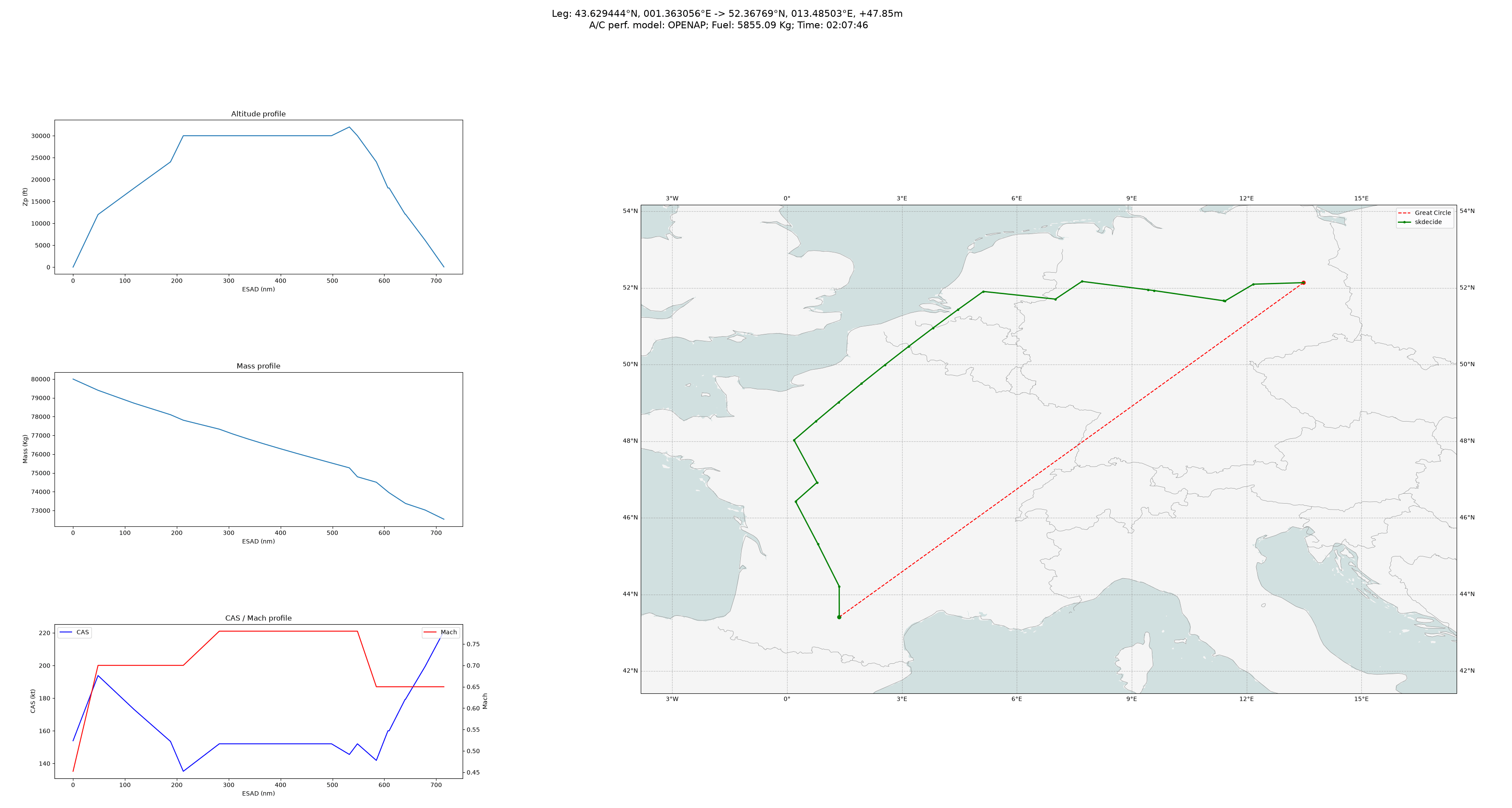
One difference from the OpenAP/scikit-decide setup: my router doesn't search a fixed grid with A*. It runs a continuous isochrone search that expands a fan of headings against the live forecast each step. That's closer to how routing is actually done for this problem, and it's what both the live product and the backtest above use.
It's nice to see the scikit brand live on.
But why would you want to use AI to control planes?
Aviation is one of the few industries where the largest regular (non-capital) expense is something other than labour, namely fuel. Anything that reduces fuel costs even a little is of obvious interest to every airline.
There are still the issues of coordinating flight paths to avoid collisions, and regulation (including international regulation). The former seems like a technical problem amenable to increasingly accurate approximations over time. I don't know about the latter, but I doubt it's as insurmountable as you imply. International air travel has been around longer than ILP solvers, meaning that at some point flight schedules were created by people. Now they're created by ILP solvers, and the regulatory environment successfully adapted to that change.