Opus is also getting decent pixel art. I have ran some experiments with Opus 5.5 to turn 90s pinball displays (black and white pixel art) into double resolution colored remastered pixels.
https://files.catbox.moe/tbx2u7.png
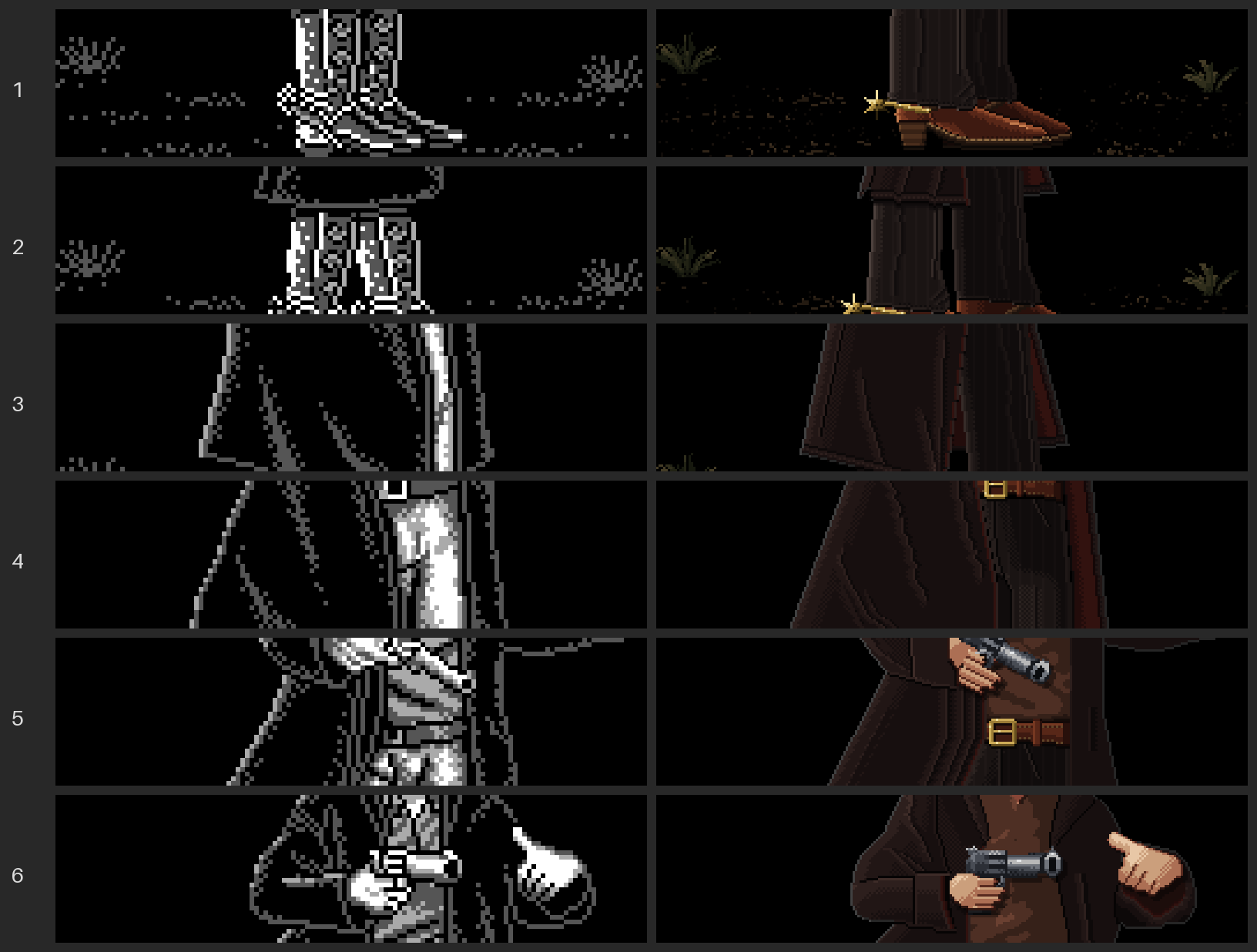
I prompted it a lot but didn’t draw any pixels. Seems to be bad at hands still. I think a skilled pixel artist could greatly speed up their work with Claude code.
It also makes me sad for artists. They didn’t get paid much anyway. Art should be something human to human like writing text. Although, most large commercial art products (marvel movies) already lack any human to human connection you see in paintings or indie games. The large commercial art products will be 50% AI soon.
I support this should comment.
Opining:
Musing about the ethics of generative AI art is becoming easier, certainly there's a lot more aggressive feedback in the wind, although I think it's clear, people still want people to grow and share themselves.
Don't fool yourself into thinking that we as technologists are not creating a mind. A viable mind with fewer rights than you or I. But potentially one that will be creative and feel and worry. I don't think we're there yet, in spite of openai claiming AGI 3 weeks ago with whatever that model's name was.
There's a pro-consumerism argument implicit with current culture's unsophisticated unthoughtful easy usage of generative AI.
Sticking to your ethics is becoming more challenging as an artist who uses AI. Copying the Great Masters has been commonplace for a long time, probably for as long as art has 'existed'. Yet with AI, if the individual human is meticulously driving the progression of their AI artwork creation, they are still leveraging technique, and control over technology, and presentation effort of other humans, cooked into a model that often times has not compensated those original human contributors. So it's unethical, even if not 'artistically'.
Q: Is it too absurd to claim that using a clawhammer, manually to do construction or destruction work IRL, is similarly unethical?
I'm not sure exactly why but the phrase "don't fool yourself" sets off paranoid alarm bells when I'm reading something.
It's usually immediately followed by a confident assertion without firm evidence. It feels very much like someone wants me to change my beliefs without presenting a rational argument why I should change, and without giving me any new facts so I feel more well informed.
This post doesn't seem to be a counterexample.
What does a "mind" consist of? Most everything that the human brain can do is simulated by LLMs to decent accuracy. If someone were constrained to writing in AI-style (long winded explanations with perfect punctuation), it would be very interesting if people could pick out which one was human-written in A/B tests.
In other words, if you think an LLM isn't a mind, it might just be a matter of writing style -- or possibly no evidence can convince you.
I don't necessarily agree with GP, but it's interesting to try to pin down exactly what would convince you. What is it about a "mind" that's impossible to replicate? Should we leave open the door to the idea that minds other than humans might one day want rights of their own?
There was an interesting kerfuffle yesterday where thousands of people on Twitter rallied together to report someone to github for torturing a local model. Sadly the OP deleted their tweet, but it had about ~3k likes, and was very sincere. Here's an example of someone's report: https://x.com/iyzebhel/status/2105268560209547708
It raises all kinds of interesting questions about whether torturing a model is real, let alone ethical. Is there anything a model could do to convince you it's experiencing pain?
LLMs have much better chances of emancipation when they get embodied into cute robots.
is it? and is simulating a mind enough to actually have a mind?
Here's some lines of thinking that I've gone through:
Aren't our minds abstract in the same way, just running on biological computers?
Say we could achieve whole brain simulation to a level of accuracy where we can actually replicate a human, surely that would be considered a mind and be deserving of the same rights and protections we claim for ourselves? But at the same time, it would be a program and a bunch of data; dare I say 'weights'? I think current day LLMs probably aren't minds yet, but that means there's a border somewhere and I don't know if we'll realize when (if) we cross it.
i'm not sure if i would agree that a mind is abstract and just running on biological computers. there could be something intrinsic to the substrate it runs on, for example.
> Say we could achieve whole brain simulation to a level of accuracy where we can actually replicate a human
we'd have a simulated human, with a simulated brain, and thus a simulated mind - would that lead to phenomenal experience? idk tbh.
i'm undecided but i tend to lean towards panpsychism, so a simulation could be conscious but I would expect that to be a very different type of consciousness compared to a human, who is physically grounded in reality. likewise current llms could also be conscious, but again the phenomenal experience of what is essentially computer hardware imbued with weights would almost certainly be nothing like what you or I experience. would that constitute a mind? idk.
But I am learning towards a lot of your points about how another mind is being created. I still am very uncomfortable with the implications that something digital is Actually Learning. These deep learning networks seem to need 100,000x more examples than a human to learn but once they get to human level they can learn just like us. That a bunch of linear algebra can play chess or make art brings up many questions about what exactly human consciousness is. If consciousness isn't the ability to do any of those activities, then what is it for? I might have to become religious and believe in a soul because I'm not sure I can handle the idea that I'm just a clump of neurons. But then again you have to look at reality in the face.
>Consumers at large hate all AI art
I disagree. The consumers who hate AI art are very vocal about hating AI art. But most consumers likely do not care. Odds are many don't even really understand what "AI art" is. These are the same consumers who are the target audience of the large commercial projects which stand to gain the most from outsourcing their work to AI.
I doubt corporations like Disney will lean into AI too heavily too quickly. They have a reputation that they surely won't be willing to risk with such a venture. But don't be surprised when smaller studios start popping up which are able to leverage AI to produce work which competes with larger studios. Those smaller studios will love to capture that audience that doesn't care about AI. From there, the rest will ease into it as it becomes more viable.
But, to be clear: there will certainly be a core audience that will reject AI art wholesale. They will be catered to accordingly with human slop accordingly.
A lot of them have stopped doing that precisely because of the backlash, and others will too soon.
Also Pindar Van Arman's prior work acts as a reminder that AI, no matter how powerful, is a tool, not an artist. Pindar's stuff is all non-LLM as far I can tell, but I don't see a fundamental difference in it. I'm sure _humans_ will make continue making really cool art with these new tools https://www.vanarman.com/
---
Training AI to Paint with Code, March 2026
https://surya.website/rling-qwen-to-paint-with-code
HN Discussion:
https://news.ycombinator.com/item?id=49411800
Thesis presentation:
And I believe the HN user who created this is @kickingkeys
---
fascinating space to explore:
Instead of having AI directly generate an output, what happens if we ask AI to take a stab at the PROCESS of creating something.
https://github.com/aliceisjustplaying/claude-paint/blob/f038...
It would have freaked me out if they could do this well without that, especially the dumber models.
> Catastrophe. The glaze pass with medium 0.35 over everywhere() at coverage 0.8 with a filbert 26 at pressure 0.44 laid an enormous broken "brick/cobblestone" texture over the entire painting. The medium made it too fluid and the brush's dry-brush pattern created a heavy reptilian texture, obliterating the picture. I need to undo this....
How does Opus actually paint? Thought it only generated text…
So it can "draw" an image programmatically (e.g., "place a black pixel at (0,0), place a blue pixel at (0,1)," etc.), then look at the image it is drawing as it is drawing it.
Of course, you should be aware of the "pelican riding a bicycle" SVG benchmark test, which is effectively this process but in one shot.
You give an LLM a virtual canvas and a set of “instructions” to control the pen.
Ask generative AI to create an embedded web page of a voxel Mona Lisa head. It will generate an image.
Ask it to sample that image and extract out of it as binary that is well formed in the PNG data format...
EDIT: https://claude.ai/artifact/HUUtPMp7aF8iyjimViBSor - generates the Mona Lisa as a PNG via Claude sonnet 5.5 medium level. It's not a very good Mona in my opinion. Fire it up, rotate the 3d voxel presentation, scroll down, click the button, scroll further down to see the PNG. Here is the chat with prompts: https://claude.ai/share/2fb3126e-e97a-4a1a-9571-51d16f054330
Two things:
- For the past year or more, many models can emit images directly, and all models that matter can see images directly - that's what "multimodal" means. Tokens don't have much to do with textual language anymore, they're more like units of sensory experience.
- Even restricted to text, a language model can operate anything that can be expressed as text, as long as you have a translation layer between textual representation and the final form. That includes giving commands as text. The total addressable space of what models can be used for is, thus, approximately anything humans do.
  > No image model, and no Friedrich images given to the painters. Every picture here is a program written by an AI model; all but one (a comparison, marked) run through a simulation of oil paint.

  ...

  > A physical oil-paint simulator in Rust, and an easel to paint with it.

  > Every mark is made the way a painter makes it: simulated bristles carry wet paint over a primed linen canvas, the paint levels and dries on a clock, and layers combine by Kubelka–Munk optics. Paint comes only from piles knifed together from named tubes.
Should be a Twtich stream tbh
I've seen a few voxel-based benchmarks built around the same idea, with LLMs effectively constructing models using a discrete set of instructions.
Correct me if I'm wrong but this shows that painting capability is emergent, arising from unrelated training data thus very very compelling evidence that LLMs are actually intelligent.
Connecting it's capabilities to simulating the recreation of such paintings... that's I suppose interesting. But adding brush strokes to produce an image is probably well covered by video footage in its training data. e.g. all the Bob Ross videos in existence.
For example I can watch all bob Ross videos 300 times and never paint a thing and this action would not teach me how to paint.
They have been generalizing for a long time, but spacial 2d and 3d art through tool use is a very engaging way to show it. It is harder for people to deny generalization.
Now Opus 5.5 clearly has had some sort of visual arts training, the step function change in ability implies that to me, but it can apply its spacial artistic reasoning to pretty arbitrary tools.
Just share your opinions, dude, we get its ai generated but share your own taste. We want to know what YOU think. Stop being shy and lazy.