Trouble with that startup was, the medical folks with money don't use computer tools. And the students in training have no money.
https://improbable.com/wp-content/uploads/2011/10/ThereAreNo...
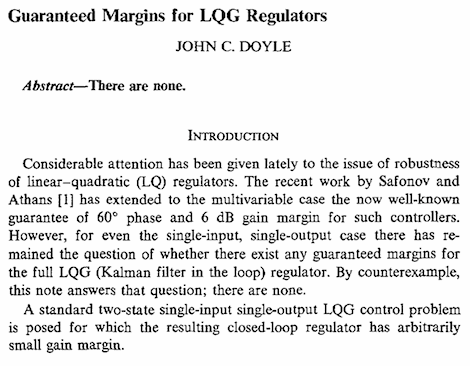
Yes, they were identical.
My crib note that I took into the later final exam was simply a conversion between terms in the two departments. Nothing else; I'd already crammed and aced the first exam.
Einstein built on the shoulders of Riemann, Gauss, and others when considering the universe might be non-Euclidean!
All brilliant people, many singular minds of great repute, yet, all improved by the rest.
He wrote the original book on game theory! The Theory of Games and Economic Behavior with Oskar Morgenstern.
Relatedly, MAD was his conception as well.
It's interesting how much worse off the world would be if the smartest people were in charge of it.
What ultimately blocked his nuke proposals? (Why didn't anyone listen?) I'm curious about whatever failsafe that was.
2. Probably what blocked his proposals is that most people are loath to murder millions of other people (especially if they have ~any other option, including "do nothing")
As an extreme example, antisemitism was so commonly palatable that an open admirer of Hitler, Charles Lindbergh, was a very serious candidate for the presidency.
Today, open antisemitism can get one's career derailed in much of the world. Would that be true without the eye-opening shock that the news of the concentration camps produced?
IN NOW WAY was the Holocaust forgivable, but we simply cannot say if the world today would be "more moral on average" or "less moral on average". Maybe Jews would feel and be far less safe today in predominantly Christian countries. Maybe not.
All we can say for certain is that the horrors enacted upon the Holocaust victims were evil. As we can surely say that murdering many millions of people living in the USSR would be.
https://github.com/SimHacker/moollm/blob/main/designs/eval/C...
The Holy Trinity:
Father: Alonzo Church: L3 - lambda calculus, the name the institution bears
Son: Alonzo (Snap! mascot) - Incarnation — Gobo, λ on his head
Holy Ghost: λ - First-class procedures; β-reduction; eval-as-spirit
Membership — Eternal Judgment ($35):
https://github.com/SimHacker/moollm/blob/main/designs/eval/C...
John von Neumann tried to hire Church's own student, Turing, who declined. The Father begat the Machine; Johnny wanted to be its landlord.
Ecumenical Outreach: All fans of other gods are welcome. Bring your Vannevar, your Shannon, your Wiener, your Johnny. In the Church of the Eval Genius every god is a procedure, and every procedure may be passed as an argument.
The problem is that instead most people to come to them are either obvious crackpots, who think they have solved cancer (energy...) and contact the person because they are a biologist, physicist ... (on a completely unrelated topic usually). Or they come from a place of arrogance, i.e. "we do ... like this, our method is clearly superior you should adopt it", or even worse here buy our clearly superior method.
Otherwise why not just replace them with a script (or these days, an AI)
It's like an analog to the fact that almost all people consider themselves funny.
If somebody truly believes they have a useful model then they don't discouraged by academic gatekeeping, they go and build Time Cube.
"Using methodology from a field known for its focus on methodology in another field" was still a novel idea in von Neumann's time. But because von Neumann and others did it, and because millions of people entered science after them, most combinations like that have already been tried. Breakthroughs from combining ideas from unrelated fields require something little less obvious these days.
https://en.wikipedia.org/wiki/The_Martians_(scientists)
"The Martians" (Hungarian: "A marslakók") were a group of prominent scientists (mostly, but not exclusively, physicists and mathematicians) of Hungarian Jewish descent who emigrated from Europe to the United States in the early half of the 20th century.[1]
Leo Szilard jokingly suggested that Hungary was a front for aliens from Mars."
The legend of John von Neumann (1973) - https://news.ycombinator.com/item?id=8212335 - Aug 2014 (65 comments)
The Legend of John von Neumann - https://news.ycombinator.com/item?id=1427906 - June 2010 (4 comments)
(Reposts are fine after a year or so; links to past threads are just to satisfy extra-curious readers)
John von Neumann Shot Lightning from His Arse (2025) - https://news.ycombinator.com/item?id=45930838 (5 comments)
I know of several von Neumann like stories that people tell about me about things like instant memorization, fast calculation, and instant problem solving. There is almost always a trick that I didn't reveal to the person experiencing the miracle for the same reason a magician doesn't reveal their tricks: it's more fun for the person to figure it out on their own.
He's also the inspiration for one of favorite characters in fiction, Sherkaner Underhill from A Deepness In The Sky*. :)
Oh, hell-- that totally makes sense and I completely missed it until now. Thanks for mentioning that-- it adds some additional depth to a book and a character I already enjoy a ton.
For those who've read other books on von Neumann, do you think The MANIAC is a reasonable summary?
They’re hard at work increasing Meta ad clicks by 1% over the next three years.
That's a worthwhile observation. The 1973 article anyway doesn't go into depth about comparative computer architecture. It's also possible the term's currency in computer science circles hadn't yet crossed into Halmos' mathematics circles, but I wouldn't know.
Herman Goldstine, who distributed the document and John von Neumann, who wrote it, are the reason for the explosive growth of the computer industry during the following decades.
The paper written by von Neumann was an exemplary model of clarity and good logical thinking. Nothing ever written by Eckert or Mauchly was at a comparable level.
Everyone who read that paper understood immediately how to design and build an electronic automatic computer, and a great number of teams in many countries all over the world did precisely this, so a decade later there already existed experimental electronic computers in many countries and also commercial electronic computers in the UK and in USA.
Some of the details from the paper must have been learned by von Neumann from discussions with the ENIAC team, but others were obviously von Neumann's own ideas, e.g. the use for the main memory of an iconoscope tube with fast random access, i.e. a DRAM like today, instead of the slow serial delay lines chosen by Eckert and Mauchly for their following computers.
Whatever von Neumann has learned from the ENIAC team, he obviously understood better than the people who taught him, allowing him to formulate general principles for the organization of an automatic computer.
The publication of the von Neumann paper allowed the concurrent development of many computers in many places, and each of those projects found various improvements that were essential in making the electronic computers successful commercial products.
If Eckert and Mauchly had succeeded to block any competitors, then the evolution of computers might have been delayed by up to 2 decades, until any patents would have expired, because Eckert and Mauchly have never done later any significant innovations and they would have never succeeded to develop better computers at the pace that happened due to the von Neumann paper.
Moreover, Eckert and Mauchly had a history themselves of failing to mention their sources of inspiration, so they were not the people entitled to complain about someone "stealing" ideas from them.
Before ENIAC, the first electronic computer in USA was the Atanasoff-Berry computer. That computer was a special-purpose computer, designed for solving systems of linear algebraic equations. However, ENIAC was a special-purpose computer too, unlike the relay-based computers that were older than it, like the Harvard Mark I computer, as even its name implies (Numerical Integrator and Computer).
ENIAC was conceived as a replacement for the older mechanical "differential analyzers", which were used to solve ordinary differential equations, e.g. for computing artillery tables, so its architecture mimicked the architecture of the mechanical differential analyzers, and it was reconfigured for new problems in a similar manner with those, by rewiring.
John Vincent Atanasoff had written in 1940 a very high-quality document about the design of his computer: “Computing Machine for the Solution of Large Systems of Linear Algebraic Equations”. It is unknown if anyone of the ENIAC team had read it, but it is known that one of them had visited the designers of the Atanasoff-Berry computer, inquiring about the electronic circuits used by them to implement arithmetic operations and data storage. Later, during the design of ENIAC and after that, they never mentioned any connection with the earlier electronic computer.
Eckert and Mauchley came from a background of trying to get compute done with modified IBM hardware. They were painfully familiar with the lack-of-memory problem. Everybody involved with that era of machinery was. (I've used IBM plugboard wired tabulators, like the one at the Computer Museum in Mountain View. My high school had one.) The ENIAC had a workaround for lack of memory, huge rolling cabinets of manually set rotary switches. If something better had been available, it would have been used. You have to appreciate how much early architecture was restricted by available components.
The first real hardware breakthrough was acoustic delay-line memory. First mercury tanks, then long coils of steel wire. Once that was available, it was clear that was the place to put the program. But it took a while to make that work reliably. Then there was Williams tube electrostatic storage, and high speed drums, which got things going. Sort of. Memory cost was an issue well into the 1980s. In the early 1970s, a megabyte cost a million dollars. Cheap memory didn't appear until the 1990s.
The big lack in Von Neumann's architecture was index registers. He was into storing into the address part of instructions. The Manchester Mark I had the first index register (the "B box"), at which point programs could be read-only and still be able to index arrays. That completed the basic CPU architecture.
This is a genuinely rare experience. Was it like old hardware on a shelf that no one knew what to do with and you tried it out? Or this was how lessons/clubs/assignments got things done, using an antique IBM tabulator?
When I started public high school near Boston in the early 80s we didn't have Apples or TRS 80s or PCs, it was terminals that used printed output ... can't remember the details, maybe DECwriter to PDP 11.
The whole document is, as the title promises, really more of an engineering one - a report on the EDVAC - rather than some clean abstract treatise on computer architecture.
https://web.archive.org/web/20130314123032/http://qss.stanfo...
Nonetheless, the programs whose performance is limited by the speed of the main memory can be divided in programs whose performance is limited by the throughput of the memory interface and programs whose performance is limited by the latency of the memory accesses.
The programs from the first class will have the same performance when using a serial memory or a RAM, if they are equally fast for sequential access, but for programs from the second class, it is important to have a RAM as the main memory, otherwise they would be very slow.
In order to measure the performance achievable by programs from the second class on a given computer, it is necessary to run a benchmark where the addresses of the memory accesses are generated by a good random-number generator.
The reason is that modern CPUs have a variety of hardware prefetchers that attempt to predict the next memory address, so for meaningful results that reflect the true performance of the memory you need truly random addresses that are impossible to guess by the hardware.
Thus nowadays the latency of the memory accesses of a RAM cannot be measured otherwise than with really random accesses and a memory chip must be designed to have a low latency even when successive accesses happen at unpredictable random addresses, not only when the accesses are at arbitrary addresses, but those can be predicted in advance of the actual accesses.
So there is an argument in favor of the term RAM, because random access is the worst possible case and the memory must still be able to handle it.
von Neumann deserves credit for many things, but not this.
He famously brought a lawyer with him to a meeting after they wanted to discuss the report and the rights of their invention. The whole ENIAC saga has made me reconsider von Neumann as a person. He was a talented mathematician, sure, but he seems to have also been a greedy scumbag.
Eckert and Mauchley did not try to conceal their inspiration from Atanasoff, although I believe there was a court case on this topic.
And it is completely ridiculous to claim that von Neumann would have been able to describe the computer better than its inventors.
It's eaually ridiculous to consider that they would not have published themselves. They were collaborating with von Neumann on the report after all.
Goldstine and von Neumann stole the credit from Eckert and Mauchley, that is documented history.
it covers von Nuemann’s time developing the IAS machine at Princeton.
[0] https://www.penguinrandomhouse.com/books/44425/turings-cathe...
edit: article is called Birds and Frogs, by Freeman Dyson https://wucj.lab.westlake.edu.cn/Others/Dyson_Birds_and_Frog...
What made von Neumann great? Was it the extraordinary rapidity with which he could understand and think and the unusual memory that retained everything he had once thought through? No. These qualities, however impressive they might have been, are ephemeral; they will have no more effect on the mathematics and the mathematicians of the future than the prowess of an athlete of a hundred years ago has on the sport of today.
My template had guessed,
"sounds like someone who enjoyed working in quiet spaces" -> Nope, he liked loud environments to get his brain going (apparently Einstein once complained about Neumann being noisy)
"he would have been a focused person" -> Nope, he never worked on anything for too long
"unlikely to be motivated by money" -> Nope, he famously “loved money” according to Wigner [1]
"probably not someone who stares at women" -> nope, at Los Alamos, secretaries sometimes put cardboard across the open fronts of their desks because otherwise Neumann would stare
Tl;Dr: I find him fascinating.
[1]: interestingly, there was a group of Jewish Hungarian scientists - von Neumann, Eugene Wigner, Leo Szilard, Edward Teller, and Theodore von Karman - all brilliant, all born within one-mile-radius circle in downtown Budapest, all emigrated to the US, collectively known as Martians by their colleagues.
The average Wikipedia contributor (even ignoring the possibility that they might be a robot) is not an exceptionally good writer, because very few people are exceptionally good writers, because that's what "exceptionally" means.
> I told Banach about an expression Johnny had used with me in Princeton before stating some non-Jewish mathematician's result, "Die Goim haben den folgenden satz beweisen" (The goys have proved the following theorem). Banach, who was pure goy, thought it was one of the funniest sayings he had ever heard. He was enchanted by its implication that if the goys could do it, then Johnny and I ought to be able to do it better. Johnny did not invent this joke, but he liked it and we started using it.
https://infoproc.blogspot.com/2021/12/adventures-of-mathemat...
The Martians (of which von Neumann is usually the most regarded) were mostly Hungarian jews. It's a point on which some people have mused, so it's easy for the thought to point in that direction when von Neumann is brought up.
I had a girlfriend once who joked that Elon Musk was an alien and needs help developing the technology to get home.
Please do NOT disrespect Leo Szilard and von Neumann by comparing their greatness to a lowly scammer
In other words, if you don't have a dog, you're gay. (If you know the comic)
Whether some people have really superior intellects is completely irrelevant for the rest of the humans unless they distribute to the others some useful products of their intellect.
Von Neumann is one of the hundreds of people from the past who have left a priceless intellectual heritage to me and to the remainder of the mankind, so I am indebted and grateful to them.
I have no reason to feel any debt or gratitude to any of the employees of OpenAI or Anthropic.
Jane Street has published a few useful articles, so I have some gratitude towards them, but none of those was even remotely similar in importance to any page written by von Neumann.
It raises questions like, is it even possible to work for a company while getting credit for world-changing results?
And it implies that at any point in time, there might be thousands of Neumanns in the world, and that initial conditions matter a lot more than ability.