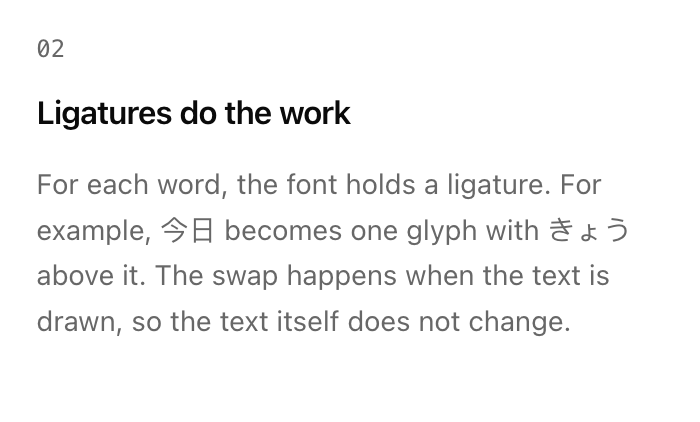
One small thing on the Japanese version of the page: in the "Ligatures do the work" section, 合字 itself only gets じ over 字, and 合 has no reading. It should be ごうじ. I guess 合字 isn't in the dictionary, so it falls back to single kanji, and 合 is skipped because it has several readings.
From practicality standpoint, this would not work on unprepared texts, as pronunciation of Japanese words are a bit arbitrary and so correct pronunciations would need to be manually selected for each words.
i.e. "maize" could be read "corn". I believe LLMs don't necessarily have good intuition for that, being trained on plain texts.
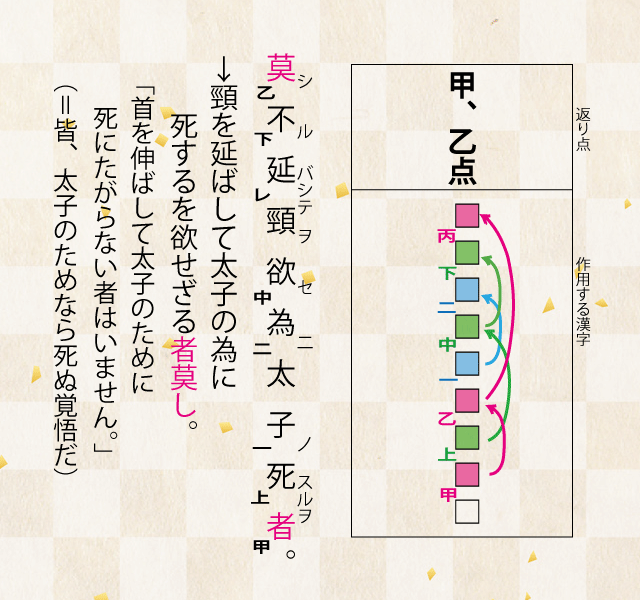
As to how could such a situation could ever manifest: I would blame the fact that the official language of historical Japanese governments having been a really creative interpretation of medieval Chinese[1] sprinkled with labels and jumps and supplements[2][3], resulting in people just accepting wild divergence between literal and spoken Japanese. I'm not a linguist or a language major so I'd happy if anyone could further elaborate...
1: https://en.wikipedia.org/wiki/Kanbun
2: https://youtu.be/_k0I6bi2pYs?t=248
3: https://d1ysbfo9sxjda0.cloudfront.net/wp-content/uploads/201...
But you could set this as the default system font for Japanese and enjoy furigana everywhere, even in places that don't support ruby tags at all.
https://pingtype.github.io/japanese.html
It also support line breaking, so that words don't get cut in half when wrapping text.
[0] https://litherum.blogspot.com/2019/03/addition-font.html
[1] https://en.wikipedia.org/wiki/Turing_completeness#Unintentio...
In the present context, an example is that the common reading of a Kanji word isn’t always well-defined, and neither is the decomposition of a sequence of Kanji characters into words.
Maybe it is:
With the ligatures to adApt to pronunciation of words.
For context, it's a hard enough problem that Google Translate's own romanised pronunciation guides are frequently wrong, or disagree with their text-to-speech.