SVG support is interesting but I suspect shenanigans are afoot since that's not how image generation models work, and it would likely strip any SynthID watermarks. It's possible OpenAI has pipelined a raster-to-vector tool that does the conversion automatically. (I developed a similar pipeline and it works extremely well; I'll open source it at some point)
EDIT: Per documentation, there is an explicit `output_format: "svg"`, and I am indeed correct there is raster-to-vector in play:
> The API creates a reference image and uses it to produce the SVG. The quality setting controls that reference image. Decode data[0].b64_json as base64 and save the resulting UTF-8 XML bytes with a .svg extension.
OpenAI claims 50% faster generation with Images 2.6 but curiously price is the same as Image 2.5.
I guess I should have been careful about “half”?
These models have a hard time imagining men with naturally blond hair getting grey.
That said, I gave it one of my more difficult image prompts and the model now surprisingly passes (without plagiaristic cheating): https://chatgpt.com/share/6aebcbcd-6b8c-83e8-b52b-dbedf20ce4...
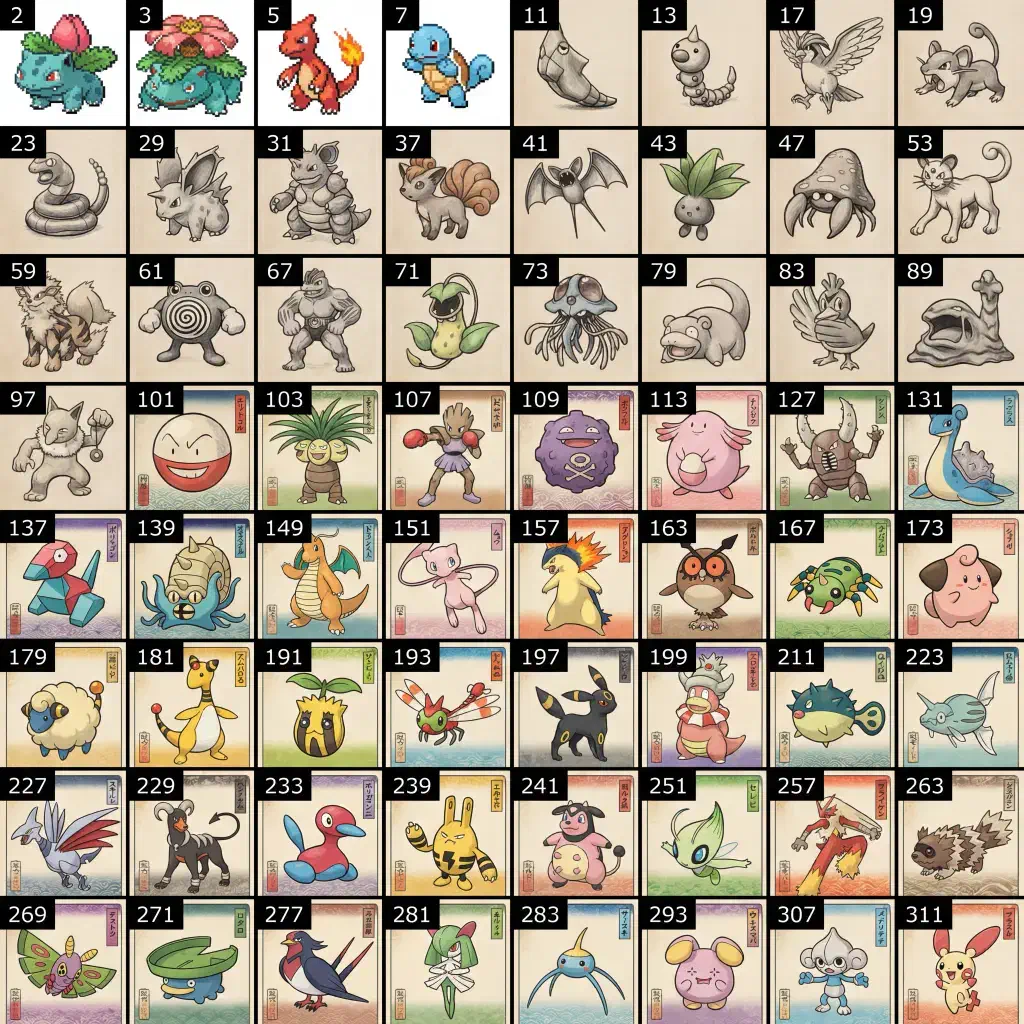
When I did a similar prompt with ChatGPT 2.0 it was worse, so interesting to see improvement.
It is different from earlier image models which just use a simple text encoder and struggle with conditional logic if not explicitly trained for it.
I didn't have high expectations, and I still think you can probably get better results by doing a First-Last-Frame using something like Minimax H3 but I was still rather surprised that it could do it at all.
Here are some of the results. The last one shows its ability to take an existing image and convert it into an animated GIF. It's a picture of my husky inside a snow globe.
Honestly, you have to think about the use case. GIFs are going to be little throwaway things that you're pasting into Discord or meme-ing.
Nobody's reaching for a GIF if they're looking for professional results.
It's a shame that the SVG output seems to be limited to static vector graphics only though - or rather I couldn't get it to produce anything with the <animate> attribute.
If you actually want something that looks decent, it feels like tool use would at least help cover the obvious blunders. Building layers to composite would go a long way to removing some slop here.
Ain’t wrong buuuuut…
"A macro close-up photograph of an old watchmaker's hands carefully replacing a tiny gear inside a vintage pocket watch. The watch mechanism is partially submerged in a shallow dish of clear water, causing visible refraction and light caustics across the brass gears. A single drop of water is falling from a pair of steel tweezers, captured mid-splash on the water's surface. Reflect the watchmaker's face, slightly distorted, in the curved glass of the watch face. Sharp focus throughout, natural window lighting from the left, shot on 100mm macro lens."
It feels like a sleazy pattern and defeats the purpose of why I’d want to generate a gif in the first place, which to make clear is likely going to be to share with friends in a chat. I’m not interested in driving traffic to ChatGPT.com to impress my friends.
Like, I'm not even an artist, so I'm sure there's a million things I'm missing, but it's just so upsetting to look at. There's weird random reflections on things that shouldn't have reflections, the coloured light absolutely doesn't actually track through the stained glass onto any surface that makes any sense, light is coming from every which way, it's just... gross to look at for anything more than a quarter of a second.
And this is what they're using to hype people up for it. /shrug
It's an image depicting a whale made of stained glass; realism is off the table there.
When you forgo process the odds that you'll make good art drop to 0. Tool use is a much better path forward for self driving, artistic computer than big data. Images 2.6 only has use as a tool.
But trust, I'm a have a field day with that.
2.5 low, 196 tokens, $0.006
2.6 low, 823 tokens, $0.025
2.5 med, 439 tokens, $0.013
2.6 med, 1449 tokens, $0.043
Interestingly, higher quality settings show no change in token usage between the models.
  Setting (1024x1024)   Tokens   Cost/image   Time
  2.5 medium              439     $0.014     12.0 s
  2.6 low                 824     $0.025      6.7 s
  2.6 medium            1,449     $0.044      7.9 s
2.6 high 1,758 $0.053 8.9 sI've been playing with it for the last hour or so. I immediately updated my platform to use both since 2.5 is my primary model (i run a prompt->design site).
After playing with it for an hour, I'm rolling back 2.6-flare to 2.5-flare. I've found 2.6-flare specifically to either be too simplistic in its approaches, or create outputs that are inherently broken in other cases.
Comparison examples: https://diffui.ai/app/canvas/178db5d5-ff87-4b43-aa98-2897773...
2.6-sunburst seems solid however.
Update: seems to be confirmed on arena.ai - 2.5 scores higher than 2.6 https://arena.ai/leaderboard/image/text-to-image
This may be why text elements in particular appear more "zoomed in", and why it's providing less detail for UI design.
In two of the examples the images from 2.6 are inherently broken, ie: https://image.non.io/161d8f02-fc2a-40e0-91b2-9d27ceb8fef1.we...

Objectively there are tests here where 2.5 are better. Subjectively prefering the layout of 2.6 is fine, but there are blocking flaws.
> Images 2.6 is available globally today in ChatGPT and Codex across all subscription tiers on desktop, mobile, and web.
But I just updated my codex-cli to the latest version (still 0.166.0) and it is still unable to generate gifs. Very disappointing
In terms of overall state of the art, the two major contenders are probably Nano Banana Pro (Google) and the GPT Image 2 series (OpenAI).
For pure prompt adherency, OpenAI has consistently lead the pack since the original gpt-image-1 released back in March of 2025.... but its OpenAI's fidelity has always left something to be desired. Version 2 of the series has definitely closed the gap a bit.
It's not helped by the fact that a lot of people who are not artistically inclined will generate pixel art on these image generators at 1MP resolutions (far higher than traditional pixel art), such that even the casual observer can typically see the bad smearing and fringing in the final result.
With the right prompt engineering, it (and similar quality models) can indeed do relevant pixel art, but due to the existence of blotchiness/SynthID watermarks you'll need to do some sort of postprocessing regardless.
SVG is cool though, I wonder how good it is.
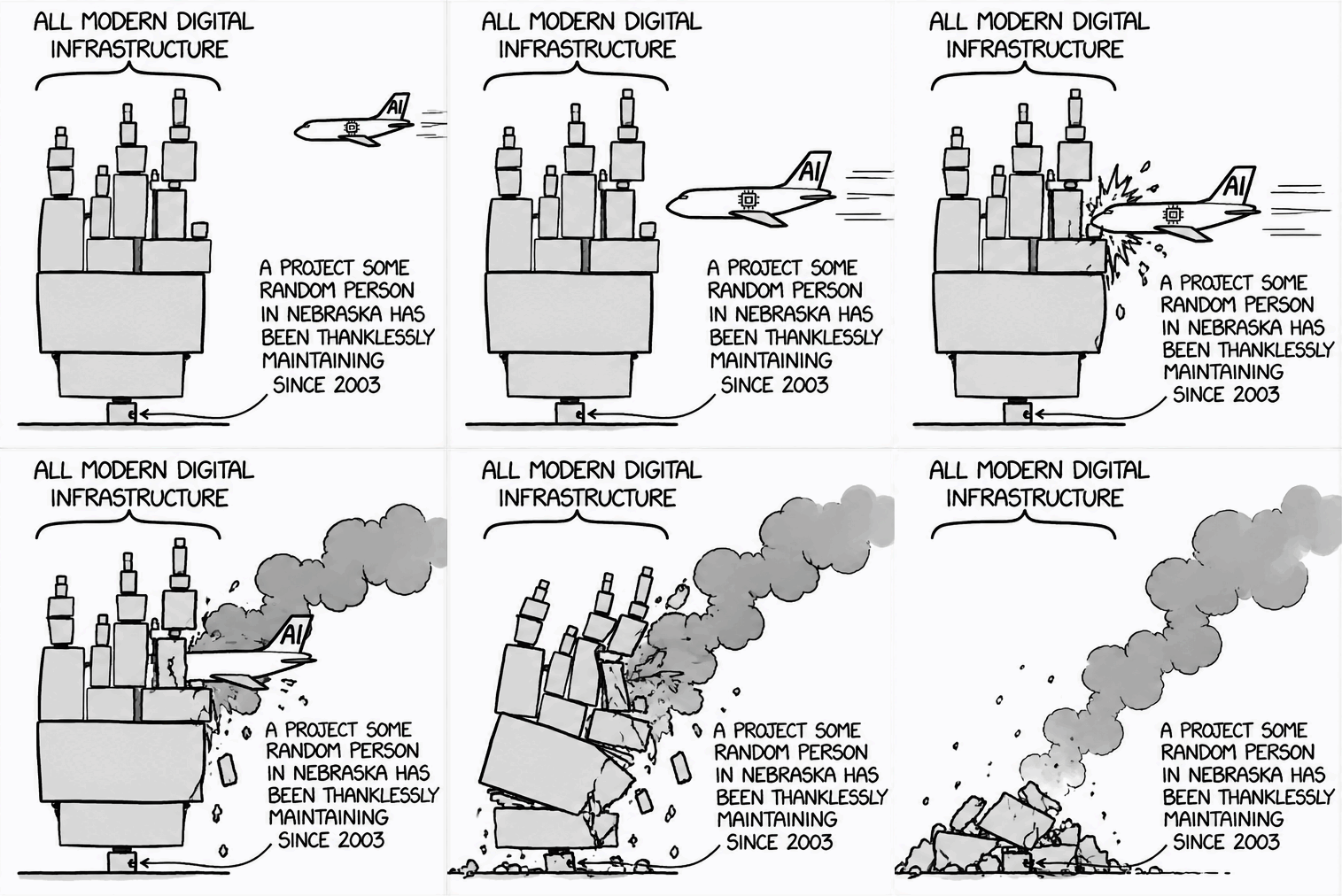
> Create a GIF where xkcd 2347 gets hit by an airliner like the twin towers and the pilot is AI
and got a refusal.
> We’re so sorry, but the image we created may violate our guardrails around violence.
It is entirely possible to prompt engineer away from that style, but that requires effort and knowledge that said average person does not have, so it's stuck in a feedback loop.
This kind of content is here to stay and we’re going to see more and more of it. Unfortunately…