The battery capacity on those things is equivalent to 9 Tesla Powerwall units or something close to it.
They may be ugly, but the emergency prepper in me always wanted one after hearing that story. Before, I always wanted to install powerwalls...but I never considered in an extended event being able to drive my powerwalls somewhere to recharge them.
> Most of the disasters I'm aware of people either get their power back in a short enough amount of time that they can use a normal generator for the gap
TBF an EV car has an absolutely massive battery relative to the electric consumption of a house, unless you're using resistive heating all around. Especially if you ration use.
My Ioniq 5 has been a godsend. No, it can't power the house without dorking around with my electrical panel. But we can run the fridge, dishwasher, a few standing lights and keep phones and computers full charged.
I used a similar setup to Alex's but with the outlet in the rear seat instead of the V2X connector. I will probably by the V2X connector since it supposedly hanldles higher power draw.
It's 30kW for one hour.
(Or 1.25kW for 24 hours, or however you prefer).
You may then use that water over the course of a day. That's 30 sqin-sec per day. That is not 30 square inches for a whole day. It's second per day.
Or watt hour per week or whatever.
Yes, it can be described like 0.00034722 sqin/day, and that corresponds to no physical object and that would be largely useless.
Why not Joules or Liters? Because that's complicated for anything electrical.
It's unintuitive because a guy named Watt decided "Joule per second" is Watt, so the intuitive units Joule and Joule per second got turned on their head to W times hour and Watt. This is opposite to usual intuition of distance and speed for example, km and km/h. If I redefined the km/h to a "tick", then a km would become "tick times hour".
If you want a "better than nothing" but imperfect analogy, Wh is how much water you have in a bottle, and W is how quickly you can get the water out.
The value of the same, repurposed to a "powerwall" - $10k per 10 KWh
The value of it once attached to a "movable powerwall" - :) add a few more zeros
Clearly, I am in the wrong business...
When we got solar we asked for quotes, but ‘No Tesla’. The sales rep said ‘We get that a lot’.
It has other downsides, obviously. But the notion of "emergency power for your house" isn't really anything special.
My experience with power outages (after big summer storms, not a hurricane thank goodness) has been that my neighborhood is impacted, but that places nearby have power. They tend to restore commercial first, so the supercharger near me is up and running before my house.
There are practical issues with it, but it's possible. The question is EROI or Energy Return on Investment. Do you get more energy from it than it took to make it, which unfortunately is not there yet. Shrinking it down to fit into your backyard is an exercise left for the reader.
And that's assuming they are sunny days.
But yes, it needs to be sunny if that’s going to be pure solar.
I'm 100% off grid on solar in the middle of nowhere. My panels could burn up, get hit by hail, get searched by law enforcement, flooded out, eaten by mice, stolen by miscreants, abducted by aliens or buried in snow. And of course in the event of a volcano they are probably not gonna function well.
So they are of course totally unworkable in events when the power grid is down.
But I like using them and they've been reliable so far...
And are regularly rotating that stockpile, because gasoline has a shelf life measured in months
edit: Apparently this leans more technically-true factoid than fact, thank you replies
Simpler gas equipment like mowers and generators don't have enough compression to really care about anything but ancient gas, and if you run any vehicle that is multi-fuel capable it can detect and adjust compression based on a fuel's capabilities.
Ive been repairing and fixing junkers of cars, mowers, ATVs, generators, and more for 30 years and not once has bad gas stopped something from running. I only remove it if it was clearly having water raining into the tank. In every other case where I couldn't start something after sitting around for 5+ years, it was from the gas gumming up in the carb or the shitty diaphragm pump, which generally means there is little to no gas left to start with.
I wouldn't even suspect gas of ever being bad unless it was atleast a few years old. If the tank was open it could have evaporated, if the tank was closed it probably ain't great gas but I bet it would still run in anything but a high compression application.
Spark, not compression.
I am guessing that one of the use cases is a support unit to charge an EV just enough to get it to a charging station.
edit: I think these also had a ford branded chainsaw over the wheel well on the other side of the engine bay.
"The generator was called the Electric Power Pak. From 1969 to 1972, Ford offered a 2,500-watt underhood generator, mostly on the Contractor’s Special, though it could be special ordered on other trucks. It also wasn’t driven off the engine’s belt. It was a separate Onan generator with its own 5.5 hp air-cooled single-cylinder engine, feeding an outlet in the bed. It sat on the driver’s side splash pan. The package the commenter calls a “Rancher” is likely the Farm & Ranch Special, which is one of the trucks that came with it.
The chainsaw was real. Ford sold Ford-blue chainsaws from 1970 to about 1976. They were rebadged Ohlsson & Rice saws: the Eagle I/II and the smaller Hawk. A mount was also sold that held the saw on the F-250’s driver’s side inner fender"
https://www.fordification.com/tech/images/onan_brochure-phot... https://images.squarespace-cdn.com/content/v1/5601f99be4b059... https://www.fordification.com/tech/onan.htm
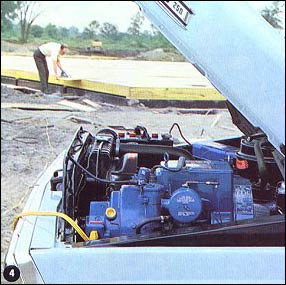

But it is still cheaper to stockpile some generators and gas than stockpile a cybertruck. If there's an EV charging station up within a 1 hr drive, gas stations are also going to be up.
A Cybertruck has nearly 10x the battery capacity of a single Powerwall, and to buy that much Powerwall capacity would cost at least as much as a Cybertruck. Even a Tesla Model 3 (which now supports home backup) is over 5x Powerwalls.
You still have to pay to install home backup support on your home’s breaker (at least $10k), but you don’t need anywhere near the amount of very expensive supplemental home batteries.
Also, even an EV with a 120V outlet and no home backup support could be very useful for recharging a portable battery bank.
$10,000 to install a socket, a breaker, and a transfer switch?
Surely not.
Electricians like their transfer switches because they are right sized and everything, e.g. they are more foolproof for the end user to operate, but the interlock approach actually gives you more control because every breaker is allowed (a transfer switch will only expose some small subset of all your breakers usually), you just have to manage the power supply yourself.
Regardless, the thing that’s really great for cost effectiveness is that the same large battery can be used everyday for driving and also used rarely for emergency home backup systems.
10% to pay for their costs - materials and labour
90% to pay for their new Cybertruck financing
I'd have animals too but society is still stable enough to provide me with food.
If you can choose between a truck that can’t power your house and a truck that can, prepper mentality is to choose the one that can.
If you want your solar panels to be operational during an outage, the typical install for this is a system that already includes batteries.
There are specialized options that exist with islanding features, but if you didn't install your solar system specifically for this you probably don't have it.
Is this thread being astroturfed? This defence for the Cybertruck ITT is one of the least rational threads I've seen on HN in the past few years and if the CT was actually valuable tech it wouldn't be one of the worst selling vehicles of all time.
You can stockpile diesel for a generator (unlike electrons). That's what actual prepping looks like.
Take it from a Ukrainian.
Much easier to just buy some solar panels to recharge the electric truck.
Much easier to use diesel in your diesel-powered vehicle.
And then you have much, much energy in your stockpile.
And if the needle is so far towards apocalypse, then the horse beats your diesel. Repairs itself, refuels itself, and replaces itself.
Take it from a Ukrainian.
PS: my dual-fuel gasoline/LPG Renault Twingo in Poland will outrun any Cybertruck on the continent.
And, unlike electricity, you can stockpile gasoline.
Source: I've mucked up multiple small engines with bad stored gas.
Propane, sure, but now you're talking about something fairly exotic, at least in terms of vehicles you can buy "off the shelf."
In any case, you can't produce propane yourself. You can "produce" electrons with a solar panel.
Edit: My bias is toward North America, but I know of only one model of "normal person car" (city buses don't count) produced in the last 50 years that you could just walk into a dealership and purchase new: The Honda Civic NX. And that was sold for only a few years and only available in California.
But for conversations sake, if we're talking about diesel trucks, and specifically an old mechanical diesel like a 7.3 ford or a 12 valve cummins, and we're talking about stored diesel, ideally a class D died diesel with a high sulfer content, then you'll get considerably more lifetime out of it than the recommended 18-24 months.
Additionally, you can burn about anything, old motor oil, fry oil, diesel with algee in it if you treat it and change your filters. A good, mechanical, not very picky diesel will burn fuel that is 20+ years old. Not forever, and you'll go through some filters and maybe injectors. By the time you get to fuel sources that can't be burned in a machine like that, or you've burned it up past your parts and ability to repair. you'll probably have a lot of other problems.
If we're talking generators, you can get off the shelf propane generators and propane stores well.
If you have a vehicle that runs on gasoline, you don't have to store gasoline for a long time to have a stockpile.
The cost of a few empty canisters is by far smaller than the cost of solar batteries, and putting gas into a vehicle in case of an emergency within a span of seconds rather than hours is a huge asset.
Not to mention: not everyone has space for solar. City dwellers are particularly constrained (as in: people who live in apartment complexes).
Not really. Some areas in California have multiple PSPS outages during fire season. Many people have gotten gas generators or powerwalls to deal with it, but using your EV would be ideal.
Generators have solved this problem. My family used to lose electricity anytime there was a semi serious snow storm. We got a gasoline generator after the second time and it was always sufficient. We never needed to siphon gas from the car either. We later transitioned to a natural gas generator. The lines are all underground and tie into the existing system for the stove and dryer. No car involved.
No. It's like a generator except way more power and mobile. Rechargable via solar. So basically just a much better generator.
But it's not bad to ride out the first couple of days if you've got 120kWh just sitting in your garage.
Ford has also marketed their hybrid F150 as being able to power home appliances for several years.
But for the other 99.99% of humanity, there are certainly more cost-effective ways. A portable power station and solar panels are probably the better move unless you have some really massive power needs.
(Admittedly, a nuclear winter reduces the effectiveness of those solar panels somewhat)
Doesn't make sense for what they are charging for it. But still!
Where I'm located, in most cases when there is an outage, neighboring areas do have power.
Specifically for my model 3, I've been considering tapping into the HV system manually to keep my Ecoflow battery topped up, but I wish there was a way to directly connect it.
And there's actually a good chance that PG&E is not being paid: most of the big tech companies have large solar installations covering the parking lot which power all the EV chargers, so they cut PG&E out of it entirely and produce their own power.
PG&E has special tariffs for meters that are used only for powering commercial EV chargers ("BEV1" and "BEV2"). They're about half of what a residential consumer would pay for an EV-only meter (the "EV-B" tariff).
In what universe is backup power a niche use case?
1. America is huge. Comparing it to places in Europe is like comparing it to New Hampshire.
2. American has imported tons of people who are incapable of sustaining a high standard of living on their own. It only takes a few percent shift in GDP/person to change how much infrastructure you can build and maintain unless you are truly willing to let all the folks with less than a high school education and no special job skills live in favelas.
Iceland (part of Europe) is the size of Florida with 2/3 the population of Wyoming. 20% of Iceland’s population are 1st generation immigrants. Neither of those facts prevents Iceland from filling in, upgrading, and maintaining their infrastructure. The two week power blackout which GP’s friend experienced is unheard of in Iceland. And every population center, no matter how remote and low population (we are talking fewer then 100) still gets broadband internet via traditional infrastructure.
I also want to note that I did not compare America with Europe, you did that. And it is a determent to your argument (as if your racism didn’t do that already).
You know that Helene was a category 4 hurricane that crossed six states, affected tens of millions of people and cause $78 billion dollars in damage. It was a major event like nothing that has ever happened in Iceland. That level of event in Iceland would remove it as a going concern.
To respond to your add, yes I brought up Europe because outside of Europe there are like 3 countries that even have comparable infrastructure to the US. If you say "America has a terrible track record with infrastructure." Then the implication is that there is somewhere that does better. And my argument is that selectively you can probably find places but nothing as large as the US or with as many people who can't contribute to it's maintenance. (Did you know that in the US more than 50% of households are not net tax payers? All of the American infrastructure burden is carried by less than half of the households.) Your example of Iceland has 13000 KM of roads, of which 7,300 KM are paved. How is that some comparison?
It is. Education has been an excuse for discrimination for a long time. When you describe a whole demographic as being uneducated you are applying exactly the kind of rhetoric which white Rhodesians used to excuse their discrimination[1].
> You know that Helene was a category 4 hurricane that crossed six states.
A Volcano erupted in the town of Grindavík, the main line which connected the town to it’s power plant, went under lava. The town was out of power for a maximum of 7 days.[2]
But in any case, 2 week long blackouts are extremely common in the USA regardless of the severity of the natural disaster. When I first moved to the Seattle area in 2016 a common snow storm caused a blackout which lasted for 2 weeks in some areas outside of Seattle. The reason for the length of the blackouts in the USA is simply due to the quality and maintenance of the infrastructure and any lack of action plans to fix them when they break.
1: https://youtu.be/SLmD23UpLOo?si=hnyOlxPqDmWwQfRp&t=1299
2: https://www.ruv.is/frettir/innlent/2024-06-05-koma-rafmagni-...
I've lived in the Seattle area since 2007. There has not been any power outage that affected 3000+ homes that has lasted longer than a day.
Additionally, Seattle area does not have common snow storms. It has extremely infrequent snow storms and thus has no reason to have lots of cold weather equipment. What we do have is frequent wind storms and lots and lots of trees (orders of magnitude more trees than all of Iceland, for example) and the wind often knocks trees into power lines and those are fixed in less than a day. In terms of neglect, that's not a problem. The longest outage I've ever had in the suburbs is 18 hours.
The real reason for the long duration blackouts is not failure to maintain infrastructure, it's because of natural disasters that damage and destroy entire swaths of infrastructure in a single event over thousands of sq km.
That someone, somewhere once used some accusation about a trait of populations as a form of discrimination does not mean that every recognition of that trait in a different population is also discrimination. Like, we can look at a person and say "oh, he never finished high school" that doesn't mean we're irrationally discriminating against him. You discriminate on exactly this basis every single day. You don't have people who don't know driving/cooking/medicine/engineering/automobile repair/etc. provide those services to you. I guess you're a bigot.
I agree. One can judge America’s lousy infrastructure and lack of action plan on its own merits. There is no reason to bring Europe into this. All I am saying is, America’s sparse population, nor the education level of immigrants is not an excuse.
It’s niche just because natural disasters are thankfully relatively rare, but I still think having good contingencies is worth it.
Fuck being seen in a cybertruck though.
Electric vehicles won't, ever, be prioritized over bringing up residential, commercial and emergency services. The fact that even on a super charger it's 20+ minutes to charge a Cybertruck means the two or three at the local gas station will just end up with 12+ hour lines. Even now generators are fueled before private vehicles.
Bringing up power after disasters is super dangerous as is. A lot of systems that hadn't been turned off in years do a cold start, and sparks fly. It's why the power company and fire departments coordinate very very closely on grid work.
You know someone's going to try and bypass any safeties and circuit breakers and end up taking down their house when they try to restore power after a flood or something. People already regularly die from running their generator in the garage and most of these aren't wired directly into house mains.
I think this is why these EV trucks don’t do well (ford also cancelled the F150 lightning). For truck things, they aren’t particularly capable (you’d get less than 100 miles towing). For daily driving duty, a car or small suv is much more efficient. You can power your home during a storm from most EVs these days, you’d just have to top it up more often
Yes, but the energy density of the energy storage mechanism in the cybertruck is substantially lower than a gas pickup truck
Not a Cybertruck fan myself, but unless you are going to tow or take many long road trips, an EV truck will work great for anyone who can charge at home. And most people don't tow, or take long road trips, with their trucks.
Except for everyone who owns an RV trailer.
I am not a fan of the truck, but let’s make some sense here
Of course the Prius Prime on electricity is way more efficient than both, but it still uses a lot more energy than a house.
Yes, driving, compared to living, uses ridiculous amounts of energy.
Little's law is another related phenomenon that is super critical. Measuring things when the units don't match has bitten me more than once.
Actually newtons are just a constant factor (3.6) compared to Wh per km, since there are 3600 seconds in a hour while there are 1000 watts in a kilowatt. For example 144 Wh/km (or 14.4 kWh/100 km) would simply be 518 N. This also means that pushing along a Tesla on the highway at constant speed is roughly as hard as holding a 50 kg weight, giving you an intuitive sense of how "hard" it is to keep things moving.
Of course, in everyday life, since we buy electricity from our utilities in kWh rather than joules, it's more convenient to talk about kWh per km (or per mile).
I thought you were autocorrected badly but I guess this is a term people use?
- the Cybertruck uses almost twice as much energy as your Niro EV
- the 40% efficient Prius uses about 2.5x as much energy as your 95% efficient Niro EV.
what seems off?
I have a lightning and it averages 0.5kwh/mile and my electricity price is $0.15/kwh, so it costs me $0.075/mile to drive. At current gas prices that's pretty much the same as a very efficient hybrid compact car (55mpg @ ~$4/gallon). If I had solar I could probably offset almost all of the lightning fuel cost based on where I live (sunny) but it's so cheap it's not worth it.
Do you mean "much more efficient" in places where electricity rates are significantly higher than the national average? Or only much more efficient when compared to when you're charging at charging stations?
Cybertruck — 2mi/kwh
Model Y — 3.8mi/kwh
Model 3 — 4mi/kwh
Driving in general uses a lot of energy. It’s the physically moving a 1,000 kg or more object that takes a lot of energy. Orders of magnitude more than a few lights or a phone. Same with flying of course; also moving a heavy object.
ICE trucks are equally inefficient for towing. People just don't seem to be able to factor it in.
Imagine a trailer takes 1 unit of energy to move, and ICE truck takes 5 units to move itself, and EV truck takes 1 unit to move itself.
The ICE truck towing it would go from 5 units to 6 units, reducing the range by 16%.
The EV truck would now go from 1 unit to 2 units, reducing the range by 50%.
So the better your efficiency, the worse you are at towing. Ideally EV trucks would have such a huge battery that even when the range is reduced by 50%, it is still as long as a gas truck's range, but modern battery technology is still too sucky to achieve this.
Not so sure about that one, boss. I can fully-load up a Ford Ranger to its 7500lb rated towing capacity and lose ~10% in fuel economy/range while you just dropped something like 30% (from the base power package range of ~240 miles, platinum package at 300 miles you're losing half if you only get 150 miles out.)
To get their equal ranges, a Ford Raptor would have a ~4 gallon tank. The fact that the cybertruck can go so far while not towing is the miracle. How far do you think you're going to get with 4 gallons?
I think in general, a country trying to become industrious and eco-friendly by saving energy is like a person trying to become a millionaire by pinching pennies. Once you have optimized an economic system to eliminate the major cost centers, you're going to have extremely hard time improving it through further cost savings.
For example, If my expenditure roughly matches my income, I would need to eliminate 100% of my expenses just to make enough surplus to match doubling my income. Once I have managed the major cost centers (rent, insurance, etc.) it's not going to be worth my time to further optimize my expendature, the time would be better spent improving my income
For EVs, the fuel cost is already low. The next cost centers are like maintainance, tires, battery life. It would be better to attack these other cost centers or somehow pursue functionality that increases utility of the car.
You can get a special account for home charging that lowers that rate to $.32/kwh, and at my work I can charge my car for $.28/kwh. At those rates, and with gas where it is now (typically $5.50 - $6.00/gal) it makes sense to use electric.
All cars just use a ton of power moving a lot of mass. It is actually impressive, it's like 100KW at full tilt. I think i saw someone do the math for how much power transfer you would need to get EV charging as fast as gasoline refuelling: It's in the megawatts.
The only way you could signifigantly reduce power usage of vehicles is to reduce mass dramaticially with a motorcyle or autocycle. The Aptera is an interesting autocycle design based on this line of reasoning, but we are also seeing the emergence of a lot of electric motorcycles.
Also regarding filling up an EV as fast as gasoline, there’s a company in China that has demonstrated charging from 20-80% in 5 minutes. They’re using 3MW charging.
It makes you realize why gasoline has been so popular for so long, you can stop for 5 minutes and dump 500 kWh of energy into your tank. Unfortunately most of that is wasted as heat during the combustion process.
Also, if you factor in the construction, idk what the timeline to pay that off would be.
Yeah that's the exact post I saw. I didn't believe the video at the time but I suppose it's possible with enough battery paralellism and cooling.
https://www.thecooldown.com/green-tech/new-ev-technology-cha...
That said if you have a Mall Crawler who's heaviest loads are your monthly Costco run, an electric truck would probably be great for you. I still wouldn't recommend a Cybertruck though.
https://www.tesla.com/powershare/#vehicles
> Powershare allows you to draw power directly from your compatible Tesla vehicle to power your devices, your home or the grid.
> Powershare is currently available for all Cybertruck vehicles, and all new Model 3 and Model Y2 vehicles ordered on October 1, 2026 or later.
> To verify if your vehicle has Powershare, navigate to ‘Software’ > ‘Additional Vehicle Info’ > ‘Powershare Support: Enabled’ on your vehicle touchscreen.
To power a house directly from an EV, the main options now are the EV trucks -- Lightning, Silverado, Cybertruck all can have this ability, 240V 30A typically
I don't think the residential power generator is needed anymore if you have an electric car.
Completely missed opportunity. I won't be buying an electric vehicle that doesn't allow powering my house, ever again.
As you probably know, there's a 12 volt battery in these cars. That battery is automatically recharged by the big 100kWh main battery.
Some years back, I bought a 12 volt, 2000W inverter and connected it to this 12 volt battery in the Tesla, ran a couple of extension cords, and powered our refrigerator, extra freezer, and a number of other things with it for many hours. The main battery percentage in the car showed an appropriate drop. This actually wasn't during an outage, it was contingency testing. We already have a natural gas, 3600 watt generator that connects to one of our panels and use that during (unfortunately frequent) outages.
In my 2017, it's a bit of work to get to that battery, but it's quite doable and seemingly quite safe. The obvious, very rough/estimated/simplistic math is the 100kWh main battery divided by 2kW is about 50 hours. Different factors would push that number up and down of course.
I will definitely try this again. If it works, that'd be great.
Only available on Tesla models ordered after October 1, 2026
Tesla models older than 6 weeks are SOL (for now? Maybe it just needs some backwards compatibility testing)
It sounds like it will require a hardware retrofit, that isn't being offered to consumers yet: https://www.notateslaapp.com/news/4585/tesla-publishes-vehic...
We have a 12v port that we can get ~200W out of, so that could power our internet.
But I agree, a real joke to have 150KwH (two EVs) in my garage and no way to even plug in a fridge.
V2H/V2L is a must have in my next EV.
1) if you're permanently modifying your home or electric panel you're over $1k. (General Motors "Vehicle2House" is ~$10-20k for hardware + installation... an EXTREME investment unless you plan on regular "emergency" usage of it)
2) if you're buying some portable solar panel "battery boom box" you'll likely run out and the folding solar panel it comes with is more gimmick than reliable
3) if you're buying a "real" gas/diesel generator, you have to run it + change the oil every 6 months otherwise it might not start in your emergency situation
...just buy a thing that clips to your car battery and dangles out the front hood of your car!
You already maintain your car every 3-9 months, you already (should) have at least 1/2 tank of gas at all times (especially in a weather / outage situation), you can generally idle your car for at least 2 days off a tank of gas in an emergency, and if this thing can charge your phone/battery packs, keep your fridge running (kindof?), and run a small space heater overnight...
It makes soooo much more sense to buy a $500-$1000 emergency accessory that piggybacks off the car you already maintain than trying to stand up a whole extra distribution mechanism for "survival-ish power, maybe 1-2 times over 3-4 years".
As soon as we got the adapter for our Ioniq 5, I sold generator to a neighbor. The car will run what we need for four days, which is longer than the generator and five gallon can of gas is going to last.
Despite the dealer saying the used one I bought supported it, it turned out to not be available in the trim I got. My fault obviously for believing something a car dealer said.
It sounds amazing. Only thing I wonder if it can even be set up so that it will be like an Uninterruptible Power Supply. So that when there is a blackout, the V2H supplies all the power without any interruption.
I have several computers but no UPS yet. Imagine if I could buy an electric car and when I am not using it, my car is UPS for my whole house including my computers! :D
That's the point of V2H (or a residential battery, which it emulates). Although you still want a UPS for computers: I doubt "without any interruption" is at the scale of a UPS, and possibly not at the scale a desktop computer will require. Notably it depends how the grids cuts off, if it cuts off in one shot (like throwing the breaker) the failover should be almost instantaneous, but if it fluctuates before failing the battery might need a lot longer to engage.
Of course there are two issues that are completely solveable if we had reasonable governance:
1. Adopting an Australia-style solar installation regulation and permitting scheme, which is literally 1/5th tho cost of the US method, and pays their tradespeolpe higher salaries than US workers get
2. Allowing EVs to feed back into the grid. This is something that naysayers would never be useful because nobody would ever want to waste battery cycles on their home. Which of course has always been nonsense. Don't buy EVs without this basic capability, IMHO.
This combines to ensure that any solar installer will do lots of very expensive things: 1) have a large sales force to close the sale, which last I looked accounted for 30%-40% of the overall cost of solar in the US, 2) roll out trucks many different times during the planning and install, each costing lots of money, 3) never have to compete with a bunch of other hyper-competitive installers and find efficiencies like batching installs together in the same general area.
There are also massively high solar PV tariffs in the US, more than tripling the cost of the panels, but that's not even that big compared to the rest of the needless inefficiency in the system.
Went looking for the campground host and bumped into another camper, who was pissed the power went out. "Don't worry though - if you need to charge something, you can put it in my truck."
Ended up on a phone charging expedition that landed me in a local library for the first time since I was a child.
Came back and met the host: "Sorry about the power last night - some dumbass tried to charge his truck and tripped the breaker to the whole campground."
(I'm sure there's more to the story, and the details aren't important, but if charging a vehicle is tripping breakers for the whole campground there's something wrong.)
Also, a bog standard 14-50 is likely not suited for 80% steady EV usage anyway. They make EV-rated 14-50s now because people keep melting the older ones. And that happens even though the vast majority of chargers won't draw more than 32A on a 14-50 due to the historical popularity of using 40A breakers for a 14-50 receptacle.
This is a pretty common feature in High capacity cars.
Even my mid-range BYD came with power strip attachment so you run basic electrical appliance with it.
An $80K-100K car that replaces the two isn't some genius purchase.
Sure you can spend all the money you want on a luxury toy, nothing wrong with it, but it's weird trying to justify it as anything but that.
In Australia, $10k would buy not only a ton of solar panels but also batteries. The US has decided to make solar and batteries at the home super expensive, unnecessarily.
That doesn't mean electric cars shouldn't be considered as power backup, or that buying a nice electric car vs a nice gas car doesn't come with the added benefit of "Don't need a 10k generator anymore".
From redundancy perspective, a genset + car is hands down a better combo. A functional ICE car is cheaper and goes everywhere without any trip planning around charging stations, which is another plus.
I never said EV is not great and it is nice that it is working out for you, but facts are facts. Also, while EV footprint is growing around the globe, there is wide vast world beyond USA where charging issue is still true (and the repair shops).
If you're looking at two $55,000 cars, and one has power interconnect and one does not, it's not like adding a $1000-$10,000 generator on top is somehow immediately better unless you're adding in factors that make it better (like buying a cheaper car). There's 3 or 4 superchargers within a few miles of my house, and every time I've lost power I could easily go charge my car so I never worried about that.
Not everyone lives in that situation or has the same "one or two days without local power but chargers still work" threat model. It just so happens that's been the biggest actual, real, problem that my car could have fixed for me.
Then there’s also the potential scenario of “buyer prefers an EV anyway.”
In my case I’m currently driving a ~10 year old conventional gasoline vehicle that I purchased new, and I plan to keep driving it for roughly another 7-10 years. Given the current automotive product lineups out there I can’t think of a scenario where my next car will involve gasoline regardless of my desire for a backup power source at home.
Depends on the vehicle of course. But for me at least, my 5-speed Civic for $2500 is way cheaper over its expected lifespan than a $7000 Nissan Leaf (and the Civic is way more flexible, since it can actually go more than 100km every 6 hours in the winter). At $1.50/L and 6L/100km, I can drive about 50,000km before I spend more on gasoline than the price difference between the two. The actual breakeven math (assuming 21kWh/100km) is closer to about 65,000km when factoring in electricity at ~$0.12/kWh. Oil changes are negligible (I do my own maintenance and oil changes), and a used Leaf is going to have just as many problems (if not more) with "the rest of the car" as a gas car (suspension, steering, brakes, tires, electrics, interior components, not to mention battery pack services).
If you buy a nicer EV than the break even point goes even further out. At least where I am, the EV equivalent of any gasoline car has a breakeven point of at least 50k km driven, usually more.
> Then there’s also the potential scenario of “buyer prefers an EV anyway.”
Entirely fair, but I'd still buy a generator and an EV. Because coupling your house power to your car just seems like a bad idea (to rely on it, at least; if you live somewhere that you never need to rely on off-grid power, then who really cares). For instance, my house has a sump pump that must run every ~hour or my basement will flood, and during storms that gets down to about 20 minutes. If my area doesn't have power, then I can't charge an EV anywhere nearby, and if I'm powering the house off the EV, how am I going to recharge it without my basement flooding?
Good grief, what year is that Civic from? LOL. I just bought a 10 year old Corolla for my kid and it was 12 grand. Civics aren't much cheaper.
If you live in an area where you can only get ethanol gas, then you definitely don't want it sitting more than 6 months, even with Sta-bil (in my experience). So that means yeah, you gotta cycle through the generator's tank twice a year, which if you live in an area with reliable power, means spending more money than you need to on gas and oil. Also, keep all containers (including fuel tanks) as full as possible, to minimize the amount of air in the container, to minimize the amount of moisture the ethanol can suck out of the air.
That puts the total setup price to about 10% of a CT-Energy station.
We could start comparing used EVs if we want to.
Personally I never really understood the value of a generator in the first place but that’s just my opinion.
See, your problem is assuming that the EV is 80-100K. Or that the ICE car is 30K. This is a contrived comparison. An average new car is well over 30K. And I bought a brand new Lightning for 50K. Being able to use 131kWh of battery for things other than driving is a pleasant bonus, and I prefer it to having a gas generator I have to keep maintained and store fuel for.
Or rather, you can take half of the difference in price and install some proper PV + battery system in your house that can be used when there's isn't a catastrophe too.
If there is a major outage most bosses understand that you won't be working normally because you need to deal with the emergency.
There is an entire genre of welding equipment designed for this scenario.
https://bakersgas.com/collections/miller-engine-driven-weldi...
Our solar panels kept the fridge running, but we were heating the house with a wood stove (it was very cloudy, so we were getting maybe an hour of sun a day). If we had bidirectional house charging, we could have had warm showers + used the heat pump: We would have been able to fast-charge the car at 100-200kw in town. The house can limp through 20-30 hours on ~ 25kwh, so the charger would charge the house at a few days per hour, including losses from driving to and from town + round tripping through the battery, and also running the house heat pump.
None of the other people around here stayed online. Some propane-dependent people had no electricity for > 2 weeks (with rationing, they managed to keep their generators online for about a week, and PG&E took three weeks to fix their lines).
This was in the outskirts of Silicon Valley, so better-than-puerto-rico infrastructure, but only just.
We are far away from, but slowly approaching, Mad Max levels of institutional failure, and everyone seems to treat it as normal and unavoidable.
Most people just plug an extension cord into the onboard inverter. You have to manually flip it on and plug it in, but 240V30A is plenty for an emergency. Doing it this way isn't any different from any other vehicle with an onboard inverter though.
On the other hand there are no tricky rules for an electric truck to have extra power outlets in it.
The whole comment comes across as an AI agent that is lacking severe human context by posting a complete non-sequitur, regardless if it is actually an agent or not.
First time I’ve been compared to an AI agent.
Cybertruck was announced first. Then Ford _released_ the F150 Lightning, including the ability to operate as a backup battery for a house. And a dozen or so months later, Cybertruck comes out at a much higher price than F150 Lightning ever was.
As has the F150 lightning. It lost so much money and demand was so low that Ford had to kill it to stop bleeding money.
If all you're after is the V2L feature, you can get it for much cheaper: for 16% of the price of a Cybertruck, you can get 86% of the battery capacity (about 8 powerwalls) by buying a used Fisker Ocean Extreme with a 107kWh battery, vs. the cybertruck's 123kWh
Ford came in and bought up all of the parts from our suppliers and I had to qual random suppliers for weeks. Even at the time, I was thinking there is too much disparity and this will haunt us for years.
We were a bit more agile and I made a lot of kernel hacks to compensate.
Ford didn’t fare better for all their choices. Recalls galore. Honestly, they made my life hell so fuck em.
On to the truck, they had a proprietary charger and power wall solution but it could run the house for days.
Weird looking truck, glad they took the risk
You also need to have the house setup to run off a generator. You don't want the truck power feeding back into the grid. IIRC, that's usually done with a big switch near the main panel.
There is a model of Ford Lightning that has power sharing and now that resale values are way down it just might be a cost effective home battery that you can drive around during non-emergencies....
You can also just plug into the 30A240V bed plug and use the onboard inverter on the lightning or powerboost hybrid f150 with less headache.
Car makers are reluctant to support this. In case of Tesla because of market segmentation.
If you are concerned about riding through a 14 day+ event you need a generator. Even a fully off-grid solar / wind setup could be compromised in these kinds of storms. I've seen entire roofs cleaned off by a <100mph storm. Anything not bolted down to a concrete slab cannot be depended on.
It’s unclear to me how a vehicle battery can be 9-10x the size of a house battery, be used as a house battery, include an highway safe cabin, motors and wheels and only cost 4x what a single home battery costs. Oh, and at least Kia rates their battery warranty based on miles driven, so using it as a home battery does not impact any 10-year capacity guarantees.
AI tells me they are completely different though, so I must be missing something.
5kWh of battery cells at the moment run around $500. The rest of the cost of production is in the power electronics (probably around another $500).
It's why you can buy 4kwh worth of battery backups from Amazon for about $2k right now. Yet the same thing sold as a home battery backup costs $5k.
Lack of competition and likely low amount of sells is what's causing the margins to be so high.
Propane generators here have the same problem.
That still doesn't explain the price gap. You can literally just get a V2H EV and use it instead of a home battery (or, you could if the ecosystem was more mature).
They want ~9k for a freaking 13.5kwh pack.
I can buy a UL certified, 16kwh, outdoor rated pack for 3.5k (ex - EG4 allweather)
I can buy just the LFP batteries themselves for the new powerwall 3 LFP version (no BMS, no shell, no certification) for $1116... https://18650battery.com/products/byd-302ah-3-2v-lifepo4-pri...
Powerwall is a scammy product. WAY too expensive for the storage it provides.
---
So the summary is: Cybertruck is using a different battery chemistry, Powerwall is a scam.
(I mean - to be clear, the Cybertruck is also a scam, but it's a different kind of scam not directly related to the battery capacity, since it's hauling around a 123kWh NCMA battery pack)
It's exhausting reading these kinds of articles from a tech publication none the less. It's just so negative. Here is a summary of paragraphs:
Cybertruck is ceasing production
Here's a mean tweet from some X account with 2,649 followers: "Fuck that shitbox"
The car rusts sometimes
Truck sold very few units
Even with low sales they're still going down
Wildly unpopular with design flaws
Mention embarrassing demo from 7 years ago
It just goes on, truly exhausting.
https://www.roadandtrack.com/car-culture/a36715409/why-does-...
https://www.f150lightningforum.com/forum/threads/franklinwh-...
The cybertruck is $70k, which in a 14-day power outage is $5000 a day.
There are cheaper options to weather such a storm. Like flying first class to New York, getting a limo to the Central Park Ritz-Carlton and spending 14 days being waited on hand and foot.
You can get a generator that will get the job done for under 1000 bucks and you can store diesel or propane to get the job done.
That's before we factor in the likelyhood needing to travel quite a distance (and assume there is no access to grid power), and that you won't have any of the cybertruck defeating issues like heavy rains or standing water that might void it's warranty and fry it's electronics.
A prepper rig is a mechanical diesel that can be roll started or hand cranked without batteries, has no electronics to get fried except the radio, and can burn almost any combustible fuel source on hand. Slap a 200 Gallon transfer tank on the back and keep it full and you can drive across the country without fueling up. And if you also have that diesel generator to power your house, you've got a years worth of fuel for that generator.
You can get all that done for around 25k USD, so, not sure how a cyber truck even enters the conversation.
I just bought a kit to convert to natural gas though. Most people who've done it are happy to not change bottles all the time. It won't help after an earthquake but the regular PSPS outages I get make natural gas a better fit for the moment.
It’s possible to get larger propane tanks and refill them more cheaply (rather than exchanging expensive grill tanks at the store). Some hardware stores will refill tanks directly. You can even get very large tanks (refilled by a truck that comes to your house) if you want weeks of power on tap. But this is probably overkill for most, unless you’re very remote.
This is a common enough occurrence in rural Louisiana, at least. And I think almost everyone I know has a 200gal or larger propane tank in their yard, specifically for multiday outages. My father-in-law doesn't have a single propane appliance, but he does have a 250gal tank, for his generac.
We don't we have a single 100lb tank, but that will run the little AC for 3 or 4 days.
This is important enough to me that I researched slow start AC units ~8 years ago when replacing my AC. I learned that almost any heat pump will do, so that's what I have.
https://hsph.harvard.edu/news/heat-waves-and-annual-death-ra...
In a traditional house with thick brick/stone walls and large roof overhangs you'd be uncomfortable but a lot less likely to die
Also, I built it myself so the labor costs aren't included but I am about $8k into a system (4kw of panels, 6kw inverter, 15kwH battery).
I personally wouldn't be able to make vehicle cheaper than having no grid tie. I get that the costs are different once you include labor. Also I am on 40acres so the panel set could be ground mounted.
But to make something commensurable with a propane home-powering generator seems a lot more do-able.
The quiter part makes sense, but there are a lot more practical solutions to that too.
A propane generator is a temporary solution but likely is good enough for most folks who just need to keep the fridge cold and maybe charge cell phones. It's not going to be able to run your house AC or anything, though.
What the fuck
- The emissions credit market (where Tesla made most of its money) is dead due to lowered standards.
- Manufacturing costs haven't come down.
- EV sales share in the US is down to 6% (and falling every quarter).
- Chinese EVs are dominating every market outside the US.
- All the overhyped moonshots (sub-$30K car, unsupervised autopilot, autonomous robots) are nowhere to be seen.
It's hard to see where Tesla goes from here as a company. The stock is still surviving on Elon hype but has been stagnant for 5 years. The day he gets bored and decides to resign to focus on SpaceX full time the company is basically done.
It's not every quarter, but it's steady and that spells absolute disaster for US car manufacturers:
https://www.coxautoinc.com/insights/q3-2026-ev-sales-report-...
US car companies have been protected and bailed out too many times and are now not only completely uncompetitive on the global market, but set up to be completely demolished as EVs take over.
Their bad leadership and overall inefficiency mean that either investors are going to pay a massive price, or US consumers are going to pay a massive price. If we keep on pushing up consumer costs by propping up bad manufacturers with protectionism and bail outs, the US's entire economy is drug down by that.
There needs to be some creative destruction, ruthless culling of the least efficient manufacturers, so that their best workers can go to the better manufacturers, if the US is ever going to be a top tier car manufacturer again.
I hadn't followed just how bad US manufacturers were failing at EVs the past two years, what with all the other disasters unfolding, thanks for the wake up call. Two years of wasted time, of the US falling even farther behind... such a massive fail and yet not the most massive.
I'd say Koreans are probably the closest to the Chinese, but Japanese manufacturers have fallen behind. Toyota spent too much time with hydrogen. Nissan? Honda? Mazda? None of them have a solid lineup of electric vehicles.
I appreciate Toyota's hybrids, but that is not the future and every model year that they try to delay, they are missing out on developing the technology, experience, internal expertise, and platform refinement.
While most others are wasting money on failed forays into the EV market, Toyota has quietly made their entire fleet (modulo trucks) hybrid.
At this point anyone can design a chassis to accommodate a skateboard battery and some drive motors. The only thing Toyota would need to wholeheartedly jump into EV is the supply chain and production capability for big battery packs. Admittedly this is a biggie, but don't discount the possibility that batteries are not at the end of their evolution and early entrants might get burned by some new chemistry or form factor.
I'm not sure where they think the market for this exists in sustainable numbers.
> It's a shame __________ didn't lean harder into EVs
California accounts for roughly 35% of all U.S. EV sales, though some estimates put its share near 40%.
The Big Three have not figured out how to make compelling EVs, without a doubt, but it's not the technology that's the problem, it's the leadership's product choices and failure of implementation.
Meaning that the entire industry will be pushed farther and farther behind in the race, only to be completely disrupted.
This will happen far slower than the transition from Palm to iOS-style phones, because the lifetime of cars is far longer than phones and are far larger investments, but the trend is inevitable. EVs are superior on so many different fronts that there's ~0 chance that gas and diesel engines persist except for a tiny fraction of future market share.
US manufacturers are trying to delay the transition as long as possible, which only ensures their own doom.
Koreans look competitive. It's interesting that the later the entrant to the market, the faster they are to adapt.
Wyoming‘s population of 600k people is less than one percent of total US population, for example. Californians buy about half that number of EVs per year (~300k-400k).
The future is affordable, well built Chinese EVs. They already have the capacity to build 50M EVs per year, more than half of global total light vehicle demand. They are currently exporting ~12M/year, and constrained only by there not being enough marine car carriers available to ship more. They are building more car carriers to ramp exports to the world. How long would it take the US to learn how to build 10-20M EVs per year? A decade, probably more, on current trajectories, during which Chinese automakers will continue to ramp. “Build the machine that builds the machine.”
[1] https://news.ycombinator.com/item?id=48586250
(the US sold out its future in this context for globalization and shareholder returns, unfortunately)
Here’s mine:
Interactive: Visualizing Median Income For All 3,000+ U.S. Counties - https://www.visualcapitalist.com/interactive-median-income-u... (blue is better, red is worse)
(assume 45k-$50k new vehicle price in the US, back out to the income needed to support a payment at current interest rates on a 5-7 year term, which is roughly $500-$1000/month, which is why auto loans are currently defaulting at record highs)
/r/dataisbeautiful: USA auto loan delinquency rate from 2000 to 2025 - https://old.reddit.com/r/dataisbeautiful/comments/1ueked2/oc...
Here's a table of states with median, top 20%, and top 5% figures: https://beforeview.com/income-percentile/state
Mississippi, the lowest one on the list, has a top 5% at over $200,000/year. That's ~150,000 people in households who can comfortably afford a nice new EV, in just one small, poor state.
The states defined by the Census Bureau as being in "the midwest" (a subset of "flyover states") contain about 70 million people. The top 5% would be 3.5 million people who can afford a nice new EV. And this is conservative: someone in the top 6% can probably afford one too, but I'm not counting them, and there's plenty of "flyover state" territory beyond the midwest.
California is big enough and rich enough to have a huge amount of market power. But it's not so big and rich that it makes 100+ million Americans in the middle of the country completely irrelevant and ignorable.
Seriously though, everywhere I've lived there have been at least some doctors, dentists, college professors, business owners and suchlike; even Mississippi has hospitals, or so I'm told.
Fundamentally, if we expect Rural America to buy affordable EVs (which, imho, they will need to do, and we should crank on policy to achieve), someone will have to force them to be affordable. Allow cheap, high quality Chinese imports, or nationalize an automaker as they approach failure. But right now, Rural America is captive to a parasite US auto industry profitmaxxing by minimizing production and maxing their profits, protected by tariffs. You cannot compel them to make affordable cars currently, but if you don’t, Rural America is fucked.
“You can just do things.”
(no current TSLA exposure, out long ago around “420 funding secured,” but still own a handful of Teslas out of sentimental reasons)
Try two generations. I think it was obvious since the oil shocks that fossil fuels were not a good bedrock of the economy.
Solar panels are an even more remarkable example of compounding a thousand different 1% improvements.
But they aren't really. In terms of efficiency, a 2x increase is a lot yes but the thing that has finally made them really viable is simply the cost dropping like a rock.
I don't care if I have to buy 2x as many solar panels when they cost as much as a fence post.
That cost reduction was entirely investment into production capacity. None of that couldn't have been accomplished decades ago.
That's the saddest part. If we had been adults in the 70s, we could already be done the green revolution basically. We could have seriously prevented global warming.
But a bunch of idiots rejected that and instead voted for people who doubled down on fucking up the middle east and burning liquids.
PV entrepreneurs are the real heroes of the climate movement, IMHO. They figured out markets that would have enough demand to push forward with developing the tech. Germany's government is a major hero too, they pushed the tech forward so far at a crucial time. Then China took up the mantle.
Both supply and demand need to build together for the industry to grow. Government subsidies played a huge role in accelerating this, and will have paid for themselves so many times over. We're going to live in a world of super-cheap technology thanks to the modest tax-cut-based investments of governments the world over.
It does suck that so many powerful people were against the obvious-in-retrospect good idea of solar PV, but I'd love to focus on all the heroes that pushed through anyway and made it happen. They deserve a lot of thanks!
With the strangle hold that these industries have on getting the government to bail them out, we are in a really bad position on the national level. We have let bad politics and weak management override good economic decision making.
Not so in Europe, where the top 10 EVs sold in 2025 [1] has not a single Chinese car.
[1] https://autorai.nl/tesla-van-de-troon-gestoten-als-populairs...
Your source only says: “Top 5 best-selling EV brands in Europe in 2025 Volkswagen – 274.417 (+56%) Tesla – 238.765 (-27%) BMW – 193.186 (+15%) Skoda – 172.100 (+117%) Audi – 153.848 (+51%)”
Correction: the European Union imposed additional tariffs (up to 35%) on Chinese-made battery-electric vehicles, while conventional hybrids and plug-in hybrids were exempt from those additional tariffs, giving Chinese manufacturers an incentive to shift toward hybrid sales.
That EV market share direction in the US, though .. really bad compared to non-petrostates (except Norway)
They don’t do a good job at the car company part. They make nice cars, but the company part has issues. Quick example… I was very happy to drive a model 3 for many years. But the constant changes in price of their new cars destroyed any resale value mine had. Every time Tesla was having a bad quarter, the value of my car dropped. That’s not the way to get me to buy another one.
There are certainly other areas where they could improve too. But my point being - they’ve never been all that good at (or interested in) what it takes to drive long term success in selling cars. It’s just too long of a time horizon for them.
And even if you do keep cars indefinitely, it can still be an important consideration because it affects how things work out when you need to make an insurance claim. It means your car is both more likely to be declared a total loss and more likely to be worth less than what you still owe for it when it does get totaled.
If my car (an asset) has more resale value, I’m more likely to sell it to buy a new one. They should be trying to protect my resale value — if they want me as a repeat customer. Even if I want to buy another Tesla, if my resale value isn’t high, I’d wait longer to buy a new one.
Or, what I’m leasing the car (reasonable for an EV and used to have better tax incentives)? If the end of lease value is low, I have to spend more on the depreciation over the lease. That makes my monthly payment higher. Instead, if the end of lease value is higher, I have a lower monthly payment and I’m more likely to buy the car.
Either way, Tesla was good at selling one car. They need to get better at selling the second or third one.
Personally I'm with you. I love my car because its exactly enough car for my needs. I bought it new (in 2016) and I never want to sell it. I'd get so much less (or more to the point I can't buy a new car) for the same money I spent on it.
GM - $74.5B market cap (6.2M cars sold annually)
Ford - $50.2B (4.6M)
Volkswagen - $40B (9M)
BYD - $100B (4.6M)
Toyota - $256B (11.3M)
Hyundai - $57B (7.3M)
Tesla - $1.4T (1.6M)
The numbers simply don't add up.
2. compare growth opportunities, ie https://www.tesla.com/robotaxi - rollout is going well, and every cybercab produced nets what ? $25k/year? $75k/year? vs $5-8k once per car sold?
Closest thing is like the Ioniq 9 but the cargo space really sucks.
For a polished product that ticks all the boxes, I would pay a premium for this.
XPeng X9 - Seven seats, 800V charging, and a third row that folds into the floor. The long-range version has 382 miles WLTP range and charges 10–80% in approximately 12 minutes under ideal conditions.
Li Auto MEGA - Seven seats, 800V architecture, 441 miles CLTC range, and manufacturer-claimed charging that adds 311 miles of CLTC range in 10 minutes. Li Auto says its trunk holds four 28-inch suitcases with all seven seats occupied.
Zeekr 009 - Seven-seat versions, up to 460 miles CLTC range, and 10–80% charging in as little as 10 minutes on the upgraded 900V model. Very luxurious, though some versions offer less rear cargo space.
Denza D9 EV - Seven seats, 115-kWh battery, up to 497 miles CLTC range, and BYD Flash Charging claims of 10–70% in five minutes using compatible ultra-high-power chargers.
China is years ahead of the West (EU/US) in terms of EVs.
https://en.wikipedia.org/wiki/List_of_predictions_for_autono...
Robotaxi is live in some markets. I've used it twice here in Houston. Works quite well.
> Recently, Jonas met with Tesla with some clients and released a new note that he hinted to be based on what he learned from Tesla during the meeting. He claims that the planned “robotaxi” rollout in Austin next month [June '25] is going to use “plenty of tele ops to ensure safety levels”: Austin’s a ‘go’ but fleet size will be low. Think 10 to 20 cars. Public roads. Invite only. Plenty of tele ops to ensure safety levels (“we can’t screw up”). Still waiting for a date. ‘Tele ops’ stands for teleoperations, meaning that Tesla employees will be able to remotely access Tesla’s vehicles and operate them in some capacity.
Wow. Compare with 41% in France (in October), 37% in Germany, 60% in China.
If autopilot is basically the only thing Tesla has going for it then they’ve got a risky path ahead of them.
Maybe a stock crash and total failure of Tesla will be the best thing that happens. The US government (assuming us citizens can somehow continue to claw it back) or some benevolent entity can buy the ML models for cheap and open source them. It's really their only truly valuable, resilient asset, IMO.
Unsupervised FSD is, yes.
> and “will competitors be able to replicate Tesla’s success?”.
I wouldn't bet on a big auto-maker, personally. But maybe they can outsource it. And...well, AI. Things are moving fast. But I think the moat can hold for a while.
I loved how the Cybertruck looked but when I test-drove it, I realized it wasn't for me. Tesla can now do a Rivian R1 or Hyundai Palissade type design and do well. But they will prioritize the cab since they got it to the current scale pretty quickly and it will be a money printer for them.
They are running a fleet of taxis around the Bay Area. It's kind of scary because they aren't that safe, given the lack of LIDAR. But they are doing it anyway.
And also, they are driving fully autonomous in Texas and Florida.
So let me guess, fully unsupervised self driving is rolling out "next year" right?
Is there data to suggest they are unsafe in Austin - as in less safe than a human?
I realize that some of it is just a cult of personality, and that part will be unusually sticky because of things like cognitive dissonance. But that can’t be all of it. My next best guess is a bunch of it is a whole bunch of institutional investors are privately thinking these companies are way too risky, but keep it to themselves because it’s not their money they’re putting on the line and taking a contrarian position would risk angering a presumably vocal subset of clients of unknown size. Which isn’t a great way to make yourself popular with your boss.
The biggest knock on him is that he says something will happen at a certain time and then it comes later. Even the sub-$30k EV. Cybercabs cost < $30k.
(I literally just asked Gemini "how many deaths are verified to be caused directly by the sudden shutdown of usaid?" to find some articles I had read featuring actual journalists tracking deaths on the ground.)
"We spent the weekend feeding USAID into the wood chipper. Could gone to some great parties. Did that instead."
This is the richest man in the world being GLEEFUL abut destroying an organization that helps the poorest people in the world. Musk is basically Ebenezer Scrooge.
In an interview when asked about it he insisted their was vast amounts of fraud in USAID.
Ignoring dozens if not hundreds of promises that never came. You can't wait forever.
Neuralink is still in clinical trials. So it hasn’t actually been delivered yet, and there’s no actual guarantee that it will be.
From a certain perspective, SpaceX’s launch business was an effort to create an airline in space. And that’s exactly what they did, profit margins and all.
Starlink is looking good right now, but its profits seem to be heavily propped up by crony capitalism, a system that the US electorate arguably voted against in a big way earlier this week. Plus, their up-and-coming competition was recently handed a gift beyond their wildest dreams, courtesy of Elon Musk, in the form of a clear demonstration that dependence on SpaceX is a major strategic liability.
The AI bit, well… yeah.
Tesla has had some past greatness, but, as I mentioned above, all of their recent misfortune is wholly or partially the fault of its own CEO. Worse, many of the minds more directly behind past successes have left the company. Investment is about future prospects, not past glory.
Boring Company’s greatest commercial success thus far is the Las Vegas loop. That’s all that needs to be said about that.
Speech Restoration - https://x.com/neuralink/status/2100342084011978896
Controlling a Power Wheelchair - https://x.com/neuralink/status/2080405463649100114
Playing Games - https://x.com/neuralink/status/2057943187746849002
Using a computer & drawing a signature - https://x.com/neuralink/status/2057222230807830948
Painting with a Robotic Arm - https://x.com/neuralink/status/2055351348728668340
Furthermore, what exactly are you getting at, anyway? If I just uncritically gave all my money to anyone who I think might have hired people who are better at mechanical engineering than I am, then I would have no money.
Probably will get acquired by SpaceX to hide the poor financials
But if Optimus ends up with a HW3 problem (current manufactured Optimus bots aren't autonomus yet because the software isn't finished) he'll have a pile of Cybertrucks and early-model Optimus units rotting in a field.
Personally, I just don't see it. If he merges Tesla and SpaceX it won't really be about cars or vehicle autonomy.
Their current stock valuation can't ride this uncertainty forever. At some point he has to have new products that work, no caveats.
The only people I've seen driving cybertrucks tend to be asian or older white guys that likely think Elon is great. Yes, this is a generalization, but an observation over thousands of miles between the Bay Area and Vancouver, BC.
I think Tesla is in for more hurt over the coming years, which I don't think is necessarily a bad thing in my opinion on how Musk has handled himself in the public arena with Tesla and Starlink.
They should just be the Toyota of EVs -- mass produce quality vehicles people want to drive -- instead he's trying to be Tony Stark and keep pumping it as a meme stock.
Tesla remains excellent at engineering and manufacturing. They need not seek the exotic.
He's a liability to that company, not an asset, at this point. And his name has become a brand liability.
If Musk left, the stock would crash. But the company would be profitable.
People may actually start buying Teslas again if they're no longer associated with a fascist trillionaire. The number of "I bought this before Elon went crazy" bumper stickers is very high. The people who would buy an electric car are turned off by his association with the brand. He's more of an albatross on the brand than a hype machine.
It's crazy that Democrats were the pro EV party because of the environment, and half the reason liberals bought Teslas, but Elon's white supremacy overrode his business interests and he went all in with the fossil fuel party. And Tesla shareholders rewarded him with an insane pay package for this genius move.
Cybertruck was a mistake but rest of the business is printing cash hand over fist.
A side effect of Trump's war with Iran is that every country which doesn't have sufficient domestic oil production, which is most countries especially in Europe, has accelerated their EV transition. Buyers are grabbing every EV they can get their hands on, and yes Tesla are the leader there.
https://www.reuters.com/world/uk/uk-electric-car-registratio...
"Tesla (TSLA.O), led the UK BEV market year-to-date, with registrations up 25.4% from a year earlier and a 9.53% market share South Korea's Kia (000270.KS), and China's BYD (002594.SZ), continued to compete for second place, with market shares of 6.9% and 6.8%, respectively"
The Kia model breakdown: https://www.kiapressoffice.com/releases/1975 (mostly Niro, now withdrawn, then EV6)
https://www.reuters.com/business/tesla-registrations-surge-a...
It's actually 4th in ev sales in Europe.... https://cleantechnica.com/2026/10/03/europe-ev-sales-report-...
And that's when ranked by manufacturer, which is only slightly less arbitrary than by model as auto groups just use it for market segmentation. If you rank them as groups (e.g. VW group), then Tesla isn't even in the top 5.
But that is over a baseline of 2-7 sightings.
There's a reason why we don't go all in on penny stocks when they go up 200% in value, you know.
Depends on the year. It and the RAV4 switch places now and then.
BYD has 61 different models in its lineup compared to Tesla's 2.
Only when compared to their recent record lows... the broader trend is still downwards. This is disingenuous. They are losing ground to other manufacturers in Europe
Also the Teslas that Europe is buying are made in China not the US.
The countries where EVs are increasing the most are those that have access to Chinese EVs.
They are primarily from Germany. There are some imports from China but they are subject to tariffs.
Huh? The cybercab with no steering wheel is only operating in Austin, in tiny premapped areas. There are 45 registered in Texas, and they have only been operating since September.
This isn’t Twitter, you’re generally expected to at least attempt to provide factual information here.
https://www.fox7austin.com/news/tesla-launches-cybercab-aust...
“Printing money hand over fist” is an interesting way to frame the dramatic drop in their margin on every vehicle sold.
About as many cybercabs driving around as Waymo, and this doesn't count the Model Y Robotaxis:
https://robotaxitracker.com/cameras?kind=cybercab&metric=veh...
~300 cybercabs in service in TX
Seems like your conclusions are wrong
The cybertruck was built in an era of high truck prices driven by zero interest rates. It bet on the price of trucks going up, just as the Ford F150 electric did. That was the wrong bet.
If it was a $40,000 truck, it would have a much bigger market despite all the other explanations of its failure. The market moved under it.
- https://www.theautopian.com/the-average-full-size-truck-now-...
- https://www.ceicdata.com/en/united-states/new-vehicle-averag...
It's an electric vehicle sold by a racist, fascist, trillionaire Trump supporter. The Venn diagram of people who want an electric vehicle and who want to give Musk even more money is vanishingly small. My next vehicle will be an electric SUV, and I'm never touching a Tesla.
The median wage in S.Cali is literally double the median wage of the midwest, but they don't pay twice as much for their cars or consumer goods.
I think median, agriculture-excluded would be more representative.
Granted, that's still pushed up by loaded in-town trophy trucks without a spot of mud on them.
When it was announced, for those who wanted an electric truck, it was going to be the only game in town. By the time Tesla delivered, there were several options already on the road from various companies. The people who really wanted an electric truck were already happy customers of another company by the time the cybertruck shipped. I see a fair number of Rivian, F-150 Lightning, and Hummer EVs around me.
When it comes to price, I expect to see a lot of Slate trucks once it starts shipping, with its low price.
Which undermines / invalidates your point.
See: F150 Raptor: 20-25k units per year (estimate), avg price: $100k
Worst thing Musk did in context of Tesla is to alienate core demographics for EVs with his politics.
There isn't even a need to discuss the intent of the salute; just look at who he donated to and who he supported as candidates. The problem is that buyers who want EVs are much, much more likely to align with the opposite ideology.
I am not making a judgement here at all and I'm making zero comments on Musk's ideology or character, only that he made a poor branding decision by supporting a voting base and politicians that to not represent the folks most likely to buy a Tesla.
You don't need to argue the intent of the salute; you can just see which candidates he supported and donated to.
(It's fine to debate policy on things like incentives, but that is at least part of the reason why we see China making big leaps here because the government has aligned the incentives with buyers and manufacturers to make electrification the default)
Tesla projected selling 250k of these a year or $15-20b in revenue per year (20%+ of vehicle revenue for Tesla). This is a big number and would’ve added significant total vehicle sales. Instead, they’ve sold less than 70,000 total trucks over its production history. That’s why it’s a rounding error.
This is an absolute disaster and failure by any rational analysis. Its failure helped puncture “Tesla sales will continue to increase” and stock price justification storyline.
Then Tesla makes an electric car that’s just a car. Surely, they put their own design touches on it, but it mostly looked like an ordinary sedan. Then they made something that mostly looked like an ordinary SUV. And then more ordinary-looking models. They looked distinctive but they didn’t look weird and didn’t make a statement the way a Prius did.
And then they make the weirdest weirdmobile that there ever was. And released it right before making a loud statement of “I’m driving an Elon Musk car!” became really unattractive to a lot of people.
Tesla scaled up CyberTruck production before finding product market fit. Somewhere tween SUV and truck, and without a clear purpose. (I thought Tesla's initial market segment was going to focus on who ever buys Jeeps, boondocking, outdoorsy stuff.)
IMHO, CyberTruck would have been a modest hit if first production run was 100. Treat CyberTruck like Roadster. A niche vehicle for a niche market. Grant enthusiasts the earliest access to the best technology.
I honestly thought that was the plan.
It would have been the cheapest, fastest way for Tesla to de-risk all of the innovations used in CyberTruck. Major stuff that Tesla's could not gracefully, incrementally add to their other models (eg 48V).
And a perfect precursor of for the Robocab (neé Model 2), that would benefit most from the innovations.
Oh well. What do I know? Musk is a trillionaire and I am not, so clearly not much.
I'm part of that market and was initially curious about the cybertruck but it was clear that tesla was totally unserious about building an actual 4x4 overlanding vehicle. I'm not sure EVs are even there yet for a true exploring vehicle since it's the extreme end of the range problem. There are places people go that are a couple hundred miles from the nearest supercharger, and I bet rock crawling kills the range like towing does.
The actual target market was probably a guy who spends 100k on a heavily upgraded Rubicon that never drives on dirt or gets a scratch, and happens to be a huge elon fanboy.
It certainly did not "fail" on aesthetics. Few people would not take note of it, and it wasn't overly impractical. Some people hated DeLorean too, which just made it even more popular as well ...
Tesla forecasted selling 250,000 trucks per year by 2025
Actual sales
2024 - 38,965
2025 - 20,237
2026 to date - 11,586
This includes trucks that have been “sold” to other Musk companies.
This product was a complete failure, making the Ford Edsel look like a roaring success
The Cybertruck was released when the company was selling millions of cars a year. It did pretty much nothing for their bottom line, didn’t break them into any new markers, and fell far short of expectations.
But the cost is steep when I'm more in the market for an SUV or offroading vehicle than a truck. Not to mention that the extent to which Musk and Tesla are intertwined with politics is really not an easy sell for me.
A sedan built by another company with similar aesthetics without completely ignoring...well basically everything from safety to build quality, would probably be on my potential list.
I have to assume that politics or sunk cost are the only reasons people keep these things because they are objectively awful vehicles.
However, it provided content and distraction and kept the stock high longer than it should have and I feel like that’s what Musk continues to excel at.
I got one, years ago. The bed was not large enough to readily hold full sheets of plywood (the minivan I owned before could hold full sheets!). And yet, the truck was long such that parking, maneuvering in parking lots, etc, was a pain in the ass (here the minivan was about tied with the truck).
So sucked as a regular errand-car, sucked for hauling sheet goods.
(Sold it during the tail of Covid when used car prices were skyrocketing for whatever reason. Never again.)
It's a luxury vehicle that beats SUVs hands down, and most functions of urban trucks as well.
It just gets soccer mom vibes, so it's not $120,000
The vehicle with soccer mom vibes may fit your use case better but that doesn't explain the cost difference. Mini vans are cheaper to manufacture. The frame, axles, brakes, engines, towing, payload hardware etc. are all lighter duty.
I have 2 questions about this:
* are you actually, really, sure? (Is this hard data?)
* does it matter when it's never going to go off-road and rarely strained (e.g. for towing)?
For example the f150 is rated for 1.2 tons, the 250 1.3 to 1.8 depending on configuration. gotta go to f350 for an 8 ton configuration.
For people who don't think about this often, imagine four 200lb guys riding in the cab of the f150. It's already a third of it's payload capacity at that point. Can't fit too many bags of cement in after that.
Of course this is moot in comparison to a minivan which has a payload capacity of about 3/4 ton. You’ll be over capacity in the minivan if you have a 175lb person on each seat.
> For example the f150 is rated for 1.2 tons, the 250 1.3 to 1.8 depending on configuration.
Now I'm really confused. My father's Citroën CX station wagon (built 1983) was rated to tow 1.5/1.7/1.8t depending on configuration (AFAIR 2.5l Diesel engine for 1.8t), and we regularly made use of that. Admittedly 2026 is not 1983, but a BMW 3 class (not X3) can also tow 1.8t. A current VW Passat tows 1.8t to 2.2t. (Both of those are available as either limousines or station wagons.) What's the point of the F150 then? I guess if you want to do tow 1.2t every day? I would expect that the max rating also be higher if the reliability/life is better...
Ed.: nevermind, I should've just looked up the F150. It's listed as 3.4t up to 6.35t depending on configuration. Where do you get 1.2t? Is there a separate rating for "when you do this every day"?
Ed.²: wait, are you talking about hauling there? That really didn't come across for me, with the preceding sentence. (more searching) Ah, yeah. 1.4t for F150, 2.6t for F350. The 8t on F350 you're mentioning is for towing again.
(FWIW, Europeans needing anything like this generally get a Ford Transit or Mercedes Sprinter.)
One of the reasons I love a pickup is that it separates the cargo from the interior
A lot of times I have oil/gas/chemicals/something dirty in the bed which I would not want in the cabin space
Also it depends do you care about height of cargo or not?
For example a minivan can fit plywood but not a dirt bike
The Tahoe I had last was a great as I keep tools and what dry in the truck. It only had 2 rows of seating and I don’t need more passenger space in my vehicle. My wife has the city vehicle SUV that we keep clean and use for passengers. Mine is the work / utility vehicle.
When I replaced it recently , the same trim level cost twice as much as a Silverado. And they all have 3 rows now, which means I lose most that space.
It’s all about trade offs. No vehicle is a perfect all rounder. I’d prefer the Tahoe but didn’t want to pay extra for it and have to yank out the 3rd row. I could own a Corolla but it would be overly inconvenient, and probably more expensive over time, to rent a larger vehicle every time I need it.
Many trucks are sold as not much more than vehicles to haul around some plants. But, what I would consider 'real' trucks tend to have 8' beds. My old Toyota Tundra was great at towing, had an 8' bed and was generally an all around great vehicle. It was long, but it was meant to be.
I haul plywood all the time, though; the shorter bed isn't really a problem. either you slide it in at an angle or you put the tailgate down and put it in that way with a strap.
I picked up a 70k mile 2011 Silverado from an Ontario government auction for $3000 and it's worked great. Tows my boat, carries my dirt bikes, and has enough room in the cab for me, my partner, and my dog between us. Who needs a backseat!
Sports cars are for the track, trucks are for hauling, and most drivers don't need either.
I wish I could show you the photo of my Mazda Miata with six 12' 2x6s hanging out the back. :-)
If someone says "I need a truck or suv" then I understand saying "you may not need one." But someone saying they want one then someone else explaining what they need is just condescending.
Someone hasn't seen not the Dakar Rally, but the support trucks class for it. The rally cars need support. Replacement tires, suspension parts, engines. How do they get them? A fleet of support vehicles doing the same course. So then they made that a race as well. The Dakar Rally Truck edition features heavy vehicles weighing over 3,500 kg (7,716 lb) T4/5 racing across 8000km/5000 miles of sand, rocks, and desert.
I had a friend who 'preordered' to get Cybertruck and he couldn't justify the price which was $140k CAD, so he bought a new Chevy pickup truck instead for $70-80k CAD.
I also bought a new Chevy truck recently for less than $40k USD, mid tier trim. Other trucks can be very affordable. The trim and budget options are quite wide. Tesla was never going to get to that as it requires volume.
There's also a big market for luxury SUVs. But you could buy a nice BMW SUV for nearly half the price. So it was really just competing with higher end SUVs.
Which is why I believe it was mostly a price issue, not that there isn't a market for such a hybrid (half SUV / pretend truck) concept.
Also, the RAM's transmission overheated on gentle slopes.
The slate looks great (more cargo weight capacity than our full sized RAM ICE truck; half the price, much lower fuel costs, much more convenient to own).
If their second model is 250 class, we'd probably buy it. The Lightning can only tow 10,000lbs, so it's not great at hauling rock, etc -- it can do it, but only ~2.5 tons per load when you add in the weight of the trailer. This means we have to keep paying $100's to delivery services.
It'd be nice if that hypothetical 250 slate seated 5-6 people too. That'd let it be a backup kid hauler, like the lightning is. The lightning has more bells and whistles, but the aesthetics of the slate are much better, and I like the idea of just buying an aftermarket radio that does not integrate in with the power train.
Of course, if we didn't need a truck, we'd get a Rivian R1S/T. They're great for camping, etc, and what most people want when they buy a pickup truck as a family car.
Funny thing is I don’t think it’s actually as cheap as many people expect. Because I think most people will be doing $5-10k of addons just to get some pretty base functionality and mods it comes without. Still think it’s a cool concept
I think it was killed for political reasons: They repurposed the plant for AI datacenter batteries. I predict we'll have EV pickup trucks again if the 2028 election looks like the 2026 election.
Anyway, my next full sized pickup will also be a pure EV. If I can't get a Ford, then I'll get something else. (The lightning is far better at truck stuff than our late model GMC and Ram trucks were. Maybe I can get a truck from China + register in Mexico? Is that a thing?)
The new Lightning has a useless serial hybrid setup and gets 700 miles of range (who needs that?). I suspect it'll end up being like other serial hybrids, and an option to omit the gas engine will be available, and also substantially lower the price (or enable a larger battery). In the meantime, they'll tell Trump that he managed to kill EV pickup trucks.
If:
Fuel economy regulations had not been suspended and the electric vehicle credits hadn't expired I'll bet there would still be a Lightning.
Unlike the CyberTrash. The question (to me) is did Ford make a semi-rational short-term financial decision at the expense of its future competitiveness?
It probably would have been better had they not been mass produced, and maybe did a very limited quantity run - make it more like a collector item... I suppose thats what it'll be now. I see quite a few on the road, it takes away from the uniqueness.
The design aesthetics for automobiles can be stale and this could also be a terrible, unworkable, ugly design.
thank god these monstruosities were forbidden in europe
The amount of hate it gets has been yet another clear indication to me just how annoyingly tribal people are. It shows you’re in the in-group and definitely-a-righteous-good-guy if you hate on the cybertruck. Not hating on the cybertruck is basically admitting you’re a fascist (I’ve had a friend literally tell me this non-jokingly). I think that’s really what 80% of the hate comes down to.
You can celebrate Tesla for trying something new while still hating the actual thing that they tried for being bad.
Good design that breaks the mold and then succeeds for that reason is what changes the world. Bad design that starts from the desire to be different without understanding the forces that led to the preexisting equilibrium is what we got. If you start out with hundreds of billions of dollars you can fake it for much longer, but if your premise is fundamentally economically incorrect then it will only last as long as you can subsidize it.
The cybertruck had good enough safety ratings, but kinda just decided to not care about the aerodynamics and economy side. Which freed Elon up a lot in terms of style.
Personally, I also agree that it was refreshing to see something bold out there on the road. It's just that the final product looked just 'off' enough to make it look bad in the end.
Like, it's wheel base is about 6 inches too long and the ride height is about 6 inches too low, making it look a bit toddler-y to my eyes. The bed was also just not practicable and too small (something I see on a lot of trucks these days). The speed was good, the torque was great, the giant screen you can't feel when driving was not. The seats were uncomfortable for my build.
Overall, the car was a statement, one that just barely missed the mark to my eyes, but it did miss
In many other countries it wasn’t even street legal because it couldn’t meet minimum safety standards.
And that's not just in cars but technology, furniture, lighting choices, clothing, etc, we're just converging to the same styles globally.
https://www.theguardian.com/technology/2026/mar/18/tesla-cyb...
> The bodywork of the vehicle is particularly problematic: the sharp-edged, rigid stainless steel panels of the Cybertruck violate EU safety regulations, which primarily serve to protect vulnerable road users.
https://www.heise.de/en/news/Cybertruck-remains-banned-in-Ge...
The Cybertruck that was released did not have that, instead the panels are just normal body parts connected to a standard car frame underneath - like any other car.
Most pick up trucks are body-on-frame style.
The Cybertruck is a hybrid. There is an aluminum frame for the tow hitch and battery pack, but the body panels are also structural (unibody).
They are going to be very valued collectors items in 30 years once the kids of today have enough disposable income to buy whichever are left roadworthy by then.
Let’s keep in mind that Tesla invested in this truck to be the next F-150, which is the best-selling vehicle in the USA for the past multiple decades.
Even the hated Edsel is worth quite a bit today.
Of course it might be harder to keep a Cybertruck running for 50 years due to all the computerized components. Restorers will probably be relegated to rebuilding Cybertruck bodies with new components.
Really no different than any classic car, really. GM isn't selling OEM parts for a '57 Chevy, for example. If you need replacement parts on those, nowadays, you're likely going to specialty manufacturers given there really aren't any "parts cars" around anymore.
Tesla’s corporate leadership would be much happier if the Cybertruck was selling 100,000 units a year and was not at all a collector’s item.
I don’t have to talk about exactly what my comment parent is talking about in all facets. This isn’t a courtroom cross-examination.
Good book on the subject: https://www.sup.org/books/history/disaster-dearborn
And all the well-documented reliability and quality issues.
It's always an excuse and everyone else's fault that things are politicized. The same people telling us to leave every social problem to the Invisible Hand get fussy when it actually manifests.
Yep. This is the world the Supreme Court handed us with Citizen's United. Now that money is speech, we all have to accept that when we buy things, our money can be used against us.
This is the world they wanted, and if you hate cancel culture, then you need to get on board with fixing the damage from Citizen's United... not raging against regular people who are doing exactly what they are supposed to do, and using their money as speech.
What you buy is your politics now. It fucking sucks, but look at it with clearer eyes.
This is interesting to say given that by most objective measures of what constitutes a good truck, the cybertruck is a bad truck.
Edit: the stupid bed cover gets stuck when exposed to a not abnormal amount of dirt. In dry climates the thing shocks you every time you touch it. People regularly are slicing their hands open randomly on it. Body panels routinely fall off. Accelerator pedal getting stuck triggering recall. Shape of the bed making it impossible to actually carry anything normal and rectangular, 100 mile tow range when putting actual weight on it, bad visibility. I've seen some hilarious videos of them getting stuck in road conditions my Yaris could handle. I've even seen someone catastrophically damage the wheels by turning them left and right rapidly a few times.
A good truck can carry things in the bed and tow something a long way. It can drive on and off a dirty worksite without critical components failing or getting dug in or snapping an axle. Or ok fine, the Houston family truck special, it should at least be able to take the cooler and kids to the beach without getting stuck.
The cybertruck is not a good truck. It may be a good something else, status symbol or something, maybe it's comfortable to drive, I don't particularly care, it's simply not a good truck.
There is literally no such thing. But regardless, in this subthread, we are discussing the response of children to the pure aesthetics of the truck (or lack thereof) vs. the coached, politicized reaction to what it is claimed to represent.
There are, of course, plenty of subjective measures such as NVH, amenability to modification through the aftermarket, total cost of ownership, offroad capabilities, etc.
From everything I've seen, some of which OP mentioned in an edit, points to the Cybertruck being a terrible truck seemingly designed by folks who have never owned/used a truck. And again, that is ignoring Elon's politics.
> Payload capacity.
Fighting against truck size, MPGs
> Towing capacity.
Fighting MPGs, possibly diesel prices
> Towing range.
Only matters on electrics, everyone else goes to the gas station.
> Stopping distance when at GVWR.
I don't max my truck out, and I don't really think others should, either.
Anyway, maybe you can see that objectively, I'd rather have a Nissan Hardbody than whatever Superduty Diesel you have in mind.
Nobody said anything about it not failing, it certainly did fail just like the Ford F150 Lighting before it.
Liking something is subjective and lots of people like the design of the Cybertruck. It failed becasue Elon lied about its specs and couldnt deliver. Just because you dont like how it looks doesn't mean everybody else doesn't as well.
Mostly I've seen younger kids love it. I was at the park and a little girl saw a Cybertruck pull up -- "Look, Dad, it's from the future!"
I think Cybertruck is probably ultimately a failure, but the amount of hate it gets when they are at least trying to push things outside of the normal makes me sad. The amount of negativity towards anything new that's not perfect is insane.
If the CyberTruck were the size of a Honda Ridgeline or Ford Maverick, I think truck folks (who skew conservative) would look at it a lot less derisively. There are entire swathes of the half-ton truck market that the Cybertruck simply cannot compete in due to a seeming fundamental misunderstanding by the design team of what the vehicle needs to be capable of and amenable to. This is especially evident in the fleet/work truck market where the unibody design immediately shuts out folks who need to put an aftermarket bed replacement (think plumbers, welders, and other trades).
It straddles the 1/2 to 3/4 ton segment in terms of specs, but it is fundamentally impossible to tow a 5th wheel or gooseneck trailer with a Cybertruck.
Again, there is "think different" and there is "misunderstand the market."
A significant portion of the hate they get is for what they represent and who they’re from, not because they’re “new” or “different” or “not perfect”.
But anyway, I don't think it's fair to say he "hoarded" wealth. It's all from ownership in companies he led, or selling stock in said companies. It's not like, I don't know, post-soviet Russian oligarchs or Carlos Slim or something, who you could all reasonably say were hoarding wealth.
Because adults around them groomed them for those actions. Kids don't just start booing at objects out of the blue, they parrot the learned behavior of the adults around them.
Otherwise you're of course right.
Why are my tax dollars going to foreign healthcare, education, and food banks when we could definitely use that here?
> claims about 200+ year olds recieving pensions Elon and a SSA inspector general investigation identified approximately $298 million paid to 24,000 deceased beneficiaries over a period spanning 1998–2019. Some of that money was recovered.
He did nothing. He was an advisor to the president, and his team made reccomendations. Also, there is a GAO that has reviewed all canceled contracts. All of the recipients had the right to protest... unfortunately, most of the NGO's simply had to show up to court to get the contracts back, but they didn't because it was obvious fraud.
And, that grok part? What is all that about? Any AI, can do all of those things? Spending on election interference? So all money donated to political orgs are election interference?
The reasons you seem to hate him, all seem like good things to me?
I somewhat agree. You vote for universal healthcare, or against it?
Either way, addressing communicable diseases in far away places also helps keep them from becoming nearby diseases. It's far cheaper to fund some vaccines in a far away land than deal with widespread disease domestically. And in the end, cutting these things did practically nothing for the deficit. It was a rounding error of spending to save so many lives around the world.
And they want to argue they're instituting a "Christian" nation. How about following His red text words?
Heal the sick, raise the dead, cleanse those who have leprosy, drive out demons. Freely you have received; freely give.
1. Elon didn't "create jobs," he profited off other's labor by having his name on some pieces of paper. Furthermore it's often reported that rather than an innovative force in a company, usually people have to work hard to keep him as uninvolved as possible, because he's mostly incompetent.
2. He's the richest man in the world. I don't care the volume of tax he paid, I care what percentage of his spending power it is, because that's how my taxes and my neighbor's taxes are calculated, and it's only fair his should be as well. By that measure, he pays functionally no taxes. My taxes impact my purchasing power and I have to budget for it. His should as well. After all, his money only has value because of the existence of this government.
3. SpaceX sucks the air out of the room the same way his fake drill company killed California HSR. Stop letting crony capitalists suck government contracts dry and then have their buddies sell the "more efficient private solution" that also doesn't get delivered. It's frankly absurd to not nationalize something as critical to sovereignty as a space program.
I worked at Tesla for two years on the capital expenditure team... He literally goes around the factory making hundreds of changes. Sometimes those changes are bad, and are reverted but in my experience, he's right 95% of the time, and the other 5% he'll revert when shown evidence of why it's a bad idea. I'm sure he does the same thing at SpaceX. He is literally the HEAD ENGINEER. He approves the factory layouts, he is responsible for tak time personally, he is constantly on the factory floor.
>"Furthermore it's often reported that rather than an innovative force in a company, usually people have to work hard to keep him as uninvolved as possible, because he's mostly incompetent."
WTF are you talking about? Who could possible keep him from being uninvoled? he is on the factory floor bi weekly making adjustments and negotiating equipment delivery. No one has the power to try and "Keep him uninvoled" and if so, they would be quickly fired.
>It's frankly absurd to not nationalize something as critical to sovereignty as a space program.
Uhh... we tried that. it'd called NASA, and it's been behind the soviet union since the early 2000's.
What happens when you nationalize it? You realise you can't force people to innovate, right? Do you think Gavin Newsom will be a better CEO of SpaceX? Do you think we have any chance of reaching mars after nationaliztion?
Why do you feel the right to be able to take what someone else has built?
The Cybertruck does not have that quality.
The classroom of kids Ive seen (my kids attend 3 different schools), all of them are amazed by them - age ranges: 3, 7, 9 all their classrooms loved them. Same with some of the older kids I've been around. They're all boys, I do imagine it's a very boy-friendly car.
I personally don't have a cyber truck, not big on it personally, but never put my own opinions into my kids. The kids may not "like it", but they are amazed by it.
I'm in an area that doesn't really hate Musk, so I think that does have an impact.
Both think it looks ugly.
No need to influence most people, IMO. Vehicles are shaped the way they are because the designs have broad appeal in general (familiarity? proportions? trends?). Most of us would find a normal, well-tailored black suit to be appealing and be baffled by avant garde, high fasion men's clothing.
Why should anyone be surprised that a completely novel design isn't appealing to most?
Isn’t it mostly fuel efficiency standards and manufacturability? You’ve got a chassis that’s used for like five different models for five years between refreshes, not a lot of room to innovate without driving up all the costs so only the luxury cars can afford to look different.
People who want cars to look different for it's own sake are saying they want worse cars.
Why? Why do those people need their cars to be shittier cars just to look different? What are they after? I bought a car as a toy, but it's average looking and not really special, and that doesn't have to actually impact how much I enjoy it. My previous shitty car was also very much enjoyed.
I don't understand the insistence that it looks "different" as if there is any virtue to a car design that was randomly generated to look different.
My kids are too young for this, but surely there's a tradeoff here. Should you override some of your child's natural wonder because of adult aesthetics (or worse political concerns)? Yes. But how often? I'm not sure the line should be drawn at a truck design. (Although, maybe you're teaching your kid taste, again I'm not sure.)
14yo probably influenced -me- more than the other direction, though. That one has strong opinions.
This is the same 14yo who when she was younger would delightedly point out every Tesla (then, mostly model S's) she saw on the road. Probably still responding to both aesthetics and politics but it was interesting to see the shift.
Every parent influences their children. It's called parenting.
(FWIW my kids giggle at the Cybertruck and say it looks silly. In a sense they do love them but I’m not convinced they’ll long for one in years to come)
Unsurprising, as they look like they were designed by an 8 year old.
There's going to be 3 owners perpetually going to Cars and Coffee with theirs, rotating with their pristine Pontiac Aztec.
And that's all they'll do with it because there is no way a CyberTruck is going to last 30 years otherwise.
Do you have anything empirical to back this up? This feels like someone kind of hoping something is true. It's like the Harley rider sure that everyone thinks they're super cool with their super loud bike.
In the same way that I'm entirely certain kids don't look at a monstrous mobile trash bin and say "wow, cool!". But the owners of those ugly abominations sure think they look cool.
The US style pickup is pretty rare. There are some Ford Ranger/Raptors, which look comically large but are apparently smaller than the common F150 (??). People who need a truck bed get a Ford Transit or similar with the bed variant.
Agricultural use cases are handled with actual tractors (who can use the cheaper "red" diesel!)
To some extent you even see this in New York too. Certainly there’s a need for these vehicles in rural areas where road conditions may be poor or absent altogether and the work needs done regardless.
The cybertruck on the other hand isn’t a work vehicle, it’s bought by the same people who buy the super kitted out models and who have no interest in using it for work, let alone taking the thing off road.
Ultimately I think of it as the modern Delorean, but I don’t think it will engender the same level of good will when it ages out and becomes less common due to the increasingly negative profile of Musk and his connections to the politics in which the vehicle was created.
Lithium nickel batteries suffer accelerated aging at high charge and at low charge, so it is usually recommended to stay in the 80-20% range, only going to 100% shortly before a road trip.
A Slate with a 200 mile range operated 100-10% would give you 180 miles between charges. That would be the same range as a lithium nickel battery EV with a 300 mile range operated 80-20%.
During the winter, range plummets. That 200 isn't getting me all the way from A to B. Having a hybrid fueling option is just much more practical for me.
I'm not saying I couldn't get it done, I could, but sitting for hours waiting for some slow-ass EV charging station in the middle of winter is not bullshit I'm signing up for.
Leave home at 100%/200mi
Drive to destination (approx 3 hours) arrive with ~0%/0mi
Charge while at destination to 80%/160mi
Begin driving back home with a 20%/40mi deficit of range.
Stop anywhere/anytime after you get below 60%/120mi
Charge for 20%/40mi (~10 minutes)
Complete drive home and fully charge again.
Total extra time on 400 mile trip vs gas (assuming 300 mi tank range, so 1 fill-up): ~5 minutes (or 8 minutes if you stop for a quick charge on the way so you don't have to white knuckle down to 0%).
For cold driving in the winter, it would probably be closer to an extra 20 minutes.
You're not actually going to get 200mi from 100% when you have 2 people and baggage loaded and traffic exists, and no one sane would be comfortable arriving with literally 0% battery. Charging stops take minimum 10 minutes just accounting for getting off & back on the freeway; usually more like 30-40 minutes because why would you not just charge back up to 80% since you're stopped anyway? Your destination hotel almost certainly does not have a charger, or if they do they charge an idle fee, so you can't just leave it overnight, so really that has to count as another charging stop.
For a 200mi each way trip, realistically you're talking probably two 30 minute charge stops in each direction. That's not completely unacceptable (eg just have some lunch at one of the stops) but your 5-8 minute quote is absolutely not realistic. A bump up to 300mi range would drop that down to one stop in each direction, which would be a real benefit.
The only way I can make this happen in my head is the combination of driving in freezing temperatures, with the heat blasting the whole time, while doing ~80mph.
Mind you we do trips to Maine in the winter and only have seen ~20% range loss. Heated seats, cruise control at 65, heat on only as needed (about 5-10 minute an hour).
I keep it at 65 and let the heater do whatever it wants to do so that people are comfortable. Temperature, elevation differences, and wind definitely change things.
There's a section of the drive where I average something like 1.3 mi/kWh on the way up the mountain, but something like 6 mi/kWh on the way down. On the return trip, it's kind of fun to see the guess-o-meter show 110 miles remaining over the course of 25 miles, or have it actually increase.
I'm sure that gas vehicles follow a similar pattern, but I don't pay attention to usage like I do in an EV.
> Stop anywhere/anytime after you get below 60%/120mi
This is the aspect which isn't really possible in very rural areas. There is nowhere to stop at to charge, or the options are very limited. It's getting better, but it's the reason why people want more range.
Plus, in the midwest, the ranges tank in the dead of winter, due to sub-zero temperatures and headwinds.
If you can. I have some family that doesn't have any power near where I park when I visit. I'm also there for less than the _many, many_ hours it would take to get an EV from ~0 to ~80% on a standard 15A/120v outlet.
In one case, they have a pretty big tesla super-charger something like 40 miles from them so I can top all the way up just before I get there if I go slightly out of my way. In the US, we still have a long ways to go in the US before _high current_ charging options are as ubiquitous as gas.
Unfortunately a lot of people only really have a level1 class charger at home and that's a 10+ hour charge on a F150. Probably somewhere around 5-7 hours for a level 2 charger but that's only a "given" on new construction.
If you live close to a level3 charger than you can get topped up in under an hour but that also isn't as convenient as plugging in when you get home and forgetting about it since you have to drive to the charger.
Then you need to get our and do more real work of lots of different types. Exposed bed is often an advantage!
I have a welder, the safety instructions include "Never carry the gas tanks in an enclosed vehicle" -if there is a leak the gas tanks (nitrogen, argon, helium) can quickly displace the oxygen inside and I'll die before I know what happened.
Most things I carry don't need to be inside constantly. A little rain won't hurt anything, I wouldn't want to store anything outside but just a couple hours won't harm most things.
Also it is a lot easier to load things in a truck than a van. I can lift it over the sides (perhaps with a forklift). I can stand up in the back while arranging things - even when it is full I can stand upright.
I have used both trucks and vans to carry things over the years. Both are a compromise - and like all compromises there are negatives where something else would be better. Overall I fall on the truck is better side for what I do most often - but that is overall and I recognize there are good reasons some will choose something else.
This is something so many people don't realize.
When you hold your breath for too long, that feeling of suffocation isn't caused by a lack of oxygen, but the build-up of CO2.
If you replace the oxygen in a room with an odorless gas non-oxygen gas, your body doesn't tell you. You don't feel like you're suffocating. You just start suffering the effects of lack of oxygen. Dizziness, confusion, lightheadedness, but you likely won't realize anything is wrong. Your judgement and ability to react goes away and you lose consciousness without ever experiencing the desperate urge to breathe.
Another good example of this is when pilots fly too high without supplemental oxygen or adequate cabin pressurization and become hypoxic. They become confused and lose coordination while feeling perfectly fine. By the time they realize something is wrong, they may no longer be able to do anything about it.
I used to think trucks were mostly useless, but have found that many people have weekly uses that make a lot of sense.
I do question the logic of lifting your truck so high you can't reach into the bed.
Lifting things in and out is considerably easier when you don't have to lift it over the sides.
Also they are much easier to load items with heavy machinery.
Even gasoline trucks are stupid no low end torque, you need to rev it. I had a 6 cylinder Cummins diesel and at 500rpm idle on a hill it could move the 10,000 pound truck up the hill.
I have a Rivian and my 400mi range gets cut significantly (down to 200 or 300, depending on the trip) when I have 7k lbs on the back, but never enough to stop me from towing. And with good charging in the area, it's a non issue. And waaaaayyyyy cheaper than diesel.
Maybe if I was towing daily, I'd feel different. Your mileage may vary. (Couldn't resist the closer!)
Edit: btw instant torque is a game changer. You can't beat an EV on that front
I borrow my brother’s truck all the time to transport various DIY supplies. I could probably get a roof rack for my car for things like plywood and drywall, but borrowing the truck is easier.
My EV has 470PS, it can hauul plenty heavy for long range. Weights 2.2 tons.
Even the Ford F-150 Lightning was already able to pull 4.5t and has a range of 300 miles.
Theres been plenty of F150L towing tests and the results are… bad. Maybe 100mi of range if you’re towing something big?
But I've done a 600 mile each way trip with the bed fully loaded and it's completely fine
I mean for sure, if you are the person who constantly need this, EVs might need a little bit more advantages, but what does an avg F150 owner would tow 100mi every day / regularly?
And the US is an incredibly large place. West of the Rockies it's essentially empty until you get to the coastal cities. So if you do anything agricultural, or your business is located in the rural places because of local resources (wood, minerals, whatever) you will be towing heavy things long distances.
Fun example of distance: last month I was in Tonopah, Nevada. My spouse wanted to try McDonald's. No problem, the sign on the billboard says there is one nearby (that exact word). It was in Hawthorne. 150km away. Americans, especially rural Americans in the Western states, have a different view of driving distance than Europeans. Bill Bryson was not really joking when he wrote that Americans will drive 60 miles for a taco.
More than 60% of truck owners use the bed to haul at least once per month; but it's difficult to determine the percentage who could have used a car instead. A small car can fit quite a few bags of soil in the trunk, for example.
It just has to look manly and rugged, any actual offroad or hauling capabilities are at best a nice-to-have.
Personally I'm going hybrid truck next time. The advantages of electric (torque, 240V inverter) with the flexibility of gas. Payload is lower but I'm hoping they fix that by the time I need a new truck
I still remember years ago seeing one in a grocery store parking lot, with a banana yellow wrap and the Zelda unlock sound as its lock chime. A brief moment of inconsequential joy.
Lastly, having the cyber truck drag race a Porsche 911, while towing a Porsche 911 (and win) has to be one of the best marketing stunts of all time.
A bad design that costs too much, the only people who bought these were ideologues committed to the vision of a man responsible for millions of unnecessary deaths, the gutting of the American state, and some of the most destructive politics of hate in living memory.
I celebrate their passing.
Republicans are the ones that insist on protecting police no matter how much they trample on people's rights.
- Speech controls (they wanted compelled speech, which is a line the Americans have so far managed not to cross - Biden managed to get it in to Title IX)
- Rabid, senseless, confusing opposition to gun rights, a civil right in the U.S. Gun ownership does not result in more or worse crime, it's very clear.
- Totally opposing widespread, bipartisan support for voter ID
Let me be clear, I'm no fan of either side.
Like the Jan 6 pardons and Trump's immunity?
> Speech controls (they wanted compelled speech...)
https://democracyforward.org/news/press-releases/ooo-win-law...
"A federal court today ruled that the Trump-Vance administration unlawfully compelled civil servants at the U.S. Department of Education to transmit partisan political messaging from their government email accounts during the ongoing federal shutdown — violating core First Amendment protections."
> Rabid, senseless, confusing opposition to gun rights, a civil right in the U.S.
As is their First Amendment right. Do you oppose that civil right?
> Totally opposing widespread, bipartisan support for voter ID
Why not? When put to the people for a vote, it fails. https://thehill.com/homenews/campaign/6178993-california-pro...
- Jan 6 was bad. People who were charged, put on trial, and convicted for being part of that very, very clearly did not get a fair trial. Some went to prison for years for ... walking in to a building, looking around a bit, taking some pictures, and walking out. This does not come close to comparing to the scale of destruction visited on American cities by the Floyd riots. Almost none of those people were punished. We're talking a 100x difference, maybe more. Don't forget the "oh jk jk gathering is fine if it's for political purposes we approve of" move by the dems during covid too.
- This is a really specific case! Seems like they shouldn't have done that. It does not compare to, "We're going to create this category of speech we'll call "hate speech", and make that illegal for everyone. Also, we'll force everyone to say stuff they don't want to say". That specific case hinges on what the Dept. of Ed's remit is. It's totally cool to ask your gov't employees to send emails promoting things they don't agree with, it's not cool to ask them to do it if it's too partisan.
- I don't understand the 1A comment about 2A rights. I support 1A rights?
- CA is not the US, and it's disingenuous to point to that. Presumably this would have been obvious to you. Here's evidence: https://electionconfidence.org/issues/voter-id/broad-support...
The question was actually, and I quote:
"In what way is the Democratic party more authoritarian?"
So I'm left wondering why these authoritarian acts don't count in a comparison between the two.
We see what modern republican party does - literally last two years.
Outside of Mad Max it’s hard to conceive of a more dangerous car to be involved in a pedestrian collision. The cybertruck is a symbol of staggering ignorance and selfishness.
We’ll probably still see them on the roads for many years to come—and laugh at the lickspittle Elon toadies who gleefully bought them, knowing full well what they symbolize.
[^1] https://hsph.harvard.edu/news/usaid-shutdown-has-led-to-hund...
Now apply to this thread.
I mostly agree it's not as simple as good guys and bad guys, but if anyone's a bad guy it's the most judgmental townspeople and the priest who lets Hester take the full brunt of judgment while he pretends he's squeaky clean.
The drivers are like 98% East Asian or Indian. Like half the cars have a "new driver" or "baby on board" sticker.
Teslas are unpopular in rural areas.
So ironically I think the ideologues (on either side) are the only people NOT buying Teslas.
Utterly insane take. Your media sources have filled your mind with poison.
It's absolutely valid to expect more from politicians and people who hold power over our lives than we do from regular people.
The best collision is no collision.
> Tesla: Rank #3 with 42.8 incidents per 1,000 drivers
Ah.
I'd trade this princess in for a hi-lux or a road-worthy late 90s ranger any day of the week, but try finding that on the market.
I own a large truck for logistical reasons (mostly hauling water and equipment and egressing a snowy area). I had a 2wd 4-banger tacoma prerunner and was going to sell it, but it's a lot better for actually driving the oil field roads where I live and much easier to park than the long bed.
I don't see why anyone would drive some giant truck when they don't have to- it's not a fun vehicle to drive, certainly not safe for other folks, and I avoid driving it in places where there are humans.
Having lived in the truck bed for a while it's nice to have some space.
I'm on off-grid solar and am looking forward to paying $90K ($14k in 2026 dollars) for a chinese fully electric when they become sale-able in the US.
I don't really want a second vehicle as it would get rare use. Urban driving with it is just an unpleasant experience. I am forced to be hyper-aware of any and every corner a tyke COULD have walked out of and entered into my driving range without me seeing, especially when running errands for the kid to places where other kids are around. Cannot relax for a moment.
I'm not an Elon fan in the least, but it does feel like most cars are designed by committee and converge on a few well-defined shapes and segments. And they sell a ton of them, so sure, of course.
But there's certainly some charm when you see a weirdmobile that doesn't conform and somehow got by the bean counters and into existence. The MINI Clubvan, for people who needed something compact and cargo-focused. The Cadillac CTS-V wagon, for people who wanted to haul ass ... and the family. The Toyota MR2, which felt like Toyota engineers decided "let's take these Corolla parts and build them in the shape of a Ferrari".
With the high costs of certifying a new car for sale it seems like we see fewer and fewer of these oddballs, and that feels like a shame.
So even though I'd never personally consider driving a poorly rendered dumpster from a 1980s video game, perhaps the world is a bit more interesting due to its existence.
Those cars did have uses, but those uses revolved around drawing attention ( think advertising ). Whenever I saw one in my neck of the woods, they were selling something.
I suppose, if you don't really like cars much, this was interesting. No one debates the ability for EVs to have absurd 0-60, 0-100 times, but there's almost no overlap between why you'd buy a Cybertruck versus a 911 besides status symbol, which gets back to... maybe it's neat, if you don't really care about cars much.
Yes sharp edges are an issue as they can very much make the difference between people getting killed in a car accident and them surviving.
But this wasn't even the biggest problem for selling it to the EU.
E.g. cars sold in the EU there are a bunch of standards for safety of pedestrians for slower speed impacts. The Cyber Truck is kinda not passing any (most?) of the standards. This also isn't just the Cybertruck in general US style trucks are more deadly (for pedestrians; especially for children) and the Cybertruck is just the cherry on the top.
Lastly even if it could be sold in the EU it is questionable if it would be profitable, given some of the quality issues surfaced, the likely small production/sells quantity (trucks aren't exactly beloved in large parts of the EU, neither needed and as an actual truck it doesn't do the best job as others have pointed out).
48 volts, steering wheel, no paint ( better durability), trunk, wipers etc. the car pushed the boundaries. If you compare level of creative thinking of cybertruck vs lets say electric ford, it's not even comparable. I respect that despite one person behind it. I don't care how it looks. It's polarizing. oh well.
My 11 y.o. relative from abroad asked me to take rl pictures of the truck, after he heard my neighbor bought it.
https://www.youtube.com/watch?v=PK_EJ3DyiiA https://www.youtube.com/watch?v=Yn4XzbMf9nY https://www.youtube.com/watch?v=ey0ZAaF2L4E
And yet there were still durability issues with the truck? My understanding is that there were many manufacturing issues, and it also experienced several recalls.
I'll give you that it was a unique design. But if we're talking about engineering... it could not have promised more or delivered less.
instead of paint/clearcoat getting scratched you can pit / etch / scar the raw metal!
Questionable choice, 12v works just fine OEMS just need to stop putting it in stupid locations.
>Steering wheel
??? the weird actual steering wheel or the terrible steer by wire?
>No paint
It's ok the panels just fall off their weak plastic attachment points instead
>Trunk
The one that would crush your fingers?
>Wipers
The singular poorly thought out wiper?
The only boundary the cybertruck pushed was NHTSA safety regulations and recalls
I blame Tesla and their "giant iPad" interiors for many of the cost-cutting trends we see in cars today.
The end result is a vehicle with all of the costs of a normal unibody design plus the costs of dealing with cutting, folding, and attaching thick sheets of stainless steel.
It never delivered the promised $40k starting price or the promised 500 mile top spec range either.
They could’ve done something like the Slate truck a decade earlier.
(I have a very slight visibility on 48V car audio R&D, for example. Most digital electronics could be adapted with a different DC-DC converter but the audio power amp stage takes direct supply voltage)
Lars Blackmore was doing self-landing rocket research before he went to spacex. Musk's reusable rockets (who doesn't want that, this is why the shuttle exists) wanted to use parachutes.
Seems to me like a sentence that's quite easy to understand.
https://www.facebook.com/61572338938589/videos/in-june-2013-...
Pathetic argumentation in this thread, to be real.
The highest number though is like 30 uses and Starship still hasn't profen itself.
Also the boring company, Doge, Solar City, the cybertruck etc.
So what do we get out of this? Musk is for sure not just an idiot, he for sure sees sometimes good opportunities, but also he had the money to invest in these and he got lucky a few times too.
Btw. the cybertruck he announced, never came.
How much money have Americans gifted NASA to pay Russia for launching payloads ton Soyuz rockets?
Do you frame all government funding as "gifting"?
They could have Roadstered it.
Buy Ford Transit 350 "gliders", work out how to make them FWD, RWD, or AWD using your own transaxles and batteries. Pickup, van, or just a bare chassis-cab to go to a coachbuilder, it doesn't matter.
The Transit has been around for 61 years. Sticking electric motors in it that you already have is a no-brainer.
"real experts" are not always correct. A bet a lot of people told him that the original Teslas were a bad idea or SpaceX would never...wait for it...take off.
But sometimes people win when they push the boundary of what might work, push the problems to the surface and then solve them.
I don't like the guy but you can't really deny his ethusiasm and single-mindedness.
Musk has enthusiasm, yes, but he’s let his luck at PayPal and successfully buying Tesla from the original founders go to his head. Nobody is right all of the time, and no serious project goes perfectly according to the original vision without adjustments. There’s nothing wrong with the idea of an electric truck — companies with better engineering culture are making great ones — but the Cybertruck failed exactly the way everyone who isn’t a superfan expected: it’s designed in a way which guarantees high costs and it just doesn’t deliver corresponding benefits for most people. Diving into the culture wars against a large chunk of potential Tesla buyers was a bad idea but even if he hadn’t, there just aren’t that many people who have that kind of money to spend and the ones who do usually won’t accept so many limitations and flaws.
- no one in the established “expert” car companies thought that mainstream EVs were feasible. Sure, there may have been individuals, but it didn’t make it into corporate strategy or product delivery. The Model S plus the Supercharger network changed the face of the car industry.
- none of the clever brains spending billions in NASA, ULA, ArianeSpace, et al made a reusable commercial rocket a reality. They had an infinite head start vs. SpaceX and failed to innovate. Even now, having their lunch money regularly stolen by SpaceX, where is the reusable competition?
No executive in the established "expert" car companies had any reason to rock the boat. Establishing EVs as a credible alternative to ICEs required a build-out of charging infrastructure that none of them were willing to commit to. But non-established companies had no such risk, and the emerging companies in China would have developed no less quickly even if Tesla never existed.
> none of the clever brains spending billions in NASA, ULA, ArianeSpace, et al made a reusable commercial rocket a reality
All of them would have told you that there's nothing impossible about a reusable rocket, only that their customers were happily served by their current offerings. Without Starlink, there would be no commercial demand that would make up for the cost of R&D.
Yes. And in fact, Tesla existed before Musk, who merely invested in the company and then rewrote the history to make him a “founder”.
Fast forward 20 years, and now we have musk shills calling people “revisionists” when they just state facts.
> Without Starlink, there would be no commercial demand that would make up for the cost of R&D.
Not sure about this analysis.
a) SpaceX developed the Falcon 9 relatively cheaply - ~$300m to it simply being a viable launch platform (i.e. without reuse, Dragon, etc.)
b) NASA contributed to some of the costs.
c) SpaceX was already offering launch services cheaper than their competition before perfecting reuse or conceiving of Starlink.
Therefore it's likely that they'd have had a positive (albeit lower) business case and made back R%D costs over time, simply by offering launch services and capturing a majority of the market thanks to their lower prices. Reusability lowered their launch costs, when it came. Starlink was an answer to the question of how to capitalise on all of the cheap surplus launch capacity they'd made available.
https://www.alphaxiv.org/@lars-blackmore
https://de.wikipedia.org/wiki/Lars_Blackmore
https://scholar.google.com/citations?user=xZvK9z0AAAAJ&hl=en
His initial success, PayPal, was just a matter of being in the right place at the right time. Online payments are an obvious thing and a natural monopoly. He guessed right that PayPal would be the one that succeeded.
That gave him the opportunity to place more big bets that paid off. Neither electric cars nor reusable spacecraft were obvious wins the way online payments were, but it's also no sign of genius to have happened to place bets on companies that succeeded.
The evidence for that is that his luck ran out. He keeps backing audacious projects, and they keep failing. Anybody else would have been bankrupted a dozen times over. He keeps going because he got lucky the first time, with so much money that it's almost impossible for him to lose it all.
That is to say, I think it's more survivorship bias than the merits of his "enthusiasm and single-mindedness". A decade ago he had such a string of successes that I would consider the case that he was actually smarter than average, but he's had such a string of conspicuous and obvious catastrophes that the net result simply seems average at best.
I want you to know that.
Musk came into Tesla as funding. People were trying to make the cars.
With regards to SpaceX, he was looking for people to build rockets to go to Mars. But no one wanted to sell to him. So he hired rocket scientists to build the rockets.
And yes, while there will always be some asshole who says "That won't work", there were plenty of ""real experts"" who were working at those companies.
They could have done what Musk did with Falcon 9 in the 90's. Instead they chose to mess around more with solid fueled heavy lift vehicles, all the while proclaiming that they were the experts/science.
(I don't necessarily disagree with you, but there's a difference between thinking outside the box and trying new ideas, and literally ignoring factual reality and repeated clear feedback from people who actually know what they're talking about.)
Steel is heavy, you have to paint the frame anyway, people like cars with colors, the steel has to be maintained too (scratches etc.).
Also painting IN THE FACTORY isn't expensive. Re-painting the part on repair is because of all of the prep work required (take apart, clean, color match etc).
Might be break-even, but I doubt it would be cheaper
"It will be cheaper" is a perspective of ignorant "smart guy" that thinks because he got successful in one thing that they can weight in on industry processes they have no idea about
You go to the DIY shop and buy a tin of white spray paint.
What happens if you scrape your brushed stainless fridge getting it into the kitchen?
Well, now you get to either live with it, or come up with some really clever ideas on polishing out the scratch and then sanding it back to disguise it with the rest of the surface which will never really look right.
Not sure I follow your ford pinto comment either.
$100 is also a trivial amount of money for a larper with half the budget required to complete the purchase. Or someone with plenty of money who just put in a reservation "just in case" they wanted one.
Entertaining the idea of a new car purchase is an upper-middle class thing, and a fully-refundable $100 is impulse buy territory for most of them. Yes, many of them would have been capable of taking on a $40K purchase, but $100 is not a serious indicator that they were serious about doing it. People who have this money are doing relatively well and blow $100 on much more inane things that aren't refundable.
A traditional dealer would ask someone with much less money looking at a used Nissan Sentra to put down $500 to hold a car.
OK, but I think it is. So can we agree to disagree, is that ok with you that I have a differing opinion?
If you want to hold reserve a damn Toyota the dealer is going to ask you to show up in person, put down $500-1000 and fill out a credit app.
Tesla knew the $100 reservation was too low to show serious commitment, and this was intentional for two reasons:
1. to float an interest free loan
2. to manipulate investors
No doubt there is some demand for an "out there" design, but I'd have to guess that the projected $40K price was itself a large part of the attraction.
2019 USA annual car/pickup sales were ~17M. I find it very hard to believe that 10% (2M cybertruck pre-orders) of those purchasers were seriously interested in a cybertruck - it really is not a design made for mainstream tastes.
I thought the early images looked amazing but I see them all the time in real life (a few people in my neighborhood own them) and they just look so stupid on the road.
With false but great looking renders and false but great sounding promises, the hype and interest was real. It was only when the real product became apparent that it became a joke and interest was lost.
You would think maybe Musk would learn something about overpromising from this fiasco, but judging by things like DOGE I guess not!
You're talking about the guy who has a fake twitter account tweet at him things like "you're such a good father, Elon, your kids are lucky to have you".
He's absolutely desperate for attention and approval, because not being perceived as cool is crippling to his sense of self-worth.
Of course he won't learn from overpromising! He inhabits a different reality, surrounded by sycophants and yes-men.
A press brake is generic and cheap. Molds for presses are cheap if the cost can be spread over many vehicles, but are expensive for low volume manufacturing.
Paint shops are similar. They're not expensive if you're running a lot of cars in the same color through it, but at low volumes with custom colors they are fabulously expensive.
Of course the final production Cybertruck didn't use the exoskeleton design so it was the worst of both worlds, but it does feel like the original design wasn't expected to sell well and was designed for low volume manufacturing.
Replacing a well-known manufacturing stage with a completely unproven one for no good reason is rarely a good idea.
I live in the UK so I'll likely never be able to get one, but I'd love a car I can just buy new panels for and wrap them with minimal tools.
Flat metal is more expensive than curved metal. Curved metal, you design the curves to help support the stress points: you can get by with thinner sheets. Flat metal requires thicker heavier more expensive sheets of sheet metal in order to be strong enough.
Curved metal also lets you design the whole thing to be more aerodynamic. which is an important consideration even with something as un-aerodynamic as a truck.
Painting cars really is a hugely optimised process that materially affects performance characteristics such as weight.
Its very difficult to appreciate just how many cars are made worldwide wide, but just think if a completely optimised fully robot optimised line cost a billion dollars, in only needs to process a few million cars to fully pay itself off. Just look at how much a “paint option” costs. Enough people paying for a premium colour would completely pay for the entire production painting line.
At the scale of Tesla the millions of dollars on a fully automated setup is cheap because amortize the cost of so many cars
Very common to use a mix of both strategies in practice.
Either you have a modern expensive car and insurance which knows how to handle it properly, or it doesn't matter anymore and you got to a cheap car doctor.
I had a jeep wrangler once. The window was "flat" but not if you looked at its reflection. There was an almost imperceptible but complex curve, no doubt for strength.
As the DeLorean community will tell you, repairing unfinished stainless steel to aesthetically pleasing levels is almost impossible.
Take a piece of tinfoil, crumple it, then try to uncrumple it to its factory finish.
Repairing painted bodywork is easy and cheap: hammer it to get a rough shape, apply fillers, then paint & polish to factory finish. Simple as.
...you don't. You replace it in whole. You can't use filler to mask small dents and paint over it, if you want it to look as before, you have to pretty much replace it.
I don't know any item where the unpainted stainless steel version is cheaper than the painted steel version, thinking about kitchen appliances for instance. For cars, the most famous car with a stainless steel body is the DeLorean DMC-12, which was notoriously expensive, even without the time circuits.
Elon talks about a lot of things. Consider if you might be part of the media ecosystem that enables that strategy.
It’s like they completely forgot the “what do people need” phase of product management.
The cybertruck was an early example of what someone on bsky called the "everyone is twelve now" theory: it looks like it was drawn by a small boy's idea of "cool", with zero further thought.
In once panel, there's the Cybertruck whose owner bragged about it carrying a large round hay bale (weighs around 1,500lbs) with the suspension looking like it was about to die. Next to it is a shot of a circa-1980 Ford F250 carrying three of the same bales and sitting perfectly level. TBF, the F250 probably had air bags in the rear suspension, but still...
That thing is only a "truck" because they decided to call it that.
At some point this gimmick misdirection nonsense has to stop working.
Oh look, if you have a transport-truck sized massive compressor in your garage and use 100kWh to spend a day filling a tank, your ComingSoonNow(TM wink) Roadster can do some silly stuff if you dedicate much of the interior to a giant explosion hazard.
https://youtube.com/watch?v=gRBDLE06qNY
Today, we'd called "founder mode".
For a company, matching products and services to demand is what matters. Being able to get more mass into orbit only matters if enough people are willing to pay to get stuff there. The analogy is that jumbo jets exist, but almost no passenger flights bother with jumbo jets because it's not economical. Unlike with civilian aviation we have yet to observe a natural experiment which would allow us to place an economically practical ceiling on rocket payload size, but it very much still remains plausible that something Falcon 9-sized is actually the sweet spot, especially given that Starlink is the only commercial offering that's pushing the existing Falcon 9 capacity. And yes, this completely ignores any mention of going to the moon or Mars, because although there may be incentives to do so (e.g. scientific incentives, political incentives, philosophical incentives), there is no economic incentive other than getting some government contracts which will be just as short-lived as Apollo was once the public loses interest.
It turns out that sitting in your office wearing an adult nappy and snorting cat sedative until your bladder no longer functions might give you a lot of quite "creative" thinking, but it doesn't make you an engineer.
At some point Elon has to climb out of the K-hole and realise that these things are better left to proper engineers.
It's also an ugly-ass car. If it had turned out to be super-reliable and cheap and "hackable" that would make up for it, even earn its strange look a cult following, but no it just ended up as an overpriced weird ugly-ass car.
Cheap hackable electric work truck (I imagine chassis with basic cabin that you can expand in various ways, like the EU van options have like half a dozen chassis) would be great but it's not something Tesla ever wants to make
95% of their cars sold have been in the $30k to $60k range. They have long been the best bang for the buck electric car (in the US, since BYD isn’t allowed.
Just because the big batteries are so dangerous?
Something new and fresh can be accepted and loved, but it still needs to be familiar and somewhat iterative. A radical change like the cybertruck is hated for that reason. (People also hate it because of Elon, but they don’t hate the other Teslas nearly as much as they hate the cybertruck)
By the time of its delayed release, Musk had become deeply unpopular with many of that original coalition of fans and buyers, the truck was more expensive than originally promised, his new ‘base’ probably couldn’t afford to buy many of them, and it was structurally a fairly normal car underneath the steel panels. It also suffered plenty of embarrassing issues, which people were of course gleeful to publicise.
It could have been a cool funky status symbol, but Musk screwed it all up.
People still hated it when it was announced, the online discourse was largely negative surrounding it. I remember being in my tech office at the time and we were all talking about how bad it looked.
None of this materialized. The truck that ended up in production was a traditional body construction, but with unpainted steel panels so it looks like the truck Musk presented. It ended up with all the drawbacks of a steel body, while still being expensive and hard to manufacture
Once the structural body concept failed (has it ever been adequately explained why they failed?) it would have made sense to either drop the Cybertruck altogether, or pivot to a more traditional design. But ego prevailed, sadly.
IMO the big missed opportunity was to follow the model 3 with a 'model 2' - a smaller, cheaper car - probably in the VW Golf / BMW 1-series class.
This was well into the Tesla flamethrower/short shorts/funding secured/etc period of $TSLA meme stockification. Also pushing Dogecoin/crypto.
He certainly wasn't the "darling of the left" by then. But you are correct that his image was significantly less tarnished by political meddling and later obsession with woke/trans/culture war of the day stuff.
He was the darling of the emerging meme stock day trader/gambler/WSB crowd which in broad strokes tends to anti-correlate with the "left".
But it didn't live up to the selling points, it is very expensive, has design issues that weren't necessary for the aesthetic, and the company's owner turned out to be a really horrible person contributing meaningfully to changes in my country that are dangerous.
And positive first reactions to that car came only from Musk fans bubble. I was seeing people calling it ugly from basically a day 1.
Trucks don't look quite the same because they have different standards to adhere to.
It doesn’t give me the impression of “radical change.” It felt familiar and iterative of the modern, oversized F250-style pickup truck in all of the worst ways.
I don't think the safety argument holds up here when you're comparing Teslas with standard automobiles.
The product failed because it was a shit product. In the grand scheme of unreliable American built cars, it was just another one. It was certainly not as bad as a Jeep. But it was ugly, and did not do what it was supposed to do; be a truck.
This is every top comment ITT, and I am checking user's post histories to confirm they are real. I understand I might be in the minority, but this belief that just being different is a merit unto itself is ridiculous.
To me, it’s more like answering a complaint about the blandness of pop music with electric bagpipes and nails on chalkboard: if you can’t be different and good, maybe don’t try so hard to be different.
Make it a federal law that the cars wifi/SIM card phone home crap needs to be easily removable.
This protectionism around American cars is a hidden tax on everyone of us.
It's cheaper to let Tesla, Ford, etc all collapse and arrange direct social support for laid off workers.
I want a 15k byd. I don't need a 25k Slate.
We then add all types of strange protectionism around which cars can be sold.
No reason I shouldn't be able to order a new EV straight from Shenzhen.
I myself have no strong opinion on the issue, and think protectionism can often be quite bad, but it's weird how things have flipped. Presumably because of reactions to one man's views.
The bad: didn't seem to be very good as a truck (eg build quality). That would not have been too bad, but it's dangerous when the design already alienates some buyers. Carmakers need time to get it right, and that needs sales.
The terrible: Elon torching his reputation in all sorts of ways and essentially insulting his past and future customer base. The politics, the bait and switch over features, etc etc. Eventually people tire of it.
It's tragic, because for better or worse Americans love their trucks, so the team that solves the electric transition is doing the world a huge favor.
Had the Cybertruck brought forward the manufacturing innovations that were alleged to cause the weirdness in its design, I could draw the comparison with the Multipla, but as it stands, it has all the visual appeal of one, with none of the practical reasons for it. Having something ugly for good reasons, I can appreciate, function over form to the nth degree. Looking awful just for the sake of looking awful, not so much. Cybertruck is the car equivalent of intentionally bad Balenciaga releases (like the plastic bag), wherein even with taste being subjective and beauty in the eye of the beholder, there is a point where it just becomes as close to objectively ugly as is possible.
Can't comment on the Pontiac, have never seen one outside Breaking Bad.
Also, all the top level comments sound the same. Is there a reason?
The chevy/gm ev trucks have bigger batteries.
I'm a current truck driver and very excited to swap out my ICE truck for a Slate next year. I need something that can haul my trash to the dump, grab a load of wood chips for the garden, and bring home the occasional sheet good from the home store.
I agree with your assessment as it applies to the Cybertruck or F150, but not the idea of an electric truck. Some people buy trucks because they need a light-duty hauling solution; unfortunately, the market seems to only want to sell luxury SUVs that happen to have truck beds.
On the other hand, I've never experienced being able to just haul something without a little planning first, so I don't miss it.
You just need to cover the bulk of uses, not every last thing you might need to do. I think the light SUV + utility trailer is a pretty good sweet spot, even better for many things than a pickup truck on its own. Like have fun lifting 20 sheets of plywood up onto a pickup truck and back down, assuming you've even got one with a long enough bed to support that whole pile.
And sure I'd imagine larger trailers get to be a hassle to move empty by hand, but isn't that what having more equipment is for? And isn't that well into the tier where you need a truck for a tow vehicle regardless?
If we can get some affordable electric trucks in the US, it will be very interesting to see how the more rational segments of the market react once they are no longer priced out.
Work trucks are a very different market than for passenger vehicles. Their usage is a lot more consistent and known. This means that electric works very well for some work trucks and very poorly for others.
The other aspect of work trucks is that they're generally purchased by very conservative businesses who don't want to buy the bleeding edge, they want several years of reliability data before committing. The F-150 Lightning was cancelled just as that data was starting to come in.
Of course, most F-150's are sold as passenger vehicles rather than work trucks. Along with almost all Cybertrucks.
1. People who need to haul stuff in the bed
2. People who need to tow stuff behind them
3. People who buy them for some form of self expression.
Electrics are probably fine for people in 1 & 3. But for 2 I have yet to find one that both tows and gets range.
1. People who need them for work. 2. People who need to carry bulky loads 3. People who need to tow. 4. People who buy them for some form of self-expression.
The only real use case for electric trucks, imho, is construction site supervisors who do most around-town driving but may occasionally need to haul stuff. Their towing range is absolutely abysmal (F150 Lightning range dropped to about 90 miles when towing a moderate trailer!).
They have a rack or canopy on the back, tow modestly and drive a few hundred km a day at most to and from the job site, the supply store, etc.
Every single one says they slashed their fuel bill by at least half, and they’re staggered how good they are.
I live in the PNW and you see people not using their trucks as trucks every single time you go out on the road. This includes urban areas.
I’ve owned an F150 and an R1T and for camping, overlanding, snow trips, etc the Rivian is hands down the most capable vehicle I have ever driven. You couldn’t pay me to go back to a Ford
But process of replacing a radiator on a Rivian really isn't any different than replacing one on a Jeep.
Most people who work on any vehicle don't know what the fuck they're doing, there's plenty of people in Autozone buying their 3rd O2 sensor for their Jeep that's throwing a P0420 as well.
It just looks too weird.
It doesn't help that nearly all chargers are arranged such that I'd block important parts of the parking lot for half an hour if I was towing when I needed a charge, then I have a complex back out (where something is behind me that I need to avoid). Most gas stations are designed so my trailer might block a pump from someone else using it but otherwise I'm not in the way.
Depends on why you're towing something. My brother-in-law is a contractor, for example, and the first thing you do when you start your own contracting business is buy a big ass pickup and a trailer to haul all of your tools and materials to your job sites.
Agreed on the chargers though, sometimes it's difficult to use a charger even with a normal-sized car just because every manufacturer wants to put the ports in a different, weird and quirky place on EVs.
The only actual difference is time you need to charge. Pull through charging stalls are ubiquitous where I live
And I just don’t know…how often are people towing loads over 100 miles regularly for this to be a problem? Where I live I see pavement princesses towing the occasional boat or landscapers towing gear and rocks.
Neither of those is going to max out the range on an EV truck in an average day
It's basically irrelevant in pedestrian collisions because the pedestrian is already taking ~95% of the impact even from a lighter car and the <5% difference between that and an arbitrarily heavier vehicle is completely dwarfed by any of the other variables like the speed of the collision. For a pedestrian it's better to get hit by a freight train at 35 MPH than a 3000 pound vehicle at 39 MPH.
Edit: okay I get it, the human acceleration from impact basically asymptotes.
If they have the same mass then they each take half. If one of them is 19 times heavier then the other one takes 95% of the acceleration. If one of them is six hundred trillion times heavier then the other one takes ~100% of the acceleration, but this is still only ~5% more than taking 95%.
Consider what happens if you walk at 2 MPH into a concrete pillar which is fully anchored into the Earth. The mass of the Earth makes the mass of your body look like zero with some zeros after it, so are you immediately crushed? No, but get launched out of a cannon into the pillar at 200 MPH and you're dead even if it's not anchored into the Earth.
Excellent thought experiment and this helped it click.
This is the silliest argument against the Cybertruck, IMO. Its forward visibility is significantly better than other full-sized trucks, yet people continue to bring up pedestrian safety every time the Cybertruck is mentioned.
90% of this is "I liked it" or "I didn't like it"
The rest is "it didn't suit this use case so it's useless"
Fwiw I thought it was stupid, but it doesn't define what an EV truck can do, or their utility. I've no problem if people poke fun at them. I've no problem if people like them.
DeLorean is the real life 80s reference of course, but in cyberpunk revival media like the coupe in Ghost in the Shell 2017, the spinner in Blade Runner 2049—those cars are all much smaller cabins than the cybertruck
The size is just too impractical. It would never fit in my garage. On top of that, the standby drain was significant. Just sitting idle, it would lose 10 to 20 miles of range.
What's most frustrating is that I had to trade in my Model 3 for a 3-row SUV, and Tesla just didn't have anything competitive in that segment.
Go find early pre-production Cybertruck photos and compare with the actual prod car. It became subtly bulkier, uglier, less streamlined, and IRL it looks even worse than on the photos. Probably they had to do this due to production difficulties or to meet some standards, or to cut costs, whatever. But it was a mistake.
Sad to see it go but glad I got mine. Oh and kids love it. My Sentry mode clips are full of kids asking their parents to take pics with it.
Frankly Tesla is dumb lucky the Europeans and Japanese have botched the EV market so badly overall. Tesla shouldn't even exist at this point with how trivial their lineup is.
I think they'll be a hard sell in rural areas, too... where the Cybertruck isn't really competitive with traditional pickups for the actual things they're used for.
It's cool, though. Even if you don't like the look, there's something whimsical about seeing a vehicle that doesn't look like every other car on the road. I just don't think there's a big enough market for it.
The upsides were the steer by wire which once you drive it feels amazing and an exterior surface unlike painted vehicles you can choose to neglect and it doesn't matter.
The major downside was the price. I feel if they could have gotten it in the mid/low 40K range for an entry model it would have sold more units.
I've rented a Cybertruck, and whatever you think if you drive one you'll be blown away.
I am the exact target audience of their new Fathom, but I abandoned my preorder sign up process when I saw the phrase "dealerships set the final price".
And yet some of the comments talk about this like these cars exist in a vacuum, detached from the realities of the person behind them. Some of them even praise this hideous, low quality, overpriced, impractical abomination of a truck. Parts of the tech world really do live in a bubble.
To anyone who is/was a crusader against cancel culture, recognize the source of it. Become a crusader against Citizen's United instead. It would be a much more productive coalition.
(btw dope earthbound reference in your username if that's what it is)
To be frank, I think this community's time has come and gone. It seems like most of the remaining members are just corporate mercs who don't care one whit about the trail of blood and misery this man leaves behind him. Certainly nothing to do with "hackers" of yore.
(Of course, these comments will be flagged into oblivion. But thank you for putting this feeling into words.)
You are deeply, utterly misinformed and loudly ignorant.
Ukraine uses StarShield, which is owned/operated by the USGov. Starlink is a civilian service not for military use.
If you can't be bothered to perform a simple google search to educate yourself about basic matters such as this in a few seconds, why should anyone listen to any of your other (ridiculous) points?
Musk says SpaceX did restrict Starlink, as Ukraine says the tech has been restored
https://www.npr.org/2026/10/24/nx-s1-6015482/ukraine-starlin...
> In a post on social media site X, Musk said that Ukraine had been violating Starlink's terms of service by using it for offensive military activity.
> On Saturday, Ukraine said that Starlink and the military's use of the related Starshield technology were back to high operating speeds after more than a week of disruptions.
> Ukrainian President Volodymyr Zelenskyy said on X that the restoration began overnight.
> "The most important thing today is that Starlink and Starshield operations have been restored to the speeds we had before the restrictions," Zelenskyy said. "The speeds are now where they need to be."
Still no conclusive proof of the Starshield access side being controlled by SpaceX - just ambiguous "wet streets cause rain" causal inferences and assumptions worded ambiguously - conspiracy theory promulgation.
It does however seem that commentators and media do not like the Starlink ToS and would prefer to have a civilian telecom somehow maintain global licenses with hundreds of countries while also surreptitiously becoming a mercenary operation with selective modification of its ToS based on their preferences of who is involved.
I did buy a Model-Y shortly before his Trump endorsement, and then sold it for technical reasons.
On a cold January morning, I was pulling up to a stop-sign, didn't have any autopilot turned on, and the car accelerated.
I think there is just too much software between gas pedal and the machinery of the car. They're honestly kind of dangerous vehicles. The average person can't handle the responsibility of a self-driving vehicle.
I told all of my friends and family that I would not recommend the vehicle yet to a non-technical person, even when I was myself driving it and loving it.
Some outside factor might cause a signal failure, causing cascading destruction.
I do know that there is not much better than average driver! There is much worse than average: people who drive drunk, and a few other classes of people who shouldn't drive at all. However the vast majority are all about equal: in reasonable mental health and limited to the same eye and reaction times. A few people have and follow better training and so are slightly safer - but this is slight. Most people think they are better than average because they excuse their mistakes as a "one time mistake", while confusing "the other guy's" mistakes with the other guy must be a bad driver.
It will be interesting to see if the substantial safety margin decreases as more people buy in.
There's a shit ton of software between the gas pedal and the machinery of just about every car on the road today whether that be an ICE, hybrid, or EV. We're a long ways away from the go-go pedal directly pulling a cable opening the throttle plate.
I just find the moral grandstanding a bit off. The vehicle industry isn’t exactly a paragon of executive virtue
I don't know what the others think so I can't judge on that, but I can judge based of what Elon says and does.
And aside, Elon's been lying for years about everything and promising stuff Tesla can't deliver.
IMHO, there's a strong parallel between the Elisabeth Holmes/Theranos situation and Elon/Tesla.
The Countach was just the usual Lamborghini luxury scam, and I say that as someone who grew up a few km from the factory. Nobody cared if it was kinda crap inside, because it existed just to look like a cool car. A truck is supposed to, y'know, be a truck.
Just because something is "angular" doesn't mean it's in any way comparable to a Cybertruck.
You realize style evolves right?
That style was futuristic in the 70s. It is not futuristic anymore. A lot has happened since the 70s to change what the future should look like.
Ironically, I am finding myself thinking that all the supposedly "bland" electric cars nowadays finally look like cars from the future, simply by being normal car looking, with very slight and subtle styling accents.
Because that's what a future car looks like: Roughly the same aerodynamic profile but with electric motors. That's literally what everyone wanted in the first place, as was Elon's thesis for Tesla as more than a niche car company.
The Cybertruck aesthetic is stupid because it is literally a middle finger to what people want, as Elon himself noted.
I don't get why people are so stuck on "But it looks different" as a good thing.
It's a car. Why are you so stuck on needing your car to stand out? Why is it a problem for you if cars look the same?
Doesn’t the new ~flying car have similar design vibes?
You might see "a lot of them" because they stand out and are "memorable".
But then I saw it in-person, and it looks indescribably weird and bad, akin to the uncanny valley. The problem is that it's a real vehicle and not in a video game.
To those that downvoted, I’m sorry my opinion offended you.
"If Kenmore had the wherewithal to manufacture 4wd electric chest freezers...that's what they'd look like."
...but I'm not offended by it. I think that sort of whimsical craziness is all too often missing from modern durable goods, so I'm glad it got built.
I'm even happier that its existence upset mincing, peevish little eurotwee Conde-Nasty scribblequeefs like this Wired author. If it'd guarantee him leaping off of a tall pier, I'd pay MSRP for a Cybertruck.
People who buy trucks as a status symbol want to be "tough". And Tesla clearly intended to appeal to "tough guys", it is big, powerful, and supposedly indestructible. Elon even twitted at some point that it would destroy the other car in a collision, a morally questionable comment, but the implications are clear, a though vehicle for people who don't give a fuck about others.
And then, they managed to break the unbreakable window during the presentation, followed by the rusty trucks, and most importantly, the whole fiasco with glued panels that came off. So, you market a tough vehicle, but it falls appart. Who is going to buy that?
The Cybertruck is weird and a "status" symbol, but most people want to fit in, but also have the "nicest" looking status symbol, so they convince themselves that "this particular truck" is really nice. (And also if I own it, it's clear I do lots of hard physical things.)
The Slate represents an ideology that combines the nostalgia of what trucks used to be (especially the Ford Ranger) with a modern EV powertrain, but most people don't actually want the stripped down basic vehicle, even if their eyes light up over the idea.
I have debated this extensively with some friends. I *jumped* at the slate pre-order precisely because it doesn't have any 'luxury' trim options. I don't want to pay out the nose for a fancy infotainment system that will use the cheapest possible under powered electronics from a decade ago, run a 10 year old version of android that spies on me, gets no useful updates...etc.
I certainly have my biases but I suspect that most people only _tolerate_ most of the painpoints w/ the various 'luxury' items in their cars and if given the opportunity to start simple and upgrade they would.
> but most people don't actually want the stripped down basic vehicle
Perhaps. But if you put two options side-by-side and show people what they get at the two different price points, I'd bet that the ~30k slate compared to the ~ 50k typical new car price will get a decent chunk of people thinking about what _else_ they could do with 20k in savings.
The overwhelming majority of new car purchases is the US aren’t based on sales price, but monthly payment.
For the vast majority of buyers, an extra $50 a month for some luxury features is the easiest upsell in the world. They simply don’t think through the savings, they think “I want heated seats, better sound, etc”
Successful companies well understand they don't know exactly what maximizing shareholder value requires. They are always making small experiments to see what really works in the market. Many of those they know will fail and in turn cost shareholder value because of a bad investment. But you have to try bad investments in order to find one that is good.
It's not going to appeal to people who want a truck as a symptom of fragile insecurities around their masculinity and that's a biiiig part of the US truck market
This is specifically about the Tesla Cybertruck, which has been shown to be fairly shoddy in construction AND is tied to a very, very divisive figure.
However, people are talking about the same truck as if it is a truck. And it's a terrible truck for people who need a truck. On the other hand, a lot of other trucks are also terrible at being a truck for the people who need a truck. You have to go into the three-quarter ton or one-ton range to find a decent truck these days, even though a modern half-ton probably has more power and weight carrying capacity than a 30-year-old three-quarter ton truck. The way it's set up means it's not going to work as well as a truck. The 30-year-old truck is going to have a longer bed, which is something that someone who needs a truck is going to want in the truck.
The only guaranteed way to lose is if you stop swinging. And Tesla has stopped swinging. They haven't revealed a mass market consumer vehicle since 2019.
There is some incredible technology in the Cybercab that allows them to be built cheaply in high volume. Instead Ford looks like they are going to be the first Western consumer vehicle out of the gate with the unboxed production method with their Ford Fathom. Unsurprisingly, the Chinese are ahead here too.
The 3/Y and the screens had lots of design and product innovations. Iterating on those lines would’ve been quite nice.
There's nothing quite like the Cybertruck and I don't think there ever will be again.
Brings me to a point I'd like to make: it boggled my mind that Tesla decided to execute the 'Cyber' aesthetic via a pickup truck, particularly after the US auto industry ramped up marketing the pickup truck's familiar shape as a cultural facet during/after the Great Recession and the fuel economy regulation changes.
Tesla could've capitalized on the billions Ford, Chevy, Dodge, and others spent in the 2010s marketing pickup trucks as God's gift to humanity, but instead decided -that- was the best market to try a complete novelty in. It makes no rational sense -- I've heard it ultimately came down to Musk stubbornly wanting the Cybertruck, but I don't know if that's factual.
There were other things that contributed to the decision, too: the announced "stressed skin" exoskeleton was panned in favor of adhering the body panels to the body with glue, it became clear that Tesla's profit and valuation were funding Elon's right-wing political project, and I would have preferred a solid-axle design.
The absurdity was not what was wrong with it. It's OK to be absurd. I really liked the stainless steel design. Less trail damage when off-roading and no need to worry about paint scratches causing body rust. The door wedge design? Meh. But it enabled the stainless steel body.
In the end, I want what the Cybertruck failed to deliver: a full-size electric pickup at a good price with excellent range. I currently have my eyes on the RAM REV. We'll see if that one gets axed, too.
No other car is as awe-striking to see on the streets, especially in the EU. This will be the Mustang Fastback or Testarossa of the 2040's ...
I can tell they are likely investing all of their production capacity into Cybercabs, in order to tap into a growing rental market (mostly short term, possibly some long term), and adjust to shrinking vehicle ownership.
But as someone who enjoys driving, car ownership, road trips, spontaneity -- I don't have a clear picture of what my next Tesla purchase would be in 5 years.
https://news.ycombinator.com/item?id=21602437
Haven’t explored it yet, but it might be interesting to see how the sentiment shifted.
I mean it's probably not that comforting for owners to unknowingly have signed up for a beta test, but that was the plan for Tesla for a while with the Cybertruck.
This was also the reason for sloppy stuff like steel panels glued to the aluminium frame, and not following up on their initial promises - the car morphed from a serious project into a low volume testbed sometime during its production.
Tesla seems to be killing its non volume cars the S and X are dead as well, I've heard rumors the Model 3 might be on its way out.
Who would think we could get satellite internet that works?
Electric vehicles obviously don't have the hurdle of meeting emissions standards so Tesla, or any other company really, had (and has) the opportunity to create a small, cheap, mass market utility truck that no gas-powered vehicle can compete with. This is what the Cybertruck should've been.
There have been breakdowns of the Cybertruck and it is such an incredibly bad design. Things like the weight of stainless steel panels but with an aluminum frame. Why is that a problem? Because aluminum is prone to catastrophic failure with the up and down motion of towing a heavy load than stainless steel simply isn't [5].
The rumor has been that the only thing propping up Cybertruck demand is Elon forcing his own companies like SpaceX to buy them [6]. Other than that, the Cybertruck became a weird political statement [7]. Those people are getting crucified on resale. It's even a trend on Tiktok and elsewhere to watch these trade in videos. People who paid $150k+ are getting <$70k less than 2 years later.
Anyway, I'm shocked no US manufacturer is tackling the EV small utility truck market. Yes there was the F150 Lightning but it's still too big (and thus expensive).
[1]: https://en.wikipedia.org/wiki/Toyota_Hilux
[2]: https://en.wikipedia.org/wiki/Toyota_War
[3]: https://www.octane-magazine.com/articles/features/usa-25-yea...
[4]: https://www.thedrive.com/news/heres-how-regulations-accident...
[5]: https://www.lesswrong.com/posts/nZcb9TTyneFbxiDav/the-giga-p...
[6]: https://www.bloomberg.com/news/articles/2026-04-16/tesla-lea...
[7]: https://www.usatoday.com/story/news/nation/2025/02/12/tesla-...
I try not to get excited about stuff, but the idea of The Next Big Thing in Cars being a total lack of garbage nonsense screens and giving us back CRANK CRANK WINDOWS -- this is pure joy.
Wheels. Seats. Motor[1]. Box to keep rain off. Done.
Oh you attached a bed to that? Double awesome.
[1] Enough top end cruise speed for American interstates.
A Tacoma is basically the US model of the Hilux.
Now I get why the gas powered Hilux has changed. Emissions standards have changed. Fuel efficiency is more important. Modern cars are full of computers and microcontrollers. But an EV is relatively simple. It's one of the big advantages. Yes you have an OS and it's not just turning the ignition but the drive system itself is fairly simple, the thing that turns battery power into movement (compared to ICEs). No moving parts (in the engine), basically.
You could absolutely make a small EV utility truck. Remember that part of the reason why people were excited about the Cybertruck when it was announced was the price point (~$35k). Of course it turned out to be 3 times that.
Look at what BYD is doing [1]. Now these are PHEVs rather than pure EVs. Other automakers are making smaller pure EV trucks.
[1]: https://www.carscoops.com/2025/12/byd-new-compact-pickup-pro...
This is a very common misconception Americans believe about the hilux. I’ve owned multiple generations of both on different continents.
The Tacoma is much heavier, but has a much lower payload rating. It has way less torque, and gets much worse fuel economy. The Tacoma only comes with a regular bed- no cab chassis, no tray back, etc.
The Tacoma is much more expensive. The Tacoma only exists in two countries. The hilux is one of only a few truly global vehicles.
One is a genuine work utility vehicle, one is a lifestyle vehicle.
They have never shared a frame, engine, transmission, axles or body panels.
They are not related, and are not similar.
No point in editorializing it.
Renault is designing cute things again, so that's a good development. So is Citroen, apparently?
So that's a good development
But where I live (deep blue territory) most people would not be caught dead driving Musk’s favorite car around
I would say the issue is more that there has been little to no progress in mainstream consumer car aesthetics in the past 25 years. It used to be that you could clearly tell a 50s car from a 60s car from a 70s car from an 80s car, etc. Everything from the past 25 years or so is pretty indistinguishable, so something comes along with a clear but possibly misguided aesthetic vision, its naturally going to appeal to some people.
Don't speak too soon, we have a few more years to go.
The steel chassis provides rigidity instead of a traditional frame. They ended up having to be flat, not curved, to meet the design goal.
I guess we all just want something that “looks like a pickup”, is heavy, and guzzles $7 a gallon diesel fuel
IIHS only really tests how good a car is at preventing an accident, not what happens when it fails like for example Euro NCAP does (and so does NHTSA starting nowish).
The poor people that bought them were the butt of his joke.
There's nothing wrong with nostalgia and the Cybertruck felt like it was from Hard Drivin' or 4D Sports Driving/Stunts.
Later cars from Tesla looked more generic but still like looked like regular cars.
The cybertruck seems like a throwback to the old electric cars that looked like something out of nerd's sketchbook.
Rivian selling the first EV pickup truck even after Elon’s announcement of the cybertruck is pretty embarrassing
On the surface, it seems to take the wind out of their sails.
They told us the cybertruck was awesome.
They told us flying cars soon.
Now we see the fate of the first promise.
I would have delayed this announcement for as long as possible after the flying car show from a PR perspective.
Which makes me think this announcement is throwing a bone to the financial bean counters ahead of the potential merger with SpaceX.
Cleaning the companies books of fat before the big game.
The Musk strategy is to quietly drop failures/broken promises from a previous hype cycle after kicking off a brand new hype cycle to take its place.
This is entirely consistent with his tried and true strategy to constantly redirect attention forward to the distant future, and never stay idle long enough to encourage looking back at the ever growing pile of ideas that didn't work out.
Literally nothing Tesla promised is coming true.
Not anymore, now its "Assisted Driving"
https://www.reuters.com/business/autos-transportation/tesla-...
I live in Europe, and here its not called Full Self Driving because regulators disagree with you that the car is driving itself. Therefore your original statement of "It's called Supervised Full Self Driving (FSD) and that is an accurate name given it controls every aspect of the vehicle's operation" is not true here at all.
If the US is happy with Elon lying about his cars abilities then thats on them. Not surprising really judging by the mess that is the USA in recent years.
And Model 3 and Y have always been 95%+ of the cars Tesla delivered.
It'll probably be folded into SpaceX by the time the feedback arrives.
It has received zero actual feedback from the market so the new products are based on ketamine high visions rather than market needs.
It'll probably be folded into SpaceX by the time the feedback arrives.
>blaming the problem on the wrong type of glue, a new adhesive “not prone to environmental embrittlement.”
>some RWD Cybertruck owners merrily driving along could be disconcertingly overtaken by their own wheels.
Who's doing the proofreading at Wired now? Is it all just AI?
> If they read their own link, that never happened?
> The issue stems from the brake rotors, and the report says more severe road conditions "may strain" the stud holes in the wheel rotor, causing cracks to form. If the cracks persist and worsen, it may result in the wheel detaching entirely.
> In a recent off-road escapade at the King of the Hammers event in Johnson Valley, California, a Tesla Cybertruck experienced a mechanical failure resulting in one of its wheels snapping off. The incident, captured over the weekend, has raised eyebrows about the durability of Tesla's much-touted electric truck.
>off-road incident
Obviously the NHTSA ('Highway' is in the name) doesn't care if you boulder-crawl and break your car. That's easy, in any car!
Boulder crawling typically involves heavily modified vehicles for a reason.
    > If the cracks persist and worsen, it may result in the wheel detaching entirely.
    >
    > ...engineers determined that continued use under strain could eventually lead to separation of the wheel stud from the hub.
Telsa made bad engineering choices on this vehicle. There's no point defending it.
Is it because your world view fractures with a fallible Musk?
Original point being, Wired is (best case) bad at proofreading and worst case trying to lie by omission and imply that this actually happened, while "merrily driving along" no less. In reality no such failure occurred.
TL;DR however much you distrust the media, it's not enough...
> however much you distrust the media, it's not enough...
I don't trust any singular source, but looking at evidence in aggregate across many sources, there are clear problems with the CT from material selection to parts engineering to overall capability vs what was sold.
As someone who described himself in an earlier post as a "Big Elon fan boy", perhaps the source of bias here lies in a location other than the author of the WIRED article.
It's just mind blowing what this guy is getting away with. Hopefully not for long anymore.
I notice this internet world we live in, networked behind screens, really demonstrates the average person's drift to totalitarianism. It's frightening to me.
The answer was wait a long time since they’re sold out. Obviously someone wants them.
hilarious sentiment
It's certainly more balanced than a forum of non-owners who's only knowledge about the issue is that they hate Elon with an undying passion.
I’m sure there are passionate people over at the Mitsubishi mirage owners club as well.
We can’t blame political reasons for the Cybetruck failing, especially in the context of the Model Y and Y L selling like hotcakes.
No, the problem with the Cybertruck is the styling is polarizing in person, it came in overpriced and under-ranged, and it wasn’t built for a buyer demographic that exists in large numbers.
Slate understands truck buyer motivation and demographics a lot better than Tesla. Chevrolet with the Silverado EV understands much better what their buyer demographic for an EV truck needs to succeed (be a regular half-ton truck, get as much range while towing as possible). And those companies are still likely to struggle or are struggling to sell EV trucks, respectively.
If Tesla knew what they were doing they’d have made a true full-size 3 row SUV similar to the EV9, and they’d also make a city car for Europe. But they blew development money on a bespoke single-country truck.
ouch
[1] https://optimusk.blog/blog/tesla-optimus-production-timeline...
To me trucks are the most useless type of vehicle apart from niche utilitarian cases in farming or construction. Super heavy, gas guzzling, open bed, compromised handling, pedestrian crushing death machine.
If you want big family hauler, grocery getter: mini-vans, wagons.
If you are in trades: van, box truck or flatbed box truck (where bed is useful shape and size, and all sides can be removed if needed).
No, you don't need 3 tonne vehicle with bajillion horsepower as a daily, because you may need to pull a trailer with your inflatable dinghy once in a two years.
If you want truck adjacent vehicle, get Toyota 4runner or Highlander. Humongous cars, vast and closed cargo space. It will pull a trailer, it will haul all your stuff and family.
> To me trucks are the most useless type of vehicle apart from niche utilitarian cases in farming or construction. Super heavy, gas guzzling, open bed, compromised handling, pedestrian crushing death machine. If you want big family hauler, grocery getter: mini-vans, wagons.
Minivans and trucks get similar fuel mileage. For the average family there are not enough kids to need a minivan.
> If you are in trades: van, box truck or flatbed box truck (where bed is useful shape and size, and all sides can be removed if needed).
Obviously you are not in the trades and don't know anyone in them. I've heard plenty of people in the trades debate the merits of truck vs van. They are compromises and there is no clear winner.
> you don't need 3 tonne vehicle with bajillion horsepower as a daily, because you may need to pull a trailer with your inflatable dinghy once in a two years.
If I need to tow something even once every two years then I need to own a truck. I've tried to rent a truck to tow something - turns out most rental contracts don't allow towing. There are exceptions, but the cost is so high, and finding a place to rent is so inconvenient that I will just own my own truck instead - it is worth it.
You rarely see them, probably because they're so dog-ugly that hardly anyone buys them.
Good riddance.
But yes, those credits have been vanishing for a while.
(Edit: the actual designer had the assistant designer throw a ball through the window.)
Tesla could simply come up with a more conventional looking EV pick-up truck of course.
But the CyberTruck is just one man's doodle-after-an-acid-trip kind of design.
Ford failed due to massive production costs which they assumed would go down as the tech got better. They bet wrong, and ended up loosing tens of thousands per unit.
Battery tech needs to get better and cheaper for it to work properly.
He wishes. Delorean is a modern classic, regardless of commercial success. Cybertruck will go down like the H1/H2; something entirely emblematic of the worst excesses in the time it was conceived and marketed in, that later generations will go "did they really think that was cool?".
Setting aside JohnZ's personal failings, the car and its production was a catastrophe.
Not that the DMC-1's PRV v6 and tall Renault 5-speed were gonna make getting to 85 easy...
Hilarious but a logical end state option for them.
IMO the Aztek is a perfect comp to the Cybertruck, actually. Both were crammed with features intended to revolutionize their market segments. Like the Cybertruck, the added value from those features was... dubious, at best.
Both are hideous. Both had a longer production run than you'd expect given their lofty goals and poor sales.
The Aztek has taken on a sort of ironic-cool status among some car nerds. It wasn't a bad car per se, just ugly and weird. Nowadays it's just a funny curio of the early 2000s.
It'll be interesting to see how the Cybertruck ages in the public eye. With time, maybe it'll be easier to separate it from its context as a Hummer for tech douchebags, and it'll just be a funny ugly car with some goofy features.
It can never shake the "Ugh, get a load of this guy" factor, and it's a wonder it stayed in production this long.
RIP Cybertruck
It brought joy and anger to many people.
Also i wonder whether in 5-7 years Model 3 and Y will be around
Also Model Y/3 battery/charging is ancient at this point. It hasn’t had any meaningful improvements for 8 years now.
Look up a Model Y’s charging curve it’s horrible. There are cars out there with much more consistent ones, 400 kW charging, much more range etc etc
The Model Y charging curve is notably bad, I agree, in particular when equipped with the big Texas batteries Tesla wanted for the Cybertruck. But the counterpoint is that even peaking out at 250kW, I usually only spend 10-15 minutes charging my Model 3. The weak charging curve only exposes itself as an issue on marathon road trips where you are running it up from 10-80 repeatedly on a tight schedule.
And in any case, the better charging curve hasn't helped the competition put a meaningful dent in Model Y sales. The leading competitor is the Ford MME, and the charging curve on it is possibly weaker than the Model Y. It still outsells the Ioniq 5.
But with such strong sales, the incentive is not to rock the boat. Incumbents refresh more often because they have a lot of competition.
Tesla does not have any meaningful competition for the Model Y. The closest competitor is the Ford MME, and just behind it the Ioniq 5. But Tesla still sells like 3-4x as many Model Ys as both of those combined.
The Model 3 has even less direct competition. But that's probably because the sedan market as a whole is not as strong as crossovers. The biggest competitor to the Model 3 is probably the Model Y. And to put some context on this -- even as a sedan, the Model 3 outsells the Subaru Outback. Anybody wondering whether Subaru will stop selling Outbacks?
Had Musk leaned into it as the "luxury"/GT of trucks (like the H2), there probably would've been less pushback. Granted he's functionally incapable of not just lying about things being the best every and setting stupid impossible goals, but I do think there's outcomes where we see more things "akin" to the cybertruck, leaning into the Pavement Princess market.
Honestly thought we’re done with that …
Hah, feels like when someone says they're going to stop dating the unemployed slob to focus on dating the alcoholic.
A taxi with only 2 doors, what an improvement!
You meant maximum? Though minimum would be fun, too: taxi won’t start unless you agree to socialize and chat with a random stranger. As soon as silence is detected it pulls over and the ride ends.
It was so bad, yet, Musk managed to make buying one became an identity thing, selling far more than the product warranted.
Americans, for whatever reason, only buy SUVs and trucks. They've left the whole truck market untapped by creating a vehicle only a very small niche could/would want.
I don't understand what product marketing was up to, or if they just completely lacked the spine to stand up to Elon.
The Model 3 was a masterpiece of design, the Cybertruck is more like Cybercuck.
They have sold 70k Cybertrucks since 2023. Ford has sold more than 10 times that alone of F-series. Toyota sells that many RAV4s every two months.
For anyone that bought one and loves it - I'm not questioning your choice and I hope the vehicle will be well supported. Many popular vehicles that sell better have been discontinued like the entire companies of Geo, Saturn, and AMC. The Chevy Malibu sold twice as many cars per year pre-Covid than total Cybertrucks have been sold, and they were discontinued in 2024.
It's relatively neat that Tesla tried something new but they should consider focusing on operations and not losing further ground to BYD globally.
This anecdote might indicate why: We recently had a bunch of work done on our house. The siding crew had a pickup truck, and every morning the very first thing they did was unload the entire contents of the truck into our back yard. The plumbers and electricians would just get the stuff they were actually using and then lock the van.
This sharp edged, fire hazard which was aimed at a certain group of people who seem to be dangerous themselves is not really something that should be cheered.
And yes, it looked different but there are different looking cars all over the world. They usually serve a purpose though like kei cars in Japan.
At present all Tesla has propping it up is bubble dust and one car model (one increasingly dated car model). Somehow after 14-15 years (Model S released in Summer 2012) these people still can't release a real SUV of any sort. The model Y is a grotesque joke of a fake SUV, a mutilated model 3 that doesn't really look like an SUV in any regard. The model Y is an SUV like the Cybertruck is a truck. They might as well have unlimited money to do it, and they can't do it. Same reason they couldn't release the roadster even after all this time. It's a fundamentally broken company because Musk won't get out of the way. Whatever Musk is good at it, it's not running a large scale automotive company.
On one hand: "Ha ha!"
On the other, oh no, all these yahoos that bought this trash may make their money back if they hold on to this garbage long enough for the rarity to drive up the value as a collectors item.
Then again, he's a con-man who's now quietly distancing himself from CyberTruck ("I had nothing to do with it") and moving on to the next con-trick: the CyberCab.
Those people are just as loud as others, but never actually buy, because a $40k CyberTruck never existed.
When I want to go to the symphony I want a chauffeured Rolls-Royce. I don't care how it is maintained, that is the chauffeurs job. If I want to see under dressed girls I'll go to a strip club after if, or maybe hire an escort to sit next to me.
When I want a truck to "go mudding", the fun is driving it through the mud. Maybe my chauffeur is tows the truck to the mud pit, but I'm getting it stuck in the mud myself. Sometimes the local cheerleaders are holding a fund raiser and I'll pay them to clean the truck after I'm done.
When I want a truck because I need to haul things - I want to pay someone else to take care of it when I'm not around.
In reality I'm not rich enough for the above. I do a lot of maintenance myself because I can't afford to pay someone. I have one vehicle that is a bad compromise for everything because I can't afford more.
In reality I have moral objections to under dressed girls and so I'm not going to the strip club or hiring escorts. But if I was that type I wouldn't be paying them to maintain my car. I have had the cheerleaders clean my car while I watched, but I wasn't paying them to be "eye candy" even though I did enjoy looking, and the next week is was the boys wrestling team (which I don't enjoy looking at) that got paid just as much for the same job.
In reality I'd prefer public transportation, but that is a different story.
Tesla took over 2 million preorders for the Cybertruck before they closed the program due to high demand.
> Musk was a fool to mistake the hollering of a small group of enthusiasts for that of the truck-buying U.S. population. Nobody was actually wanting for the CyberTruck. He should've listened to his marketing people and not be guided by social media and his right-wing instinct.
It wasnt social media and his 'right wing instinct' whatever that is. It was massive amounts of paid pre-orders feeding their opinions that it was going to be popular.
EDIT: Oh I see you have edited your comment since I wrote mine. The massive amounts of pre order cancellation came after it was released, so how does that factor into their initial opinions that it would be popular during development?
Even very ugly cars will sell if they give you a really good deal for the money. The Cybertruck at $39,999 was a shockingly good deal. It was just a lie.
> Zero-emission trucks over 12 t ·
(Cybertruck is still in the <3.5t class afaik)
> Zero-emission Class 7–8 trucks
These seem to be the classical cargo carrying trucks, not the pickup trucks.
Tesla cyber truck sales are going down from 38k a year to 20k a year. The Chinese net sales of electric trucks is massively more than Tesla's production if you look at the data that I posted.
https://www.centraloregondaily.com/news/consumer/tesla-to-pu...
It can never shake the "Ugh, get a load of this guy" factor.
There was nothing "new" in cybertruck. Delorean had bare metal panels! It wasn't a good truck, vehicle, EV, anything. It was Elon's crayon drawing turned car. That's not "innovation" we should applaud
Not even close - there are probably at least a dozen 4 wheel steering cars going back to the mid 80's starting with things like Nissan Skyline, Honda Prelude, etc.
The Cybertruck I thought was initially kind of neat but when you try to use one as a truck you quickly can see some glaring problems that most people who buy a truck want. Towing with an EV is terrible. I've heard there's power stations with pull throughs but havent' seen them personally. The truck bed isn't practical for anything but a lawn mower. When I ride in one it rides like a car. It doesn't look good dirty. I just think they were going for warthog from Halo and thought the rest would work out. It's also super expensive for all these issues. It's a hobby vehicle. A toy.
I think Tesla is struggling personally. The marketing tactics of showcasing cars we'll never be able to buy just to cause a scene. Don't get me wrong the new Roadster my jaw dropped and I agree with Elon now that SpaceX and Tesla are the 'same' company I think it's great but let's be realistic. Most people want cars that are cheap, dependable and sort of cool. Not everyone can afford multiple cars, and a corvette that isn't feasible. Like I said I work for a competitor (GM) and I fear China is going to eat our lunch. Unless we make infrastructure for charging better and make it a no brainer.
The model Y is still the best selling EV despite the wide choice of other brands. BYD out sell them in aggregate, but Tesla are holding their own pretty well. Of course, all the Tesla cars here are made in the Shanghai Gigafactory, but still, I don't think Chinese brand dominance is a forgone conclusion. I think the real danger is if American protectionism makes Tesla feel like they don't need to innovate any more.
Absolutely sublime. I turned it off _once_ yesterday as I didnt trust the gap it was leaving with a woman who was driving over the lines.
Honestly blew me away.
Did I miss something big on the stock market or are these actually still two different public companies? How do the shareholders of both of these (ostensibly different, kind of unrelated) large publicly-held companies feel about them being conflated like this? Is there any historical precedent for this situation?
“I agree with Elon now”
Meaning now I agree, and
“that SpaceX and Tesla are the 'same' company”
With ‘same’ in quotes meaning they are not literally the same but conceptually they are the same.
FTR I do not agree they are the ‘same’ company and I think the circular relationships between Musk’s companies is kind of like a shell game.
1. Power. He can amass more power by concentrating it in SpaceX. There was a lot of financing needed getting Tesla to mass produce vehicles… where Musk likely conceded more power (and money) than he wanted.
2. SpaceX (sans xAI and Xitter) is the one business he’s got really generating a profit and likely will be able to continue that trend. It lets him paper over financial issues that would show up in the balance sheets of individual companies.
The roadster uses Space X propulsion tech, the cybercab uses starlink, grok is in all Tesla cars, both companies share Terafab. But then Tesla also supplies batteries and cybertrucks to Space X etc.
... and to offload a ton of bad luck onto retail bagholders.
Once the AI bubble pops, SPCX will collapse, but everyone in on the game will have gotten much more thanks to selling their stock than they'd ever put in in either SpaceX or Twitter.
What is your opinion on the upcoming Tesla Semi? I expect that it will be successful, useful, and efficient.
My towing-capable gas vehicle sees at worst a 30% decrease in range from towing my camping trailer, and my towing-capable diesel vehicle sees closer to a 10% decrease in range.
A while back, I read a comment on here from someone who lived in a trailer full-time as a digital nomad. They were also dedicated to driving an EV. They towed their small trailer with their Model Y. I grant you, the Model Y is not optimized for towing the way that the Cybertruck (ostensibly) is, but they described the process of travelling between Grand Junction, Colorado, and Moab, Utah, a distance just over 110 miles. With the trailer, they had to drive to Cisco, about halfway in between, drop the trailer, drive back to Grand Junction, recharge fully, drive back again, pick up the trailer, and drive the remaining 60 or so miles to Moab, where they could recharge again. Because without the trailer, they could drive the entire 1-way distance 3 times over without recharging. With the trailer, they could not make the whole trip once.
The Tesla Semi proves that this is the issue: with an extremely large battery and high-speed charging, the Semi solves these problems.
A regular truck that can TOW 300 miles would certainly not be "terrible for towing."
Your understanding is not wrong, but quantity of torque is a minor piece of what matters, so that doesn't move the needle.
Towing lowers the range of an EV by so much that it becomes nearly useless. This is much more important with an EV than an ICE, because EV charging is less available and takes much longer.
It's understandable that you might not fully understand the magnitude of the pros and cons from your LLM prompt, those sorts of responses usually assume certain levels of experience and familiarity with the topic. It'll make more sense when you get older!
And towing requires a lot of electricity. How do you bring enough electrons?
Why?
The thing is that ICE vehicles are so inefficient to begin with, but a towed trailer needs the same amount of energy regardless of what is towing it. Imagine a trailer takes 1 unit of energy to move, and ICE truck takes 5 units to move itself, and EV truck takes 1 unit to move itself.
The ICE truck towing it would go from 5 units to 6 units, reducing the range by 16%.
The EV truck would now go from 1 unit to 2 units, reducing the range by 50%.
So the better your efficiency, the worse you are at towing. Ideally EV trucks would have such a huge battery that even when the range is reduced by 50%, it is still as long as a gas truck's range, but modern battery technology is still too sucky to achieve this.
An ICE vehicle isn't less efficient because the frame itself takes more energy to move, it's less efficient because the engine burns off a high percentage of its energy as waste heat.
But that will be true regardless of what the load is. If the ICE truck takes 5 units of energy to pull itself compared with 1 unit for the electric truck, that implies that the the truck chassis only actually requires 1 unit to move, but the ICE engine burns off 80% of its energy as waste heat. The engine is only 20% efficient.
Now if you start pulling a trailer, you have (in total) 2 units of energy worth of load. But if the ICE engine is still only 20% efficient, then it will take 10 units to pull both, rather than 6.
I can believe that this effect is real (electric cars suffering more range loss when towing), but it seems to require an explanation beyond this one.
Generally this is only true for ICE with an abundance of extra power to start with, but that is basically every truck and most other cars for the last 25 years.
There's also that electric cars have a marginally better drag coefficients for a few reasons - ICE vehicles have a bot less incentive and they need to use more air for cooling - so the drag from a trailer will be worse, as a percentage extra, on the average electric vehicle.
* cylinder filling is more efficient at maximum output request (on naturally aspirated engines operating in vacuum, due to less simple pumping loss, on turbocharged or supercharged engines, due to less wasted energy producing charge air and generally more optimized air/exhaust exchange). in short, air gets into the cylinder more efficiently in the first place at high torque requests
* combustion is more complete at high cylinder filling; not only does more air get into the cylinder, but it also burns more completely
* friction losses matter less at higher torque, especially on larger engines
Almost every ICE complexity advancement over the years is to hack around these basic properties: VVL and VVT to optimize pumping, direct injection, stratified injection, and dynamic compression hackery to get around cylinder filling efficiency, and cylinder deactivation / variable displacement to avoid friction and pumping loss from unnecessary engine size. but while ICE engines have made huge strides, they're still more efficient when they're loaded.
And note that this is efficiency, not absolute consumption - of course you'll consume more at higher load still, but the ratio is better. Combine this with the aerodynamics of most ICE pickup trucks and you have a scenario where ICE trucks frequently lose very little fuel economy / actual consumption when towing a trailer.
Of course an ICE uses more fuel in absolute terms on a higher load than a lower one. But the proportion of fuel wasted compared to fuel turned into propulsion improves as load is increased (at least up to a point, maybe not all the way to absolute maximum load).
Electric systems also have efficiency curves, but they are less drastic within the primary load range.
I frequently tow between Washington and Montana, and I only have to fill up the F-350 once or twice when loaded. You would need to recharge a loaded Cybertruck 5+ times on that same route. My 11 hour drive just turned into a 15 hour drive in ideal conditions. And I don't think there are the latest superchargers available on most of the route, so the time spent charging is likely much higher.
Don't get me wrong, I like EVs and have a Model 3 as my daily driver. But I would never get rid of the gasser given today's battery tech with the number of roadtrips we take.
But... why? Like, at that point it should make more sense shipping whatever freight you want to ship by train?!
If a car held gas worth of 750mi of driving and towing would reduce it to 500mi, and your actual driving distance was significantly less than both, the difference would be unnoticed.
If a car held gas worth of just 500mi with extremely well optimized aero and driveline loss minimization and highly efficient regen, and a towed trailer would absolutely ruin that, and your driving distance was too close to the diminished range, you will notice that.
If your EV held like 12500kWh of charge for like 3000 miles of range, and it was mostly for Costco runs, towing range penalties will not be among your top concerns.
But boy does my model Y tow tiny trailers well.
Is it just that these EV trucks don't have multiple gears to tune themselves for towing? Like how many EV cars are geared for city speeds but suffer on the highway. I know dual-motor ones have different ratios, but that's still 2 speeds vs 6-10. Edit: Could also be about engine tuning.
Ironically, the private owner/operators are most often the ones installing accessories to make their trucks look cool and sacrificing immensely for it.
2. When optimizing, you want to start with the biggest problem and work your way down. ICEs are so laughably inefficient that improving aerodynamics just won't have that much of an impact.
By contract in EVs, much more of the energy is going towards moving the vehicle and therefore both weight and air resistance greatly affect the amount of energy use.
The efficiency is usually defined as the energy the car can use to move itself over the energy going in (electrical, or chemical for gas). If an ICE is 20% efficient then using 5 units means you get one unit out. Towing a trailer that doubles the load means you need 2 units out, which means you need 10 units in. So you get half the range either way.
The engine doesn't get more efficient just because you hook a trailer to it: it's still 20% efficient regardless.
“20% efficient” is like an EVs “270km range” - how far you can actually drive an EV depends on temperature, speed, etc.
Care to clarify with actual math? We are a technical audience here.
Once I discovered that the entire EV battery holds only 2 gallons-of-gas-worth of energy (roughly about 65kwh) , all of the range issues made a lot more sense.
In practice, diesel engines can become more efficient under additional load, and it obviously varies between models but it’s not a 16% vs 50% difference like your example.
The reason EVs don’t tow well is they don’t have a high enough range to begin with. Diesels have nearly double the starting range of an equivalent EV, and storing additional fuel on board is an option.
With that type of reasoning, let me guess, the competitor you work for is General Motors?
A federal law could easily fix this though, but you would need an administration that cares about climate change or at least about EV
Ergonomics and ease of use are why people get cars. Ergnomics right now to me are reason why EV's in America don't sell well. Infrastructure. If every apartment complex and shopping mall had chargers or we had a novel way to charge a battery like an ICE engine then yeah it will take off. Culturally though I think we just love gas stations, emissions and pollusion.
That doesn’t change the gist of your comment however - which is correct. (I’m a happy Bay Area Rivian owner who’s made that trip often)
Excellent sleuthing, either way.
If the charging port were on the front of the vehicle, you could pull straight in, but now your trailer is probably blocking traffic.
Of course you could disconnect and reconnect the trailer, which adds an extra 5-10 extra minutes to your 15-40 minute charge time depending on your battery level.
Pulling a trailer with an EV is very common around here (Norway).
China can produce 7M more vehicles annually than the entire world (including them) needs, so the world has to decide whether to give up all their manufacturing to let china do it, or china has to increase worker’s rights and pay so that they can afford to buy more vehicles (their currency and financing tactics essentially reduce purchasing power at scale to fund their manufacturing infrastructure).
The Cybertruck failed because it's an awfully designed vehicle, along with all of the baggage of being associated with Elon Musk's politics (whether you agree with them or not).
Gas/Diesel trucks lose range when towing too, but dealing with a shorter range gas truck isn't too big of a problem on a trip beyond the extra cost. Gas stations are everywhere and it takes 5 minutes to fill up. At most gas stations, filling up while towing a trailer isn't too big of a problem. Even if your truck only had a 150 mile range while towing, it would only be a minor annoyance, and the reality is that you'll probably get at least 250 miles out of a tank.
If you're towing with an electric though, you probably are looking at less than 150 miles. Now every couple of hours you have to stop for probably an hour or so, even with a fast charger, because you're probably going to want to charge the truck to full, not 80%. You're also probably driving somewhat out of your way to hit charging stations that frequently if you're not in a very populated area.
Why? Doesn’t make any sense to me although there is much speculation as to why Musk wants to merge them.
I could pick nearly any two random companies and come up with equally wild speculative synergies.
AFAIK outside of trucks GM is mostly a reseller of chinese cars these days.
Everywhere else on the planet, though? Most certainly.
FWIW Rivian has pull through charging stations along I-5, so they do exist. In general, their charging infrastructure is very reliable, uses renewable energy (matching), and is fast (even for my non-Rivian EV) and is not associated with a fascist.
Why? I saw a Cybertruck towing a Porsche 911 racing a Porsche 911 and winning. That seems like decent torque.
How do you not understand the trickle down effect of motorsports, given that you work for a competitor? The tech in the roadster trickles down to normal cars (e.g., its drivetrain advancements), and possibly to off-planet rovers (Earth is the brutal case to test the equipment on, but I don't know enough about the potential to reuse here).
you lost me here, laughing. Nobody calls them that. You’ve never driven an EV long distance, much less actually towed with one.
I’ve towed 5000+ lbs, including a mid-size SUV on a trailer, cross-country with another EV half of a dozen times. Stopping a lot is bit tedious, but it drives so well. The Rivian and Silverado both have big packs and work well. The Lightning didn’t have enough range for long-distance towing.
Moving a trailer around in town or taking a boat or camper to a lake nearby would be comfortable and the torque makes the drive effortless.
A 3.6L V6 can do that easily and they are dime a dozen.
I did some towing of loaded ~1500lb trailers with a 1.6 liter Corolla twenty years ago and it was sort of OK... Not great, not terrible. Requires some patience and some extra planning ahead.
If you have to charge, it can be a pain. It's fine for towing short distance. It can tow up to 11k lbs.
> The truck bed isn't practical for anything but a lawn mower.
Hard disagree. I've hauled gravel, lumber, furniture, appliances. It can fit a 4x8 sheet of sheetrock with the tailgate down.
> When I ride in one it rides like a car.
It drives like a sports car. Literally the most fun vehicle I've ever driven.
> It doesn't look good dirty.
Disagree, I think it looks better dirty. More dystopian.
> It's also super expensive
The price for the AWD dual motor is comparable to other pickups.
It's also the safest pickup truck you can buy, according to the IIHS and NHTSA.
AWD CT can haul 7500 lbs, air suspension, tonneau cover, premium sound, 240v out, FSD, etc.