https://www.princeton.edu/news/2018/06/28/sheep-shear-mainte...
Evaluating land productivity with semi-transparent colored CdTe thin-film PV and broccoli cultivation in agrivoltaic systems - https://www.cell.com/cell-reports-physical-science/fulltext/...
Also the OP was thinking that the land under the solar panels could be put into better use, but such ultra high voltage transmission lines themselves come with restrictions on what can be built beneath them.
- Coal’s share of generation will likely decline from 17% in 2025 to 15% by 2027 as 13 GW of capacity is scheduled to retire by the end of next year, EIA said.
Not many coal plants left to go.
CATL Sodium Battery Hits LFP Cost Parity in 2026: 15,000 Cycles, 30-Year Life - https://news.ycombinator.com/item?id=50399657 - November 2026
Ember Energy: Solar electricity every hour of every day is here and it changes everything - https://ember-energy.org/latest-insights/solar-electricity-e... - June 21st, 2025
https://ember-energy.org/app/uploads/2025/06/Ember-24-Hour-S... [pdf]
- 1 kW of stable solar power across 24 hours of the day can be achieved on an average day in a sunny place like Las Vegas with 5 kW of fixed solar panels and a 17 kWh battery.
- The sunniest regions in the world can get as close as 97% of the way to 24/365 solar – stable supply every hour of every day of the year.
- Achieving 97% of the way to 24/365 solar in very sunny regions is now affordable at as low as $104/MWh, cheaper than coal and nuclear and 22% less than a year earlier.
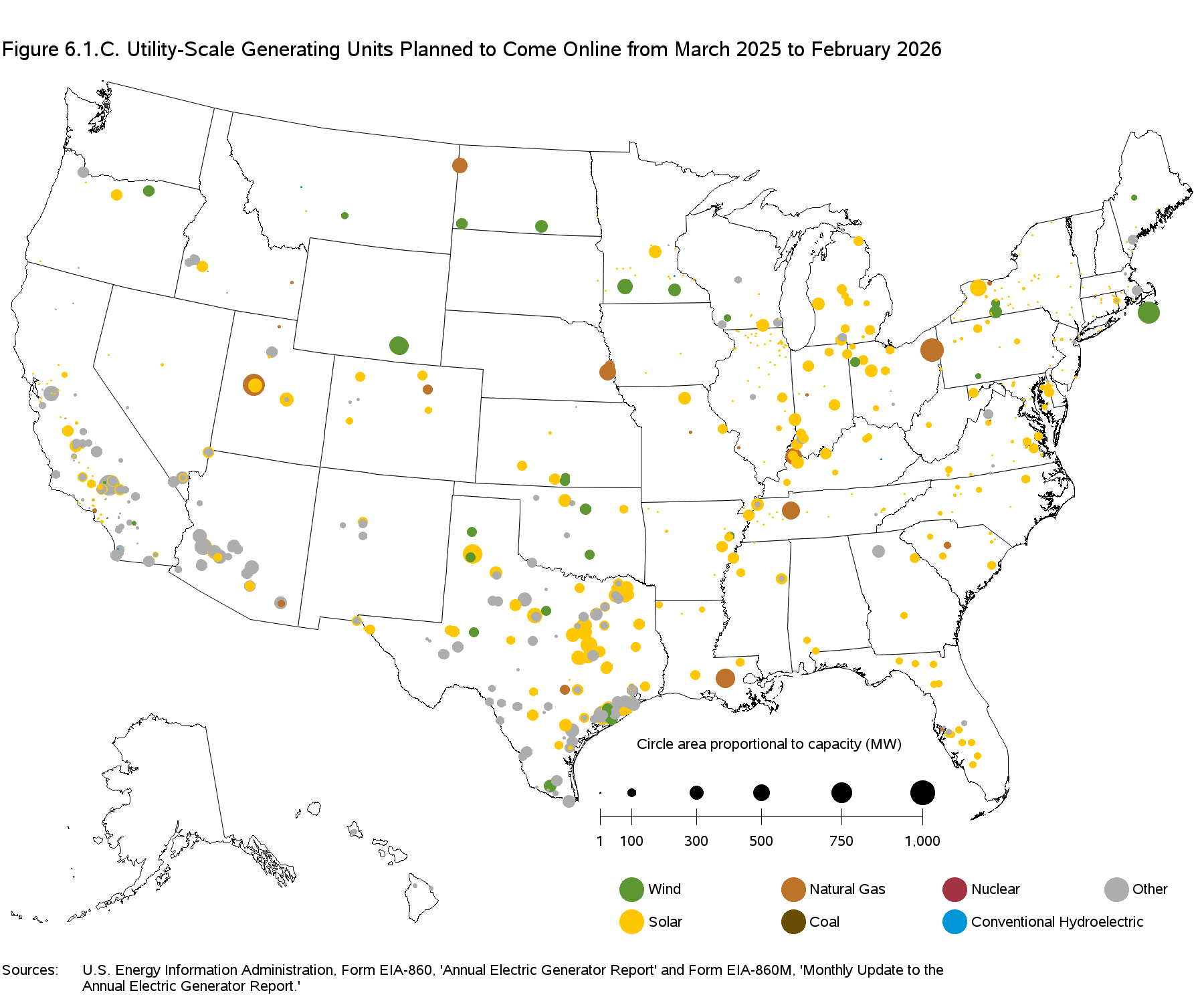
https://emp.lbl.gov/news/new-national-lab-study-quantifies-0
https://emp.lbl.gov/publications/improving-estimates-transmi...
Improving estimates of transmission capital costs for utility-scale wind and solar projects to inform renewable energy policy - https://linkinghub.elsevier.com/retrieve/pii/S03014215193058... - December 2019
- Estimating the overall costs of transmission needed to integrate variable renewable energy (VRE) onto the grid is challenging. An improved understanding of these transmission costs would support electricity system planning as VRE penetrations increase. This paper brackets VRE transmission capital costs using multiple approaches based on interconnection studies, actual transmission projects, capacity-expansion simulation models, and aggregated U.S. VRE-related transmission expenditures. Each approach possesses advantages and drawbacks, and combining the approaches lends confidence to the results. The resulting range of average levelized VRE transmission costs is $1–$10/MWh, which is generally lower than earlier estimates in the literature. These transmission capital costs can increase the direct plant-level levelized cost of VRE by 3%–33%, based on levelized costs of energy of $29–$56/MWh for utility-scale wind and $36–$46/MWh for utility-scale solar. As VRE deployment continues to expand, policy makers can use this information to (1) assess the benefits of transmission avoidance and deferral when comparing distributed energy resources versus utility-scale projects, (2) evaluate the potential costs of large-scale public transmission investments, and (3) better analyze system-level costs of utility-scale VRE technologies. Future research can expand on the framework presented here by providing a review of operation and maintenance costs for transmission systems.
I don't have a link handy at the moment, but there is also a project to use machine learning to maximize the power existing transmission lines can carry using real time monitoring of their health metrics to push harder towards maximum safe utilization (versus more conservative limits).
Anyway there’s my ethos. This farm has solar panels only on top of grazing pastures, cause it keeps cows cool. They’re not like blotting out the sun or anything. It’s a productivity and health boost for the cattle, and renewable energy that runs other systems on the farm.
https://patternenergy.com/sunzia-comes-online/
It took 3 years to build from start of construction but 20 years from start of planning:
https://en.wikipedia.org/wiki/SunZia_Wind_and_Transmission#H...
>The world has plenty of barren, desert areas
In these cases, we should regenerate the ecosystems we destroyed, not treat it as "free" surface area that doesn't matter just because we damaged it.
No sane Antique Shop has a "you break it, it's now yours to do whatever you like" policy. I wonder why? :)
I mean, you break it, then you pay for it/deal with the consequences, then the broken pieces are yours to do whatever you like with. That is generally how it works.
I don't think leaving the land as-is is going to be better than putting solar panels on it. In fact, is seems like solar panels might be better than leaving the land alone: https://www.ecoportal.net/en/sahara-solar-panels-double-sahe...
Many efforts to reverse desertification, plant trees and grow stuff/crops in the semi-shade. Shade does a lot for keeping moisture in the ground, but it’s much less effective than tree cover, as the roots draw water up from deep below etc.
https://www.scmp.com/news/china/science/article/3363108/grea...
There's nothing really "barren" in a natural landscape. Maybe dry lakebeds?
There is significantly more biodiversity in permanent grassland - solar panels or not.
And solar produces way more than 10 times more energy than energy crops.
So if you worry about nature and land use, you should focus on energy crops (and efficient ways of getting tasty protein).
Sheep are easier on the surroundings in general.
Solar panels are joined together into "strings" which means that you have something like 12-18 panels in series. Those strings are joined into a combinerbox that takes 8-15 strings and join them into one big lump.
Each string is >500volts DC. So they need to be protected from both sun and animals.
The main animal oopsey is where the strings enter the string combiner box. the stings come straight out the back of the panels, run along the mounts and then into the combiner at the end of the row. When the strings emerge into the combiner box, they are protected by a metal cage.
The big fat combined cable then goes into a ground conduit to go to the inverter.
Direct burial PV cable https://www.wireandcableyourway.com/solar-photovoltaic-pv-wi...