That everywhere is warmer now so we need more cooling? (Implies global warming)
That developing countries need more cooling than heat? (Buried lead)
That datacenters make up the majority of new demand? (Misleading headline)
I see many comments here assuming it means continuous energy needs. From the article, we see the headline implies my second question:
> That growth comes mostly from hot countries that are getting richer.
https://graphenemg.com/graphene-products/thermal-xr/
They have a coating that can be applied to HVAC units which results in about a 40% improvement in energy efficiency. In the US it's distribution seems to be handled by Nu-Calgon and for whatever reason they branded it "CoolWorx" in addition to a data center focused version called "DataWorx."
The branding was bit of a shock because it takes something that's a potentially a global leap forward at a reasonable price and makes it look like something you'd buy off of an infomercial.
In terms of making your own home more energy efficient, the path is always cost optimized. You figure out where your energy bleeds are and fix them first because it's significantly better ROI than trying to add solar to cover everything. Then when you reduce your consumption enough, you don't need as much solar. Efficiency of your fridge, HVAC units, seals and temp loss from windows & doors. If you're in an area with rates that vary by time of day, home batteries that can charge when it's cheap and then use that when it's more expensive.
40% efficiency improvement in one of the most expensive utilities should be an automatic purchase for the price.
Sorry to disappoint, but their coating will not do that.
As far as I can see, they've mixed some graphene into a corrosion protection coating. Then their marketing team abandoned reality and claimed 40% improvements in something.
Corrosion protection is important for extending service life of an HVAC unit, but the coating isn't going to increase efficiency by 40%, or at all. It's a film on top of the coils which technically reduces thermal performance, but the film is so small I guarantee this is negligible.
Maybe they're trying to claim that the graphene in the mix improves emissivity? You would achieve the same result by coating the coils with anything black, but that's a negligible factor.
Sorry to burst your bubble, but this company doesn't have anything that will change world energy consumption. It's a corrosion inhibitor with a little bit of graphene and a lot of marketing.
> 10-50% energy reduction measured across commercial HVAC, chillers and data centres.
If the claim is 40% more efficient AC, that’s the whole system.
If it were only for, say, the heat sink component, thats only one component.
You see how one component being more efficient contributes only a fraction to the total system?
Improving the heat transfer of a heat sink with a surface coating is hard (for reasonable definitions of "heat sink" and "surface coating") because you run right into physics.
Maybe they did focus group tests that showed that name got them the attention they needed in that market.
They must be making some weird marketing truck where they've set up some special situation where 10% improvement results in 4x that reduction in energy usage some other way For example in a heating context it's really easy to imagine how a 10% improvement to a heat pump could result in it kicking on the resistive heating much less in some climates for an overall 40% reduction in energy for the same set point.
If real world performance were anywhere near claimed without unacceptable tradeoffs (falls off if you look at it funny and then the dust gives you an incurable disease) and if you it would already be everywhere. Even if it cost as much as upsizing the hardware you'd see it space constrained applications.
15yr ago everyone was making the same silver bullet claims about ERV/HRV and it turned out those only really move the needle for very specific climates and building uses but the sellers are laughing all the way to the bank because the various codes and green this and that incentives that they got written into draw no such distinction.
So yeah, color me skeptical.
It's called the Duck Curve because the graph kind of looks like a duck if you squint https://en.wikipedia.org/wiki/Duck_curve
It's a familiar problem to everyone in the energy industry. Solar alone isn't enough, you also need energy storage to time-shift the generation and the load.
On an individual scale, if you're into home automation you can do some tricks like pre-cooling the house below your target temperature while you're gone for the day. At one house where we had significant excess solar I briefly entertained the idea of having a cooling vent into the attic to try to make that space cold on days with excess generation available during the day.
My attic has spray foam insulation and the HVAC system (also in the attic) already does this to a mild extent. I can go up there in the middle of an August day and not feel it at all.
Allowing the ceiling above your living space to reach 140F+ starts to get into radiative heating issues. You don't need to cool the attic to 72F. Anything would make a huge difference. Radiative heating scales quartically with temperature.
https://www.energy.gov/cmei/buildings/articles/unvented-cond...
My idea was to use excess electricity generation to cool the attic somewhat below the temperature of the living space. That space would then sink some heat after the sun went down, reducing the cooling demands in the evening.
An analogous idea would be to have a large water tank in the basement with a chiller attached. You run the chiller when you have excess electricity to get the water colder than the house, then let it passively soak up heat later.
It was all shower thoughts, but the idea of storing excess energy generation during peak as coldness (wording which makes pedants cringe) for evening cooling is not new. You can pre-cool your entire house, but having to wear a sweater for a couple hours every day during the summer is not fun after a while.
10kWp needs around 60m2 of roof space, and that's gonna be more than enough power to cool a single floor house four or five times that size. Multi floor buildings are more efficient, as there are less exterior walls/ceilings.
Except what happens is not actual cooling, but spending energy to move the heat outside. In total we heat the planet, when we try to cool a small part down.
But what about panels over empty land? Claude with my simpleton prompting says panels win over grass -- grass albedo isn't that high (0.25 vs 0.07), panels offset it with generated electricity (unless your grid is wind/hydro/no waste heat source).
That said I think in practice it is pretty close to free. My own numbers show that if the Earth’s landmass were entirely grass, and we entirely replaced it with solar panels, it would be equivalent to roughly doubling atmospheric CO2 in terms of retained heat energy. Powering all of civilization would require less, and only be a few hundredths of watts per square meter.
Well, you are using that power for your own comfort when it could be used to reduce carbon emissions. Instead of cooling your house, you could allow that power to be used by industry, say an aluminum smelter, and thereby reduce the amount of carbon being burnt to power that smelter. Or, instead of running your AC, that power could be sent to the factory that builds solar panels... making new panels cheaper for everyone.
If producing solar panels is profitable, then your purchase gives the manufacturer capital it can use to expand production. And your purchase demonstrates demand, encouraging expansion of production and attracting investment in expansion.
You also become part of economies of scale that reduce the cost for everyone.
And the industry also gains experience from your purchase, pushing it further along the experience curve[1] which tends to increase efficiency.
Buying solar panels to power your air conditioner probably improves the situation for everyone by some small amount. Of course, it's possible that some other choice might improve the situation more, but most people aren't going to feel guilt as long as they haven't made the situation worse.
---
If we're talking about winter heating in for example German climates, you'd have to over build so much solar capacity to handle cold winters (even if we're willing to turn on fuel burning supplementary heaters for a statistically single digit number of days per year) that you have severe excess in summer.
You'd turn most factories (those with decently high electricity draw per capital expenditure) off for about a month worth of days in winter, usually combining this with scheduled maintenance, and:
To further shift large amounts of country-scale power consumption from year-round/winter to only sunny summer days: try to set up electrical refining of (purified) iron ore into (metallic) iron at larger solar farms where you could recycle their grid connection and their AC/DC converters together with already normalized (for there) local batteries (to shift delivery of half the production from around noon to the night, which reduces the AC/DC converter capacity and the AC grid connection/transformer size requirements). There are realistic low-temperature electrolysis options for electro-chemically splitting the oxygen off of the iron (purified iron ore is iron oxide) like Siderwin [0] and even near-room-temperature options like Electra [1].
For scale, [0] claims replacing the production of the existing coal-based iron ore refining plants of Europe with Siderwin would require 471 TWh/year in additional electricity in the grid; [2] claims the EU (without the overall insignificant island Malta, as it's not connected to the continental grid in a way that'd be readily suited to inclusion in these common-measurement-definitions statistics) produced 2497.3 TWh in the entire year of 2024, of which 237.6 TWh were solar.
Thus, it's overall "not that much" extra production capacity that'd even be spent on this (assuming an essentially-fully renewable grid, let's call it 99% by yearly aggregate electricity production): during heavy solar days, you'd import solar power from the grid at night, aim for something like 5~30% yearly average utilization of the electricity-guzzling iron-deoxidizer, and feed excess summer production into the iron-deoxidizer day and night via the local batteries. There's an overlap zone in grid daily solar yield, where you'd even import from other solar plants, depending on how expensive a kW of iron-deoxider capacity is vs. a kW of solar panel (with MPPT, but without AC inverter). Expensive solar and AC-grid means you'd import more on very sunny days (use the other solar plants instead of just discarding their power, as you'd run with no exported AC during daytime and suck the other plant's batteries dry at night, with more local iron-deoxider kW than day-average peak solar kW; local batteries do the flattening of the local solar power across the day/night cycle), while expensive iron-deoxidizer kW force you to run it more continuously across the summer months with only brief exceptions during some sporadic weeks of clouds (where you want big industry to just power through instead) despite this wasting solar power during summer daytime that can't be stored in the local batteries and can't be exported to the grid (on such peak sunny days, the plant would have to throttle the panels during the afternoon once it's local batteries hit 100% around noon).
It's around 1/6th of current yearly electricity production; at say 33% duty cycle however it'd approximately look like 1/2 of electricity production (during the third of the year where solar is in excess), so we'd be talking about a massive grid capacity impact. Hence the proposal/suggestion to move it to the DC side of solar farms that are large enough to warrant the staffing/infrastructure overhead.
[0]: https://industrydecarbonization.com/news/making-steel-with-e... [1]: https://www.electra.earth/our-technology/ [2]: https://eepublicdownloads.blob.core.windows.net/public-cdn-c...
Found a link for the Mall of America: https://brokensecrets.com/2010/03/02/the-mall-of-america-doe...
edit: Should have read the article. It's taking into account households, which obviously have far less human thermal energy available than malls.
But also the article seems to be going back and forth between whether it's talking about total energy use, or electricity use in particular. But either way, the shift is primarily because of an increase in availability of air conditioning in hot places, rather than a change in the balance in places which use both.
wont do it all but cuts the costs substantially
However real airconditioners get a coefficient of more like 3.
This strikes me as a massive engineering opportunity - the person to close that gap and be able to extract $$$ from the savings will become very rich.
Such a home requires pretty much zero heating or cooling - merely body warmth will keep it warm in winter.
For the most part, ammonia is used in cold storage warehouses, hockey rinks, and industrial process cooling.
"Measured by the fuel and electricity consumed, heating is still well ahead."
Then what "...as an energy need" supposed to mean? They even go on to use a better term in the article, “useful energy”: the energy that does the job people want.
Not disagreeing on useful energy (as opposed to final and primary energy), which are a bit technical terms and which the IEA likes to (ab)use to muddy the waters a bit. But it's a bit of a technical topic. But I think their assessment that cooling needs are growing rapidly while heating needs aren't is probably not wrong.
Which, I get it. Nevada is hotter. Extremely so. But I also thought all of the middle east was hotter, as well. Not so much?
It does give me empathy to all of the people that laugh about how bad the US south is with snow. With the added amusement that Seattle is exactly the same on that front.
It's not that complex as someone who lives in the UK, Buildings are built for the average climate you had over the preceding decades at the time they were built with the understanding that the outliers will happen, it's just a naturally lagging thing - We haven't caught up with the new reality that sustained periods of high heat (by our standards) are much more likely, the South East caught it particularly bad this year, London baked.
Not hard to see the problem when you look at the longest continuous longitudinal temperature record in the world (the Central England Mean Temperature) averages - https://www.metoffice.gov.uk/hadobs/hadcet/graphs/ts_meantem...
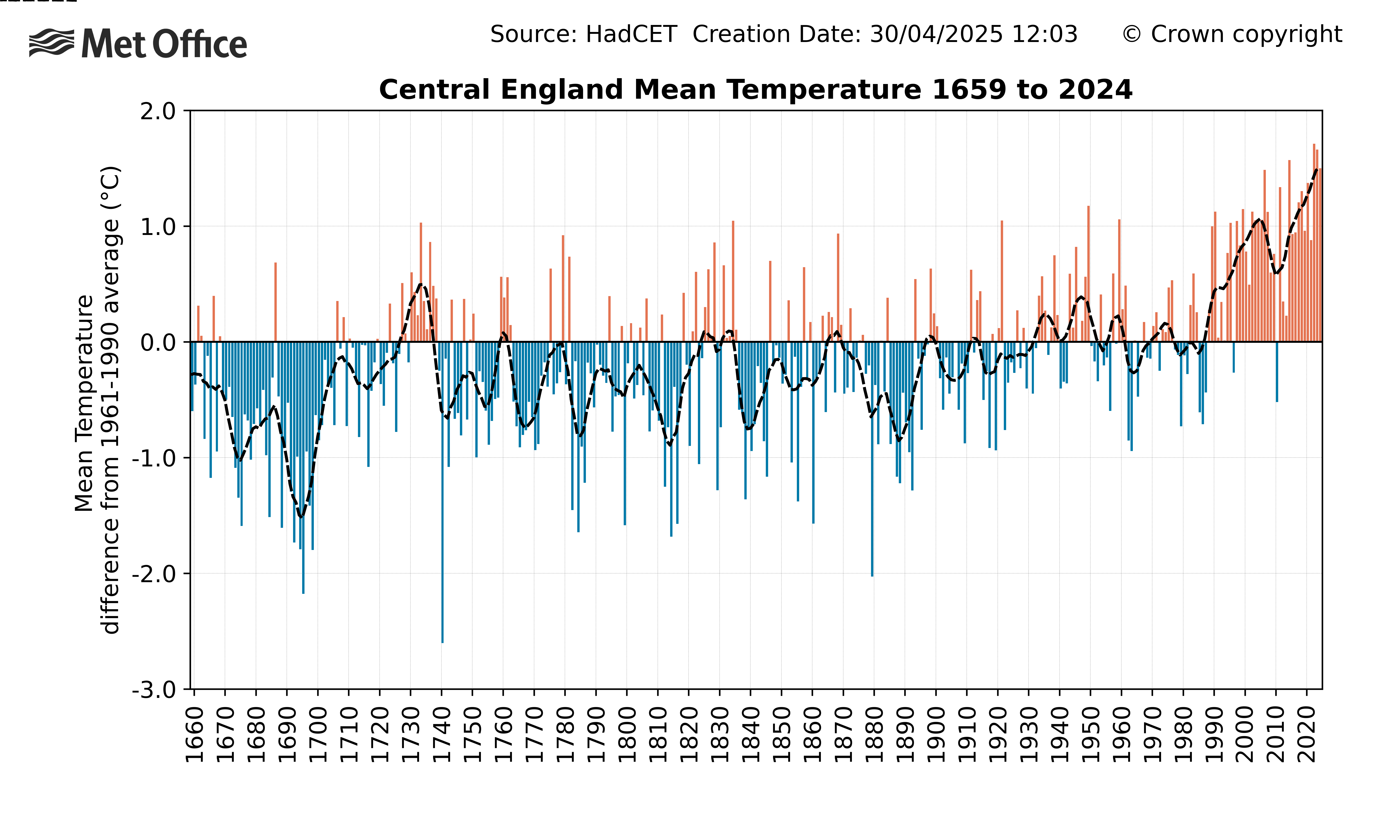
My house was built in the early 1980's, it's becoming less and less suited to our climate now and that'll get worse.
Long term the plan is to re-insulate the loft, insulate the walls, install shutters on the flat windows (and look at them for the bay windows, our windows are a pain as they aren't flat and they usually open outwards), heat pumps/AC and PV (complicated by roof been east/west but if you panel both you get not far off the same as the same area facing south and more nicely you get power in mornings/evenings which is when we use the most (for much of the year anyway)).
The house my boy inherits will be more suited for the climate he'll be living in when he inherits it (hopefully not for another 30-40 years but the universe may have other plans).
Still, where I live a problem is that most residential buildings are designed to be warm in the winter first and foremost, without concern for potential summer overheating. But the latter has now become a real problem, and there’s often not much to do about existing buildings without extensive renovations but to install per-unit AC. At least there’s the fact that it can often be done with a heat pump so it’s also useful in the winter.
Teleheating is very common around here, and cities have started building telecooling networks to complement heating, simply circulating cold water to be used as a heat sink. But building comprehensive pipe networks is of course slow and expensive.
One unique characteristic of the eastern US is that people here live in a climate with hot and humid summers but imported the clothing norms of a subcontinent (Europe) with warm and dry summers. If you look at traditional — pre-colonial — dress in Africa or India, you'll find it's much less warm. Even in China, which resembles the eastern US from a climate perspective, loose and lightweight clothing (silk!) was much more common prior to the global adoption of western norms.
I know this because I grew up in a house in Florida built in the 1950s, with no A/C. Southern vernacular architecture includes high ceilings (so the heat rises above the people), lots of windows (to let the air go through and heat escape), and with the house raised off the ground (so cooling air flows underneath). While my house didn't have it, another typical design element is a wraparound porch, to provide extra shade and let the windows stay open even when it rains.
If you build for A/C in the South then you want a building with good insulation and little airflow, to save on power. If the A/C doesn't run then these places get very warm, humid, and stuffy. Nearly every house is built this way.
Further, if you are used to the chill that A/C provides then your body doesn't adjust to the heat.
The US Southwest has its own vernacular architecture. The days are hot and the night cool, so use thick adobe walls which take 12 hours for the heat of day to seep through. Close the windows in the morning to keep the cool in, open them at night to cool off, while the heat from the walls keeps the inside more moderate.
Heating tends to be during shorter days and less solar production, making it trickier to cover the power needs with new energy alone.
Of course this doesn’t mean heating is going down, just that cooling is going up (unless populations are moving to warmer climes).
>Heating tends to be during shorter days and less solar production, making it trickier to cover the power needs with new energy alone.
This is a key issue with renewables, particularly solar. At summer peaks, the electric demand peaks at the part of the day with the highest solar production (mostly). It's hot when the sun is at the maximum. This isn't 100% true because the peak is actually a little later when people get home from work, but close enough
In the winter peak, it's usually coldest early early in the morning when it's been dark for hours and people start to wake up but the sun isn't up producing solar yet
> unless populations are moving to warmer climes
Rather: warmer climes are moving to populations